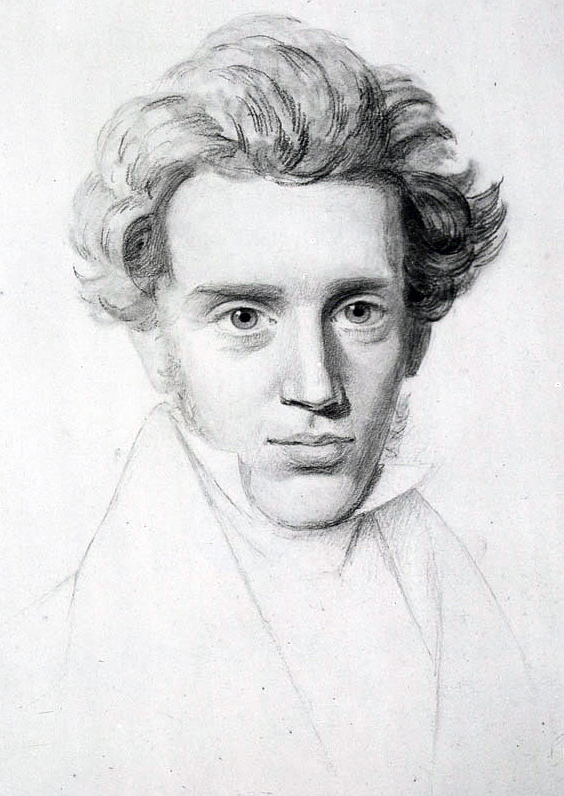
Søren Kierkegaard
Danish father of existentialism: truth is subjectivity, and faith a leap beyond reason.
Key ideas
Søren Aabye Kierkegaard ( SORR-ən KEER-kə-gard, US also -gor; Danish: [ˈsɶːɐn ˈɔˀˌpyˀ ˈkʰiɐ̯kəˌkɒːˀ] ; 5 May 1813 – 11 November 1855) was a Danish philosopher, Christian theologian, poet, social critic, and religious author who is widely considered to be the first existentialist philosopher. He wrote critical texts on organized religion, Christianity, morality, ethics, psychology, love, and the philosophy of religion, displaying a fondness for metaphor, irony, and parables. Much of his philosophical work deals with the issues around how one lives as a "single individual", highlighting the importance of authenticity, personal choice and commitment, and the duty to love. Kierkegaard prioritized concrete human reality over abstract thinking.
Kierkegaard's theological work focuses on Socratic Christian ethics, the institution of the Church, the differences among purely objective proofs of Christianity, the infinite qualitative distinction between man and God, and the individual's subjective relationship to the God-Man Jesus Christ, which came through faith. Much of his work deals with Christian love. He was extremely critical of the doctrine and practice of Christianity as a state-controlled religion (Caesaropapism), like the Church of Denmark. His psychological work explored the emotions and feelings of individuals when faced with life choices. Unlike Jean-Paul Sartre and the atheistic existentialism paradigm, Kierkegaard focused on Christian existentialism.
Kierkegaard's early work was written using pseudonyms, who presented distinctive viewpoints and interacted in complex dialogue. He wrote Upbuilding Discourses under his own name and dedicated them to the "single individual" who might want to discover the meaning of his works. He wrote: "Science and scholarship want to teach that becoming objective is the way. Christianity teaches that the way is to become subjective, to become a subject." Kierkegaard emphatically denied that observation alone could reveal the inner workings of the world of the spirit.
Some of Kierkegaard's key ideas include the concept of "subjective and objective truths", the knight of faith, the recollection and repetition dichotomy, angst, the infinite qualitative distinction, faith as a passion, and the three stages on life's way. Kierkegaard wrote in Danish and the reception of his work was initially limited to Scandinavia, but by the turn of the 20th century his writings were translated into French, German, and other major European languages. By the middle of the 20th century, his thought exerted a substantial influence on philosophy, theology, and Western culture in general.
Early years (1813–1836)
Kierkegaard was born to an affluent family in Copenhagen as the youngest of seven children. His mother, Ane Sørensdatter Lund Kierkegaard (1768–1834), had served as a maid in the household before marrying his father, Michael Pedersen Kierkegaard (1756–1838). She was an unassuming figure: quiet, and not formally educated. Her granddaughter, Henriette Lund, wrote that she "wielded her scepter with delight, cosseted them [Søren and his brother Peter], and protected them like a hen her chicks". She also wielded influence on her children so that later Peter Christian Kierkegaard said that his brother preserved many of their mother's words in his writings. His father, on the other hand, was a devoutly Christian well-to-do wool merchant from Jutland. He was a "very stern man, to all appearances dry and prosaic, but under his 'rustic cloak' demeanor he concealed an active imagination which not even his great age could blunt". He was also interested in philosophy and often hosted intellectuals at his home. He was devoted to the rationalist philosophy of Christian Wolff, and he eventually retired partly to pursue more of Wolff's writings. Kierkegaard, who followed his father's beliefs as a child, was heavily influenced by Michael's devotion to Wolffian rationalism. He also enjoyed the comedies of Ludvig Holberg, the writings of Johann Georg Hamann, Gotthold Ephraim Lessing, Edward Young, and Plato. The figure of Socrates, whom Kierkegaard encountered in Plato's dialogues, would prove to be a phenomenal influence on the philosopher's later interest in irony, as well as his frequent deployment of indirect communication.
Kierkegaard loved to walk along the crooked streets of 19th century Copenhagen, where carriages rarely went. In 1848, Kierkegaard wrote, "I had real Christian satisfaction in the thought that, if there were no other, there was definitely one man in Copenhagen whom every poor person could freely accost and converse with on the street; that, if there were no other, there was one man who, whatever the society he most commonly frequented, did not shun contact with the poor, but greeted every maidservant he was acquainted with, every manservant, every common laborer." Our Lady's Church was at one end of the city, where Bishop Mynster preached the Gospel. At the other end was the Royal Theatre where Fru Heiberg performed.
Based on a speculative interpretation of anecdotes in Kierkegaard's unpublished journals, especially a rough draft of a story called "The Great Earthquake", some early Kierkegaard scholars argued that Michael believed he had earned God's wrath and that none of his children would outlive him. He is said to have believed that his personal sins, perhaps indiscretions such as cursing the name of God in his youth or impregnating Ane out of wedlock, necessitated this punishment. Though five of his seven children died before he did, both Søren and his brother Peter outlived him. Peter, who was seven years older, later became bishop in Aalborg. Julia Watkin thought Michael's early interest in the Moravian Church could have led him to a deep sense of the devastating effects of sin.
From 1821 to 1830, Kierkegaard attended the School of Civic Virtue, Østre Borgerdyd Gymnasium when the school was situated in Klarebodeme, where Kierkegaard studied Latin, Greek, and history, among other subjects. During his time there he was described as "very conservative"; someone who would "honour the King, love the church and respect the police". He frequently got into altercations with fellow students and was ambivalent towards his teachers. He went on to study theology at the University of Copenhagen. He had little interest in historical works, philosophy dissatisfied him, and he couldn't see "dedicating himself to Speculation". He said, "What I really need to do is to get clear about "what am I to do", not what I must know." He wanted to "lead a completely human life and not merely one of knowledge". Kierkegaard didn't want to be a philosopher in the traditional or Hegelian sense and he didn't want to preach a Christianity that was an illusion. "But he had learned from his father that one can do what one wills, and his father's life had not discredited this theory."
One of the first physical descriptions of Kierkegaard comes from an attendee, Hans Brøchner, at his brother Peter's wedding party in 1836: "I found [his appearance] almost comical. He was then twenty-three years old; he had something quite irregular in his entire form and had a strange coiffure. His hair rose almost six inches above his forehead into a tousled crest that gave him a strange, bewildered look." Another comes from Kierkegaard's niece, Henriette Lund (1829–1909), who recounts that as a little boy Søren was "of a slight and delicate appearance. He went around in a coat the color of red cabbage, and his father usually called him 'the Fork,' because of his precocious tendency to make satirical remarks. Even though there was a serious, almost strict tone in the Kierkegaard home, I still have the impression that there was room for youthful liveliness, though perhaps of a more sober, homemade sort than is usual today. In the same way the house was also open, with an old-fashioned kind of hospitality." He was also described as "quaintly attired, slight and small".
Kierkegaard's mother "was a nice little woman with an even and happy disposition," according to a grandchild's description. She was never mentioned in Kierkegaard's works. Ane died on 31 July 1834, age 66, possibly from typhus. His father died on 8 August 1838, age 82. On 11 August, Kierkegaard wrote: "My father died on Wednesday (the 8th) at 2:00 a.m. I so deeply desired that he might have lived a few years more... Right now I feel there is only one person (E. Boesen) with whom I can really talk about him. He was a 'faithful friend.'"
Journals
According to Samuel Hugo Bergmann, "Kierkegaard's journals are one of the most important sources for an understanding of his philosophy". Kierkegaard wrote over 7,000 pages in his journals on events, musings, thoughts about his works and everyday remarks. The entire collection of Danish journals (Journalen) was edited and published in 13 volumes consisting of 25 separate bindings including indices. The first English edition of the journals was edited by Alexander Dru in 1938. The style is "literary and poetic [in] manner".
Kierkegaard wanted to have Regine, his fiancée (see below), as his confidant, but considering this an impossibility, made his confidant "my reader, that single individual". His question was whether or not one can have a spiritual confidant. He wrote the following in his Concluding Postscript: "With regard to the essential truth, a direct relation between spirit and spirit is unthinkable. If such a relation is assumed, it actually means that the party has ceased to be spirit."
Kierkegaard's journals were the source of many aphorisms. The following passage, from 1 August 1835, is perhaps his most oft-quoted aphorism and a key quote for existentialist studies:
What I really need is to get clear about what I must do, not what I must know, except insofar as knowledge must precede every act. What matters is to find a purpose, to see what it really is that God wills that I shall do; the crucial thing is to find a truth which is truth for me, to find the idea for which I am willing to live and die.
Although his journals clarify some aspects of his work and life, Kierkegaard took care not to reveal too much. Abrupt changes in thought, repetitive writing, and unusual turns of phrase are some among the many tactics he used to throw readers off track. Consequently, there are many varying interpretations of his journals. Kierkegaard did not doubt the importance his journals would have in the future. In December 1849, he wrote: "Were I to die now the effect of my life would be exceptional; much of what I have simply jotted down carelessly in the Journals would become of great importance and have a great effect; for then people would have grown reconciled to me and would be able to grant me what was, and is, my right."
Regine Olsen and graduation (1837–1841)
An important aspect of Kierkegaard's life—generally considered to have had a major influence on his work—was his broken engagement to Regine Olsen (1822–1904).
Kierkegaard and Olsen met on 8 May 1837 and were instantly attracted to each other. In his journals, Kierkegaard wrote idealistically about his love for her. After passing his theological examinations in July 1840, Kierkegaard formally proposed to Olsen on 8 September. He soon felt disillusioned about his prospects. He broke off the engagement on 11 August 1841, though it is generally believed that the two were deeply in love. Kierkegaard’s first attempt did not end the matter. After he returned the ring with a farewell letter on 11 August 1841, Olsen pleaded with him not to leave her, and by his own account he then tried to repel her so that she would break with him, before he broke the engagement verbally on 11 October 1841. In his journals, Kierkegaard mentions his belief that his "melancholy" made him unsuitable for marriage, but his precise motive for ending the engagement remains unclear.
It was also during this period that Kierkegaard dedicated himself to authoring a dissertation. Upon submitting it in June 1841, a panel of faculty judged that his work demonstrated considerable intellect while criticizing its informal tone; however, Kierkegaard was granted permission to proceed with its defense. He defended On the Concept of Irony with Continual Reference to Socrates over seven and a half hours on 29 September 1841. As the title suggests, the thesis dealt with irony and Socrates; the influence of Kierkegaard's friend Poul Martin Møller, who had died in 1838, is evident in the subject matter. Kierkegaard graduated from the University of Copenhagen on 20 October 1841 with a Magister degree in philosophy. His inheritance of approximately 31,000 rigsdaler enabled him to fund his work and living expenses.
Authorship (1843–1846)
Kierkegaard published some of his works using pseudonyms and some in his own name. Whether being published under pseudonym or not, Kierkegaard's central writing on religion was Fear and Trembling, and Either/Or is considered to be his magnum opus. Pseudonyms were used often in the early 19th century as a means of representing viewpoints other than the author's own. Kierkegaard employed the same technique as a way to provide examples of indirect communication. In writing under various pseudonyms to express sometimes contradictory positions, Kierkegaard is sometimes criticized for playing with various viewpoints without ever committing to one in particular. He has been described by those opposing his writings as indeterminate in his standpoint as a writer, though he himself has testified to all his work deriving from a service to Christianity. He wrote his first book under the pseudonym "Johannes Climacus" (after John Climacus) between 1841 and 1842. De omnibus dubitandum est (Latin for 'Everything must be doubted') was not published until after his death.
Kierkegaard's magnum opus Either/Or was published 20 February 1843. It was mostly written during Kierkegaard's stay in Berlin, where he took notes on Friedrich Wilhelm Joseph Schelling's Philosophy of Revelation. Either/Or includes essays of literary and music criticism and a set of romantic-like aphorisms, as part of his larger theme of examining the reflective and philosophical structure of faith. Edited by "Victor Eremita", the book contained the papers of an unknown "A" and "B" which the pseudonymous author claimed to have discovered in a secret drawer of his secretary. Eremita had a hard time putting the papers of "A" in order because they were not straightforward. "B"'s papers were arranged in an orderly fashion. Both of these characters are trying to become religious individuals. Each approached the idea of first love from an aesthetic and an ethical point of view. The book is basically an argument about faith and marriage with a short discourse at the end telling them they should stop arguing. Eremita thinks "B", a judge, makes the most sense. Kierkegaard stressed the "how" of Christianity as well as the "how" of book reading in his works rather than the "what".
Three months after the publication of Either/Or, he published Two Upbuilding Discourses, 1843 and continued to publish discourses along with his pseudonymous books. These discourses were published under Kierkegaard's own name and are available as Eighteen Upbuilding Discourses today. The word "upbuilding" was more in line with Kierkegaard's thought after 1846, when he wrote Christian deliberations about Works of Love. An upbuilding discourse or edifying discourse isn't the same as a sermon because a sermon is preached to a congregation while a discourse can be carried on between several people or even with oneself. The discourse or conversation should be "upbuilding", which means one would build up the other person, or oneself, rather than tear down to build up. Kierkegaard said: "Although this little book (which is called 'discourses', not sermons, because its author does not have authority to preach, 'upbuilding discourses', not discourses for upbuilding, because the speaker by no means claims to be a teacher) wishes to be only what it is, a superfluity, and desires only to remain in hiding".
On 16 October 1843, Kierkegaard published three more books about love and faith and several more discourses. Fear and Trembling was published under the pseudonym Johannes de Silentio. Repetition is about a Young Man (Søren Kierkegaard) who has anxiety and depression because he feels he has to sacrifice his love for a girl (Regine Olsen) to God. He tries to see if the new science of psychology can help him understand himself. Constantin Constantius, who is the pseudonymous author of that book, is the psychologist. At the same time, he published Three Upbuilding Discourses, 1843 under his own name, which dealt specifically with how love can be used to hide things from yourself or others. These three books, all published on the same day, are an example of Kierkegaard's method of indirect communication.
Kierkegaard questioned whether an individual can know if something is a good gift from God or not and concludes by saying, "it does not depend, then, merely upon what one sees, but what one sees depends upon how one sees; all observation is not just a receiving, a discovering, but also a bringing forth, and insofar as it is that, how the observer himself is constituted is indeed decisive." God's love is imparted indirectly just as our own sometimes is.
During 1844, he published two, three, and four more upbuilding discourses just as he did in 1843, but here he discussed how an individual might come to know God. Theologians, philosophers and historians were all engaged in debating about the existence of God. This is direct communication and Kierkegaard thinks this might be useful for theologians, philosophers, and historians (associations) but not at all useful for the "single individual" who is interested in becoming a Christian. Kierkegaard always wrote for "that single individual whom I with joy and gratitude call my reader"; the single individual must put what is understood to use or it will be lost. Reflection can take an individual only so far before the imagination begins to change the whole content of what was being thought about. Love is won by being exercised just as much as faith and patience are.
He also wrote several more pseudonymous books in 1844: Philosophical Fragments, Prefaces and The Concept of Anxiety and finished the year up with Four Upbuilding Discourses, 1844. He used indirect communication in the first book and direct communication in the rest of them. He doesn't believe the question about God's existence should be an opinion held by one group and differently by another no matter how many demonstrations are made. He says it's up to the single individual to make the fruit of the Holy Spirit real because love and joy are always just possibilities. Christendom wanted to define God's attributes once and for all but Kierkegaard was against this. His love for Regine was a disaster but it helped him because of his point of view.
Kierkegaard believed "each generation has its own task and need not trouble itself unduly by being everything to previous and succeeding generations". In an earlier book he had said, "to a certain degree every generation and every individual begins his life from the beginning", and in another, "no generation has learned to love from another, no generation is able to begin at any other point than the beginning", "no generation learns the essentially human from a previous one." And, finally, in 1850 he wrote, "those true Christians who in every generation live a life contemporaneous with that of Christ have nothing whatsoever to do with Christians of the preceding generation, but all the more with their contemporary, Christ. His life here on earth attends every generation, and every generation severally, as Sacred History..." But in 1848, "The whole generation and every individual in the generation is a participant in one's having faith."
He was against the Hegelian idea of mediation because it introduces a "third term" that comes between the single individual and the object of desire. Kierkegaard wrote in 1844, 'If a person can be assured of the grace of God without needing temporal evidence as a middleman or as the dispensation advantageous to him as interpreter, then it is indeed obvious to him that the grace of God is the most glorious of all." He was against mediation and settled instead on the choice to be content with the grace of God or not. It's the choice between the possibility of the "temporal and the eternal", "mistrust and belief, and deception and truth", "subjective and objective". These are the "magnitudes" of choice. He always stressed deliberation and choice in his writings and wrote against comparison.
The Inwardness of Christianity
Kierkegaard believed God comes to each individual mysteriously. He published Three Discourses on Imagined Occasions (first called Thoughts on Crucial Situations in Human Life, in David F. Swenson's 1941 translation) under his own name on 29 April, and Stages on Life's Way edited by Hilarius Bookbinder, 30 April 1845. The Stages is a sequel to Either/Or which Kierkegaard did not think had been adequately read by the public and in Stages he predicted "that two-thirds of the book's readers will quit before they are halfway through, out of boredom they will throw the book away." He knew he was writing books but had no idea who was reading them. His sales were meager and he had no publicist or editor. He was writing in the dark, so to speak. Many of his readers have been and continue to be in the dark about his intentions. He explained himself in his "Journal": "What I have understood as the task of the authorship has been done. It is one idea, this continuity from Either/Or to Anti-Climacus, the idea of religiousness in reflection. The task has occupied me totally, for it has occupied me religiously; I have understood the completion of this authorship as my duty, as a responsibility resting upon me." He advised his reader to read his books slowly and also to read them aloud since that might aid in understanding.
He used indirect communication in his writings by, for instance, referring to the religious person as the "knight of hidden inwardness" in which he's different from everyone else, even though he looks like everyone else, because everything is hidden within him.
Kierkegaard imagined hidden inwardness several ways in 1848. He was writing about the subjective inward nature of God's encounter with the individual in many of his books, and his goal was to get the single individual away from all the speculation that was going on about God and Christ. Speculation creates quantities of ways to find God and his Goods but finding faith in Christ and putting the understanding to use stops all speculation, because then one begins to actually exist as a Christian, or in an ethical/religious way. He was against an individual waiting until certain of God's love and salvation before beginning to try to become a Christian. He defined this as a "special type of religious conflict the Germans call Anfechtung" (contesting or disputing).
In Kierkegaard's view, the Church should not try to prove Christianity or even defend it. It should help the single individual to make a leap of faith, the faith that God is love and has a task for that very same single individual. Kierkegaard identified the leap of faith as the good resolution. Kierkegaard discussed the knight of faith in Works of Love, 1847 by using the story of Jesus healing the bleeding woman who showed the " originality of faith" by believing that if she touched Jesus' robe she would be healed. She kept that secret within herself.
Kierkegaard wrote his Concluding Unscientific Postscript to Philosophical Fragments in 1846 and here he tried to explain the intent of the first part of his authorship. He said, "Christianity will not be content to be an evolution within the total category of human nature; an engagement such as that is too little to offer to a god. Neither does it even want to be the paradox for the believer, and then surreptitiously, little by little, provide him with understanding, because the martyrdom of faith (to crucify one's understanding) is not a martyrdom of the moment, but the martyrdom of continuance." The second part of his authorship was summed up in Practice in Christianity:
Early Kierkegaardian scholars, such as Theodor W. Adorno and Thomas Henry Croxall, argue that the entire authorship should be treated as Kierkegaard's own personal and religious views. This view leads to confusions and contradictions which make Kierkegaard appear philosophically incoherent. Later scholars, such as the post-structuralists, interpreted Kierkegaard's work by attributing the pseudonymous texts to their respective authors. Postmodern Christians present a different interpretation of Kierkegaard's works. Kierkegaard used the category of "The Individual" to stop the endless Either/Or.
Pseudonyms
Kierkegaard's most important pseudonyms, in chronological order, were:
Victor Eremita, editor of Either/Or
A, writer of many articles in Either/Or
Judge Vilhelm, author of rebuttals to A in Either/Or
Johannes de Silentio, author of Fear and Trembling
Constantin Constantius, author of the first half of Repetition
Young Man, author of the second half of Repetition
Vigilius Haufniensis, author of The Concept of Anxiety
Nicolaus Notabene, author of Prefaces
Hilarius Bookbinder, editor of Stages on Life's Way
Johannes Climacus, author of Philosophical Fragments and Concluding Unscientific Postscript to Philosophical Fragments
Inter et Inter, author of The Crisis and a Crisis in the Life of an Actress
H.H., author of Two Minor Ethical-Religious Essays
Anti-Climacus, author of The Sickness unto Death and Practice in Christianity
All of these writings analyze the concept of faith, on the supposition that if people are confused about faith, as Kierkegaard thought the inhabitants of Christendom were, they will not be in a position to develop the virtue. Faith is a matter of reflection in the sense that one cannot have the virtue unless one has the concept of virtue—or at any rate the concepts that govern faith's understanding of self, world, and God.
The Corsair affair
On 22 December 1845, Peder Ludvig Møller, who studied at the University of Copenhagen at the same time as Kierkegaard, published an article indirectly criticizing Stages on Life's Way. The article complimented Kierkegaard for his wit and intellect, but questioned whether he would ever be able to master his talent and write coherent, complete works. Møller was also a contributor to and editor of The Corsair, a Danish satirical paper that lampooned everyone of notable standing. Kierkegaard published a sarcastic response, charging that Møller's article was merely an attempt to impress Copenhagen's literary elite.
Kierkegaard wrote two small pieces in response to Møller, The Activity of a Traveling Esthetician and Dialectical Result of a Literary Police Action. The former focused on insulting Møller's integrity while the latter was a directed assault on The Corsair, in which Kierkegaard, after criticizing the journalistic quality and reputation of the paper, openly asked The Corsair to satirize him.
Kierkegaard's response earned him the ire of the paper and its second editor, also an intellectual of Kierkegaard's own age, Meïr Aron Goldschmidt. Over the next few months, The Corsair took Kierkegaard up on his offer to "be abused", and unleashed a series of attacks making fun of Kierkegaard's appearance, voice and habits. For months, Kierkegaard perceived himself to be the victim of harassment on the streets of Denmark. In a journal entry dated 9 March 1846, Kierkegaard made a long, detailed explanation of his attack on Møller and The Corsair, and also explained that this attack made him rethink his strategy of indirect communication.
There had been much discussion in Denmark about the pseudonymous authors until the publication of Concluding Unscientific Postscript to Philosophical Fragments, 27 February 1846, where he openly admitted to be the author of the books because people began wondering if he was, in fact, a Christian or not. Several Journal entries from that year shed some light on what Kierkegaard hoped to achieve. This book was published under an earlier pseudonym, Johannes Climacus. On 30 March 1846 he published Two Ages: A Literary Review, under his own name. A critique of the novel Two Ages (in some translations Two Generations) written by Thomasine Christine Gyllembourg-Ehrensvärd, Kierkegaard made several insightful observations on what he considered the nature of modernity and its passionless attitude towards life. Kierkegaard writes that "the present age is essentially a sensible age, devoid of passion... The trend today is in the direction of mathematical equality, so that in all classes about so and so many uniformly make one individual". In this, Kierkegaard attacked the conformity and assimilation of individuals into "the crowd" which became the standard for truth, since it was the numerical. How can one love the neighbor if the neighbor is always regarded as the wealthy or the poor or the lame?
As part of his analysis of the "crowd", Kierkegaard accused newspapers of decay and decadence. Kierkegaard stated Christendom had "lost its way" by recognizing "the crowd", as the many who are moved by newspaper stories, as the court of last resort in relation to "the truth". Truth comes to a single individual, not all people at one and the same time. Just as truth comes to one individual at a time so does love. One doesn't love the crowd but does love their neighbor, who is a single individual. He says, "never have I read in the Holy Scriptures this command: You shall love the crowd; even less: You shall, ethico-religiously, recognize in the crowd the court of last resort in relation to 'the truth.'"
Authorship (1847–1855)
Kierkegaard began to publish under his own name again in 1847: the three-part Edifying Discourses in Diverse Spirits. It included Purity of Heart is to Will One Thing, What we Learn from the Lilies in the Field and from the Birds in the Air, and The Gospel of Sufferings. He asked, What does it mean to be a single individual who wants to do the good? What does it mean to be a human being? What does it mean to follow Christ? He now moves from "upbuilding (Edifying) discourses" to "Christian discourses", however, he still maintains that these are not "sermons". A sermon is about struggle with oneself about the tasks life offers one and about repentance for not completing the tasks. Later, in 1849, he wrote devotional discourses and Godly discourses.
Works of Love followed these discourses on 29 September 1847. Both books were authored under his own name. It was written under the themes "Love covers a multitude of sins" and "Love builds up". (1 Peter 4:8 and 1 Corinthians 8:1) Kierkegaard believed that "all human speech, even divine speech of Holy Scripture, about the spiritual is essentially metaphorical speech". "To build up" is a metaphorical expression. One can never be all human or all spirit, one must be both. Later, in the same book, Kierkegaard deals with the question of sin and forgiveness. He uses the same text he used earlier in Three Upbuilding Discourses, 1843, Love hides a multitude of sins. (1 Peter 4:8). He asks if "one who tells his neighbors faults hides or increases the multitude of sins".
Adapted from the Wikipedia article Søren Kierkegaard, available under CC BY-SA 4.0.
In their words
“Anxiety is the dizziness of freedom.”
“Life can only be understood backwards; but it must be lived forwards.”
Connections
Founded
1Influenced by
9



Influenced
18


Ideas & arguments
8


Works
1Contributed to
5

Criticized
1You might also explore
 Friedrich Nietzsche★Modern European1844 – 1900Diagnostician of nihilism who proclaimed the death of God and called for a revaluation of all values.
 Martin Heidegger★Modern European1889 – 1976Asked the question of the meaning of Being; analysed human existence (Dasein) as being-in-the-world and…
 Arthur Schopenhauer★Modern European1788 – 1860Pessimist who saw the world as blind Will and found relief in art, compassion and Indian philosophy.
 Aristotle★Greek & Roman384 – 322 BCEPlato's student and Alexander's tutor, who systematised logic, ethics, biology, metaphysics and politics — "the master…
 Plato★Greek & Romanc. 428 – 348 BCEFounder of the Academy whose dialogues defined Western philosophy's agenda: Forms, justice, the soul, knowledge and the…
 G. W. F. Hegel★Modern European1770 – 1831Systematic idealist for whom history is the dialectical self-realisation of Spirit and freedom.