Vedānta
वेदान्त
"The end of the Vedas": schools interpreting the Upaniṣads on the relation between the self (ātman), the world and ultimate reality (Brahman).
Key ideas
Vedanta (; Sanskrit: वेदान्त, IAST: Vedānta [ʋeːdɑ́ːntɐ]), also known as Uttara Mīmāṃsā, is one of the six orthodox (āstika) schools of Hindu philosophy and textual exegesis. The word Vedanta means 'conclusion of the Vedas,' and encompasses the ideas that emerged from, or aligned and reinterpreted, the speculations and enumerations contained in the Upanishads, focusing, with varying emphasis, on devotion, knowledge, and liberation. Vedanta developed into many traditions, all of which give their specific interpretations of a common group of texts called the Prasthānatrayī, translated as 'the three sources': the Upanishads, the Brahma Sutras, and the Bhagavad Gita.
All Vedanta traditions place great emphasis on textual exegesis and contain extensive discussions on ontology, soteriology, and epistemology, even though there is much disagreement among the various traditions. Independently considered, they may seem completely disparate due to the pronounced differences in thoughts and reasoning.
The main distinct traditions or movements within Vedanta are: Bhedabheda (difference and non-difference); Advaita (non-dualism); and the Vishnu-centred traditions of Dvaitadvaita (dualistic non-dualism), Vishishtadvaita (qualified non-dualism), Tattvavada (Dvaita) (dualism), Suddhadvaita (pure non-dualism), and Achintya-Bheda-Abheda (inconceivable difference and non-difference). Modern developments in Vedanta include Neo-Vedanta, and the philosophy of the Swaminarayan Sampradaya.
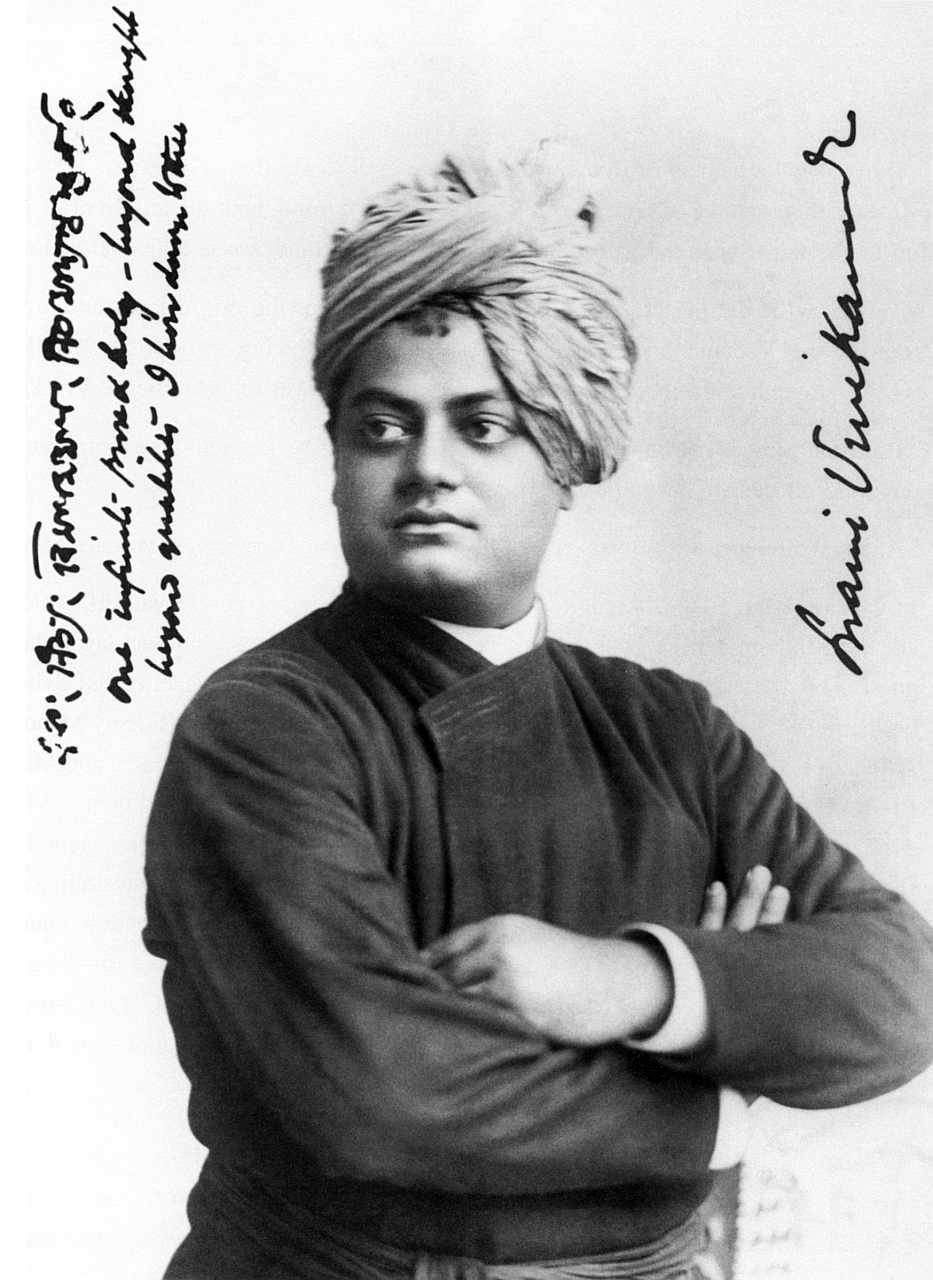
Most major Vedanta schools, except Advaita Vedanta and Neo-Vedanta, are related to Vaishnavism and emphasize devotion (bhakti) to God, understood as Vishnu or a related manifestation. Advaita Vedanta, on the other hand, emphasizes jñana (knowledge) and jñana yoga over theistic devotion, though Shankara may also have been a Vaishnavite. While the monism of Advaita has attracted considerable attention in the West due to the influence of the 14th century Advaitin Vidyaranya and modern Hindus like Swami Vivekananda and Ramana Maharshi, most Vedanta traditions focus on Vaishnava theology.
Etymology and nomenclature
The word Vedanta is made of two words:
Veda (वेद) — refers to the four sacred Vedic texts.
Anta (अन्त) — meaning "end."
The word Vedanta literally means the end of the Vedas and originally referred to the Upanishads. Vedanta is concerned with the jñānakāṇḍa or knowledge section of the Vedas which is called the Upanishads. The meaning of Vedanta expanded later to encompass the different philosophical traditions that interpret and explain the Prasthānatrayī in the light of their respective views on the relation between humans and the Divine or Absolute reality.
The Upanishads may be regarded as the end of Vedas in different senses:
They were the last literary products of the Vedic period.
They represent the pinnacle of Vedic philosophy.
They were taught and debated last, in the Sannyasa (ascetic) stage.
Vedanta is one of the six orthodox (āstika) traditions of textual exegesis and Indian philosophy. It is also called Uttara Mīmāṃsā, which means the "latter enquiry" or "higher enquiry"; and is often contrasted with Pūrva Mīmāṃsā, the "former enquiry" or "primary enquiry". Pūrva Mīmāṃsā deals with the karmakāṇḍa or ritualistic section (the Samhita and Brahmanas) in the Vedas while Uttara Mīmāṃsā concerns itself with the deeper questions of the relation between humans and Divine or Absolute reality.
Common features
Despite their differences, all traditions of Vedanta share some common features:
Vedanta is the investigation of Brahman and Ātman.
The various traditions give their own, specific exegesis of the Upaniṣads, the Bhagavadgītā, and the Brahma Sūtras (known as the three canonical sources).
Scripture (Sruti Śabda) is the main reliable source of knowledge (pramana).
Brahman — Īśvara (God), exists as the unchanging material cause and instrumental cause of the world. The exception is that Dvaita Vedanta does not hold Brahman to be the material cause, but only the efficient cause.
The self (Ātman or Jīva) is the agent of its own acts (karma) and the recipient of the consequences of these actions.
Belief in rebirth (samsara) and the desirability of release from the cycle of rebirths (moksha).
Rejection of Buddhism and Jainism and conclusions of the other Vedic schools (Nyaya, Vaisheshika, Samkhya, Yoga, and, to some extent, the Purva Mimamsa).
Scripture
The main Upanishads, the Bhagavadgītā, and the Brahma Sūtras are the foundational scriptures in Vedanta. All traditions of Vedanta give a specific exegesis of these texts, collectively called the Prasthānatrayī, literally, three sources.
The Upanishads, or Śruti prasthāna; considered the Sruti, the "heard" (and repeated) foundation of Vedanta.
The Brahma Sūtras, or Nyaya prasthāna / Yukti prasthāna; considered the reason-based foundation of Vedanta.
The Bhagavadgītā, or Smriti prasthāna; considered the Smriti (remembered tradition) foundation of Vedanta.
All prominent Vedantic teachers, including Shankara, Bhaskara, Ramanuja, Madhva, Nimbarka, and Vallabha, wrote commentaries on these three sources. The Brahma Sūtras of Badarayana serve as a bhedabheda-based synthesis of the teachings found in the diverse Upanishads, and while there may have been other similar syntheses in the past, only the Brahma Sūtras have survived to the present day. The Bhagavadgītā, with its syncretism of Samkhya, Yoga, and Upanishadic thought, has also been a significant influence on Vedantic thought.
All Vedāntins agree that scripture (śruti) is the only means of knowing (pramāṇa) regarding spiritual matters (which are beyond perception and inference). This is explained by Rāmānuja as follows:A theory that rests exclusively on human concepts may at some other time or place be refuted by arguments devised by cleverer people.... The conclusion is that with regard to supernatural matters, Scripture alone is the epistemic authority and that reasoning is to be used only in support of Scripture' [Śrī Bhāṣya 2.1.12].
For specific sub-traditions of Vedanta, other texts may be equally important. For example, for Advaita Vedanta, the works of Adi Shankara are nominally central, though other teachers were equally, or even more, influential. For the theistic Vaishnava schools of Vedanta, the Bhāgavata Purāṇa is particularly important. The Bhāgavata Purāṇa is one of the most widely commented upon works in Vedanta. This text is so central to the Krishna-centered Vedanta schools that Vallabha added the Bhāgavata Purāṇa as a fourth text to the Prasthānatrayī (three classic scriptures of Vedanta).
Metaphysics
Vedanta philosophies discuss three fundamental metaphysical categories and the relations between the three.
Brahman or Īśvara: the ultimate reality
Ātman or Jivātman: the individual soul, self
Prakriti or Jagat: the empirical world, ever-changing physical universe, body and matter
Brahman / Īśvara – Conceptions of the Supreme Reality
Shankara, in formulating Advaita, talks of two conceptions of Brahman:
Parā or Higher Brahman: The undifferentiated, absolute, infinite, transcendental, supra-relational Brahman beyond all thought and speech is defined as parā Brahman, nirviśeṣa Brahman, or nirguṇa Brahman and is the Absolute of metaphysics.
Aparā or Lower Brahman: The Brahman with qualities defined as aparā Brahman or saguṇa Brahman. The saguṇa Brahman is endowed with attributes and represents the personal God of religion.
Ramanuja, in formulating Vishishtadvaita Vedanta, rejects Nirguṇa – that the undifferentiated Absolute is inconceivable – and adopts a theistic interpretation of the Upanishads, accepting Brahman as Īśvara, the personal God who is the seat of all auspicious attributes, as the One reality. The God of Vishishtadvaita is accessible to the devotee, yet remains the Absolute, with differentiated attributes.
Madhva, in expounding Dvaita philosophy, maintains that Vishnu is the supreme God, thus identifying the Brahman, or absolute reality, of the Upanishads with a personal god, as Ramanuja had done before him. Nimbarka, in his Dvaitadvata philosophy, accepted the Brahman both as nirguṇa and as saguṇa. Vallabha, in his Shuddhadvaita philosophy, not only accepts the triple ontological essence of the Brahman, but also His manifestation as personal God (Īśvara), as matter, and as individual souls.
Relation between Brahman and Jīva / Atman
The schools of Vedanta differ in their conception of the relation they see between Ātman / Jīvātman and Brahman / Īśvara:
According to Advaita Vedanta (non-dualism), Ātman is identical with Brahman and there is no difference.
According to Viśiṣṭādvaita (qualified non-dualism), Jīvātman is different from Īśvara, though eternally connected with Him as His mode. The oneness of the Supreme Reality is understood in the sense of an organic unity (vishistaikya). Brahman/Īśvara alone, as organically related to all Jīvātman and the material universe, is the one Ultimate Reality.
According to Dvaita (dualism), the Jīvātman is totally and always different from Brahman / Īśvara.
According to Shuddhadvaita (pure non-dualism), the Jīvātman and Brahman are identical; both, along with the changing empirically observed universe being Krishna.
Pramana
Pramāṇa (Sanskrit: प्रमाण) literally means "proof", "that which is the means of valid knowledge". It refers to epistemology in Indian philosophies, and encompasses the study of reliable and valid means by which human beings gain accurate, true knowledge. The focus of Pramana is the manner in which correct knowledge can be acquired, how one knows or does not know, and to what extent knowledge pertinent to someone or something can be acquired. Ancient and medieval Indian texts identify six pramanas as correct means of accurate knowledge and truths:
Pratyakṣa (perception)
Anumāṇa (inference)
Upamāṇa (comparison and analogy)
Arthāpatti (postulation, derivation from circumstances)
Anupalabdi (non-perception, negative/cognitive proof)
Śabda (scriptural testimony/ verbal testimony of past or present reliable experts).
The different schools of Vedanta have historically disagreed as to which of the six are epistemologically valid. For example, while Advaita Vedanta accepts all six pramanas, Vishishtadvaita and Dvaita accept only three pramanas (perception, inference and testimony).
Advaita considers Pratyakṣa (perception) as the most reliable source of knowledge, and Śabda, the scriptural evidence, is considered secondary except for matters related to Brahman, where it is the only evidence. In Viśiṣṭādvaita and Dvaita, Śabda, the scriptural testimony, is considered the most authentic means of knowledge instead.
Theory of cause and effect
All schools of Vedanta subscribe to the theory of Satkāryavāda, which means that the effect is pre-existent in the cause. But there are two different views on the status of the "effect", that is, the world. Most schools of Vedanta, as well as Samkhya, support Parinamavada, the idea that the world is a real transformation (parinama) of Brahman. According to Nicholson (2010, p. 27), "the Brahma Sutras espouse the realist Parinamavada position, which appears to have been the view most common among early Vedantins". In contrast to Badarayana, post-Shankara Advaita Vedantists hold a different view, Vivartavada, which says that the effect, the world, is merely an unreal (vivarta) transformation of its cause, Brahman.
Overview of the classical schools of Vedanta
The Upanishads present an associative philosophical inquiry in the form of identifying various doctrines and then presenting arguments for or against them. They form the basic texts and Vedanta interprets them through polemical philosophical exegesis to defend the point of view of their specific sampradaya. Varying interpretations of the Upanishads and their synthesis, the Brahma Sutras, led to the development of different schools of Vedanta over time.
Gavin Flood suggests that although Advaita Vedanta is the most well-known school of Vedanta and is sometimes wrongly perceived as the sole representation of Vedantic thought, with Shankara being a follower of Shaivism, the true essence of Vedanta lies within the Vaisnava tradition and can be considered a discourse within the broad framework of Vaisnavism. Four Vaishnava sampradays are considered to be of special significance based on the teachings of Ramanuja, Madhva, Vallabha, and Nimbarka.
The number of classical Vedanta schools varies among scholars, but typically includes three to six or seven:
Bhedabheda, as early as the 7th century CE, or even the 4th century CE.
Dvaitādvaita or Svabhavikabhedabheda (Vaishnava), founded by Nimbarka and Srinivasacharya in the 7th century CE
Aupādhika Bhedābheda, Bhāskara (8th–9th c. CE)
Suddhadvaita (Vaishnava), founded by Vallabha (1479–1531 CE)
Achintya Bheda Abheda (Vaishnava), founded by Chaitanya Mahaprabhu (1486–1534 CE), propagated by Gaudiya Vaishnava
Advaita (monistic), many scholars of which most prominent are Gaudapada (c. 500 CE) and Adi Shankaracharya (8th century CE)
Vishishtadvaita (Vaishnava), prominent scholars are Nathamuni, Yāmuna and Ramanuja (1017–1137 CE)
Tattvavada (Dvaita) (Vaishnava), founded by Madhvacharya (1199–1278 CE). The prominent scholars are Jayatirtha (1345–1388 CE), and Vyasatirtha (1460–1539 CE)
Bhedabheda Vedanta (difference and non-difference)
Bhedābheda means "difference and non-difference" and is more a tradition than a school of Vedanta. The schools of this tradition emphasize that the individual self (Jīvatman) is both different and not different from Brahman. Notable figures in this school are Bhartriprapancha, Nimbārka and Srinivasa (7th century) who founded the Dvaitadvaita school, Bhāskara (8th–9th century), Ramanuja's teacher Yādavaprakāśa, Chaitanya (1486–1534) who founded the Achintya Bheda Abheda school, and Vijñānabhikṣu (16th century).
Dvaitādvaita
Nimbārka (7th century) sometimes identified with Bhāskara, and Srinivasa propounded Dvaitādvaita. Brahman (God), souls (chit) and matter or the universe (achit) are considered as three equally real and co-eternal realities. Brahman is the controller (niyanta), the soul is the enjoyer (bhokta), and the material universe is the object enjoyed (bhogya). The Brahman is Krishna, the ultimate cause who is omniscient, omnipotent, all-pervading Being. He is the efficient cause of the universe because, as Lord of Karma and internal ruler of souls, He brings about creation so that the individual souls can reap the consequences of their karma. God is considered to be the material cause of the universe because creation was a manifestation of His powers of soul (chit) and matter (achit); creation is a transformation (parinama) of God's powers. He can be realized only through a constant effort to merge oneself with His nature through meditation and devotion.
Achintya-Bheda-Abheda
Chaitanya Mahaprabhu (1486–1533) was the prime exponent of Achintya-Bheda-Abheda. In Sanskrit achintya means 'inconceivable'. Achintya-Bheda-Abheda represents the philosophy of "inconceivable difference in non-difference", in relation to the non-dual reality of Brahman-Atman which it calls (Krishna), svayam bhagavan. The notion of "inconceivability" (acintyatva) is used to reconcile apparently contradictory notions in Upanishadic teachings. This school asserts that Krishna is Bhagavan of the bhakti yogins, the Brahman of the jnana yogins, and has a divine potency that is inconceivable. He is all-pervading and thus in all parts of the universe (non-difference), yet he is inconceivably more (difference). This school is at the foundation of the Gaudiya Vaishnava religious tradition. The ISKCON or the Hare Krishnas also affiliate to this school of Vedanta Philosophy.
Advaita Vedanta
Advaita Vedanta (IAST Advaita Vedānta; Sanskrit: (अद्वैत वेदान्त), propounded by Gaudapada (7th century) and Adi Shankara (9th century), but popularized by Vidyaranya (14th century) and 19th-20th century neo-Vedantins, espouses non-dualism and monism. Brahman is held to be the sole unchanging metaphysical reality and identical to the individual Atman. The physical world, on the other hand, is always-changing empirical Maya. The absolute and infinite Atman-Brahman is realized by a process of negating everything relative, finite, empirical and changing.
The school accepts no duality, no limited individual souls (Atman / Jīvatman), and no separate unlimited cosmic soul. All souls and their existence across space and time are considered to be the same oneness. Spiritual liberation in Advaita is the full comprehension and realization of oneness, that one's unchanging Atman (soul) is the same as the Atman in everyone else, as well as being identical to Brahman.
Vishishtadvaita Vedanta
Vishishtadvaita, propounded by Ramanuja (11–12th century), asserts that Jīvatman (human souls) and Brahman (as Vishnu) are different, a difference that is never transcended. With this qualification, Ramanuja also affirmed monism by saying that there is unity of all souls and that the individual soul has the potential to realize identity with the Brahman. Vishishtadvaita is a qualified non-dualistic school of Vedanta and like Advaita, begins by assuming that all souls can hope for and achieve the state of blissful liberation. Such liberation consists of attaining a 'perfected spiritual body' in Vishnu's abode, Vaikuntha. On the relation between the Brahman and the world of matter (Prakriti), Vishishtadvaita states both are two different absolutes, both metaphysically true and real, neither is false or illusive, and that saguna Brahman with attributes is also real. Ramanuja states that God, like man, has both soul and body, and the world of matter is the glory of God's body. The path to Brahman (Vishnu), according to Ramanuja, is devotion to godliness and constant remembrance of the beauty and love of the personal god (bhakti of saguna Brahman).
Dvaita
Tattvavada, propounded by Madhvacharya (13th century), is based on the premise of realism or realistic point of view. The term Dvaita, which means dualism, was later applied to Madhvacharya's philosophy. Atman (soul) and Brahman (as Vishnu) are understood as two completely different entities. Brahman is the creator of the universe, perfect in knowledge, perfect in knowing, perfect in its power, and distinct from souls, distinct from matter. In Dvaita Vedanta, an individual soul must feel attraction, love, attachment and complete devotional surrender to Vishnu for salvation, and it is only His grace that leads to redemption and salvation. Once liberated, souls reach the abode of Vishnu, Vaikuntha, with each soul experiencing a unique amount of bliss. Madhva believed that some souls are eternally doomed and damned, a view not found in Advaita and Vishishtadvaita Vedanta. While the Vishishtadvaita Vedanta asserted "qualitative monism and quantitative pluralism of souls", Madhva asserted both "qualitative and quantitative pluralism of souls".
Shuddhādvaita
Shuddhadvaita (pure non-dualism), propounded by Vallabhacharya (1479–1531 CE), states that the entire universe is real and is subtly Brahman only in the form of Krishna. Vallabhacharya agreed with Advaita Vedanta's ontology, but emphasized that prakriti (empirical world, body) is not separate from the Brahman, but just another manifestation of the latter. Everything, everyone, everywhere – soul and body, living and non-living, jīva and matter – is the eternal Krishna. The way to Krishna, in this school, is bhakti. Vallabha opposed renunciation of monistic sannyasa as ineffective and advocates the path of devotion (bhakti) rather than knowledge (jnana). The goal of bhakti is to turn away from ego, self-centered-ness and deception, and to turn towards the eternal Krishna in everything continually offering freedom from samsara.
History
Adapted from the Wikipedia article Vedanta, available under CC BY-SA 4.0.
Connections

Influenced
1

Includes
6


Criticized by
3
Key contributors
1
You might also explore
 Advaita VedāntaIndian700 – presentNon-dualism: the individual self (ātman) is identical with Brahman, and the world of many things is appearance (māyā).
 Buddhist philosophyIndian500 BCE – presentFrom the Buddha's Four Noble Truths: suffering arises from craving and ignorance and can end through insight into…
 Kantianism★Modern European1781 – presentKant's critical philosophy and its heirs: the mind structures experience; morality is grounded in rational autonomy.
 Chan / Zen Buddhism★Chinese500 – presentMeditation school stressing sudden awakening, direct pointing to the mind and transmission outside the scriptures.
 Daoism★Chinese400 BCE – presentFollow the Dao — the nameless way of nature — through simplicity, spontaneity and effortless action (wu wei).
 Sikh philosophy★Indian1500 – presentGuru Nanak's teaching of one formless God (Ik Onkar), honest work, sharing and service, and the equality of all people.