
Ramakrishna
Bengali mystic who taught that all religions are paths to the same God; teacher of Vivekananda.
Key ideas
Ramakrishna (18 February 1836 – 16 August 1886), also called Ramakrishna Paramahamsa, born Ramakrishna Chattopadhyay (his childhood nickname was Gadadhar), was an Indian Hindu mystic. He was a devotee of the goddess Kali, but adhered to various religious practices from the Hindu traditions of Vaishnavism, Tantric Shaktism, and Advaita Vedanta, as well as Christianity and Sufi Islam. His parable-based teachings advocated the essential unity of religions and proclaimed that world religions are "so many paths to reach one and the same goal". He is regarded by his followers as an avatar (divine incarnation).
Ramakrishna was born in Kamarpukur, Bengal Presidency, India. He described going through religious experiences in childhood. Around the age of twenty, he became a temple priest at the Dakshineshwar Kali Temple in Calcutta. While at the temple, his devotional temperament and intense religious practices led him to experience various spiritual visions. He was assured of the authenticity and sanctity of his visions by several religious teachers.
Ramakrishna's native language was Bengali, but he also spoke Hindi (Hindustani) and understood Sanskrit. There are instances recorded in the Gospel of Ramakrishna of him using English words a few times.
In 1859, in accordance with then prevailing customs, Ramakrishna was married to Sarada Devi, a marriage that was never consummated. As described in the Gospel of Ramakrishna, he took spiritual instruction from several gurus in various paths and religions, and was also initiated into sannyasa in 1865 by Tota Puri, a vedanta monk. Ramakrishna gained widespread acclaim amongst the temple visiting public as a guru, attracting social leaders, elites, and common people alike. Although initially reluctant to consider himself a guru, he eventually taught disciples and founded the monastic Ramakrishna Order. His emphasis on direct spiritual experience instead of adhering to scriptural injunctions has been influential. Ramakrishna died due to throat cancer on the night of 15 August 1886. After his death, his chief disciple Swami Vivekananda continued and expanded his spiritual mission, both in India and the West.
Birth and childhood
Ramakrishna was born on 18 February 1836, in the village of Kamarpukur, in the Hooghly district of West Bengal, India, in a poor and pious Bengali Brahmin family. He was the fourth and the youngest child of his parents, father Khudiram Chattopadhyaya, born in 1775, and mother Chandramani Devi, born in 1791. The couple's first son Ramkumar is said to have been born in 1805, a daughter Katyayani five years later, and a second son Rameswar in 1826.
Chandramani Devi was Khudiram's second wife. His first wife died young. Khudiram had ancestral property in the Dere Village of present-day West Bengal, India. An unscrupulous landlord, Ramananda Roy, who was angry with Khudiram for refusing to commit perjury, brought a false petition against him in the court and took possession of his ancestral property. Bereft of all property, Khudiram and Chandramani Devi moved to Kamarpukur where a friend, Sukhlal Goswami, gifted them one Bigha and ten Chataks of land for their maintenance.
According to traditional accounts, parents of Ramakrishna reported having experienced supernatural incidents and visions regarding his birth. In Gaya, his father Khudiram had a dream in which Bhagavan Gadadhara (a form of Vishnu) told him that he would be born as his son. Chandramani Devi reported to have had a vision of light entering her womb from the lingam in Yogider Shiv mandir. In another vision following Ramakrishna's birth, his mother saw a strange tall person lying in the bed instead of the baby Ramakrishna.
The family was devoted to the Hindu deity Rama, the family deity was Sri Raghubir–an epithet of Rama, and the male children of Khudiram and Chandramani were given names that started with Ram or Rama: Ramkumar, Rameswar, and Ramakrishna. There has been some dispute about the origin of the name Ramakrishna, but there is "...evidence which proves beyond doubt that the name 'Ramakrishna' was given to him by his father..." Ramakrishna confirmed this himself, as recorded in "M"s diaries, "I was a pet child of my father. He used to call me Ramakrishnababu."
First "superconsciousness experience"
At age nine, in accordance with Brahminical tradition, the sacred thread was vested on Ramakrishna, thus making him eligible for conducting ritual worship. He would later help his family in performing worship of their deities. According to Saradananda, as a result of his devotion in worship, he started to experience Bhava-Samadhi or Savikalpa-Samadhi. He reportedly had experiences of similar nature a few other times in his childhood—while worshiping the Goddess Vishalakshi, and portraying the God Shiva in a drama during the Shivaratri festival.
Ramakrishna described his first "superconsciousness experience,"
"When I was ten or eleven years old and lived in Kamapukur, I first experienced samadhi. As I was passing through a paddy-field, I saw something and was overwhelmed. There are certain characteristics of God-vision. One sees light, feels joy, and experiences the upsurge of a great current in one's chest, like the bursting of a rocket."
Further details are given, "One morning, while walking along the narrow ridges of a paddy field, eating puffed rice from a small basket, he saw a flock of white cranes flying against the backdrop of a dark rain cloud. The sight captivated him that he lost external awareness, and collapsed with the rice scattered around him. People nearby who saw this came to his rescue and carried him home."
This experience has been interpreted as Samadhi by Ramakrishna and his followers, but also as a trance or epileptic seizure by naturalistic minded interpreters. Samādhi, in Hinduism, Buddhism, Jainism, Sikhism, is a state of meditative consciousness. In many Indian religious traditions, the cultivation of Samādhi through various meditation methods is essential for the attainment of spiritual liberation.
Education
Ramakrishna was sent to the village school where he learned to read and write, but had an aversion towards arithmetic and didn't progress beyond simple addition, multiplication and division. He read the Ramayana, the Mahabharata and other religious books with devotion. He observed the scholars and found that they were only interested in acquiring wealth and contrasted this with his father's standards of detachment and righteous conduct. He later lost interest in this "bread-winning education". He instead became proficient in making images, acting and painting. When he was fourteen years old, he started a drama group with some of his friends and left school to pursue it. Ramakrishna had practically no formal education and spoke ungrammatical imperfect Bengali with a rustic accent.
Kamarpukur, being a transit-point on the well-established pilgrimage routes to Puri, brought Ramakrishna into contact with many renunciate saints and holy men. He became well-versed in the Puranas, the Ramayana, the Mahabharata, and the Bhagavata Purana, hearing them from the wandering monks and the Kathaks–a class of men in ancient India who preached and sang the Purāṇas. He used to sing and enact the songs and scenes from the Purāṇas to the village women. A trader, Durgadas Pyne, who enforced a strict purdah on the women in his household, criticised those who would meet Ramakrishna to listen to the Purāṇas. Ramakrishna argued with him that women will be protected through good education and devotion to God, and not through Purdah. Once a challenge was thrown by Durgadas that it was impossible to look into his inner apartments, Ramakrishna accepted the challenge and dressed himself like a weaver woman, then fooled Durgadas with his disguise and entered the inner apartments of his house. Durgadas, defeated, allowed the women to go and listen to Ramakrishna's recitals.
Ramakrishna's father died in 1843, a loss which he felt very strongly and made him reticent. He would visit the nearby cremation ground alone to practice spiritual disciplines there. At this stage the family responsibilities fell on his elder brother, Ramkumar, who was about thirty-one years older than him. When Ramakrishna was in his teens, the family's financial position worsened, Ramkumar then started a Sanskrit school in Calcutta (Jhama pukur lane), whilst also serving as a priest there. In 1852, Ramakrishna moved to Calcutta along with his brother to assist him with the priestly work.
Lead up to priesthood
In the 19th century Calcutta, there lived Rani Rasmani, a wealthy woman with a commanding personality. A widow with four daughters, she was the first of the many prominent women who played a major role in the life of Ramakrishna. Inheriting property from her husband the late Babu Rajchandra Das, the Rani managed to endear herself to the people of the city through her exceptional managerial skills of the estate, her resistance against the British colonial authorities, and her various philanthropic works. Known well for her kindness, benevolence to the poor, and also for her religious devotion, she was much loved and revered by the people and proved herself to be worthy of the title "Rani". Being an ardent devotee of the Goddess Kali, the Rani had the words, "Sri Rasmani Dasi, longing for the Feet of Kali”, inscribed in her estates official seal. After having a vision of the Goddess Kali in a dream on the night before her departure for a pilgrimage to the Hindu holy city of Kashi, she founded the now famous Dakshineswar Kali Temple. Reportedly in the dream, the goddess instructed her that instead of visiting Kashi she better set up a stone idol of the Goddess at a beautiful place on the banks of the Bhagirathi River, and make arrangements for the daily worship and prasada offering there, then she would manifest in the deity and receive her worship.
With great delight the Rani bought a large piece of land on the banks of Hooghly river at Dakshineswar and started the construction of a nine-spired temple where pilgrims could congregate to catch a glimpse of the Goddess. However, for being born into a Cāsi kaivarta family, she was deemed unworthy by the local Brahmins to make food offerings to Kali. It was her heart's desire to offer prasada to Kali, and if she did so going against the norms of the Brahmanical society of the time, the devotees would no longer visit that temple, nor would a Brahmin priest officiate there. To find a scriptural solution to her problem, the Rani sought written opinions of various pandits from different parts of the country. However, none of the opinions were in her favor. When all hope was seemingly lost, she received a letter from Ramkumar, who assured her that the scriptural principles would be observed intact if she made a gift of the property to a Brahmin, who could then install the deity and make arrangements for food offerings. No blemish would then be incurred by those who partook the prasada there. She readily agreed to these conditions, displaying savviness in working around the rigidities of caste while adhering to its restrictions.
The Rani thus decided to consecrate the temple and proceeded with her plans. While the search for a priest was on, a Brahmin named Mahesh Chandra Chattopadhyaya who worked on the estate of the Rani, and her secretary Ramdhan Ghosh, both of whom were well acquainted with Ramkumar, requested him to officiate as a priest at the temple of the Rani, albeit temporarily.
The devout Ramkumar agreed and later after the opening of the temple on the last day of May in 1855, on request by the Rani, he continued as its chief priest.
Ramkumar informed Ramakrishna that he was taking up the post of the priest and asked him to stay at the Kali Temple. At this injunction Ramakrishna strenuously objected and reminded Ramkumar that their father never officiated in the ceremonies of the purported 'lower castes' and refused to join him, but the will of Ramkumar prevailed in this matter. To conquer his own ego on caste, he performed menial tasks like cleaning the toilets of untouchables (scavengers) using his own hair and hands, teaching that such acts remove feelings of shame, hatred, and fear associated with caste.
Officiation as priest
On Thursday, 31 May 1855, Ramkumar in the presence of his brother Ramakrishna officiated at the dedication ceremony of the Dakshineswar Kali Temple.
Within three months after the consecration of the temple, Mathur Babu, the Rani's right-hand man and son-in-law, was much impressed by Ramakrishna and appointed him with the task of dressing up the deity of Kali, and Hriday, the sixteen year old nephew of Ramakrishna was appointed as an assistant to both him and Ramkumar. Soon, Ramkumar began to teach his brother the modes of worship and service of the Goddess, in the hope that he might perform them in his absence. To initiate him properly, a Sadhaka of Shakti named Kenaram Bhattacharya was invited. He was apparently charmed to see the religious fervor in Ramakrishna, who reportedly became ecstatic as soon as a mantra was recited in his ear. In order to get him more accustomed, Ramkumar later employed Ramakrishna on few occasions to perform the worship of Kali.
As Ramkumar grew too old and infirm to carry out the difficult duties at the Kali temple, Mathur with the permission of the Rani, requested him to move to the Vishnu temple in the complex for conducting worship, and appointed Ramakrishna to the office of priest. Ramkumar was glad with this arrangement, and after serving for one year since the consecration of the temple, he died suddenly in 1856 while preparing to go home on a leave.
Vision of the Goddess Kali
At age 20, Ramakrishna, who by now had witnessed more than one death in his family, realising the utter impermanence of life, became more engrossed in the worship of Kali. After the daily worship, he would sit in the temple looking intently at the deity and get absorbed in her, before losing himself in devotion whilst singing with profound emotion the songs composed by devotees like Ramprasad and Kamalakanta. He regarded their songs as an aid in his worship, and was certain about having the vision of Kali as Ramprasad did. With an ardent heart, he would say, "Thou showed thyself to Ramprasad, Mother, why then shouldst Thou not reveal Thyself to me? I don't want wealth, friends, relatives, enjoyment of pleasure, and the like. Do show Thyself to me." Being averse to wasting any time, after the closure of the temple during midday or at night, he would visit the nearby jungle to think about and meditate on Kali.
Before meditating, he would put his clothes and the sacred thread aside, and meditate completely naked. When Hriday found this out, he confronted his uncle and asked him to explain his strange conduct. Ramakrishna answered that when one thinks about God, one should be free from all attachments and the eight servitudes of "hatred, fear, shame, aversion, egoism, vanity, noble descent, and good conduct." He viewed his sacred thread as a display of the ego of his Brahmin descent and thus kept it aside, saying that when calling upon the Mother, one should discard all such bondages and call on Her with a focused mind. He assured his nephew that he would put them on after the end of his meditation. Hriday was aghast at hearing this and left him in dismay.
In this way, Ramakrishna spent his days and nights altogether in prayer, singing, and meditation while his longing for her vision kept increasing daily. It was not long before people around the temple started noticing his passion and adherence to devotion, which was quite unperturbed by the opinions of people around him. The Rani was informed by her son-in-law Mathurmohan Biswas thus: "We have got an extraordinary worshipper; the Goddess will be awakened very soon".
As the days passed, Ramakrishna's food intake and sleep gradually declined and when not engaged in either worship or meditation, he was seen in a state of turmoil over whether he would get a vision of the Mother. Seeing the evening sun, he would cry, "Mother, another day is gone and still I have not seen you!" Eventually he would question, "Are you true, Mother, or is it all a fabrication of my mind, mere poetry without reality? If you do exist, why can't I see you?"
Soon his longing for her vision became extreme and he was engaged in either worship or meditation for almost twenty-four hours a day. Despairing, and feeling an unbearable pain at the thought that he might never have her vision, one day, as he later recounted: "In my agony, I said to myself, 'What is the use of this life?' Suddenly my eyes fell on the sword that hangs in the temple. I decided to end my life with it then and there. Like a madman, I ran to it and seized it. And then — I had a marvellous vision of the Mother and fell down unconscious." He became overwhelmed and before fainting, observed that to his spiritual sight, houses, doors, temples and everything else around vanishing into an empty void and "What I saw, was a boundless infinite conscious sea of light! However far and in whatever direction I looked, I found a continuous succession of effulgent waves coming forward, raging and storming from all sides with great speed. Very soon they fell on me and made me sink to the unknown bottom. I panted, struggled and fell unconscious. I did not know what happened then in the external world — how that day and the next slipped away. But, in my
heart of hearts, there was flowing a current of intense bliss, never experienced before, and I had the immediate knowledge of the light that was Mother." When he regained consciousness, he was found uttering the word "Maa" (Mother) repeatedly in an aching voice.
Thoroughly convinced of Kali's existence, Ramakrishna now lived at her abode, all the time, and like a child disinclined to leave its mother, so was he disinclined to leave his Divine Mother Kali. Hovering in an ocean of bliss he guided various seekers to Kali, realising one cannot experience it anywhere but from Her. When asked why he called the deity a "Mother", he answered that it was because the child is most free with the Mother, and she alone can cherish the child more than anyone else. People around him noted that he engaged in talks of spiritual matters only and never about any worldly issues, and while talking about Kali the Divine Mother, he would simply cry and be elated. When someone once asked him about Kali worship, he said:
"I do not worship Kali made of clay and straw. My Mother is the conscious principle. My Mother is pure Satchidananda — Existence-Knowledge-Bliss Absolute. That which is infinite and deep is always dark-coloured. The extensive sky is dark-coloured and so is the deep sea. My Kali is infinite, all-pervading, and consciousness itself."
Marriage
Adapted from the Wikipedia article Ramakrishna, available under CC BY-SA 4.0.
Connections
Belongs to
1Students
1Influenced
1Related
1You might also explore
 Ādi ŚaṅkaraIndianc. 700 – 750The great systematiser of Advaita Vedānta: the self is Brahman, and the world of plurality is appearance.
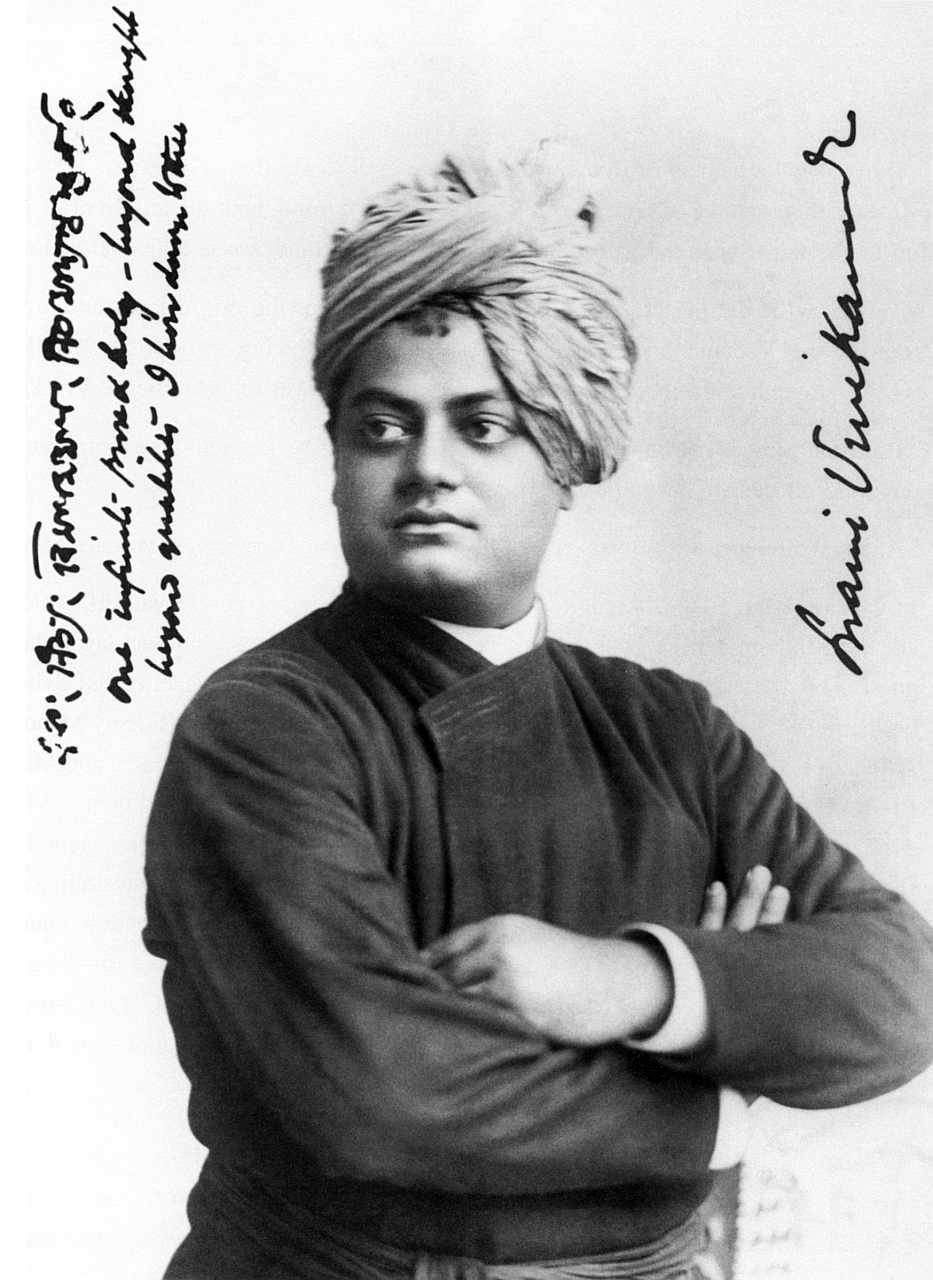 Swami Vivekananda★Indian1863 – 1902Brought Vedānta and yoga to the West at the 1893 Parliament of Religions.
 Sri AurobindoIndian1872 – 1950Nationalist turned philosopher-yogi who developed "integral yoga" and an evolutionary spirituality.
 Gautama Buddha★Indianc. 563 – 483 BCEThe awakened one: a prince who renounced his life to find the cause of suffering and taught the Middle Way to its end.
 Arthur Schopenhauer★Modern European1788 – 1860Pessimist who saw the world as blind Will and found relief in art, compassion and Indian philosophy.
 OshoIndian1931 – 1990Provocative Indian mystic and speaker who blended Zen, Tantra, Sufism and Western psychology into a philosophy of…