Buddhist philosophy
From the Buddha's Four Noble Truths: suffering arises from craving and ignorance and can end through insight into impermanence, no-self and dependent origination.
Key ideas
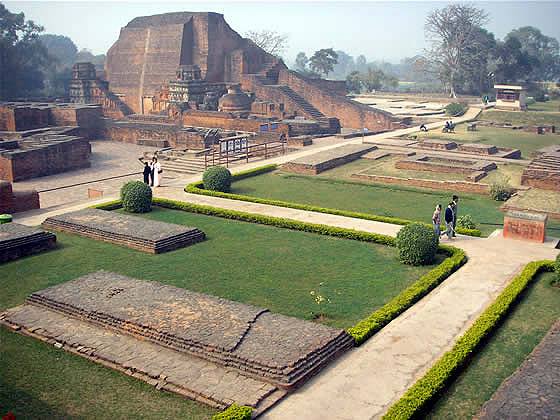
Buddhist philosophy begins with a diagnosis. Life as ordinarily lived is marked by duḥkha — unsatisfactoriness, suffering. Its cause is craving rooted in ignorance; it can cease; and there is a path to its cessation. These are the Four Noble Truths of the Buddha's first sermon at Sarnath.
The ignorance in question is philosophical. We take ourselves and things to be permanent, independent substances, when in fact everything arises in dependence on conditions (pratītyasamutpāda), is impermanent, and lacks a fixed self (anātman). The "self" is a convenient label for a changing stream of physical and mental events.
Over two millennia, Buddhist thinkers developed these insights into rich systems: the Abhidharma analysis of reality into momentary events, Nāgārjuna's Madhyamaka philosophy of emptiness, the Yogācāra analysis of consciousness, and the logic of Dignāga and Dharmakīrti. Carried across Asia, Buddhism was reshaped into Tibetan, Chinese, Korean and Japanese forms such as Chan/Zen.
Buddhist philosophy is the ancient Indian philosophical system that developed within the religio-philosophical tradition of Buddhism. It encompasses the philosophical ideas and systems of inquiry developed by Buddhist schools in ancient India following the parinirvāṇa of Gautama Buddha (c. 5th century BCE), as well as subsequent developments across Asia.
Buddhism combines both philosophical reasoning and the practice of meditation. The Buddhist religion presents a multitude of Buddhist paths to liberation; and with the expansion of early Buddhism from ancient India to Sri Lanka and subsequently to East Asia and Southeast Asia, Buddhist philosophers have examined subjects including cosmology, ethics, epistemology, logic, metaphysics, ontology, phenomenology, the philosophy of mind, the philosophy of time, and soteriology.
Early Buddhist texts describe the Buddha as declining to answer certain metaphysical questions because he considered them irrelevant to the attainment of liberation. However, his teachings also included doctrines with metaphysical implications, such as dependent arising, karma, and rebirth.
Particular points of Buddhist philosophy have often been the subject of disputes between different schools of Buddhism, as well as between representative thinkers of Buddhist schools and Hindu or Jain philosophers. These elaborations and disputes gave rise to various early Buddhist schools of Abhidharma, the Mahāyāna movement, and scholastic traditions such as Prajñāpāramitā, Sarvāstivāda, Mādhyamaka, Sautrāntika, Vaibhāṣika, Buddha-nature, Yogācāra, and more. One recurrent theme in Buddhist philosophy has been the desire to find a Middle Way between philosophical views seen as extreme.
Historical phases of Buddhist philosophy
Edward Conze splits the development of Indian Buddhist philosophy into three phases:
The phase of the pre-sectarian Buddhist doctrines derived from oral traditions that originated during the life of Gautama Buddha, and are common to all later schools of Buddhism.
The second phase concerns non-Mahāyāna "scholastic" Buddhism, as evident in the Abhidharma texts beginning in the 3rd century BCE, that feature scholastic reworking and schematic classification of material in the early Buddhist texts. The Abhidhamma philosophy of the Theravāda school belongs to this phase.
The third phase concerns Mahāyāna Buddhism, beginning in the late first century CE. This movement emphasizes the path of a bodhisattva and includes various schools of thought, such as Prajñāpāramitā, Mādhyamaka, Sautrāntika, Buddha-nature, and Yogācāra.
Various elements of these three phases are incorporated and/or further developed in the philosophy and worldview of the various sects of Buddhism that then emerged.
Philosophical orientation
Buddhism is an Indian religion and dhārma that encompasses a variety of traditions, beliefs, and spiritual practices based on teachings attributed to Gautama Buddha (5th century BCE), but diversified since then in a wide variety of schools and traditions. Buddhism originated in ancient India, from where the Buddhadhārma spread from the northeastern region of the Indian subcontinent throughout Central Asia, East Asia, Mainland Southeast Asia, and Maritime Southeast Asia. Philosophy in ancient India was aimed primarily at spiritual liberation and had soteriological goals. In his study of the Mādhyamaka and Sautrāntika schools of Buddhist philosophy in ancient India, Peter Deller Santina writes:
Attention must first of all be drawn to the fact that philosophical systems in India were seldom, if ever, purely speculative or descriptive. Virtually all the great philosophical systems of India: Sāṃkhya, Advaita Vedānta, Mādhyamaka and so forth, were preeminently concerned with providing a means to liberation or salvation. It was a tacit assumption with these systems that if their philosophy were correctly understood and assimilated, an unconditioned state free of suffering and limitation could be achieved. [...] If this fact is overlooked, as often happens as a result of the propensity engendered by formal Occidental philosophy to consider the philosophical enterprise as a purely descriptive one, the real significance of Indian and Buddhist philosophy will be missed.
For the Indian Buddhist philosophers, the teachings of Gautama Buddha were not meant to be taken on faith alone, but to be confirmed by logical analysis and inquiry (pramāṇa) of the world. The early Buddhist texts mention that a person becomes a follower of the Buddha's teachings after having pondered them over with wisdom (jñana) and the gradual training also requires that a disciple "investigate" (upaparikkhati) and "scrutinize" (tuleti) the teachings. The Buddha also expected his disciples to approach him as a teacher in a critical fashion and scrutinize his actions and words, as shown in the Vīmaṃsaka Sutta.
Some Buddhist thinkers even argued that systems of rational reflection and philosophical analysis were a central practice which was necessary for the attainment of insight during meditation. Thus, Mahāyāna philosophers like Prajñakaragupta argue that one is not a yogi "merely because of meditation"; rather, one must meditate, listen to the teachings, and understand them by "reflecting through rational inquiry" (yukti-cintāmaya). Only through this method, which combined rational reflection and the practice of meditation, will the wisdom that leads to enlightenment arise.
The Buddha and early Buddhism
Buddhism is devoted primarily to gaining correct insight (bodhi, awakening or enlightenment) into our attachment to changing (anicca), 'unreliable' (Duḥkha) things, and the subsequent development (bhavana) of ahimsa and the 'blowing out' (nirvāṇa) of these attachments through the threefold trainings (ethical conduct, meditative absorption, and wisdom). Classical Indian Buddhism emphasized the importance of the individual's self-cultivation (through numerous spiritual practices like keeping ethical precepts, Buddhist meditation, and worship) in the process of liberation from the defilements which keep us bound to the cycle of rebirth. According to the standard Buddhist scholastic understanding, liberation arises when the proper spiritual qualities (dharmas) are cultivated and when the mind has been purified of its attachment to fetters and hindrances that produce unwholesome mental factors (various called defilements, poisons, or fluxes). This cultivation is traditionally interpreted as a liberation of sentient beings from saṃsāra (the cycle of compulsory birth, death, and rebirth)
The Buddha
Scholars disagree on whether Gautama Buddha's teachings should be understood as a form of philosophical inquiry. Siddartha Gautama (c. 5th century BCE) was a north Indian Śramaṇa (wandering ascetic), whose teachings are preserved in the Pāli Nikayas and in the Āgamas as well as in other surviving fragmentary textual collections, collectively known as the early Buddhist texts. Scholars have not established which parts of these texts can be attributed to the historical Buddha. While the focus of the Buddha's teachings is about attaining the highest good of nirvāṇa, they also contain an analysis of the source of human suffering (duḥkha), the nature of personal identity (ātman), and the process of acquiring knowledge (prajña) about the world.
The Middle Way
The Buddha defined his teaching as "the Middle Way" (Pāli: majjhimāpaṭipadā). In the Dharmacakrapravartana Sūtra, this is used to refer to the fact that his teachings steer a middle course between the extremes of asceticism and bodily denial (as practiced by the Jains and other Indian ascetic groups) and sensual hedonism or indulgence. Many Śramaṇa ascetics of the Buddha's time placed much emphasis on a denial of the body, using practices such as fasting, to liberate the mind from the body. Gautama Buddha, however, realized that the mind was embodied and causally dependent on the body, and therefore that a malnourished body did not allow the mind to be trained and developed. Thus, Buddhism's main concern is not with luxury or poverty, but instead with the human response to circumstances.
Another related teaching of the historical Buddha is "the teaching through the middle" (majjhena dhammaṃ desana), which claims to be a metaphysical middle path between the extremes of eternalism and annihilationism, as well as the extremes of existence and non-existence. This idea would become central to later Buddhist metaphysics, as all Buddhist philosophies would claim to steer a metaphysical middle course.
Basic teachings
Several teachings recur throughout the early Buddhist texts. Based on these textual similarities, earlier scholarship has identified the following doctrines as teachings that may originate with the historical Buddha:
The Four Noble Truths, which provide an analysis of the cause of suffering (duḥkha)
The Noble Eightfold Path, which illustrate the path to spiritual liberation (mokṣa)
The four dhyānas (meditations)
The three marks of existence, three characteristics which apply to all phenomena and which are: suffering (duḥkha), impermanence (anicca), and non-self (anattā)
The five aggregates of clinging (skandhā), which provide an analysis of personal identity and physical existence
Dependent origination (pratītyasamutpāda), a complex doctrine which analyzes the how living beings come to be and how they are conditioned by various psycho-physical processes
Karma and rebirth, actions which lead to a new existence after death, in an endless cycle of birth, death, and rebirth (saṃsāra)
Nirvāṇa, the ultimate soteriological goal which leads to the cessation of all suffering
Adapted from the Wikipedia article Buddhist philosophy, available under CC BY-SA 4.0.
Connections
Founded by
1


Includes
4


Criticized
1Criticized by
1


You might also explore
 Advaita VedāntaIndian700 – presentNon-dualism: the individual self (ātman) is identical with Brahman, and the world of many things is appearance (māyā).
 Kantianism★Modern European1781 – presentKant's critical philosophy and its heirs: the mind structures experience; morality is grounded in rational autonomy.CārvākaIndian600 BCE – 1400 CEIndian materialism: only perception is valid; no soul, no afterlife, no karma.MīmāṃsāIndian300 BCE – presentInterpretation of Vedic ritual and duty (dharma); a sophisticated philosophy of language.
 Bhakti movementIndian600 – 1800A devotional revolution across India that put loving devotion above caste, ritual and priesthood — through poet-saints…