
Friedrich Schleiermacher
Friedrich Daniel Ernst Schleiermacher was a German Reformed theologian, pastor, philosopher, and biblical scholar known for his attempt to reconcile the criticisms of the Enlightenment with traditional Protestant Christianity. He also became influential in the evolution of higher criticism, and his work forms part of t
Friedrich Daniel Ernst Schleiermacher (; German: [ˈfʁiːdʁɪç ˈʃlaɪɐˌmaxɐ]; 21 November 1768 – 12 February 1834) was a German Reformed theologian, pastor, philosopher, and biblical scholar known for his attempt to reconcile the criticisms of the Enlightenment with traditional Protestant Christianity. He also became influential in the evolution of higher criticism, and his work forms part of the foundation of the modern field of hermeneutics. Because of his profound effect on subsequent Christian thought, he is often called the "Father of Modern Liberal Theology" and is considered an early leader in liberal Christianity. The neo-orthodoxy movement of the twentieth century, typically (though not without challenge) seen to be spearheaded by Karl Barth, was in many ways an attempt to challenge his influence. As a philosopher he was a leader of German Romanticism.
Early life and development
Born in Breslau in Prussian Silesia as the grandson of Daniel Schleiermacher, a pastor at one time associated with the Zionites, and the son of Gottlieb Schleiermacher, a Reformed Church chaplain in the Prussian army, Schleiermacher started his formal education in a Moravian school at Niesky in Upper Lusatia, and at Barby near Magdeburg. However, pietistic Moravian theology failed to satisfy his increasing doubts, and his father reluctantly gave him permission to enter the University of Halle, which had already abandoned pietism and adopted the rationalist spirit of Christian Wolff and Johann Salomo Semler. As a theology student, Schleiermacher pursued an independent course of reading and neglected the study of the Old Testament and of Oriental languages. However, he attended the lectures of Semler and became acquainted with the techniques of historical criticism of the New Testament, and of Johann Augustus Eberhard from whom he acquired a love of the philosophy of Plato and Aristotle. At the same time, he studied the writings of Immanuel Kant and Friedrich Heinrich Jacobi and began to apply ideas from the Greek philosophers to a reconstruction of Kant's system.
Schleiermacher developed a deep-rooted skepticism as a student and soon rejected orthodox Christianity.
Brian Gerrish, a scholar of the works of Schleiermacher, wrote:
In a letter to his father, Schleiermacher drops the mild hint that his teachers fail to deal with those widespread doubts that trouble so many young people of the present day. His father misses the hint. He has himself read some of the skeptical literature, he says, and can assure Schleiermacher that it is not worth wasting time on. For six whole months there is no further word from his son. Then comes the bombshell. In a moving letter of 21 January 1787, Schleiermacher admits that the doubts alluded to are his own. His father has said that faith is the "regalia of the Godhead," that is, God's royal due.
Schleiermacher confessed: "Faith is the regalia of the Godhead, you say. Alas! dearest father, if you believe that without this faith no one can attain to salvation in the next world, nor to tranquility in this—and such, I know, is your belief—oh! then pray to God to grant it to me, for to me it is now lost. I cannot believe that he who called himself the Son of Man was the true, eternal God; I cannot believe that his death was a vicarious atonement."
Tutoring, chaplaincy and first works
At the completion of his course at Halle, Schleiermacher became the private tutor to the family of Friedrich Alexander Burggraf und Graf zu Dohna-Schlobitten (1741–1810), developing in a cultivated and aristocratic household his deep love of family and social life.
Schleiermacher was ordained in 1794. Two years later, in 1796, he became chaplain to the Charité Hospital in Berlin. Lacking scope for the development of his preaching skills, he sought mental and spiritual satisfaction in the city's cultivated society and in intensive philosophical studies, beginning to construct the framework of his philosophical and religious system. Here Schleiermacher became acquainted with art, literature, science and general culture. He was strongly influenced by German Romanticism, as represented by his friend Karl Wilhelm Friedrich von Schlegel. That interest is borne out by his Confidential Letters on Schlegel's Lucinde as well as by his seven-year relationship (1798–1805) with Eleonore Christiane Grunow (née Krüger) (1769/1770–1837), the wife of Berlin clergyman August Christian Wilhelm Grunow (1764–1831).
Though his ultimate principles remained unchanged, he placed more emphasis on human emotion and the imagination. Meanwhile, he studied Spinoza and Plato, both of whom were important influences. He became more indebted to Kant though they differed on fundamental points. He sympathised with some of Jacobi's positions, and took some ideas from Fichte and Schelling. The literary product of that period of rapid development was his influential book, Reden über die Religion (On Religion: Speeches to Its Cultured Despisers), and his "new year's gift" to the new century, the Monologen (Soliloquies).
In the first book, Schleiermacher gave religion an unchanging place among the divine mysteries of human nature, distinguished it from what he regarded as current caricatures of religion and described the perennial forms of its manifestation. That established the programme of his subsequent theological system. In the Monologen, he revealed his ethical manifesto in which he proclaimed his ideas on the freedom and independence of the spirit and on the relationship of the mind to the sensual world, and he sketched his ideal of the future of the individual and of society.
Pastorship
From 1802 to 1804, Schleiermacher served as a pastor of a small Reformed church in the Pomeranian town of Stolp. He relieved Friedrich Schlegel entirely of his nominal responsibility for the translation of Plato, which they had together undertaken (vols. 1–5, 1804–1810; vol. 6, Repub. 1828). Another work, Grundlinien einer Kritik der bisherigen Sittenlehre [Outlines of a Critique of the Doctrines of Morality to date] (1803), the first of his strictly critical and philosophical productions, occupied him; it is a criticism of all previous moral systems, including those of Kant and Fichte: Plato's and Spinoza's find most favour. It contends that the tests of the soundness of a moral system are the completeness of its view of the laws and ends of human life as a whole and the harmonious arrangement of its subject-matter under one fundamental principle. Although it is almost exclusively critical and negative, the book announces Schleiermacher's later view of moral science, attaching prime importance to a Güterlehre, or doctrine of the ends to be obtained by moral action. The obscurity of the book's style and its negative tone prevented immediate success.
Professorship
In 1804, Schleiermacher moved to become university preacher and professor of theology to the University of Halle, where he remained until 1807. He quickly obtained a reputation as professor and preacher and exercised a powerful influence in spite of charges of atheism, Spinozism and pietism. In this period, he began his lectures on hermeneutics (1805–1833) and he also wrote his dialogue the Weihnachtsfeier (Christmas Eve: Dialogue on the Incarnation, 1806), which represents a midway point between his Speeches and his great dogmatic work, Der christliche Glaube (The Christian Faith); the speeches represent phases of his growing appreciation of Christianity as well as the conflicting elements of the theology of the period. After the Battle of Jena, he returned to Berlin (1807), was soon appointed pastor of the Trinity Church and, on 18 May 1809, married Henriette von Willich (née von Mühlenfels; 1788–1840), the widow of his friend Johann Ehrenfried Theodor von Willich (1777–1807).
At the foundation of the University of Berlin (1810), in which he took a prominent part, Schleiermacher obtained a theological chair and soon became secretary to the Prussian Academy of Sciences. He took a prominent part in the reorganization of the Prussian church and became the most powerful advocate of the union of the Lutheran and Reformed divisions of German Protestantism, paving the way for the Prussian Union of Churches (1817). The 24 years of his professional career in Berlin began with his short outline of theological study (Kurze Darstellung des theologischen Studiums, 1811) in which he sought to do for theology what he had done for religion in his Speeches.
While he preached every Sunday, Schleiermacher also gradually took up in his lectures in the university almost every branch of theology and philosophy: New Testament exegesis, introduction to and interpretation of the New Testament, ethics (both philosophic and Christian), dogmatic and practical theology, church history, history of philosophy, psychology, dialectics (logic and metaphysics), politics, pedagogy, aesthetics and translation.
In politics, Schleiermacher supported liberty and progress, and in the period of reaction that followed the overthrow of Napoleon, he was charged by the Prussian government with "demagogic agitation" in conjunction with the patriot Ernst Moritz Arndt.
At the same time, Schleiermacher prepared his chief theological work, Der christliche Glaube nach den Grundsätzen der evangelischen Kirche (1821–1822; 2nd ed., greatly altered, 1830–1831; 6th ed., 1884; The Christian faith according to the principles of the evangelical church). Its fundamental principle is that the source and the basis of dogmatic theology are the religious feeling, the sense of absolute dependence on God as communicated by Jesus through the church, not the creeds or the letter of Scripture or the rationalistic understanding. The work is therefore simply a description of the facts of religious feeling, or of the inner life of the soul in its relations to God, and the inward facts are looked at in the various stages of their development and presented in their systematic connection. The aim of the work was to reform Protestant theology, to put an end to the unreason and superficiality of both supernaturalism and rationalism, and to deliver religion and theology from dependence on perpetually changing systems of philosophy.
Though the work added to the reputation of its author, it aroused the increased opposition of the theological schools it was intended to overthrow, and at the same time, Schleiermacher's defence of the right of the church to frame its own liturgy in opposition to the arbitrary dictation of the monarch or his ministers brought him fresh troubles. He felt isolated although his church and his lecture-room continued to be crowded.
Schleiermacher continued with his translation of Plato and prepared a new and greatly-altered edition of his Christlicher Glaube, anticipating the latter in two letters to his friend Gottfried Lücke (in the Studien und Kritiken, 1829) in which he defended his theological position generally and his book in particular against opponents on both the right and the left.
The same year, Schleiermacher lost his only son, Nathaniel (1820–1829), a blow that he said "drove the nails into his own coffin", but he continued to defend his theological position against Hengstenberg's party and the rationalists Daniel Georg Konrad von Cölln (1788–1833) and David Schulz (1779–1854), protesting against both subscription to the ancient creeds and the imposition of a new rationalistic formulary.
Death
Schleiermacher died at 65 of pneumonia on 12 February 1834.
Doctrine of knowledge
Schleiermacher's psychology takes as its basis the phenomenal dualism of the ego and the non-ego, and regards the life of man as the interaction of these elements with their interpenetration as its infinite destination. The dualism is therefore not absolute, and, though present in man's own constitution as composed of body and soul, is relative only even there. The ego is itself both body and soul — the conjunction of both constitutes it. Our "organization" or sense nature has its intellectual element, and our "intellect" its organic element, and there is no such thing as "pure mind" or "pure body." The one general function of the ego, thought, becomes in relation to the non-ego either receptive or spontaneous action, and in both forms of action its organic, or sense, and its intellectual energies co-operate; and in relation to man, nature and the universe the ego gradually finds its true individuality by becoming a part of them, "every extension of consciousness being higher life."
The specific functions of the ego, as determined by the relative predominance of sense or intellect, are either functions of the senses (or organism) or functions of the intellect. The former fall into the two classes of feelings (subjective) and perceptions (objective); the latter, according as the receptive or the spontaneous element predominates, into cognition and volition. In cognition, thought is ontologically oriented to the object; and in volition it is the teleological purpose of thought. In the first case we receive (in our fashion) the object of thought into ourselves. In the latter we plant it out into the world. Both cognition and volition are functions of thought as well as forms of moral action.
It is in those two functions that the real life of the ego is manifested, but behind them is self-consciousness permanently present, which is always both subjective and objective — consciousness of ourselves and of the non-ego. This self-consciousness is the third special form or function of thought — which is also called feeling and immediate knowledge. In it we cognize our own inner life as affected by the non-ego. As the non-ego helps or hinders, enlarges or limits, our inner life, we feel pleasure or pain. Aesthetic, moral and religious feelings are respectively produced by the reception into consciousness of large ideas — nature, mankind and the world; those feelings are the sense of being one with these vast objects. Religious feeling therefore is the highest form of thought and of life; in it we are conscious of our unity with the world and God; it is thus the sense of absolute dependence.
Schleiermacher's doctrine of knowledge accepts the fundamental principle of Kant that knowledge is bounded by experience, but it seeks to remove Kant's skepticism as to knowledge of the ding an sich (the noumenon) or Sein, as Schleiermacher's term is. The idea of knowledge or scientific thought as distinguished from the passive form of thought — of aesthetics and religion — is thought which is produced by all thinkers in the same form and which corresponds to being. All knowledge takes the form of the concept (Begriff) or the judgment (Urteil), the former conceiving the variety of being as a definite unity and plurality, and the latter simply connecting the concept with certain individual objects.
In the concept, therefore, the intellectual and in the judgment the organic or sense element predominates. The universal uniformity of the production of judgments presupposes the uniformity of our relations to the outward world, and the uniformity of concepts rests similarly on the likeness of our inward nature. This uniformity is not based on the sameness of either the intellectual or the organic functions alone, but on the correspondence of the forms of thought and sensation with the forms of being. The essential nature of the concept is that it combines the general and the special, and the same combination recurs in being; in being the system of substantial or permanent forms answers to the system of concepts and the relation of cause and effect to the system of judgments, the higher concept answering to "force" and the lower to the phenomena of force, and the judgment to the contingent interaction of things.
The sum of being consists of the two systems of substantial forms and interactional relations, and it reappears in the form of concept and judgment, the concept representing being and the judgment being in action. Knowledge has under both forms the same object, the relative difference of the two being that when the conceptual form predominates we have speculative science and when the form of judgment prevails we have empirical or historical science. Throughout the domain of knowledge the two forms are found in constant mutual relations, another proof of the fundamental unity of thought and being or of the objectivity of knowledge. Plato, Spinoza and Kant had contributed characteristic elements of their thought to this system, and directly or indirectly it was largely indebted to Schelling for fundamental conceptions.
Hermeneutics
While Schleiermacher did not publish extensively on hermeneutics during his lifetime, he lectured widely on the field. His published and unpublished writings on the subject were collected together after his death and published in 1838 as Hermeneutik und Kritik mit besonderer Beziehung auf das Neue Testament. However, it was not until Heinz Kimmerle's 1959 edition "based on a careful transcription of the original handwritten manuscripts, that an assured and comprehensive overview of Schleiermacher's theory of hermeneutics became possible."
Schleiermacher wanted to shift hermeneutics away from specific methods of interpretation (e.g. methods for interpreting biblical or classical texts) and toward a focus on how people understand texts in general. He was interested in interpreting Scripture, but he thought one could do so properly only after establishing a system of interpretation that was applicable to all texts. This process was not a systematic or strictly philological approach, but what he called "the art of understanding." Schleiermacher viewed a text as a vehicle that an author used to communicate thoughts that he had had before creating the text. These thoughts were what caused the author to produce the text; at the moment of text creation, these "inner thoughts" become "outer expression" in language. In order to interpret a text, then, the interpreter must consider both the inner thoughts of the author and the language that s/he used in writing the text. In other words, the reader must submerge himself in the realities of the object of understanding (the text). This approach to interpreting texts involves both "grammatical interpretation" and "psychological (or technical) interpretation." The former deals with the language of the text; the latter with the thoughts, emotions, intentions and aims of the author.
The language used by an author "is what mediates sensuously and externally between utterer and listener". The ultimate goal of hermeneutics for Schleiermacher is "understanding in the highest sense"— experiencing the same thoughts that the author experienced when writing the text which he identified as submerging Understanding is a historical process involving learning about the context in which the author wrote, and how the text's original readership understood its language. Understanding is also a psychological process drawing upon intuition and a connection between interpreter and the author. Reader and author are both human. As humans, they have some degree of shared understanding. That shared understanding is what makes it possible for a reader to understand an author.
Part of the art of understanding is the art of avoiding misunderstanding. Schleiermacher identifies two forms of misunderstanding. Qualitative misunderstanding is a failure of grammatical interpretation— failing to understand the language of the text— "the confusion of the meaning of a word for another." Quantitative misunderstanding a failure of technical/psychological interpretation— misunderstanding the nuance in the author’s own "sphere."
Adapted from the Wikipedia article Friedrich Schleiermacher, available under CC BY-SA 4.0.
Connections
Belongs to
1
Influenced
8


Ideas & arguments
3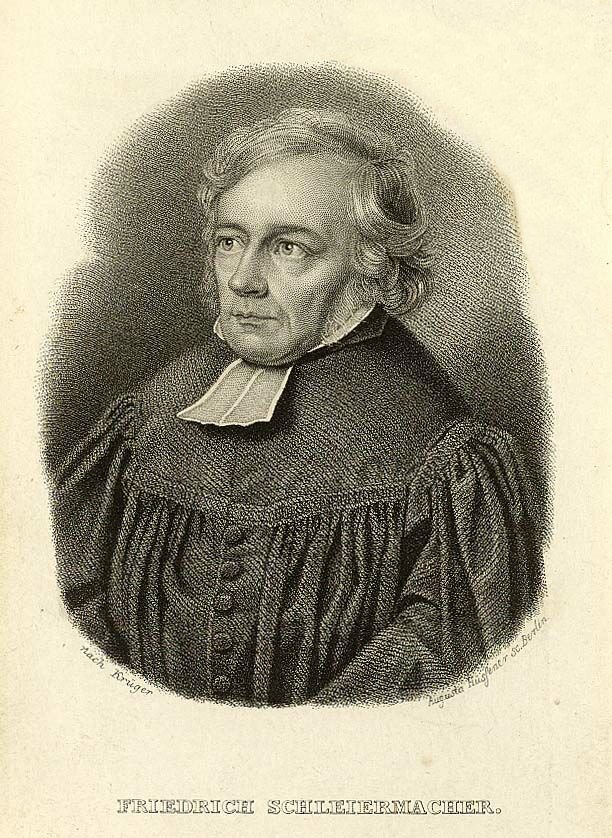

Contributed to
4

You might also explore
 G. W. F. Hegel★Modern European1770 – 1831Systematic idealist for whom history is the dialectical self-realisation of Spirit and freedom.
 Martin Heidegger★Modern European1889 – 1976Asked the question of the meaning of Being; analysed human existence (Dasein) as being-in-the-world and…
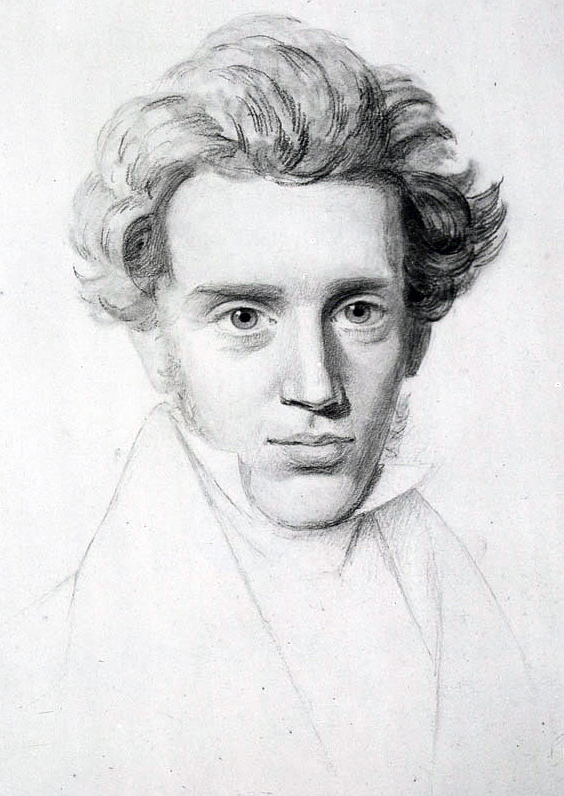 Søren Kierkegaard★Modern European1813 – 1855Danish father of existentialism: truth is subjectivity, and faith a leap beyond reason.
 Max StirnerModern European1806 – 1856Johann Caspar Schmidt, known by the pen name Max Stirner (; German: [ˈʃtɪʁnɐ]), was a German philosopher, dealing…
 Immanuel KantModern European1724 – 1804Königsberg professor whose critical philosophy reconciled rationalism and empiricism and grounded morality in the…
 Aristotle★Greek & Roman384 – 322 BCEPlato's student and Alexander's tutor, who systematised logic, ethics, biology, metaphysics and politics — "the master…