Phenomenology and existentialism
Husserl returned to experience itself; Heidegger asked about Being; Sartre and Beauvoir made freedom and responsibility central; Camus confronted the absurd; Arendt analysed totalitarianism.
- 1
 SchoolModern European1900 – present
Phenomenology
Describe experience exactly as it is lived, "back to the things themselves".
Read the full pagePhenomenology is a philosophical study and movement largely associated with the early 20th century that seeks to objectively investigate the nature of subjective, conscious experience. It attempts to describe the universal features of consciousness while avoiding assumptions about the external world, aiming to describe phenomena as they appear, and to explore the meaning and significance of lived experience.
This approach, while philosophical, has found many applications in qualitative research across different scientific disciplines, especially in the social sciences, humanities, psychology, and cognitive science, but also in fields as diverse as health sciences, architecture, and human-computer interaction, among many others. The application of phenomenology in these fields aims to gain a deeper understanding of subjective experience, rather than focusing on behavior.
Phenomenology is contrasted with phenomenalism, which reduces mental states and physical objects to complexes of sensations, and with psychologism, which treats logical truths or epistemological principles as the products of human psychology. In particular, transcendental phenomenology, as outlined by Edmund Husserl, aims to arrive at an objective understanding of the world via the discovery of universal logical structures in human subjective experience.
- 2PhilosopherModern European1859 – 1938
Edmund Husserl
Founder of phenomenology: bracket assumptions and describe consciousness as it presents itself.
- ◆Phenomenology
- ◆Phenomenological reduction
- ◆eidetic reduction
- ◆Noesis
- ◆noema
- ◆Formal ontology
Read the full pageEdmund Gustav Albrecht Husserl (Austrian German: [ˈɛdmʊnd ˈhʊsɐl]; 8 April 1859 – 27 April 1938) was an Austrian and German philosopher and mathematician who established the school of phenomenology.
In his early work, he elaborated critiques of historicism and of psychologism in logic based on analyses of intentionality. In his mature work, he sought to develop a systematic foundational science based on the so-called phenomenological reduction. Arguing that transcendental consciousness sets the limits of all possible knowledge, Husserl redefined phenomenology as a transcendental idealist philosophy. Husserl's thought profoundly influenced 20th-century philosophy, and he remains a notable figure in contemporary philosophy and beyond.
Husserl studied mathematics, taught by Karl Weierstrass and Leo Königsberger, and philosophy taught by Franz Brentano and Carl Stumpf. He taught philosophy as a Privatdozent at Halle from 1887, then as professor, first at Göttingen from 1901, then at Freiburg from 1916 until he retired in 1928, after which he remained highly productive. In 1933, under racial laws of the Nazi Party, Husserl was banned from using the library of the University of Freiburg due to his Jewish family background and months later resigned from the Deutsche Akademie. Following an illness, he died in Freiburg in 1938.
- 3Read the full page
Intentionality is the mental ability to refer to or represent something. Sometimes regarded as the mark of the mental, it is found in mental states like perceptions, beliefs or desires. For example, the perception of a tree has intentionality because it represents a tree to the perceiver. A central issue for theories of intentionality has been the problem of intentional inexistence: to determine the ontological status of the entities which are the objects of intentional states.
An early theory of intentionality is associated with Anselm of Canterbury's ontological argument for the existence of God, and with his tenets distinguishing between objects that exist in the understanding and objects that exist in reality. The idea fell out of discussion with the end of the medieval scholastic period, but in recent times was resurrected by empirical psychologist Franz Brentano and later adopted by contemporary phenomenological philosopher Edmund Husserl. Today, intentionality is a live concern among philosophers of mind and language. A common dispute is between naturalism, the view that intentional properties are reducible to natural properties as studied by the natural sciences, and the phenomenal intentionality theory, the view that intentionality is grounded in consciousness.
The concept of intentionality was reintroduced in 19th-century contemporary philosophy by Franz Brentano (a German philosopher and psychologist who is generally regarded as the founder of act psychology, also called intentionalism) in his work Psychology from an Empirical Standpoint (1874). Brentano described intentionality as a characteristic of all acts of consciousness that are thus "psychical" or "mental" phenomena, by which they may be set apart from "physical" or "natural" phenomena.
- 4
 PhilosopherModern European1889 – 1976
Martin Heidegger
Asked the question of the meaning of Being; analysed human existence (Dasein) as being-in-the-world and being-toward-death.
- ◆Dasein
- ◆Being-in-the-world
- ◆Being-toward-death
- ◆Authenticity
- ◆The question concerning technology
Read the full pageMartin Heidegger (26 September 1889 – 26 May 1976) was a German philosopher whose work was central to the development of phenomenology, hermeneutics, and existentialism. He has had significant influence within subsequent philosophy, social sciences and humanities, and theology.
Heidegger's magnum opus, Being and Time (1927), is widely considered one of the most significant works of modern philosophy. In it, he introduced the concept of Dasein ("being-there") to describe the distinctive character of human existence, arguing that humans possess a "pre-ontological" understanding of being that shapes how they live and act, which he analyzed in terms of the unitary structure of "being-in-the-world". Through his analysis of Dasein, Heidegger sought to reawaken what he called "the question of being": the fundamental inquiry into what makes entities intelligible as the entities they are. In other words, Heidegger's governing "question of being" is concerned with what makes beings intelligible as beings. This question, he believed, had been neglected or obscured throughout the history of Western philosophy since the ancient Greeks.
His later work turned increasingly to questions of technology, language, art, and poetry, developing themes of human "dwelling" in the world and critiquing what he saw as the nihilistic trajectory of modern technological civilisation. Thinkers as varied as Jean-Paul Sartre, Hans-Georg Gadamer, Hannah Arendt, Jacques Derrida, Michel Foucault, Emmanuel Levinas, and Richard Rorty were substantially shaped by engagement with his thought, whether in agreement or opposition.
- 5ConceptModern European
Dasein
Heidegger's term for the kind of being humans have: being-there, being-in-the-world.
Read the full pageDasein ( DAH-zyne; German: [ˈdaːzaɪn]) is a term in the philosophy of Martin Heidegger. Adopted from the ordinary German word Dasein meaning 'existence', Heidegger used it to refer to the mode of being that he believed is particular to human beings, who are aware of and must confront such issues as personhood, mortality, and the dilemma or paradox of living in relationship with other humans while being ultimately alone with oneself. To put it in simpler terms, it may be understood as a particular way in which humans have consciously felt addressed and challenged by this world, or the philosophical inquiry of difference itself.
In German, Dasein is the vernacular term for "existence". It is derived from da-sein, which literally means "being-there" or "there-being". In a philosophical context, it was first used by Leibniz and Wolff in the 17th century, as well as by Kant and Hegel in the 18th and 19th; however, Heidegger's later association of the word with human existence was uncommon and not of special philosophical significance during this period.
Dasein for Heidegger is a mode of being involved with and caring for the immediate world in which one lives, while always remaining aware of the contingent element of that involvement, of the priority of the world to the self, and of the evolving nature of the self itself.
- 6
 WorkModern European1927
Being and Time
Heidegger's analysis of Dasein and the question of the meaning of Being.
Read the full pageBeing and Time (German: Sein und Zeit) is the 1927 magnum opus of German philosopher Martin Heidegger and a key document of existentialism. Being and Time had a notable impact on subsequent philosophy, literary theory and many other fields. Though controversial, its stature in intellectual history has been compared with works by Immanuel Kant and G. W. F. Hegel. The book attempts to revive ontology through an analysis of Dasein, or "being-in-the-world." It is also noted for an array of neologisms and complex language, as well as an extended treatment of "authenticity" as a means to grasp and confront the unique and finite possibilities of the individual.
Richard Wolin notes that the work "implicitly adopted the critique of mass society" epitomised earlier by Søren Kierkegaard and Friedrich Nietzsche. "Elitist complaints about the 'dictatorship of public opinion' were common currency to the German mandarins of the twenties," according to Jürgen Habermas (1989). Wolin writes that Being and Time is "suffused by a sensibility derived from secularized Protestantism" and its stress on original sin, and that the human condition is portrayed as "essentially a curse." Wolin cites the work's extended emphasis on "emotionally laden concepts" like guilt, conscience, angst and death.
The book is likened to a secularized version of Martin Luther's project, which aimed to turn Christian theology back to an earlier and more "original" phase. Taking this view, John D. Caputo notes that Heidegger made a systematic study of Luther in the 1920s after training for 10 years as a Catholic theologian. Similarly, Hubert Dreyfus likens Division II of the volume to a secularized version of Kierkegaard's Christianity. Almost all central concepts of Being and Time are derived from Augustine, Luther, and Kierkegaard, according to Christian Lotz.
- 7SchoolModern European1840 – present
Existentialism
Existence precedes essence: we are thrown into a world without given meaning and must create ourselves through free choices.
- ◆Existence precedes essence
- ◆Radical freedom and responsibility
- ◆Anxiety, absurdity and authenticity
- ◆Bad faith
Read the full pageExistentialism is less a doctrine than a mood and a method. It starts not from abstract questions about knowledge or substance but from the concrete situation of an individual who must live, choose and die.
Kierkegaard insisted that truth worth having must be lived "subjectively"; Nietzsche announced the death of God and asked how we could create values without him. In 20th-century France Jean-Paul Sartre gave the movement its slogan — existence precedes essence: there is no human nature that determines what we are; we make ourselves through our choices, and we are "condemned to be free". Simone de Beauvoir applied the idea to gender ("one is not born, but becomes, a woman"), while Albert Camus explored the absurd clash between our demand for meaning and a silent universe.
Existentialism shaped literature, theology, psychotherapy and the counter-culture, and its questions — how to live authentically, how to face death and freedom — remain urgent.
- 8
 PhilosopherModern European1905 – 1980
Jean-Paul Sartre
Existentialist who declared that existence precedes essence and that we are condemned to be free.
- ◆Existence precedes essence
- ◆Condemned to be free
- ◆Bad faith
- ◆Hell is other people
Read the full pageJean-Paul Charles Aymard Sartre (, US also ; French: [saʁtʁ]; 21 June 1905 – 15 April 1980) was a French philosopher, political activist, and writer, considered a leading figure in 20th-century French philosophy and Marxism. Sartre was one of the key figures in the philosophy of existentialism (and phenomenology) and was a proponent of Libertarian Marxism. His work has influenced sociology, critical theory, post-colonial theory, and literary studies including literary history and literary theory. He was awarded the 1964 Nobel Prize in Literature despite attempting to refuse it, saying that he always declined official honors and that "a writer should not allow himself to be turned into an institution".
Sartre had an open relationship with prominent feminist and fellow existentialist philosopher Simone de Beauvoir. Together, Sartre and de Beauvoir challenged the cultural and social assumptions and expectations of their upbringings, which they considered bourgeois, in both lifestyles and thought. The conflict between oppressive, spiritually destructive conformity (mauvaise foi, literally, 'bad faith') and an "authentic" way of "being" became the dominant theme of Sartre's early work, a theme embodied in his principal philosophical work Being and Nothingness (L'Être et le Néant, 1943). Sartre provided an introduction to his philosophy in his work Existentialism Is a Humanism (L'existentialisme est un humanisme, 1946), originally presented as a lecture.
Born in Paris, Sartre lost his father at the age of two and was raised primarily by his mother and grandfather, who introduced him to literature. He studied at the prestigious École Normale Supérieure, where he developed a deep interest in philosophy, influenced by thinkers like Henri Bergson, Edmund Husserl, and Martin Heidegger. Sartre's early academic career included teaching in several French lycées and engaging in provocative pranks and debates.
- 9ConceptModern European
Existence precedes essence
We first exist, then define ourselves through choices; there is no fixed human nature.
Read the full pageThe proposition that existence precedes essence (French: l'existence précède l'essence) is a central claim of existentialism, which reverses the traditional philosophical view that the essence (the nature) of a thing is more fundamental and immutable than its existence (the mere fact of its being). To existentialists, human beings—through their consciousness—create their own values and determine a meaning for their life because the human being does not possess any inherent identity or value. That identity or value must be created by the individual. By posing the acts that constitute them, they make their existence more significant.
The idea originates from a speech by F. W. J. Schelling delivered in December 1841. Søren Kierkegaard was present at this occasion and the idea can be found in Kierkegaard's works in the 19th century, but was explicitly formulated by philosopher Jean-Paul Sartre in the 20th century. The three-word formula originated in his 1945 lecture "Existentialism Is a Humanism", though antecedent notions can be found in Heidegger's Being and Time.
As a result, for Sartre, "existence precedes essence" not only defines and determines his own existential thinking or interpretation of existentialism, but also any thinking or philosophising that declares itself to be existential. Despite Sartre's later efforts to distance himself and his thinking from this remark and its consequences, it has become the most quoted, repeated, and cited description of existentialism and any non-theistic existential thought.
- 10ConceptModern European
Bad faith
Self-deception by which we deny our freedom and pretend we have no choice.
Read the full pageIn existentialism, bad faith (French: mauvaise foi) is the psychological phenomenon whereby individuals act inauthentically, by yielding to the external pressures of society to adopt false values and disown their innate freedom as sentient human beings. Bad faith also derives from the related concepts of self-deception and ressentiment.
In Sartre's view authenticity is the opposite of bad faith and inauthenticity is synonymous with it, though he only sketched out this idea in his writings.
Although external circumstances may limit individuals, called facticity, they cannot force a person to follow one of the remaining courses over another. In this sense, the individual still has some freedom of choice. For this reason, an individual may choose in anguish, fully aware that this will have consequences. For Jean-Paul Sartre, to claim that one amongst many conscious possibilities takes undeniable precedence (for instance, "I cannot risk my life, because I must support my family") is to assume the role of an object in the world, not a free agent, but merely at the mercy of circumstance (a being-in-itself that is only its own facticity, i.e., it "is" inside itself, and acts there as a limitation).
- 11
 PhilosopherModern European1908 – 1986
Simone de Beauvoir
Existentialist and founder of modern feminist philosophy: "One is not born, but rather becomes, a woman."
- ◆Woman as the Other
- ◆Gender as becoming
- ◆Ethics of ambiguity
Read the full pageSimone Lucie Ernestine Marie Bertrand de Beauvoir (9 January 1908 – 14 April 1986) was a French existentialist philosopher, writer, social theorist, and feminist activist. Though she did not consider herself a philosopher, nor was she considered one at the time of her death, she had a significant influence on both feminist existentialism and feminist theory.
Beauvoir wrote novels, essays, short stories, biographies, autobiographies, and monographs on philosophy, politics, and social issues. She was best known for her "trailblazing work in feminist philosophy", The Second Sex (1949), a detailed analysis of women's oppression and a foundational tract of contemporary feminism. She was also known for her novels, the most famous of which were She Came to Stay (1943) and The Mandarins (1954).
Her most enduring contribution to literature is her memoirs, notably the first volume, Mémoires d'une jeune fille rangée (1958). She received the 1954 Prix Goncourt, the 1975 Jerusalem Prize, and the 1978 Austrian State Prize for European Literature. She was also nominated for the Nobel Prize in Literature in 1961, 1969 and 1973.
- 12WorkModern European1949
The Second Sex
Beauvoir's analysis of women's oppression, a founding text of modern feminism.
Read the full pageThe Second Sex (French: Le Deuxième Sexe) is a 1949 book by the French existentialist philosopher Simone de Beauvoir, in which the author discusses the treatment of women in the present society as well as throughout all of history. Beauvoir researched and wrote the book in about 14 months between 1946 and 1949. She published the work in two volumes: Facts and Myths, and Lived Experience. Some chapters first appeared in the journal Les Temps modernes.
One of Beauvoir's best-known books, it is also one of the most controversial, even being banned by the Vatican. The Second Sex is regarded as a groundbreaking work of feminist philosophy, and as the starting inspiration point of second-wave feminism.
Beauvoir asks, "What is woman?" She argues that man is considered the default, while woman is considered the "Other": "Thus, humanity is male, and man defines woman not herself, but as relative to him." Beauvoir describes the relationship of ovum to sperm in various creatures (fish, insects, mammals), leading up to the human being. She describes women's subordination to the species in terms of reproduction, compares the physiology of men and women, concluding that values cannot be based on physiology and that the facts of biology must be viewed in light of the ontological, economic, social, and physiological context.
- 13
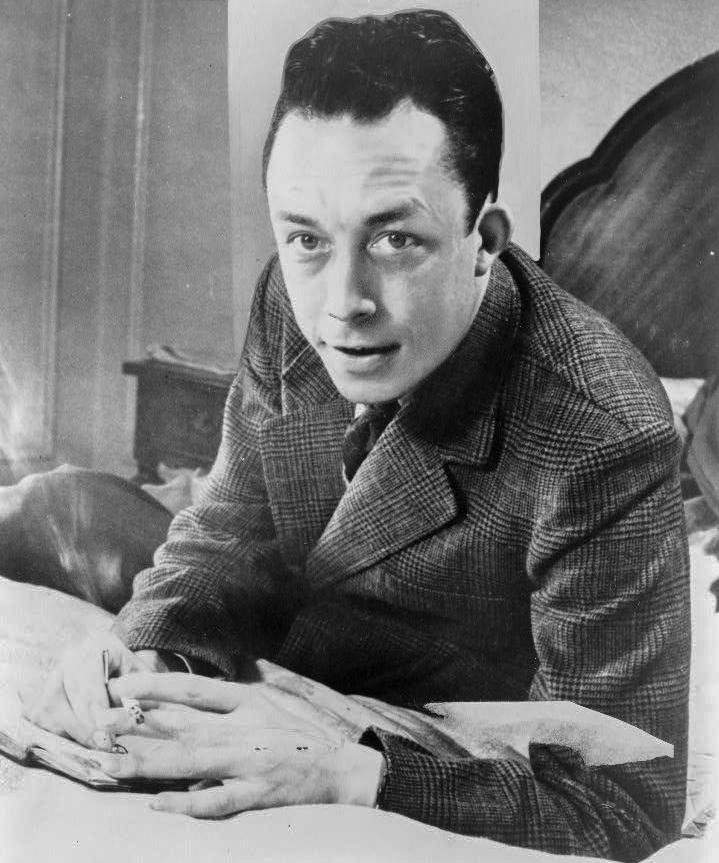 PhilosopherModern European1913 – 1960
Albert Camus
Philosopher of the absurd: we must imagine Sisyphus happy.
- ◆The absurd
- ◆Revolt
- ◆Against suicide and nihilism
Read the full pageAlbert Camus ( kam-OO; French: [albɛʁ kamy] ; 7 November 1913 – 4 January 1960) was a French philosopher, writer, and political activist. He was the recipient of the 1957 Nobel Prize in Literature at the age of 44, the second-youngest recipient in history, and the first laureate in literature born in Africa. His works include The Stranger, The Plague, The Myth of Sisyphus, The Fall and The Rebel.
Camus was born in French Algeria to pied-noir parents. He spent his childhood in a poor neighbourhood and later studied philosophy at the University of Algiers. He was in Paris when the Germans invaded France during World War II in 1940. Camus tried to flee but finally joined the French Resistance where he served as editor-in-chief at Combat, an outlawed newspaper. After the war, he was a celebrity figure and gave many lectures around the world.
He married twice but had many extramarital affairs. Camus was politically active; he was part of the left that opposed Joseph Stalin and the Soviet Union because of their totalitarianism. Camus was a moralist and leaned towards anarcho-syndicalism. He was part of many organisations seeking European integration. During the Algerian War (1954–1962), he kept a neutral stance, advocating a multicultural and pluralistic Algeria, a position that was rejected by most parties.
- Read the full page
Absurdism is the philosophical theory that the universe is irrational and meaningless. It states that trying to find meaning leads people into conflict with a seemingly meaningless world. This conflict can be between rational humanity and an irrational universe, between intention and outcome, or between subjective assessment and objective worth, but the precise definition of the term is disputed. Absurdism claims that, due to one or more of these conflicts, existence as a whole is absurd. It differs in this regard from the less global thesis that some particular situations, persons, or phases in life are absurd.
Various components of the absurd are discussed in the academic literature, and different theorists frequently concentrate their definition and research on different components. On the practical level, the conflict underlying the absurd is characterized by the individual's struggle to find meaning in a meaningless world. The theoretical component, on the other hand, emphasizes more the epistemic inability of reason to penetrate and understand reality. Traditionally, the conflict is characterized as a collision between an internal component of human nature, and an external component of the universe. However, some later theorists have suggested that both components may be internal: the capacity to see through the arbitrariness of any ultimate purpose, on the one hand, and the incapacity to stop caring about such purposes, on the other hand. Certain accounts also involve a metacognitive component by holding that an awareness of the conflict is necessary for the absurd to arise.
Some arguments in favor of absurdism focus on the human insignificance in the universe, on the role of death, or on the implausibility or irrationality of positing an ultimate purpose. Objections to absurdism often contend that life is in fact meaningful or point out certain problematic consequences or inconsistencies of absurdism. Defenders of absurdism often complain that it does not receive the attention of professional philosophers that it merits in virtue of the topic's importance and its potential psychological impact on the affected individuals in the form of existential crises. Various possible responses to deal with absurdism and its impact have been suggested. The three responses discussed in the traditional absurdist literature are suicide, religious belief in a higher purpose, and rebellion against the absurd. Of these, rebellion is usually presented as the recommended response since, unlike the other two responses, it does not escape the absurd and instead recognizes it for what it is. Later theorists have suggested additional responses, like using irony to take life less seriously or remaining ignorant of the responsible conflict. Some absurdists argue that whether and how one responds is insignificant. This is based on the idea that if nothing really matters, then the human response toward this fact does not matter either.
- 15
 PhilosopherModern European1906 – 1975
Hannah Arendt
Political theorist of totalitarianism, action and the "banality of evil".
- ◆Banality of evil
- ◆Vita activa: labour, work, action
- ◆Natality
Read the full pageHannah Arendt (born Johanna Arendt; 14 October 1906 – 4 December 1975) was a German and American philosopher, political theorist, and public historian. She was one of the most influential political theorists of the twentieth century.
Her works cover a broad range of topics, but she is best known for those dealing with the nature of wealth, power, fame, and evil, as well as politics, direct democracy, authority, tradition, and totalitarianism. She is also remembered for the controversy surrounding the trial of Adolf Eichmann, for her attempt to explain how ordinary people become actors in totalitarian systems, and for the phrase "the banality of evil". Her name appears in the names of journals, schools, scholarly prizes, humanitarian prizes, think-tanks, and streets; appears on stamps and monuments; and is attached to other cultural and institutional markers that commemorate her thought.
Hannah Arendt was born to a German-Jewish family in Linden in 1906. Her father died when she was seven. Arendt was raised in a politically progressive, secular family, her mother being an ardent Social Democrat. After completing secondary education in Berlin, Arendt studied at the University of Marburg under Martin Heidegger, with whom she engaged in a romantic affair that began while she was his student. She obtained her doctorate in philosophy at the University of Heidelberg in 1929. Her dissertation was entitled Love and Saint Augustine, and her supervisor was the existentialist philosopher Karl Jaspers.
- 16
 ConceptModern European
Banality of evil
Great evil can be done by ordinary people who simply fail to think.
Read the full pageEichmann in Jerusalem: A Report on the Banality of Evil is a 1963 book by the philosopher and political thinker Hannah Arendt. A Jew who fled Germany during Adolf Hitler's rise to power, Arendt reported for The New Yorker on the trial of Adolf Eichmann, one of the key organizers of the Holocaust. A revised and enlarged edition was published in 1964.
Arendt's subtitle introduced the phrase "the banality of evil". In part the phrase refers to Eichmann's comportment at the trial as the man displayed neither guilt for his actions nor hatred for those trying him, claiming he bore no responsibility because he was simply "doing his job." ("He did his 'duty'...; he not only obeyed 'orders', he also obeyed the 'law'".)
Arendt takes Eichmann's court testimony and the historical evidence available and makes several observations about him:
- 17
 PhilosopherModern European1909 – 1943
Simone Weil
French philosopher-mystic of attention, affliction and the needs of the soul.
- ◆Attention as prayer
- ◆Affliction
- ◆Decreation
Read the full pageSimone Adolphine Weil (; French: [simɔn adɔlfin vɛj]; 3 February 1909 – 24 August 1943) was a French philosopher, mystic, political activist and labourer. Despite her short life, her ideas concerning religion, spirituality and politics have remained widely influential in contemporary philosophy.
She was born in Paris to an Alsatian Jewish family. Her elder brother, André, would later become a renowned mathematician. After her graduation from formal education, Weil became a teacher. She taught intermittently throughout the 1930s, taking several breaks because of poor health and in order to devote herself to political activism. She assisted in the trade union movement, taking the side of the anarchists known as the Durruti Column in the Spanish Civil War. During a twelve-month period she worked as a labourer, mostly in car factories, so that she could better understand the working class.
Weil was very attracted to the ascetic egalitarian elements of Christianity, and became increasingly religious and inclined towards mysticism as her life progressed. She died of heart failure in 1943, while working for the Free French government in exile in Britain. Her uncompromising personal ethics may have contributed to her death—she had restricted her food intake in solidarity with the inhabitants of Nazi-occupied France.


