The analytic revolution
Frege invented modern logic; Russell and Wittgenstein used it to analyse language; the Vienna Circle declared metaphysics meaningless; Popper and Kuhn rethought science.
- 1
 SchoolModern European1900 – present
Analytic philosophy
Philosophy as clarity through logical and linguistic analysis; dominant in the English-speaking world.
- ◆Logical analysis of language
- ◆Clarity and rigour
- ◆Continuity with science
Read the full pageAnalytic philosophy is a broad school of thought or style in contemporary Western philosophy, especially anglophone philosophy, with an emphasis on analysis, clear prose, rigorous arguments, formal logic, mathematics, and the natural sciences (with less emphasis on the humanities). It is further characterized by the linguistic turn, or a concern with language and meaning.
Analytic philosophy is often contrasted with continental philosophy, a catch-all term for other methods prominent in continental Europe, most notably existentialism, phenomenology, and Hegelianism. The distinction has also been drawn between "analytic" being academic or technical philosophy and "continental" being literary philosophy.
The proliferation of analytic philosophy began around the turn of the twentieth century and has been dominant since the second half of the century. Central figures in its history include Gottlob Frege, G. E. Moore, Bertrand Russell, and Ludwig Wittgenstein. Other important figures include the logical positivists (particularly Rudolf Carnap) and the proponents of ordinary language philosophy.
- 2PhilosopherModern European1848 – 1925
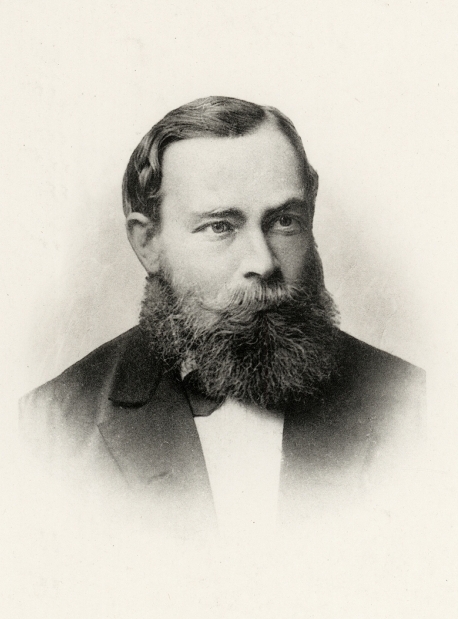
Gottlob Frege
Inventor of modern logic and the sense–reference distinction; grandfather of analytic philosophy.
- ◆Analytic philosophy
- ◆Ancestral relation
- ◆Anti-psychologism
- ◆Basic law V
- ◆Concept and object
- ◆Concept horse paradox
Read the full pageFriedrich Ludwig Gottlob Frege (; German: [ˈɡɔtloːp ˈfreːɡə]; 8 November 1848 – 26 July 1925) was a German philosopher, logician, and mathematician. He was a mathematics professor at the University of Jena, and is understood by many to be the father of analytic philosophy, concentrating on the philosophy of language, logic, and mathematics. Though he was largely ignored during his lifetime, Giuseppe Peano (1858–1932), Bertrand Russell (1872–1970), and, to some extent, Ludwig Wittgenstein (1889–1951) introduced his work to later generations of philosophers. Frege is widely considered to be one of the greatest logicians since Aristotle, and one of the most profound philosophers of mathematics ever.
His contributions include the development of modern logic in the Begriffsschrift and work in the foundations of mathematics. His book The Foundations of Arithmetic is the seminal text of the logicist project, and is cited by Michael Dummett as where to pinpoint the linguistic turn. His philosophical papers "On Sense and Reference" and "The Thought" are also widely cited. The former argues for two different types of meaning and descriptivism. In Foundations and "The Thought", Frege argues for Platonism against psychologism and formalism, concerning numbers and propositions respectively.
Frege was born in 1848 in Wismar, Mecklenburg-Schwerin (today part of Mecklenburg-Vorpommern in northern Germany). His father, Carl (Karl) Alexander Frege (1809–1866), was the co-founder and headmaster of a girls' high school until his death. After Carl's death, the school was led by Frege's mother Auguste Wilhelmine Sophie Frege (née Bialloblotzky, 12 January 1815 – 14 October 1898); her mother was Auguste Amalia Maria Ballhorn, a descendant of Philipp Melanchthon and her father was Johann Heinrich Siegfried Bialloblotzky. Frege was a Lutheran.
- 3
 PhilosopherModern European1872 – 1970
Bertrand Russell
Logician, pacifist and public intellectual; co-founded analytic philosophy and discovered Russell's paradox.
- ◆Logicism
- ◆Theory of descriptions
- ◆Russell's paradox
- ◆Knowledge by acquaintance
Read the full pageBertrand Arthur William Russell, 3rd Earl Russell (18 May 1872 – 2 February 1970), was an English mathematician, philosopher, and social critic.
A grandson of John Russell, 1st Earl Russell, a former prime minister of the United Kingdom, Russell was orphaned at the age of four and raised primarily by his grandmother Frances. He won a scholarship to Trinity College, Cambridge, where he studied mathematics and graduated with a first-class degree in 1893. Russell was initially an adherent of British idealism, the dominant philosophy of the time. His friendship with G. E. Moore, a professor of philosophy at Cambridge, led him to analytic philosophy. In Moore and Russell's "revolt against idealism", he rejected dialectic, monism, and idealism and championed logical analysis and pluralism.
Russell was one of the early 20th century's prominent logicians and a founder of analytic philosophy, along with his predecessor Gottlob Frege, his friend and colleague G. E. Moore, and his student and protégé Ludwig Wittgenstein. Russell with Moore led the British "revolt against idealism". Together with his former teacher Alfred North Whitehead, Russell wrote Principia Mathematica, a milestone in the development of classical logic and a major attempt to reduce the whole of mathematics to logic (see logicism). Russell's article "On Denoting" has been considered a "paradigm of philosophy".
- 4ConceptModern European
Russell's paradox
The set of all sets that do not contain themselves — does it contain itself?
Read the full pageIn mathematical logic, Russell's paradox (also known as Russell's antinomy) is a set-theoretic paradox published by the British philosopher and mathematician, Bertrand Russell, in 1901. Russell's paradox shows that every set theory that contains an unrestricted comprehension principle leads to contradictions.
According to the unrestricted comprehension principle, for any sufficiently well-defined property, there is the set of all and only the objects that have that property. Let R be the set of all sets that are not members of themselves (sometimes called "the Russell set"). If R is not a member of itself, then its definition entails that it is a member of itself; yet, if it is a member of itself, then it is not a member of itself, since it is the set of all sets that are not members of themselves. The resulting contradiction is Russell's paradox. In symbols:
Russell also showed that a version of the paradox could be derived in the axiomatic system constructed by the German philosopher and mathematician Gottlob Frege, hence undermining Frege's attempt to reduce mathematics to logic and calling into question the logicist programme. Two influential ways of avoiding the paradox were both proposed in 1908: Russell's own type theory and the Zermelo set theory. In particular, Zermelo's axioms restricted the unlimited comprehension principle. With the additional contributions of Abraham Fraenkel, Zermelo set theory developed into the standard Zermelo–Fraenkel set theory (commonly known as ZFC when including the axiom of choice). The main difference between Russell's and Zermelo's solution to the paradox is that Zermelo modified the axioms of set theory while maintaining a standard logical language, while Russell modified the logical language itself. The language of ZFC, with the help of Thoralf Skolem, turned out to be that of first-order logic.
- 5
 PhilosopherModern European1889 – 1951
Ludwig Wittgenstein
Austrian-British philosopher who wrote two revolutionary philosophies: the picture theory of the Tractatus and the language games of the Investigations.
- ◆Picture theory of meaning
- ◆"Whereof one cannot speak, thereof one must be silent"
- ◆Meaning is use
- ◆Language games
- ◆Private language argument
- ◆Family resemblance
Read the full pageLudwig Wittgenstein came from one of Vienna's richest families, studied engineering, then arrived in Cambridge in 1911 to work with Bertrand Russell, who soon felt he had little left to teach him.
His first book, the Tractatus Logico-Philosophicus (1921), argues that language pictures reality: meaningful propositions share a logical form with the facts they represent. Ethics, aesthetics and the meaning of life cannot be said, only shown — and so the book ends: "Whereof one cannot speak, thereof one must be silent." Believing he had solved philosophy's problems, Wittgenstein left to become a schoolteacher in rural Austria.
He returned to Cambridge in 1929 and gradually rejected his earlier view. The posthumous Philosophical Investigations (1953) treats meaning not as picturing but as use within "language games" embedded in forms of life. Philosophical problems arise "when language goes on holiday", and philosophy's task is therapeutic: to show the fly the way out of the fly-bottle. His private language argument and his remarks on rule-following remain among the most debated passages in 20th-century philosophy.
- 6
 WorkModern European1921
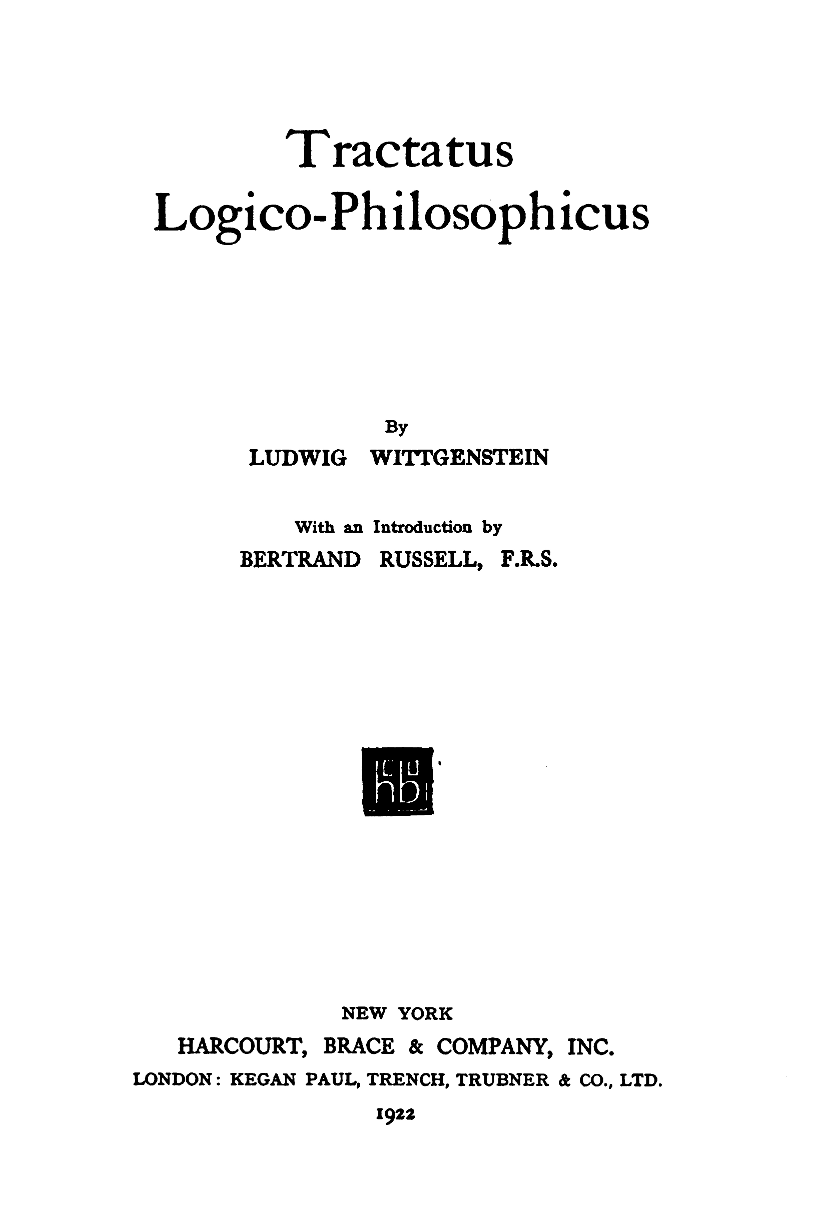
Tractatus Logico-Philosophicus
Wittgenstein's numbered propositions on language, logic and the world.
Read the full pageThe Tractatus Logico-Philosophicus (widely abbreviated and cited as TLP) is the only book-length philosophical work by the Austrian philosopher Ludwig Wittgenstein that was published during his lifetime. The project had a broad goal: to identify the relationship between language and reality, and to define the limits of science. Wittgenstein wrote the notes for the Tractatus while he was a soldier during World War I and completed it during a military leave in the summer of 1918. It was originally published in German in 1921 as Logisch-Philosophische Abhandlung (Logical-Philosophical Treatise). In 1922 it was published together with an English translation and a Latin title, which was suggested by G. E. Moore as homage to Baruch Spinoza's Tractatus Theologico-Politicus (1670).
The Tractatus is written in an austere and succinct literary style, containing almost no arguments as such, but consists of 525 declarative statements, which are hierarchically numbered.
The Tractatus is recognized by philosophers as one of the most significant philosophical works of the twentieth century and was influential among the logical positivists of the Vienna Circle, such as Rudolf Carnap and Friedrich Waismann. It also influenced Bertrand Russell's article "The Philosophy of Logical Atomism".
- 7ConceptModern European
Language games
Meaning lies in use within rule-governed activities embedded in forms of life.
Read the full pageA language-game (German: Sprachspiel) is a philosophical concept developed by Ludwig Wittgenstein, referring to simple examples of language use and the actions into which the language is woven. Wittgenstein argued that a word or even a sentence has meaning only as a result of the "rule" of the "game" being played. Depending on the context, for example, the utterance "Water!" could be an order, the answer to a question, or some other form of communication.
In his work Philosophical Investigations (1953), Ludwig Wittgenstein regularly referred to the concept of language-games. Wittgenstein rejected the idea that language is somehow separate from and corresponding to reality, and he argued that concepts do not need clarity for meaning. Wittgenstein used the term "language-game" to designate forms of language simpler than the entirety of a language itself, "consisting of language and the actions into which it is woven" and connected by family resemblance (Familienähnlichkeit). The concept was intended "to bring into prominence the fact that the speaking of language is part of an activity, or a form of life," which gives language its meaning.
Wittgenstein develops this discussion of games into the key notion of a language-game. He introduces the term using simple examples, but intends it to be used for the many ways in which we use language. In one language-game, a word might be used to stand for (or refer to) an object, but in another the same word might be used for giving orders, or for asking questions, and so on. The famous example is the meaning of the word "game". We speak of various kinds of games: board games, betting games, sports, "war games". These are all different uses of the word "games". Wittgenstein also gives the example of "Water!", which can be used as an exclamation, an order, a request, or an answer to a question. The meaning of the word depends on the language-game within which it is being used. Another way Wittgenstein puts the point is that the word "water" has no meaning apart from its use within a language-game. One might use the word as an order to have someone else bring you a glass of water. But it can also be used to warn someone that the water has been poisoned.
- 8WorkModern European1953
Philosophical Investigations
Wittgenstein's later philosophy: meaning as use, language games, private language.
Read the full pagePhilosophical Investigations (German: Philosophische Untersuchungen) is a work by the philosopher Ludwig Wittgenstein, published posthumously in 1953.
Philosophical Investigations is divided into two parts, consisting of what Wittgenstein calls, in the preface, Bemerkungen, translated by G. E. M. Anscombe as "remarks".
A survey among American university and college teachers ranked the Investigations as the most important book of 20th-century philosophy.
- 9
 SchoolModern European1920 – 1960
Logical positivism
Only empirically verifiable or logically true statements are meaningful; metaphysics is nonsense.
Read the full pageLogical positivism (also known as logical empiricism or neo-positivism) was a philosophical movement rooted in the empiricist tradition, seeking to formulate a scientific philosophy in which philosophical discourse proves as authoritative and meaningful as empirical science.
A central thesis endorsed by some logical positivists (e.g. Moritz Schlick) and rejected by others (e.g. Rudolf Carnap and Otto Neurath) was the verification principle, also known as the "verifiability criterion of meaning", according to which a statement is cognitively meaningful only if it can be verified through empirical observation or if it is a tautology (true by virtue of its own meaning or its own logical form). The verifiability criterion thus rejected statements of metaphysics, theology, ethics and aesthetics as cognitively meaningless in terms of truth value or factual content. Despite its ambition to overhaul philosophy by mimicking the structure and process of empirical science, logical positivism became erroneously stereotyped as an agenda to regulate the scientific process and to place strict standards on it.
The movement emerged in the late 1920s among philosophers, scientists and mathematicians congregated within the Vienna Circle and the Berlin Circle and flourished in several European centres through the 1930s. By the end of World War II, many of its members had settled in the English-speaking world and the project shifted to less radical goals within the philosophy of science.
- 10
 PhilosopherModern European1902 – 1994
Karl Popper
Philosopher of science for whom theories must be falsifiable; defender of the open society.
- ◆Bold hypothesis
- ◆Falsifiability
- ◆dogmatic
- ◆naive falsificationism
- ◆Demarcation problem
- ◆trial and error
Read the full pageSir Karl Raimund Popper (28 July 1902 – 17 September 1994) was an Austrian–British philosopher, academic and social commentator. One of the 20th century's most influential philosophers of science, Popper is known for his rejection of the classical inductivist views on the scientific method in favour of empirical falsification made possible by his falsifiability criterion, and for founding the Department of Philosophy at the London School of Economics and Political Science. According to Popper, a theory in the empirical sciences can never be proven, but it can be falsified, meaning that it can (and should) be scrutinised with decisive experiments. Popper was opposed to the classical justificationist account of knowledge, which he replaced with "the first non-justificational philosophy of criticism in the history of philosophy", namely critical rationalism.
In political discourse, he is known for his vigorous defence of liberal democracy and the principles of social criticism that he believed made a flourishing open society possible. His political thought resides within the camp of Enlightenment rationalism and humanism. He was a dogged opponent of totalitarianism, communism, nationalism, fascism, historicism, and other kinds of (in Popper's view) reactionary and irrational ideas, and identified modern liberal democracies as the best-to-date embodiment of an open society.
Karl Popper was born in Vienna (then in Austria-Hungary) in 1902 to upper-middle-class parents. All of Popper's grandparents were assimilated Jews; the Popper family converted to Lutheranism before he was born and so he received a Lutheran baptism. His father, Simon Siegmund Carl Popper (1856–1932), was a lawyer from Bohemia and a doctor of law at the Vienna University. His mother, Jenny Schiff (1864–1938), was an accomplished pianist of Silesian and Hungarian descent. Popper's uncle was the Austrian philosopher Josef Popper-Lynkeus. After establishing themselves in Vienna, the Poppers made a rapid social climb in Viennese society, as Popper's father became a partner in the law firm of Vienna's liberal mayor Raimund Grübl, and after Grübl's death in 1898 took over the business. Popper received his middle name after Raimund Grübl. (In his autobiography, Popper erroneously recalls that Grübl's first name was Carl). His parents were close friends of Sigmund Freud's sister Rosa Graf. His father was a bibliophile who had 12,000–14,000 volumes in his personal library and took an interest in philosophy, the classics, and social and political issues. Popper inherited both the library and the disposition from him. Later, he would describe the atmosphere of his upbringing as having been "decidedly bookish".
- 11
 ConceptModern European
Falsifiability
A theory is scientific only if it could in principle be shown false.
Read the full pageFalsifiability is a standard of evaluation of scientific statements, including theories and hypotheses. A statement is falsifiable if it belongs to a language or logical structure capable of describing an empirical observation that contradicts it.
In the case of a theory, falsifiability requires that, given an initial condition, the theory must theoretically exclude some observations, that is, it must make formal predictions. It was introduced by the philosopher of science Karl Popper in his book The Logic of Scientific Discovery (1934). Popper emphasized that the contradiction is to be found in the logical structure alone, without having to worry about methodological considerations external to this structure. He proposed falsifiability as the cornerstone solution to both the problem of induction and the problem of demarcation.
Popper also emphasized the related asymmetry created by the relation of a universal law with basic observation statements and contrasted falsifiability with the intuitively similar concept of verifiability that was then current in the philosophical discipline of logical positivism. He argued that the only way to verify a claim such as "All swans are white" would be if one could empirically observe all swans, which is not pragmatically possible. On the other hand, the observation of a single black swan is enough to refute this claim.
- 12
 PhilosopherAmericas1922 – 1996
Thomas Kuhn
Historian of science who introduced paradigms and scientific revolutions.
- ◆Paradigm shift
- ◆Incommensurability
- ◆Normal science
- ◆Transcendental nominalism
- ◆Ian Hacking
Read the full pageThomas Samuel Kuhn (; July 18, 1922 – June 17, 1996) was an American historian and philosopher of science whose 1962 book The Structure of Scientific Revolutions was influential in both academic and popular circles. The book popularized the term paradigm shift, which has since become an English-language idiom.
Kuhn made several claims concerning the progress of scientific knowledge: that scientific fields undergo periodic "paradigm shifts" rather than solely progressing in a linear and continuous way, and that these paradigm shifts open up new approaches to understanding what scientists would never have considered valid before; and that the notion of scientific truth, at any given moment, cannot be established solely by objective criteria but is defined by a consensus of a scientific community. Competing paradigms are frequently incommensurable; that is, there is no one-to-one correspondence of assumptions and terms. Thus, our comprehension of science can never rely wholly upon "objectivity" alone. Science must account for subjective perspectives as well, since all objective conclusions are ultimately founded upon the subjective conditioning/worldview of its researchers and participants.
Kuhn was born in Cincinnati, Ohio, in 1922 to Minette Stroock Kuhn and Samuel L. Kuhn, an industrial engineer, both Jewish though non-observant.
- 13Read the full page
A paradigm shift is a fundamental change in the basic concepts and experimental practices of a scientific discipline. It is a concept in the philosophy of science that was introduced and brought into the common lexicon by the American physicist and philosopher Thomas Kuhn. Even though Kuhn restricted the use of the term to the natural sciences, the concept of a paradigm shift has also been used in numerous non-scientific contexts to describe a profound change in a fundamental model or perception of events.
Kuhn presented his notion of a paradigm shift in his influential book The Structure of Scientific Revolutions (1962).
Kuhn contrasts paradigm shifts, which characterize a scientific revolution, to the activity of normal science, which he describes as scientific work done within a prevailing framework or paradigm. Paradigm shifts arise when the dominant paradigm under which normal science operates is rendered incompatible with new phenomena, facilitating the adoption of a new theory or paradigm.
- 14
 PhilosopherAmericas1908 – 2000
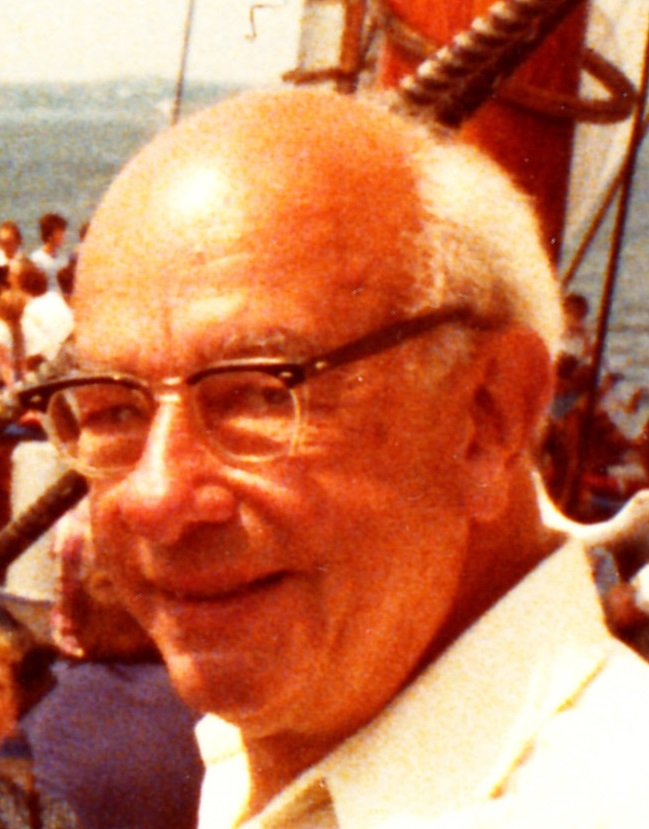
W. V. O. Quine
Naturalist who rejected the analytic–synthetic distinction.
- ◆New Foundations
- ◆abstract objects
- ◆indeterminacy of translation
- ◆referential inscrutability
- ◆naturalized epistemology
- ◆ontological commitment
Read the full pageWillard Van Orman Quine ( KWYNE; June 25, 1908 – December 25, 2000) was an American logician and philosopher in the analytic tradition, recognized as "one of the most influential philosophers of the twentieth century". He held the Edgar Pierce Chair of Philosophy at Harvard University from 1956 to 1978.
Quine was a teacher of logic and set theory. He was famous for his position that first-order logic is the only kind worthy of the name, and developed his own system of mathematics and set theory, known as New Foundations. In the philosophy of mathematics, he and his Harvard colleague Hilary Putnam developed the Quine–Putnam indispensability argument, an argument for the reality of mathematical entities. He was the main proponent of the view that philosophy is not conceptual analysis, but continuous with science; it is the abstract branch of the empirical sciences. This led to his famous quip that "philosophy of science is philosophy enough". He led a "systematic attempt to understand science from within the resources of science itself" and developed an influential naturalized epistemology that tried to provide "an improved scientific explanation of how we have developed elaborate scientific theories on the basis of meager sensory input". He also advocated holism in science, known as the Duhem–Quine thesis.
His major writings include the papers "On What There Is" (1948), which elucidated Bertrand Russell's theory of descriptions and contains Quine's famous dictum of ontological commitment, "To be is to be the value of a variable", and "Two Dogmas of Empiricism" (1951), which attacked the traditional analytic-synthetic distinction and reductionism, undermining the then-popular logical positivism, advocating instead a form of semantic holism and ontological relativity. They also include the books The Web of Belief (1970), which advocates a kind of coherentism, and Word and Object (1960), which further developed these positions and introduced Quine's famous indeterminacy of translation thesis, advocating a behaviorist theory of meaning.
