Modern Indian thought and spirituality
Ramakrishna and Vivekananda presented Vedānta as universal religion; Tagore a humanist spirituality; Gandhi made non-violence a political force; Ambedkar reinterpreted Buddhism against caste. Ramana Maharshi, Krishnamurti and Osho taught new paths to inner freedom.
- 1
 PhilosopherIndian1836 – 1886
Ramakrishna
Bengali mystic who taught that all religions are paths to the same God; teacher of Vivekananda.
- ◆As many faiths, so many paths
- ◆God-realisation as life's goal
Read the full pageRamakrishna (18 February 1836 – 16 August 1886), also called Ramakrishna Paramahamsa, born Ramakrishna Chattopadhyay (his childhood nickname was Gadadhar), was an Indian Hindu mystic. He was a devotee of the goddess Kali, but adhered to various religious practices from the Hindu traditions of Vaishnavism, Tantric Shaktism, and Advaita Vedanta, as well as Christianity and Sufi Islam. His parable-based teachings advocated the essential unity of religions and proclaimed that world religions are "so many paths to reach one and the same goal". He is regarded by his followers as an avatar (divine incarnation).
Ramakrishna was born in Kamarpukur, Bengal Presidency, India. He described going through religious experiences in childhood. Around the age of twenty, he became a temple priest at the Dakshineshwar Kali Temple in Calcutta. While at the temple, his devotional temperament and intense religious practices led him to experience various spiritual visions. He was assured of the authenticity and sanctity of his visions by several religious teachers.
Ramakrishna's native language was Bengali, but he also spoke Hindi (Hindustani) and understood Sanskrit. There are instances recorded in the Gospel of Ramakrishna of him using English words a few times.
- 2
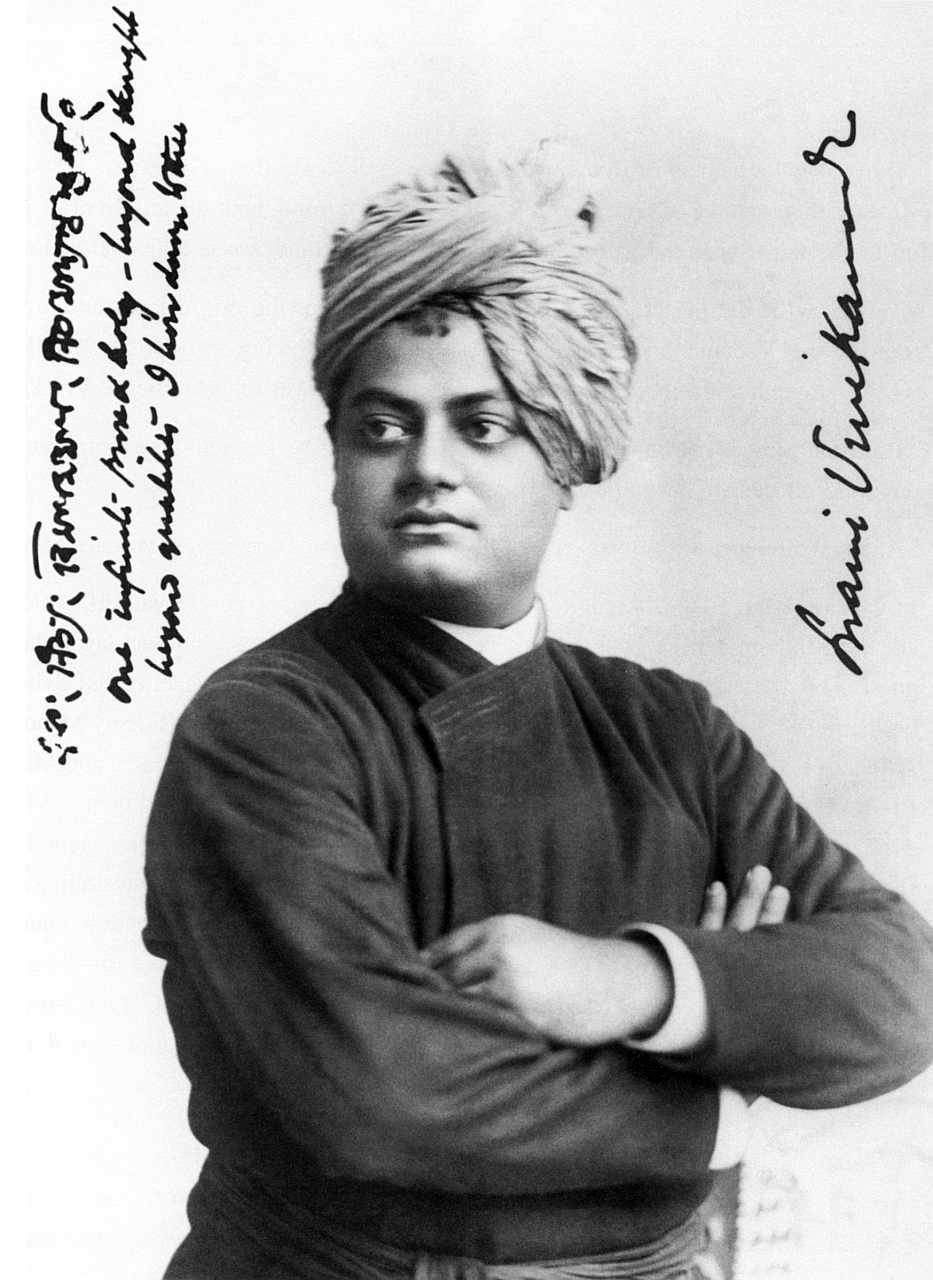 PhilosopherIndian1863 – 1902
Swami Vivekananda
Brought Vedānta and yoga to the West at the 1893 Parliament of Religions.
Read the full pageSwami Vivekananda () (12 January 1863 – 4 July 1902), born Narendranath Datta, was an Indian Hindu monk, philosopher, author, religious teacher, and the chief disciple of the Indian mystic Ramakrishna. Vivekananda was a major figure in the introduction of Vedanta and Yoga to the Western world during the late 19th century, and is credited with raising interfaith awareness and elevating Hinduism to the status of a major world religion.
Vivekananda showed an early inclination towards religion and spirituality. At the age of 18, he met Ramakrishna and became his devoted disciple, and later took up the vows of a sannyasin (renunciate). Following Ramakrishna’s death, Vivekananda travelled extensively across the Indian subcontinent as a wandering monk, gaining first-hand knowledge of the often harsh living conditions endured by the Indian masses under then British India, he sought a way to alleviate their suffering by establishing social services but lacked capital. In 1893, he travelled to the United States to participate in the Parliament of the World's Religions in Chicago, where he delivered a landmark speech beginning with the words "Sisters and brothers of America...". His powerful message introduced Hindu spiritual thought and advocated for both religious tolerance as well as universal acceptance. The speech made a profound impression; an American newspaper described him as "an orator by divine right and undoubtedly the greatest figure at the Parliament".
Following his success in Chicago, Vivekananda lectured widely across the United States, the United Kingdom, and continental Europe, disseminating the essential principles of Hindu philosophy. He established the Vedanta Society of New York and the Vedanta Society of San Francisco (now the Vedanta Society of Northern California), both of which became the foundations for later Vedanta Societies in the West. In India, he founded the Ramakrishna Math, a monastic order for spiritual training, and the Ramakrishna Mission, dedicated to social services, education, and humanitarian work.
- 3SchoolIndian1850 – present
Neo-Vedānta
Modern reinterpretations of Vedānta by Vivekananda, Aurobindo and Radhakrishnan that stress universal religion and experience.
Read the full pageNeo-Vedanta, also called neo-Hinduism, Hindu modernism, Global Hinduism and Hindu Universalism, are terms to characterise interpretations of Hinduism that developed in the 19th century. The term "Neo-Vedanta" was coined by German Indologist Paul Hacker, in a pejorative way, to distinguish modern developments from "traditional" Advaita Vedanta.
Scholars have repeatedly argued that these modern interpretations incorporate Western ideas into traditional Indian religions, especially Advaita Vedanta, which is asserted as central or fundamental to Hindu culture. Other scholars have described a Greater Advaita Vedānta, which developed since the medieval period. Drawing on this broad pool of sources, after Muslim rule in India was replaced by that of the East India Company, Hindu religious and political leaders and thinkers responded to Western colonialism and orientalism, contributing to the Indian independence movement and the modern national and religious identity of Hindus in the Republic of India. This societal aspect is covered under the term of Hindu reform movements.
Among the main proponents of such modern interpretations of Hinduism were Vivekananda, Aurobindo and Radhakrishnan, who to some extent also contributed to the emergence of Neo-Hindu movements in the West.
- 4
 PhilosopherIndian1872 – 1950
Sri Aurobindo
Nationalist turned philosopher-yogi who developed "integral yoga" and an evolutionary spirituality.
- ◆Integral yoga
- ◆Supermind
- ◆Sri Aurobindo Ashram
- ◆Mirra Alfassa
- ◆Auroville
Read the full pageSri Aurobindo (born Aurobindo Ackroyd Ghosh; 15 August 1872 – 5 December 1950) was an Indian philosopher, yogi, and nationalist who is noted for his participation in the movement for India's independence from British rule; he advocated for complete autonomy through his writings and political activity. Following his imprisonment and acquittal, he withdrew to Pondicherry to devote himself to spiritual practice, eventually formulating the path of Integral Yoga. His extensive literary output includes the treatises The Life Divine and The Synthesis of Yoga and the epic poem Savitri.
Aurobindo studied for the Indian Civil Service at King's College, in Cambridge, England from 1890 until his departure in 1892. After returning to India, he took up various civil service work under the Maharaja of the princely state of Baroda. He became increasingly involved in nationalist politics in the Indian National Congress and the nascent revolutionary movement in Bengal with the Anushilan Samiti. He was arrested in the aftermath of a number of bombings linked to the revolutionary group he was associated with. He faced charges in a public trial for treason in the Alipore Conspiracy and was then released; after that, he moved to Pondicherry and developed a spiritual practice he called Integral Yoga. He wrote The Life Divine, which deals with the philosophical aspect of Integral Yoga and Synthesis of Yoga, which deals with the principles and methods of Integral Yoga. In 1926, he and Mirra Alfassa founded Sri Aurobindo Ashram.
Sri Aurobindo created a major literary corpus in English. His work synthesizes the histories of Eastern and Western philosophy, religion, literature, and psychology into a complex vision of the transition of humanity to divinity. His principal philosophical writings are The Life Divine and The Synthesis of Yoga, while his principal poetic work is Savitri: a Legend and a Symbol. He wrote translations and commentaries on the Vedas, Upanishads, and the Gita, among others; plays; literary, social, political, and historical criticism; devotional works; and an extensive collection of correspondence. Several volumes of his conversations have also been recorded.
- 5
 PhilosopherIndian1861 – 1941
Rabindranath Tagore
Poet-philosopher of universal humanism and critic of nationalism.
Read the full pageRabindranath Tagore (Bengali: [ˈrobind̪ɾonat̪ʰ ˈʈʰakuɾ] ; 7 May 1861 – 7 August 1941) was a Bengali polymath - who worked as a poet, author, playwright, musician, composer, philosopher, social reformer, painter, and was one of the foremost figures of the Bengal Renaissance. In 1913, Tagore became the first Indian and non-European to win a Nobel Prize in any category, and also the first lyricist to win the Nobel Prize in Literature. A significant moulder of culture within Bengal and the Indian subcontinent, he wrote and composed the national anthems of India and Bangladesh.
He reshaped Bengali literature and music as well as Indian art with Contextual Modernism in the late 19th and early 20th centuries. He was the author of the "profoundly sensitive, fresh and beautiful" poetry of Gitanjali. Tagore's poetic songs were viewed as spiritual and mercurial; his elegant prose and magical poetry were widely popular in the Indian subcontinent. He was a fellow of the Royal Asiatic Society. Referred to as "the Bard of Bengal", Tagore was known by the sobriquets Gurudeb, Kobiguru, and Bishwokobi.
A Bengali Brahmin from Calcutta with ancestral gentry roots in Jessore and Bardhaman districts, Tagore wrote poetry as an eight-year-old. At the age of sixteen, he released his first substantial poems under the pseudonym Bhānusiṃha ("Sun Lion"), which were seized upon by literary authorities as long-lost classics. By 1877 he graduated to his first short stories and dramas, published under his real name. As a humanist, universalist, internationalist, and ardent critic of nationalism, he denounced the British Raj and advocated independence from Britain. As an exponent of the Bengal Renaissance, he advanced a vast canon that comprised paintings, sketches and doodles, hundreds of texts, and some two thousand songs; his legacy also endures in his founding of Visva-Bharati University.
- 6
 PhilosopherIndian1869 – 1948
Mahatma Gandhi
Turned non-violence (ahiṃsā) and truth-force (satyāgraha) into a philosophy of political action.
- ◆Satyāgraha
- ◆Ahiṃsā
- ◆Swaraj — self-rule
Read the full pageMohandas Karamchand Gandhi (2 October 1869 – 30 January 1948) was an Indian lawyer, anti-colonial nationalist, and political ethicist who employed nonviolent resistance to lead the successful campaign for India's independence from British rule, and whose legacy would later inspire movements for civil rights and freedom across the world. The honorific Mahātmā (Sanskrit: "great-souled", "venerable"), first applied to him in 1914 in South Africa, is now used throughout the world.
Born and raised in a Hindu family in coastal Gujarat, Gandhi was trained in the law at the Inner Temple in London and was called to the bar at the age of 22. After two uncertain years in India, where he was unable to start a successful law practice, Gandhi moved to South Africa in 1893 to represent an Indian merchant in a lawsuit. He went on to live in South Africa for the next 21 years. Here, Gandhi raised a family and first employed nonviolent resistance in a campaign for civil rights. In 1915, aged 45, he returned to India and soon set about organising peasants, farmers, and urban labourers to protest against discrimination and excessive land tax.
Assuming leadership of the Indian National Congress in 1921, Gandhi led nationwide campaigns for easing poverty, expanding women's rights, building religious and ethnic amity, ending untouchability, and, above all, achieving swaraj or self-rule. Gandhi adopted the short dhoti woven with hand-spun yarn as a mark of identification with India's rural poor. He began to live in a self-sufficient residential community, to eat simple food, and undertake long fasts as a means of both introspection and political protest. Bringing anti-colonial nationalism to the common Indians, Gandhi led them in challenging the British-imposed salt tax with the 400 km (250 mi) Dandi Salt March in 1930 and in calling for the British to quit India in 1942. He was imprisoned many times and for many years in both South Africa and India.
- 7
 ConceptIndian
Satyāgraha
Gandhi's "truth-force": non-violent resistance that seeks to convert, not coerce, the opponent.
Read the full pageSatyāgraha, or "truth force", is a particular form of nonviolent resistance or civil resistance. Someone who practises satyagraha is a satyagrahi.
The term satyagraha was coined and developed by Mahatma Gandhi (1869–1948) as early as 1919.
Gandhi practised satyagraha as part of the Indian independence movement and also during his earlier struggles in South Africa for Indian rights. Satyagraha theory influenced Martin Luther King Jr.'s and James Bevel's campaigns during the Civil Rights Movement in the United States, as well as Nelson Mandela's struggle against apartheid in South Africa and many other social-justice and similar movements.
- 8
 PhilosopherIndian1891 – 1956
B. R. Ambedkar
Architect of India's constitution and philosopher of social democracy who reinterpreted Buddhism against caste.
Read the full pageBhimrao Ramji Ambedkar (14 April 1891 – 6 December 1956) was an Indian jurist, economist, social reformer and politician who chaired the committee that drafted the Constitution of India based on the debates of the Constituent Assembly of India and the first draft of Sir Benegal Narsing Rau. Ambedkar served as Law and Justice minister in the first cabinet of Jawaharlal Nehru. He later renounced Hinduism and converted to Buddhism, inspiring the Dalit Buddhist movement.
After graduating from Elphinstone College, University of Bombay, Ambedkar studied economics at Columbia University and the London School of Economics, receiving doctorates in 1927 and 1923, respectively, and was among a handful of Indian students to have done so at either institution in the 1920s. During his time at Columbia University, Ambedkar came under the influence of John Dewey and his philosophy of pragmatism. He also trained in the law at Gray's Inn, London. In his early career, he was an economist, professor, and lawyer. His later life was marked by his political activities; he became involved in campaigning and negotiations for partition, publishing journals, advocating political rights and social freedom for Dalits, and contributing to the establishment of the state of India. In 1956, he converted to Buddhism, initiating mass conversions of Dalits. He was also appointed to work with the Simon Commission.
In 1990, the Bharat Ratna, India's highest civilian award, was posthumously conferred on Ambedkar. The salutation Jai Bhim (lit. "Hail Bhim") is used by his followers to honour him. He is also referred to by the honorific Babasaheb, meaning "Respected Father".
- 9
 PhilosopherIndian1888 – 1975
Sarvepalli Radhakrishnan
Philosopher and President of India who presented Vedānta to the West as a philosophy of experience.
Read the full pageSarvepalli Radhakrishnan (Telugu: [sɐɾʋeːpɐlːi ɾaːd̪ʰaːkɾuʂɳɐn] ; 5 September 1888 – 17 April 1975) was an Indian academic, philosopher and statesman who served as the Vice President of India from 1952 to 1962 and President of India from 1962 to 1967. He was the ambassador of India to the Soviet Union from 1949 to 1952. He was also the vice-chancellor of Banaras Hindu University from 1939 to 1948 and the vice-chancellor of Andhra University from 1931 to 1936. Radhakrishnan is considered one of the most influential and distinguished 20th century scholars of comparative religion and philosophy, he held the King George V Chair of Mental and Moral Science at the University of Calcutta from 1921 to 1932 and Spalding Chair of Eastern Religion and Ethics at University of Oxford from 1936 to 1952.
Radhakrishnan's philosophy was grounded in Advaita Vedanta, reinterpreting this tradition for a contemporary understanding. He defended Hinduism against what he called "uninformed Western criticism", contributing to the formation of contemporary Hindu identity. He has been influential in shaping the understanding of Hinduism, in both India and the west, and earned a reputation as a bridge-builder between India and the West.
Radhakrishnan received several high awards during his life, including a knighthood in 1931, the Bharat Ratna, India's highest civilian award, in 1954, and honorary membership of the British Royal Order of Merit in 1963. He was also a founder of HelpAge India, a non-profit organisation for elderly underprivileged in India. Radhakrishnan believed that "teachers should be the best minds in the country."
- 10
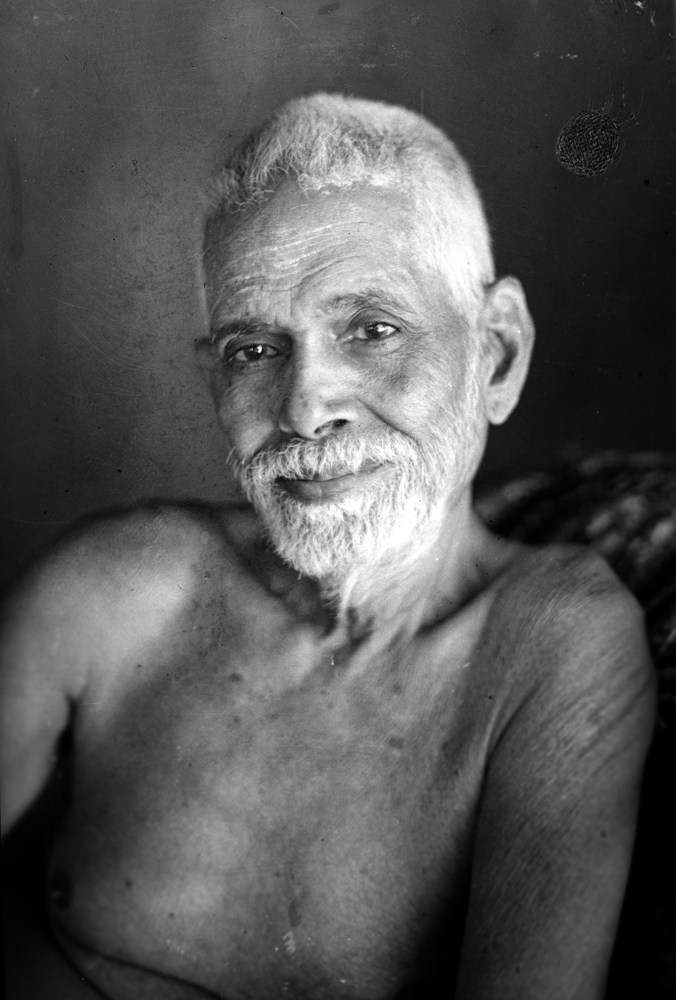 PhilosopherIndian1879 – 1950
Ramana Maharshi
Sage of Arunachala whose method of self-enquiry — asking "Who am I?" — became one of the best-known paths of Advaita in modern times.
- ◆Self-enquiry: "Who am I?"
- ◆Silence as the highest teaching
- ◆The Self is ever-present awareness
Read the full pageRamana Maharshi was an Indian Hindu sage widely regarded by his followers and by "most advocates of Advaita" as a jivanmukta (liberated being). He was born Venkataraman Iyer, but is mostly known by the name Bhagavan Sri Ramana Maharshi.
He was born in Tiruchuli, Tamil Nadu, India in 1879. In 1895, an attraction to the sacred hill Arunachala and the 63 Nayanmars was aroused in him, and in 1896, at the age of 16, he had a "death-experience" in which he became aware of a "current" or "force" (avesam) which he recognised as his true "I" or "self", and which he later identified with "the personal God, or Iswara", that is, Shiva. This resulted in a state that he later described as "the state of mind of Iswara or the jnani". Six weeks later he left his uncle's home in Madurai, and journeyed to the holy mountain Arunachala, in Tiruvannamalai, where he took on the role of a sannyasin (though not formally initiated), and remained for the rest of his life.
He attracted devotees who regarded him as an avatar of Shiva and came to him for darshan ("the sight of God"). In later years, an ashram grew up around him, where visitors received upadesa ("spiritual instruction") by sitting silently in his company or by asking questions. Since the 1930s his teachings have been popularised in the West.
- 11
 PhilosopherIndian1895 – 1986
Jiddu Krishnamurti
Rejected the role of world teacher prepared for him and spent sixty years urging people to free themselves from all authority, including his own.
- ◆Truth is a pathless land
- ◆Choiceless awareness
- ◆The observer is the observed
- ◆Freedom from the known
Read the full pageJiddu Krishnamurti was an Indian spiritual figure, speaker, and writer. Adopted by members of the Theosophical Society as a child, Krishnamurti was raised to fill the mantle of the prophesied World Teacher, a role tasked with aiding humankind's spiritual evolution. In 1922, he began to suffer from painful, seizure-like mystical episodes that would produce a lasting change in his perception of reality. In 1929, he broke from the Theosophy movement and disbanded the Order of the Star in the East, a related organization which had been formed around him. He spent the rest of his life speaking to groups and individuals around the world, hoping to contribute a radical transformation of mankind.
Krishnamurti asserted that "truth is a pathless land" and advised against following any doctrine, discipline, teacher, guru, or authority, including himself. Nonetheless, during his life he tried to share his insights in "the teachings", urging for a state without conceptual deliberations and thought. In Krishnamurti's perception, such a righteousness was only possible through the practice of passive or choiceless awareness, which he called the essence of "true meditation" in contrast to contrived techniques. He gained a wider recognition in the 1950s, after Aldous Huxley had introduced him to his mainstream publisher and the publication of The First and Last Freedom (1954). Many of his talks and writings have been published since, among them Commentaries on Living (1956–60) and Krishnamurti's Notebook (written 1961-62).
A few days before his death, he stated that nobody had understood what energy or intelligence had passed through his body, and that after his death no other such body or intelligence would be found "for many hundred years." His supporters—working through non-profit foundations in India, the United Kingdom, and the United States—oversee several centres and independent schools based on his educational philosophy and continue to distribute his extensive body of talks, dialogues, and writings in various media formats and languages.
- 12
 PhilosopherIndian1893 – 1952
Paramahansa Yogananda
Brought Kriya Yoga to the West; his Autobiography of a Yogi introduced millions to Indian spirituality.
Read the full pageParamahansa Yogananda (; born Mukunda Lal Ghosh; January 5, 1893 – March 7, 1952) was an American Hindu monk, yogi, and guru who founded the Self-Realization Fellowship (SRF)/Yogoda Satsanga Society of India (YSS), a religious meditation and Kriya Yoga organization, to disseminate his teachings. A chief disciple of the yoga guru Swami Sri Yukteswar Giri, he was sent by his lineage to spread yogic teachings to the West. He immigrated to the US at the age of 27, intending to demonstrate a unity between Eastern and Western religions and advocate for a balance between Western material growth and Indian spirituality. His longstanding influence on the American yoga movement, and especially the yoga culture of Los Angeles, led yoga experts to consider him the "Father of Yoga in the West". He lived his final 32 years in the US.
Yogananda was among the first Indian religious teachers to settle in the US, and the first prominent Indian to be hosted in the White House (by President Calvin Coolidge in 1927); his early acclaim led to him being dubbed "the 20th century's first superstar guru" by the Los Angeles Times. Arriving in Boston in 1920, he embarked on a successful transcontinental speaking tour before settling in Los Angeles in 1925. Over the next two and a half decades, he established a monastic order, trained disciples, conducted teaching tours, acquired properties for his organization in California, and initiated thousands into Kriya Yoga. By 1952, SRF had over 100 centers in both India and the United States. As of 2012, they had groups in nearly every major American city. His "plain living and high thinking" principles attracted people from all backgrounds among his followers.
He published his Autobiography of a Yogi in 1946 to critical and commercial acclaim. It has sold over four million copies, with Harper San Francisco listing it as one of the "100 best spiritual books of the 20th Century". Former Apple CEO Steve Jobs ordered 500 copies of the book, for each guest at his memorial to be given a copy. It was also one of Elvis Presley's favorite books, and one he gave out often. The book has been regularly reprinted and is known as "the book that changed the lives of millions". A documentary about his life commissioned by SRF, Awake: The Life of Yogananda, was released in 2014. He remains a leading figure in Western spirituality. A biographer of Yogananda, Phillip Goldberg, considers him "the best known and most beloved of all Indian spiritual teachers who have come to the West".
- 13
 PhilosopherIndian1931 – 1990
Osho
Provocative Indian mystic and speaker who blended Zen, Tantra, Sufism and Western psychology into a philosophy of meditation, celebration and radical freedom.
- ◆Meditation as the art of witnessing
- ◆Zorba the Buddha — uniting worldly joy and spiritual depth
- ◆Dynamic meditation
- ◆Against organised religion and dogma
- ◆Love and freedom over morality
Read the full pageChandra Mohan Jain — later Acharya Rajneesh, Bhagwan Shree Rajneesh and finally Osho — was a philosophy lecturer from Jabalpur who became one of the most widely read and most controversial spiritual teachers of the 20th century. His thousands of recorded discourses on the Buddha, Laozi, Zhuangzi, Kabir, Jesus, the Upaniṣads, Heraclitus and Nietzsche were transcribed into more than 600 books.
His central teaching is meditation understood as witnessing: watching thoughts, feelings and bodily sensations without identifying with them. Because modern people are too restless to sit silently, he devised "active" methods such as Dynamic Meditation, in which catharsis precedes stillness. His ideal was "Zorba the Buddha" — a person who fully enjoys the senses and the world like Kazantzakis's Zorba, yet has the inner silence of the Buddha.
Osho attacked organised religion, nationalism, the family as an institution and conventional morality, and argued that love, play and awareness — not obedience — make people good. His commune in Oregon in the 1980s ended in scandal and criminal charges against some leaders, and he died in Pune in 1990. His ideas remain widely read across India and the world, and his meditation centre in Pune still operates.
- 14
 PhilosopherIndianborn 1935
Tenzin Gyatso, 14th Dalai Lama
Tibetan Buddhist leader whose teaching on compassion, secular ethics and dialogue with science has reached the world.
- ◆Compassion as the basis of ethics
- ◆Secular ethics
- ◆Dialogue between Buddhism and science
Read the full pageThe 14th Dalai Lama (born Lhamo Thondup, 6 July 1935; full spiritual name: Jetsun Jamphel Ngawang Lobsang Yeshe Tenzin Gyatso, shortened as Tenzin Gyatso) is the current Dalai Lama, the highest spiritual leader and head of Tibetan Buddhism. He served as the resident spiritual and temporal leader of Tibet before 1959, and subsequently led the Tibetan government in exile represented by the Central Tibetan Administration in Dharamshala, India. The 14th Dalai Lama is also known to Tibetans as Gyalwa Rinpoche ("The Precious Jewel-like Buddha-Master"), Kundun ("The Presence"), and Yizhin Norbu ("The Wish-Fulfilling Gem"). His devotees, as well as much of the Western world, often call him His Holiness the Dalai Lama. The Mongolic word dalai means ocean. He is the leader and a monk of the newest Gelug school of Tibetan Buddhism.
The 14th Dalai Lama was born to a farming family in Taktser (Hongya village), in the traditional Tibetan region of Amdo, at the time a Chinese frontier district. He was selected as the tulku of the 13th Dalai Lama in 1937, and formally recognised as the 14th Dalai Lama in 1939. As with the recognition process for his predecessor, a Golden Urn selection process was waived and approved by the Nationalist government of China. His enthronement ceremony was held in Lhasa on 22 February 1940. A belief central to the Tibetan Buddhist tradition as well as the institution of the Dalai Lama is that the reincarnated person is a living Bodhisattva, specifically an emanation of Avalokiteśvara (in Sanskrit) or Chenrezig (in Tibetan), the Bodhisattva of Compassion.
Following the Battle of Chamdo, in which PRC forces annexed Central Tibet, the Tibetan government, the Ganden Phodrang, invested the Dalai Lama with temporal duties on 17 November 1950 (at 15 years of age), which he held until his exile in 1959. During the 1959 Tibetan uprising, the Dalai Lama escaped to India, where he continues to live. On 29 April 1959, the Dalai Lama established the independent Tibetan government in exile in the north Indian hill station of Mussoorie, which then moved in May 1960 to Dharamshala, where he resides. He retired as political head in 2011 to make way for a democratic government, the Central Tibetan Administration.
