Kierkegaard and Nietzsche
Kierkegaard insisted that truth must be lived and faith is a leap; Nietzsche declared God dead and called for a revaluation of all values.
- 1
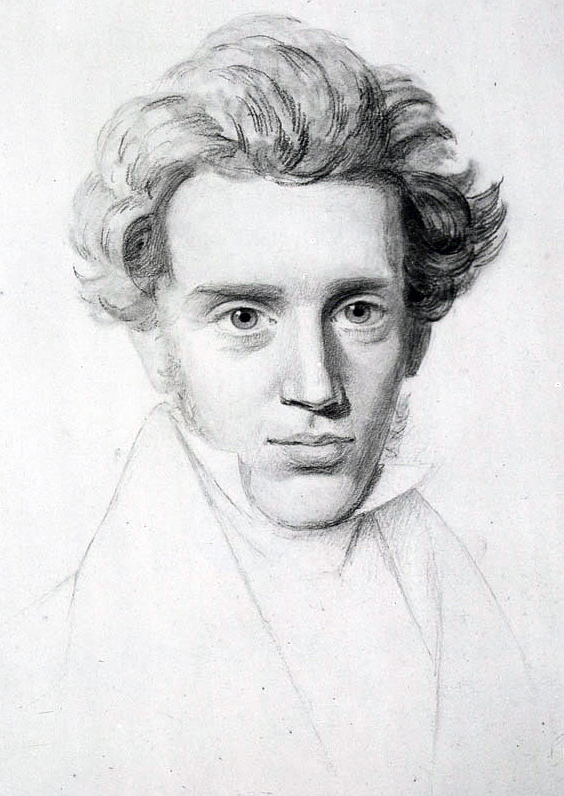 PhilosopherModern European1813 – 1855
Søren Kierkegaard
Danish father of existentialism: truth is subjectivity, and faith a leap beyond reason.
- ◆Leap of faith
- ◆Anxiety as the dizziness of freedom
- ◆Aesthetic, ethical and religious stages
- ◆Truth is subjectivity
Read the full pageSøren Aabye Kierkegaard ( SORR-ən KEER-kə-gard, US also -gor; Danish: [ˈsɶːɐn ˈɔˀˌpyˀ ˈkʰiɐ̯kəˌkɒːˀ] ; 5 May 1813 – 11 November 1855) was a Danish philosopher, Christian theologian, poet, social critic, and religious author who is widely considered to be the first existentialist philosopher. He wrote critical texts on organized religion, Christianity, morality, ethics, psychology, love, and the philosophy of religion, displaying a fondness for metaphor, irony, and parables. Much of his philosophical work deals with the issues around how one lives as a "single individual", highlighting the importance of authenticity, personal choice and commitment, and the duty to love. Kierkegaard prioritized concrete human reality over abstract thinking.
Kierkegaard's theological work focuses on Socratic Christian ethics, the institution of the Church, the differences among purely objective proofs of Christianity, the infinite qualitative distinction between man and God, and the individual's subjective relationship to the God-Man Jesus Christ, which came through faith. Much of his work deals with Christian love. He was extremely critical of the doctrine and practice of Christianity as a state-controlled religion (Caesaropapism), like the Church of Denmark. His psychological work explored the emotions and feelings of individuals when faced with life choices. Unlike Jean-Paul Sartre and the atheistic existentialism paradigm, Kierkegaard focused on Christian existentialism.
Kierkegaard's early work was written using pseudonyms, who presented distinctive viewpoints and interacted in complex dialogue. He wrote Upbuilding Discourses under his own name and dedicated them to the "single individual" who might want to discover the meaning of his works. He wrote: "Science and scholarship want to teach that becoming objective is the way. Christianity teaches that the way is to become subjective, to become a subject." Kierkegaard emphatically denied that observation alone could reveal the inner workings of the world of the spirit.
- 2Read the full page
In philosophy, a leap of faith is the act of believing in or accepting something not on the basis of reason. The phrase is commonly associated with Danish philosopher Søren Kierkegaard.
As an idiom, leap of faith can refer to the act of believing something that is unprovable. The term can also refer to a risky thing a person does in hopes of a positive outcome.
The phrase is commonly attributed to Søren Kierkegaard, though he never used the term "leap of faith", but instead referred to a "qualitative leap".
- Read the full page
Fear and Trembling (Danish: Frygt og Bæven) is a philosophical work by Søren Kierkegaard, published in 1843 under the pseudonym Johannes de silentio (Latin for John of the Silence). It is widely regarded as one of Kierkegaard's most influential texts and a foundational contribution to the philosophy of religion and existentialism.
The work is an extended meditation on Genesis 22, also known as the Binding of Isaac. Johannes de silentio examines the tension between ethical duty and faith through an analysis of Abraham's psychological state during his journey to Moriah. The text argues that it is impossible to understand Abraham's actions through the ethical framework of Hegel's philosophy. Rather, the actions can only be understood through a distinct category—faith.
The title references Philippians 2:12, "continue to work out your salvation with fear and trembling". The Philippians verse is thought to reference Psalm 55:5.
- 4
 PhilosopherModern European1844 – 1900
Friedrich Nietzsche
Diagnostician of nihilism who proclaimed the death of God and called for a revaluation of all values.
- ◆God is dead
- ◆Will to power
- ◆Übermensch
- ◆Eternal recurrence
- ◆Master and slave morality
- ◆Perspectivism
Read the full pageFriedrich Nietzsche was a classical philologist who became a professor at twenty-four, left academia because of ill health, and wrote a string of brilliant, aphoristic books in the decade before his collapse into madness in 1889.
His central diagnosis is that "God is dead": modern Europeans no longer really believe in the Christian God, but have not faced the consequences. Without a divine foundation, the values that rested on it — including the moral ideals of pity, humility and equality — are left hanging. The danger is nihilism.
In On the Genealogy of Morality he traces our morality to a "slave revolt" in which the weak redefined the strong's values as evil. Against this he set ideals of self-overcoming: the Übermensch who creates his own values, and the test of eternal recurrence — could you will to live your life again, exactly the same, forever? Nietzsche's style — aphorism, irony, polemic — and his influence on existentialism, psychoanalysis and post-structuralism make him one of the most read and misread philosophers.
- 5ConceptModern European
Death of God
Nietzsche's diagnosis that belief in God no longer grounds Western values.
Read the full page"God is dead" (German: Gott ist tot [ɡɔt ɪst toːt] ; also known as the death of God) is a metaphor used by the philosopher Friedrich Nietzsche, appearing in The Gay Science (1882) and Thus Spoke Zarathustra (1883–85). Nietzsche does not claim that a supernatural being has perished, nor does he offer an argument for atheism as a doctrine. Rather, the phrase is a diagnostic claim about the condition of Western civilisation. Nietzsche used "God" as a symbol representing Christian morality and its metaphysical worldview that, for centuries, provided Europe with its foundation for morality, meaning, and value.
Discourses of a "death of God" in German culture appear as early as the 17th century and originally referred to Lutheran theories of atonement. The phrase "God himself is dead" also translated as "God himself lies dead" ("Gott selbst liegt tot"), appears in the Lutheran hymn by Johann von Rist "Ein trauriger Grabgesang" ("A mournful dirge"), also named "O Traurigkeit, o Herzeleid" ("Oh sadness, Oh heartache").
Before Nietzsche, the phrase 'Dieu est mort!' ('God is dead') was written in Gérard de Nerval's 1854 poem "Le Christ aux oliviers" ("Christ at the olive trees"). The poem is an adaptation into a verse of a dream-vision that appears in Jean Paul's 1797 novel Siebenkäs under the chapter title of 'The Dead Christ Proclaims That There Is No God'. In an address he gave in 1987 to the American Academy of Arts and Sciences, the literary scholar George Steiner claims that Nietzsche's formulation 'God is dead' is indebted to the aforementioned 'Dead Christ' dream-vision of Jean Paul.
- 6
 ConceptModern European
Will to power
Nietzsche's basic drive of life: growth, expansion and self-overcoming.
Read the full pageThe will to power (German: der Wille zur Macht) is the core concept in the philosophy of Friedrich Nietzsche. The will to power describes what Nietzsche may have believed to be the main driving force in humans. He never systematically defined it, leaving its interpretation open to debate. His use of the term can be summarized as self-determination, the concept of actualizing one's will onto oneself or one's surroundings, and it coincides heavily with egoism.
Some of the misconceptions of the will to power, including Nazi appropriation of Nietzsche's philosophy, arise from overlooking Nietzsche's distinction between Kraft ('force' or 'strength') and Macht ('power' or 'might'). Kraft is primordial strength that may be exercised by anything possessing it, while Macht is, within Nietzsche's philosophy, closely tied to sublimation and "self-overcoming", the conscious channeling of Kraft for creative purposes.
Nietzsche's early thinking was influenced by that of Arthur Schopenhauer, the German philosopher whom he first discovered in 1865. Schopenhauer puts a central emphasis on will and in particular has a concept of the "will to live". Writing a generation before Nietzsche, he explained that the universe and everything in it is driven by a primordial will to live, which results in a desire in all living creatures to avoid death and to procreate. For Schopenhauer, this will is the most fundamental aspect of reality – more fundamental even than being.
- 7
 ConceptModern European
Übermensch
Nietzsche's ideal of one who creates their own values after the death of God.
Read the full pageThe Übermensch ( OO-bər-mensh, German: [ˈyːbɐmɛnʃ] ; ) lit. 'Superman' or 'Beyond-Man') is a concept in the philosophy of Friedrich Nietzsche. In his 1883 book, Thus Spoke Zarathustra (German: Also sprach Zarathustra), Nietzsche has his character Zarathustra posit the Übermensch as a goal for humanity to set for itself. The Übermensch represents a shift from otherworldly Christian values and manifests the grounded human ideal. Zarathustra proclaims the will of the Übermensch to give meaning to life on planet Earth, and admonishes his audience to ignore those who promise other-worldly fulfillment.
In 1909, Thomas Common translated the term to English as "Superman", following the terminology of George Bernard Shaw's 1903 stage play Man and Superman. Walter Kaufmann blamed this translation for the widespread misidentification of Nietzsche's concept with the comic-book character Superman. Kaufmann and others preferred to translate Übermensch as "overman". A translation like "superior humans" might better fit the concept of Nietzsche as he unfolds his narrative. Scholars continue to employ both terms, with some simply opting for the German word.
In 1896, Alexander Tille made the first English translation of Thus Spoke Zarathustra, rendering Übermensch as "Beyond-Man". In 1909, Thomas Common translated it as "Superman", following the terminology of George Bernard Shaw's 1903 stage play Man and Superman. Walter Kaufmann lambasted this translation in the 1950s for two reasons: first, the failure of the English prefix "super" to capture the German über (though in Latin, super means "above" or "beyond", which is closer to the German); and second, for permitting a widespread misidentification of Nietzsche's concept with the comic-book character Superman. Kaufmann and others preferred to translate Übermensch as "overman". A translation like "superior humans" might better fit the concept of Nietzsche as he unfolds his narrative. Scholars continue to employ both terms, some simply opting to reproduce the German word.
- 8ConceptModern European
Eternal recurrence
Could you will to live your life again, exactly the same, forever?
Read the full pageIn philosophy, eternal return (or eternal recurrence) is the concept stating that time repeats itself in an infinite loop, and that exactly the same events will continue to occur in exactly the same way, over and over again, for eternity.
In classical antiquity, the concept of eternal return was most prominently associated with Empedocles and with Stoicism, the school of philosophy founded by Zeno of Citium. The Stoics believed that the universe is periodically destroyed and reborn, and that each universe is exactly the same as the one before. This school of thought was fiercely criticized by Christian authors such as Augustine of Hippo, who saw it as a fundamental denial of the Christian ideas of sin, free will and salvation.
The concept was revived in the 19th century by German philosopher Friedrich Nietzsche. Having briefly presented the idea as a thought experiment in The Gay Science, he explored it more thoroughly in his novel Thus Spoke Zarathustra, in which the protagonist learns to overcome his horror of the thought of eternal return. It is not known whether Nietzsche believed in the literal truth of eternal return, or, if he did not, what he intended to demonstrate by it.
- 9
 WorkModern European1883
Thus Spoke Zarathustra
Nietzsche's philosophical novel of the Übermensch and eternal recurrence.
Read the full pageThus Spoke Zarathustra: A Book for All and None (German: Also sprach Zarathustra: Ein Buch für Alle und Keinen), also translated as Thus Spake Zarathustra, is a work of philosophical fiction written by German philosopher Friedrich Nietzsche and published in four volumes between 1883 and 1885. The protagonist is nominally the historical Zarathustra, more commonly called Zoroaster in the West.
Much of the book consists of discourses by Zarathustra on a wide variety of subjects, most of which end with the refrain "thus spoke Zarathustra." The character of Zarathustra first appeared in Nietzsche's earlier book The Gay Science (at §342, which closely resembles §1 of "Zarathustra's Prologue" in Thus Spoke Zarathustra).
The style of Nietzsche's Zarathustra has facilitated varied and often incompatible ideas about what Nietzsche's Zarathustra says. The "[e]xplanations and claims" given by the character of Zarathustra in this work "are almost always analogical and figurative." Though there is no consensus about what Zarathustra means when he speaks, there is some consensus about that which he speaks. Thus Spoke Zarathustra deals with multiple subjects ranging from the mundane to philosophical, such as metaphysics, war, perspectivism, and the amorality of nature; it also began or elaborated on many of Nietzsche's core ideas such as the Übermensch, the death of God, the will to power, and eternal recurrence.
- Read the full page
Nihilism is a family of philosophical views that reject the existence of any objectively meaningful purpose, moral value, truth, knowledge, or related concepts. Nihilistic views span several branches of philosophy, including ethics, value theory, epistemology, and metaphysics. Nihilism is also described as a broad cultural phenomenon or historical movement that pervades modernity in the Western world.
Existential nihilism asserts that life has no objective meaning or purpose. The idea that all individual and societal values are ultimately pointless has been associated with various responses. They range from general indifference and existential crises to transformative reinterpretations of established ideals and a creative embrace of personal meaning-making. Moral nihilism, a related view, denies the objective existence of morality, arguing that moral evaluations and practices rest on misguided assumptions without any foundation in external reality.
In epistemology or the theory of knowledge, nihilism challenges knowledge and truth. According to relativism, knowledge, truth, or meaning are relative to the perspectives of specific individuals or cultural contexts. This implies there is no independent framework to assess which opinion is ultimately correct. Skeptical interpretations go further by denying the existence of knowledge or truth altogether. In metaphysics, one form of nihilism states that the universe could have been empty without any objects. This view holds that there is no fundamental reason for why something exists rather than nothing. Mereological nihilism asserts there are only simple objects, like elementary particles, but no composite objects, like tables. Cosmological nihilism is the view that reality is unintelligible and indifferent to human understanding. Other nihilist positions include political, semantic, logical, and therapeutic nihilism.


