
Tibetan Buddhist philosophy
Tibet preserved and extended the late Indian Buddhist universities: Madhyamaka metaphysics, Pramāṇa logic, monastic debate and Vajrayāna practice.
Key ideas
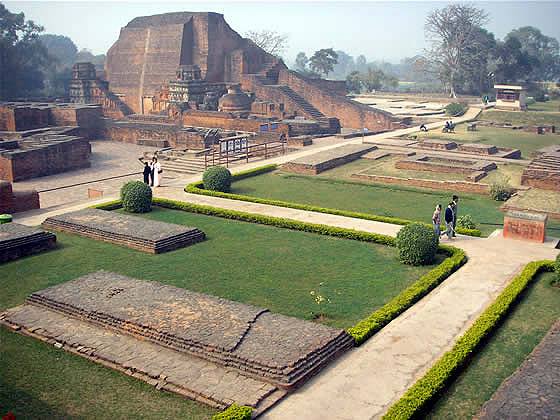
When Nālandā and the other Indian monastic universities declined, their curriculum lived on in Tibet. From the 8th century, teachers such as Śāntarakṣita and Padmasambhava brought Buddhism over the Himalayas; in the 11th the Bengali master Atiśa reorganised it around the "stages of the path".
Tibetan philosophy is above all a philosophy of emptiness. Its scholars wrote vast commentaries on Nāgārjuna and Candrakīrti and argued fiercely over how to understand the two truths. Tsongkhapa (1357–1419), founder of the Gelug school, insisted that emptiness is compatible with valid conventional knowledge and logic; others, like the Jonang, defended a "shentong" view of a luminous ultimate nature.
Monastic training still centres on formal debate — students clap and stamp as they challenge each other's definitions in the courtyard. Alongside this rigour sits the poetry of Milarepa and an ethic of compassion that the 14th Dalai Lama has carried to the world.
Tibetan Buddhism is a branch of the Vajrayana tradition of Buddhism which developed in Tibet and is practised in parts of Asia. Tibetan Buddhism evolved as a form of Mahayana Buddhism stemming from the latest stages of Buddhism (which included many Vajrayana elements). It thus preserves many Indian Buddhist tantric practices of the post-Gupta early medieval period (500–1200 CE), along with numerous native Tibetan developments. In the pre-modern era, Tibetan Buddhism spread outside of Tibet primarily due to the influence of the Mongol-led Yuan dynasty, founded by Kublai Khan, who ruled China, Mongolia, and parts of Siberia. In the Modern era, Tibetan Buddhism has spread outside of Asia because of the efforts of the Tibetan diaspora (1959 onwards). As the Dalai Lama escaped to India, the Indian subcontinent also came to be known for its renaissance of Tibetan Buddhism monasteries, including the rebuilding of the three major monasteries of the Gelug tradition.
Apart from classical Mahāyāna Buddhist practices like the ten perfections, Tibetan Buddhism includes tantric practices, such as deity yoga and the Six Dharmas of Naropa, as well as methods that are seen as transcending tantra, like Dzogchen. Its main goal is Buddhahood. The primary language of scriptural study in this tradition is classical Tibetan.
Tibetan Buddhism has four major schools, namely Nyingma (8th century), Kagyu (11th century), Sakya (1073), and Gelug (1409). The Jonang is a smaller school that exists, and the Rimé movement (19th century), meaning "no sides", is a more recent non-sectarian movement that attempts to preserve and understand all the different traditions. The predominant spiritual tradition in Tibet before the introduction of Buddhism was Bon, which has been strongly influenced by Tibetan Buddhism (particularly the Nyingma school). While each of the four major schools is independent and has its own monastic institutions and leaders, they are closely related and intersect with common contact and dialogue.
It is followed by a majority of the population in the Tibet Autonomous Region of China, and in Bhutan and Mongolia. Sizeable populations are found in parts of the Himalayas in Nepal and in parts of all of Indian Himalayan states, including Ladakh, Sikkim, Himachal Pradesh (Lahaul, Spiti and Kinnaur), West Bengal (Darjeeling), Arunachal Pradesh, Jammu and Kashmir (Paddar) and Uttarakhand. Smaller groups of practitioners can be found in Central Asia, some other regions of China such as Northeast China, Gansu, Yunnan, Xinjiang, Inner Mongolia and some regions of Russia, such as Tuva, Buryatia, and Kalmykia. It was also formerly practiced in the Baltistan region of Pakistan. Following Chinese annexation of Tibet, a large number of Tibetan Buddhist refugees, including the religious leadership such as the 14th Dalai Lama, have fled to India and other parts of the world.
Nomenclature
The native Tibetan term for Buddhism is "The Dharma of the insiders" (nang chos) or "The Buddha Dharma of the insiders" (nang pa sangs rgyas pa'i chos). "Insider" means someone who seeks the truth not outside but within the nature of mind. This is contrasted with other forms of organized religion, which are termed chos lugs (dharma system). For example, Christianity is termed Yi shu'i chos lugs (Jesus dharma system).
Westerners unfamiliar with Tibetan Buddhism initially turned to China for understanding. In Chinese, the term used is Lamaism (literally, "doctrine of the lamas": 喇嘛教 lama jiao) to distinguish it from a then-traditional Chinese Buddhism (佛教 fo jiao). The term was taken up by western scholars, including Hegel, as early as 1822. Insofar as it implies a discontinuity between Indian and Tibetan Buddhism, the term has been discredited.
Another term, "Vajrayāna" (Tibetan: dorje tegpa) is occasionally misused for Tibetan Buddhism. More accurately, Vajrayāna signifies a certain subset of practices and traditions that are not only part of Tibetan Buddhism but also prominent in other Buddhist traditions such as Chinese Esoteric Buddhism and Shingon in Japan.
In the west, the term "Indo-Tibetan Buddhism" has become current in acknowledgement of its derivation from the latest stages of Buddhist development in northern India. "Northern Buddhism" is sometimes used to refer to Indo-Tibetan Buddhism, for example, in the Brill Dictionary of Religion.
Another term, "Himalayan" Buddhism is sometimes used to indicate how this form of Buddhism is practiced not just in Tibet but throughout the Himalayan Regions.
The Provisional Government of Russia, by a decree of 7 July 1917, prohibited the appellation of Buryat and Kalmyk Buddhists as "Lamaists" in official papers. After the October revolution the term "Buddho-Lamaism" was used for some time by the Bolsheviks with reference to Tibetan Buddhism, before they finally reverted, in the early 1920s, to a more familiar term "Lamaism", which remains in official and scholarly usage in Russia to this day.
Pre–6th century
Centuries after Buddhism originated in India, the Mahayana Buddhism arrived in China through the Silk Route in 1st century CE via Tibet.
During the 3rd century CE, Buddhism began to spread into the Tibetan region, and its teachings affected the Bon religion in the Kingdom of Zhangzhung.
First dissemination (7th–9th centuries)
While some stories depict Buddhism in Tibet before this period, the religion was formally introduced during the Tibetan Empire (7th–9th century CE). Sanskrit Buddhist scriptures from India were first translated into Tibetan under the reign of the Tibetan king Songtsän Gampo (618–649 CE). This period also saw the development of the Tibetan writing system and classical Tibetan.
In the 8th century, King Trisong Detsen (755–797 CE) established it as the official religion of the state and commanded his army to wear robes and study Buddhism. Trisong Detsen invited Indian Buddhist scholars to his court, including Padmasambhāva (8th century CE) and Śāntarakṣita (725–788), who are considered the founders of Nyingma (The Ancient Ones), the oldest tradition of Tibetan Buddhism. Padmasambhava, who is considered by the Tibetans as Guru Rinpoche ("Precious Master"), is also credited with building the first monastery building named "Samye" around the late 8th century. According to some legend, it is noted that he pacified the Bon demons and made them the core protectors of Dharma. Modern historians also argue that Trisong Detsen and his followers adopted Buddhism as an act of international diplomacy, especially with the major power of those times such as China, India, and states in Central Asia that had strong Buddhist influence in their culture.
Yeshe Tsogyal, the most important female in the Nyingma Vajrayana lineage, was a member of Trisong Detsen's court and became Padmasambhava's student before gaining enlightenment. Trisong Detsen also invited the Chan master Moheyan to transmit the Dharma at Samye Monastery. Some sources state that a debate ensued between Moheyan and the Indian master Kamalaśīla, without consensus on the victor, and some scholars consider the event to be fictitious.
Era of fragmentation (9th–10th centuries)
A reversal in Buddhist influence began under King Langdarma (r. 836–842), and his death was followed by the so-called Era of Fragmentation, a period of disunity during the 9th and 10th centuries. During this era, the political centralization of the earlier Tibetan Empire collapsed and civil wars ensued.
In spite of this loss of state power and patronage however, Buddhism survived and thrived in Tibet. According to Geoffrey Samuel this was because "Tantric (Vajrayana) Buddhism came to provide the principal set of techniques by which Tibetans dealt with the dangerous powers of the spirit world [...] Buddhism, in the form of Vajrayana ritual, provided a critical set of techniques for dealing with everyday life. Tibetans came to see these techniques as vital for their survival and prosperity in this life." This includes dealing with the local gods and spirits (sadak and shipdak), which became a specialty of some Tibetan Buddhist lamas and ngagpas (mantrikas, mantra specialists).
Second dissemination (10th–12th centuries)
The late 10th and 11th centuries saw a revival of Buddhism in Tibet with the founding of "New Translation" (Sarma) lineages as well as the appearance of "hidden treasures" (terma) literature which reshaped the Nyingma tradition.
In 1042 the Bengali saint, Atiśa (982–1054) arrived in Tibet at the invitation of a west Tibetan king and further aided dissemination of Buddhist values in Tibetan culture and in consequential affairs of state.
His erudition supported the translation of major Buddhist texts, which evolved into the canons of Bka'-'gyur (Translation of the Buddha Word) and Bstan-'gyur (Translation of Teachings). The Bka'-'gyur has six main categories: (1) Tantra, (2) Prajñāpāramitā, (3) Ratnakūṭa Sūtra, (4) Avataṃsaka Sūtra, (5) Other sutras, and (6) Vinaya. The Bstan-'gyur comprises 3,626 texts and 224 volumes on such things as hymns, commentaries and supplementary tantric material.
Atiśa's chief disciple, Dromtön founded the Kadampa school of Tibetan Buddhism, one of the first Sarma schools. The Sakya (Grey Earth) school, was founded by Khön Könchok Gyelpo (1034–1102), a disciple of the great scholar, Drogmi Shākya. It is headed by the Sakya Trizin, and traces its lineage to the mahasiddha Virūpa.
Other influential Indian teachers include Tilopa (988–1069) and his student Nāropā (probably died ca. 1040). Their teachings, via their student Marpa, are the foundations of the Kagyu (Oral lineage) tradition, which focuses on the practices of Mahāmudrā and the Six Dharmas of Nāropā. One of the most famous Kagyu figures was the hermit Milarepa, an 11th-century mystic. The Dagpo Kagyu was founded by the monk Gampopa who merged Marpa's lineage teachings with the monastic Kadam tradition.
All the sub-schools of the Kagyu tradition of Tibetan Buddhism surviving today, including the Drikung Kagyu, the Drukpa Kagyu and the Karma Kagyu, are branches of the Dagpo Kagyu. The Karma Kagyu school is the largest of the Kagyu sub-schools and is headed by the Karmapa.
Mongol dominance (13th–14th centuries)
Tibetan Buddhism exerted a strong influence from the 11th century CE among the peoples of Inner Asia, especially the Mongols, and Tibetan and Mongolian Buddhism influenced each other. This was done with the help of Kublai Khan and Mongolian theologians influenced by the Church of the East.
The Mongols invaded Tibet in 1240 and 1244. They eventually annexed Amdo and Kham and appointed the great scholar and abbot Sakya Pandita (1182–1251) as Viceroy of Central Tibet in 1249.
In this way, Tibet was incorporated into the Mongol Empire, with the Sakya hierarchy retaining nominal power over religious and regional political affairs, while the Mongols retained structural and administrative rule over the region, reinforced by the rare military intervention. Tibetan Buddhism was adopted as the de facto state religion by the Mongol Yuan dynasty (1271–1368) of Kublai Khan.
It was also during this period that the Tibetan Buddhist canon was compiled, primarily led by the efforts of the scholar Butön Rinchen Drup (1290–1364). A part of this project included the carving of the canon into wood blocks for printing, and the first copies of these texts were kept at Narthang monastery.
Tibetan Buddhism in China was also syncretized with Chinese Buddhism and Chinese folk religion.
From family rule to Ganden Phodrang government (14th–18th centuries)
With the decline and end of the Mongol Yuan dynasty, Tibet regained independence and was ruled by successive local families from the 14th to the 17th century.
Jangchub Gyaltsän (1302–1364) became the strongest political family in the mid 14th century. During this period the reformist scholar Je Tsongkhapa (1357–1419) founded the Gelug school which would have a decisive influence on Tibet's history. The Ganden Tripa is the nominal head of the Gelug school, though its most influential figure is the Dalai Lama. The Ganden Tripa is an appointed office and not a reincarnation lineage. The position can be held by an individual for seven years and this has led to more Ganden Tripas than Dalai Lamas.
Internal strife within the Phagmodrupa dynasty, and the strong localism of the various fiefs and political-religious factions, led to a long series of internal conflicts. The minister family Rinpungpa, based in Tsang (West Central Tibet), dominated politics after 1435.
In 1565, the Rinpungpa family was overthrown by the Tsangpa Dynasty of Shigatse, which expanded its power in different directions of Tibet in the following decades and favoured the Karma Kagyu sect. They would play a pivotal role in the events which led to the rise of power of the Dalai Lama's in the 1640s.
In China, Tibetan Buddhism continued to be patronized by the elites of the Ming Dynasty. According to David M. Robinson, during this era, Tibetan Buddhist monks "conducted court rituals, enjoyed privileged status and gained access to the jealously guarded, private world of the emperors". The Ming Yongle Emperor (r. 1402–1424) promoted the carving of printing blocks for the Kangyur, now known as "the Yongle Kanjur", and seen as an important edition of the collection.
The Ming Dynasty also supported the propagation of Tibetan Buddhism in Mongolia during this period. Tibetan Buddhist missionaries also helped spread the religion in Mongolia. It was during this era that Altan Khan the leader of the Tümed Mongols, converted to Buddhism, and allied with the Gelug school, conferring the title of Dalai Lama to Sonam Gyatso in 1578.
During a Tibetan civil war in the 17th century, Sonam Choephel (1595–1657 CE), the chief regent of the 5th Dalai Lama, conquered and unified Tibet to establish the Ganden Phodrang government with the help of the Güshi Khan of the Khoshut Mongols. The Ganden Phodrang and the successive Gelug tulku lineages of the Dalai Lamas and Panchen Lamas maintained regional control of Tibet from the mid-17th to mid-20th centuries.
Qing rule (18th–20th centuries)
The Qing dynasty (1644–1912) established a Chinese rule over Tibet after a Qing expeditionary force defeated the Dzungars (who controlled Tibet) in 1720, and lasted until the fall of the Qing dynasty in 1912. The Manchu rulers of the Qing dynasty supported Tibetan Buddhism, especially the Gelug sect, during most of their rule. The reign of the Qianlong Emperor (respected as the Emperor Manjushri) was the high mark for this promotion of Tibetan Buddhism in China, with the visit of the 6th Panchen Lama to Beijing, and the building of temples in the Tibetan style, such as Xumi Fushou Temple, the Puning Temple and Putuo Zongcheng Temple (modeled after the Potala Palace).
This period also saw the rise of the Rimé movement, a 19th-century nonsectarian movement involving the Sakya, Kagyu and Nyingma schools of Tibetan Buddhism, along with some Bon scholars. Having seen how the Gelug institutions pushed the other traditions into the corners of Tibet's cultural life, scholars such as Jamyang Khyentse Wangpo (1820–1892) and Jamgön Kongtrül (1813–1899) compiled together the teachings of the Sakya, Kagyu and Nyingma, including many near-extinct teachings. Without Khyentse and Kongtrul's collecting and printing of rare works, the suppression of Buddhism by the Communists would have been much more final. The Rimé movement is responsible for a number of scriptural compilations, such as the Rinchen Terdzod and the Sheja Dzö.
During the Qing, Tibetan Buddhism also remained the major religion of the Mongols under Qing rule (1635–1912), as well as the state religion of the Kalmyk Khanate (1630–1771), the Dzungar Khanate (1634–1758) and the Khoshut Khanate (1642–1717).
20th century
In 1912, following the fall of the Qing Dynasty, Tibet became de facto independent under the 13th Dalai Lama government based in Lhasa, maintaining the current territory of what is now called the Tibetan Autonomous Region.
During the Republic of China (1912–1949), the "Chinese Tantric Buddhist Revival Movement" (Chinese: 密教復興運動) took place, and important figures such as Nenghai (能海喇嘛, 1886–1967) and Master Fazun (法尊, 1902–1980) promoted Tibetan Buddhism and translated Tibetan works into Chinese. This movement was severely damaged during the Cultural Revolution, however.
After the Battle of Chamdo, Tibet was annexed by China in 1950. In 1959 the 14th Dalai Lama and a great number of clergy and citizenry fled the country, to settle in India and other neighbouring countries. The events of the Cultural Revolution (1966–76) saw religion as one of the main political targets of the Chinese Communist Party, and most of the several thousand temples and monasteries in Tibet were destroyed, with many monks and lamas imprisoned. During this time, private religious expression, as well as Tibetan cultural traditions, were suppressed. Much of the Tibetan textual heritage and institutions were destroyed, and monks and nuns were forced to disrobe.
After 1980, under the leadership of Tulku Yanban Shire Jangtsen (Karma Rinpoche), Changlei Monastery was gradually rebuilt.
Outside of Tibet, however, there has been a renewed interest in Tibetan Buddhism in places such as Nepal and Bhutan.
Meanwhile, the spread of Tibetan Buddhism in the Western world was accomplished by many of the refugee Tibetan Lamas who escaped Tibet, such as Akong Rinpoche and Chögyam Trungpa who in 1967 were founders of Kagyu Samye Ling the first Tibetan Buddhist Centre to be established in the West.
After the liberalization policies in China during the 1980s, the religion began to recover with some temples and monasteries being reconstructed. Tibetan Buddhism is now an influential religion in China, Taiwan, Hong Kong, and overseas Chinese communities. However, the Chinese government retains strict control over Tibetan Buddhist Institutions in the PRC. Quotas on the number of monks and nuns are maintained, and their activities are closely supervised.
Within the Tibetan Autonomous Region, violence against Buddhists has been escalating since 2008. Widespread reports document the arrests and disappearances of nuns and monks, while the Chinese government classifies religious practices as "gang crime". Reports include the demolition of monasteries, forced disrobing, forced reeducation, and detentions of nuns and monks, especially those residing at Yarchen Gar's center, the most highly publicized.
21st century
Today, Tibetan Buddhism is adhered to widely in the Tibetan Plateau, Mongolia, northern Nepal, Kalmykia (on the north-west shore of the Caspian), Siberia (Tuva and Buryatia), the Russian Far East and northeast China. It is the state religion of Bhutan. The Indian regions of Sikkim and Ladakh, both formerly independent kingdoms, are also home to significant Tibetan Buddhist populations, as are the Indian states of Himachal Pradesh (which includes Dharamshala and the district of Lahaul-Spiti), West Bengal (the hill stations of Darjeeling and Kalimpong) and Arunachal Pradesh. Religious communities, refugee centers and monasteries have also been established in South India.
Adapted from the Wikipedia article Tibetan Buddhism, available under CC BY-SA 4.0.
Connections



You might also explore
 Indian philosophyIndian1200 BCE – presentA family of rigorous systems (darśanas) — Hindu, Buddhist and Jain — united by questions about the self, liberation…Korean philosophyJapanese & Korean400 – presentKorean thinkers transformed Buddhism and Neo-Confucianism, producing the Hwaeom synthesis, Seon meditation and the…