
Emmanuel Mounier
Emmanuel Mounier was a French philosopher, Catholic theologian, teacher and essayist.
Emmanuel Mounier (; French: [munje]; 1 April 1905 – 22 March 1950) was a French philosopher, Catholic theologian, teacher and essayist.
Biography
Mounier was the guiding spirit in the French personalist movement, and founder and director of Esprit, the magazine which was the organ of the movement. He was a brilliant scholar at the Sorbonne. In 1929, when he was only twenty-four, he came under the influence of the French writer Charles Péguy, to whom he ascribed the inspiration of the personalist movement. Mounier's personalism became a main influence of the non-conformists of the 1930s.
Peter Maurin used to say wherever he went, "There is a man in France called Emmanuel Mounier. He wrote a book called The Personalist Manifesto. You should read that book."
He taught at the Lycée du Parc at Lyon and at the Lycee Français Jean Monnet at Brussels.
Although Mounier was critical of the Moscow Trials of the 1930s, he has been criticized by the historian Tony Judt, among others, for his failure to condemn the excesses of Stalinism in the postwar period.
In 1939, Mounier commented in a restrained manner on the newly elected Pope Pius XII remaining silent on the Italian invasion of Albania. Thus, Mounier has contributed to the debate about Pope Pius XII's controversial stance on the Holocaust.
Adapted from the Wikipedia article Emmanuel Mounier, available under CC BY-SA 4.0.
Connections
Ideas & arguments
1Contributed to
1
You might also explore
 Dietrich von HildebrandModern European1889 – 1977Dietrich Richard Alfred von Hildebrand was a German Catholic philosopher and religious writer. Hildebrand was called…
 Jean-Paul Sartre★Modern European1905 – 1980Existentialist who declared that existence precedes essence and that we are condemned to be free.
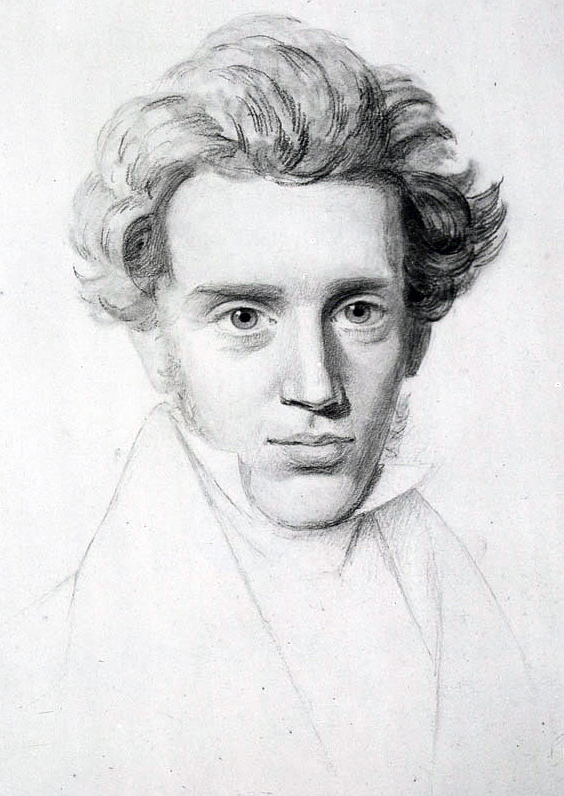 Søren Kierkegaard★Modern European1813 – 1855Danish father of existentialism: truth is subjectivity, and faith a leap beyond reason.
 Martin Heidegger★Modern European1889 – 1976Asked the question of the meaning of Being; analysed human existence (Dasein) as being-in-the-world and…
 Henri Bergson★Modern European1859 – 1941Henri-Louis Bergson was a French philosopher who was influential in the traditions of analytic philosophy and…
 Max StirnerModern European1806 – 1856Johann Caspar Schmidt, known by the pen name Max Stirner (; German: [ˈʃtɪʁnɐ]), was a German philosopher, dealing…