
Jacques Derrida
Founder of deconstruction, exposing hidden hierarchies in texts and concepts.
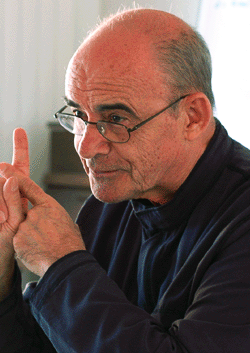
Jacques Derrida (; French: [ʒak dɛʁida]; born Jackie Élie Derrida; 15 July 1930 – 9 October 2004) was a French philosopher. He developed the philosophy of deconstruction, which he applied in some of his texts, and which he developed through close readings of the linguistics of Ferdinand de Saussure and Husserlian and Heideggerian phenomenology. He is one of the major figures associated with post-structuralism and postmodern philosophy although he distanced himself from post-structuralism and disavowed the word "postmodernity".
During his career, Derrida published over 40 books, together with hundreds of essays and public presentations. He has had a significant influence on the humanities and social sciences, including philosophy, literature, law, anthropology, historiography, applied linguistics, sociolinguistics, psychoanalysis, music, architecture, and political theory.
Into the 2000s, his work retained major academic influence throughout the United States, continental Europe, South America and all other countries where continental philosophy has been predominant, particularly in debates around ontology, epistemology (especially concerning social sciences), ethics, aesthetics, hermeneutics, and the philosophy of language. For the last two decades of his life, Derrida was Professor in Humanities at the University of California, Irvine. In most of the Anglosphere, where analytic philosophy is dominant, Derrida's influence is most presently felt in literary studies include literary theory and criticism due to his longstanding interest in language and his association with prominent literary critics. He also influenced architecture (in the form of deconstructivism), music (especially in the musical atmosphere of hauntology), art, and art criticism.
Particularly in his later writings, Derrida addressed ethical and political themes in his work. Some critics consider Speech and Phenomena (1967) to be his most important work, while others cite Of Grammatology (1967), Writing and Difference (1967), and Margins of Philosophy (1972). These writings influenced various activists and political movements. He became a well-known and influential public figure, while his approach to philosophy and notoriously abstruse work made him controversial.
Early life and education
Derrida was born on 15 July 1930, in a summer home in El Biar (Algiers), Algeria. His father was Haïm Aaron Prosper Charles (known as "Aimé") Derrida (1896–1970), who worked all his life for the wine and spirits company Tachet, including as a traveling salesman. The elder Derrida enlisted his son to be a "docile employee," waking him early to help with business accounts at the dining-room table, which Jacques later recalled as "exhausting" and "humiliating." His mother was Georgette Sultana Esther (1901–1991), daughter of Moïse Safar. The Safar family was Sephardic Jewish (originally from Toledo) and became French in 1870 when the Crémieux Decree granted full French citizenship to the Jews of Algeria. His parents named him "Jackie", "which they considered to be an American name", although he would later adopt a more "correct" version of his first name when he moved to Paris; some reports indicate that he was named Jackie after the American child actor Jackie Coogan, who had become well known around the world via his role in the 1921 Charlie Chaplin film The Kid. He was also given the middle name Élie after his paternal uncle Eugène Eliahou, at his circumcision; this name was not recorded on his birth certificate unlike those of his siblings, and he would later call it his "hidden name".
Derrida was the third of five children. His elder brother Paul Moïse died at less than three months old, the year before Derrida was born, leading him to suspect throughout his life his role as a replacement for his deceased brother. Derrida spent his youth in Algiers and in El-Biar.
On the first day of the school year in 1942, French administrators in Algeria—implementing antisemitism quotas set by the Vichy government—expelled Derrida from his lycée. He secretly skipped school for a year rather than attend the Jewish lycée formed by displaced teachers and students, and also took part in numerous football competitions (he dreamed of becoming a professional player). In this adolescent period, Derrida found in the works of philosophers and writers (such as Rousseau, Nietzsche, and Gide) an instrument of revolt against family and society. His reading also included Camus and Sartre. He was also drawn into works by André Gide, Friedrich Nietzsche, and Jean Jacques Rousseau in his teenage years.
In the late 1940s, he attended the Lycée Bugeaud, in Algiers; in 1949 he moved to Paris, attending the Lycée Louis-le-Grand, where his professor of philosophy was Étienne Borne. At that time he prepared for his entrance exam to the prestigious École Normale Supérieure (ENS); after failing the exam on his first try, he passed it on the second, and was admitted in 1952. On his first day at ENS, Derrida met Louis Althusser, with whom he became friends. A professor of his, Jan Czarnecki, was a progressive Protestant who would become a signer of the Manifesto of the 121. After visiting the Husserl Archive in Leuven, Belgium (1953–1954), he completed his master's degree in philosophy (diplôme d'études supérieures) on Edmund Husserl. He then passed the highly competitive agrégation exam in 1956. Derrida received a grant for studies at Harvard University, and he spent the 1956–57 academic year reading James Joyce's Ulysses at the Widener Library.
Career
During the Algerian War of Independence of 1954–1962, Derrida asked to teach soldiers' children in lieu of military service, teaching French and English from 1957 to 1959. Following the war, from 1960 to 1964, Derrida taught philosophy at the Sorbonne, where he was an assistant of Suzanne Bachelard (daughter of Gaston Bachelard), Georges Canguilhem, Paul Ricœur (who in these years coined the term hermeneutics of suspicion), and Jean Wahl. His wife, Marguerite, gave birth to their first child, Pierre, in 1963. In 1964, on the recommendation of Louis Althusser and Jean Hyppolite, Derrida received a permanent teaching position at the ENS, which he kept until 1984. In 1965 Derrida began an association with the Tel Quel group of literary and philosophical theorists, which lasted for seven years. Derrida's subsequent distance from the Tel Quel group, after 1971, was connected to his reservations about their embrace of Maoism and of the Chinese Cultural Revolution.
With "Structure, Sign, and Play in the Discourse of the Human Sciences", his contribution to a 1966 colloquium on structuralism at Johns Hopkins University, his work began to gain international prominence. At the same colloquium Derrida would meet Jacques Lacan and Paul de Man, the latter an important interlocutor in the years to come. A second son, Jean, was born in 1967. In the same year, Derrida published his first three books—Writing and Difference, Speech and Phenomena, and Of Grammatology.
In 1980, he received his first honorary doctorate (from Columbia University) and was awarded his State doctorate (doctorat d'État) by submitting to the University of Paris ten of his previously published books in conjunction with a defense of his intellectual project under the title "L'inscription de la philosophie : Recherches sur l'interprétation de l'écriture" ("Inscription in Philosophy: Research on the Interpretation of Writing"). The text of Derrida's defense was based on an abandoned draft doctoral thesis he had prepared in 1957 under the direction of Jean Hyppolite, along with Maurice de Gandillac, at the ENS entitled "The Ideality of the Literary Object" ("L'idéalité de l'objet littéraire"); his 1980 dissertation was subsequently published in English translation as "The Time of a Thesis: Punctuations". In 1983, Derrida collaborated with Ken McMullen on the film Ghost Dance. Derrida appears in the film as himself and also contributed to the script.
Derrida traveled widely and held a series of visiting and permanent positions. Derrida became full professor (directeur d'études) at the École des Hautes Études en Sciences Sociales in Paris from 1984 (he had been elected at the end of 1983). With François Châtelet and others he in 1983 co-founded the Collège international de philosophie (CIPH; 'International college of philosophy'), an institution intended to provide a location for philosophical research which could not be carried out elsewhere in the academia. He was elected as its first president. In 1985 Sylviane Agacinski gave birth to Derrida's third child, Daniel.
On 8 May 1985, Derrida was elected a Foreign Honorary Member of the American Academy of Arts and Sciences, to Class IV – Humanities, Section 3 – Criticism and Philology.
In 1986, Derrida became Professor of the Humanities at the University of California, Irvine, where he taught until shortly before his death in 2004. His papers were filed in the university archives. When Derrida's colleague, Dragan Kujundzic, was accused of sexual assault, Derrida wrote a letter to then-Chancellor Cicerone saying "if the scandalous procedure" against Kujundzic was not "interrupted or cancelled," he would end all his "relations with UCI." Regarding his archival papers, there would be "another consequence: since I never take back what I have given, my papers would of course remain the property of UCI and the Special Collections department of the library. However, it goes without saying that the spirit in which I contributed to the constitution of these archives (which is still underway and growing every year) would have been seriously damaged. Without renouncing my commitments, I would regret having made them and would reduce their fulfillment to the barest minimum." After Derrida's death, his widow and sons said they wanted copies of UCI's archives shared with the Institute of Contemporary Publishing Archives in France. The university had sued in an attempt to get manuscripts and correspondence from Derrida's widow and children that it believed the philosopher had promised to UC Irvine's collection, although it dropped the suit in 2007.
Derrida was a regular visiting professor at several other major American and European universities, including Johns Hopkins University, Yale University, New York University, Stony Brook University, The New School for Social Research, and European Graduate School.
He was awarded honorary doctorates by the University of Cambridge (1992), Columbia University, The New School for Social Research, the University of Essex, Katholieke Universiteit Leuven, the University of Silesia, the University of Coimbra, the University of Athens, and many others around the world. In 2001, he received the Adorno-Preis from the University of Frankfurt.
Derrida's honorary degree at Cambridge was protested by leading philosophers in the analytic tradition. Philosophers including Quine, Marcus, and Armstrong wrote a letter to the university objecting that "Derrida's work does not meet accepted standards of clarity and rigour," and "Academic status based on what seems to us to be little more than semi-intelligible attacks upon the values of reason, truth, and scholarship is not, we submit, sufficient grounds for the awarding of an honorary degree in a distinguished university".
Late in his life, Derrida participated in making two biographical documentaries, D'ailleurs, Derrida (Derrida's Elsewhere) by Safaa Fathy (1999), and Derrida by Kirby Dick and Amy Ziering Kofman (2002).
On 19 February 2003, with the 2003 invasion of Iraq impending, René Major moderated a debate entitled "Pourquoi La Guerre Aujourd'hui?" between Derrida and Jean Baudrillard, co-hosted by Major's Institute for Advanced Studies in Psychoanalysis and Le Monde Diplomatique. The debate discussed the relation between terrorist attacks and the invasion.
Personal life and death
In June 1957, he married the psychoanalyst Marguerite Aucouturier in Boston.
Derrida was diagnosed with pancreatic cancer in 2002. He died during surgery in a hospital in Paris in the early hours of 9 October 2004.
At the time of his death, Derrida had agreed to go for the summer to University of Heidelberg as holder of the Gadamer professorship. Peter Hommelhoff, Rector at Heidelberg at that time, summarized Derrida's place as: "Beyond the boundaries of philosophy as an academic discipline he was a leading intellectual figure not only for the humanities but for the cultural perception of a whole age."
Philosophy
Derrida referred to himself as a historian. He questioned assumptions of the Western philosophical tradition and also more broadly Western culture. By questioning the dominant discourses and trying to modify them, he attempted to democratize the university scene and to politicize it. Derrida called his challenge to the assumptions of Western culture "deconstruction". On some occasions, Derrida referred to deconstruction as a radicalization of a certain spirit of Marxism.
With his detailed readings of works from Plato to Rousseau to Heidegger, Derrida frequently argues that Western philosophy has uncritically allowed metaphorical depth models to govern its conception of language and consciousness. He sees these often unacknowledged assumptions as part of a "metaphysics of presence" to which philosophy has bound itself. This "logocentrism", Derrida argues, creates "marked" or hierarchized binary oppositions that affect everything from the conception of speech's relation to writing to the understanding of racial difference. Deconstruction is an attempt to expose and undermine such "metaphysics".
Derrida approaches texts as constructed around binary oppositions, which all speech must articulate if it is to make any sense whatsoever. This approach to text is, in a broad sense, influenced by the semiology of Ferdinand de Saussure. Saussure, considered to be one of the fathers of structuralism, posited that terms get their meaning in reciprocal determination with other terms inside language.
Perhaps Derrida's most quoted and famous assertion, which appears in an essay on Rousseau in his book Of Grammatology (1967), is the statement that "there is no outside-text" (il n'y a pas de hors-texte). Critics of Derrida have been often accused of having mistranslated the phrase in French to suggest he had written "Il n'y a rien en dehors du texte" ("There is nothing outside the text") and of having widely disseminated this translation to make it appear that Derrida is suggesting that nothing exists but words. Derrida once explained that this assertion, "which for some has become a sort of slogan, in general so badly understood, of deconstruction ... means nothing else: there is nothing outside context. In this form, which says exactly the same thing, the formula would doubtless have been less shocking."
Early works
Derrida began his career examining the limits of phenomenology. His first lengthy academic manuscript, written as a dissertation for his diplôme d'études supérieures and submitted in 1954, concerned the work of Edmund Husserl. Gary Banham has said that the dissertation is "in many respects the most ambitious of Derrida's interpretations with Husserl, not merely in terms of the number of works addressed but also in terms of the extraordinarily focused nature of its investigation." In 1962 he published Edmund Husserl's Origin of Geometry: An Introduction, which contained his own translation of Husserl's essay. Many elements of Derrida's thought were already present in this work. In the interviews collected in Positions (1972), Derrida said:
In this essay the problematic of writing was already in place as such, bound to the irreducible structure of 'deferral' in its relationships to consciousness, presence, science, history and the history of science, the disappearance or delay of the origin, etc. ...this essay can be read as the other side (recto or verso, as you wish) of Speech and Phenomena.
Derrida first received major attention outside France with his lecture, "Structure, Sign, and Play in the Discourse of the Human Sciences," delivered at Johns Hopkins University in 1966 (and subsequently included in Writing and Difference). The conference at which this paper was delivered was concerned with structuralism, then at the peak of its influence in France, but only beginning to gain attention in the United States. Derrida differed from other participants by his lack of explicit commitment to structuralism, having already been critical of the movement. He praised the accomplishments of structuralism but also maintained reservations about its internal limitations; this has led US academics to label his thought as a form of post-structuralism.
The effect of Derrida's paper was such that, by the time the conference proceedings were published in 1970, the title of the collection had become The Structuralist Controversy. The conference was also where he met Paul de Man, who would be a close friend and source of great controversy, as well as where he first met the French psychoanalyst Jacques Lacan, with whose work Derrida had a mixed relationship.
Phenomenology vs structuralism debate (1959)
In the early 1960s, Derrida began speaking and writing publicly, addressing the most topical debates at the time. One of these was the new and increasingly fashionable movement of structuralism, which was being widely favoured as the successor to the phenomenology approach, the latter having been started by Husserl sixty years earlier. Derrida's countercurrent take on the issue, at a prominent international conference, was so influential that it reframed the discussion from a celebration of the triumph of structuralism to a "phenomenology vs structuralism debate".
Phenomenology, as envisioned by Husserl, is a method of philosophical inquiry that rejects the rationalist bias that has dominated Western thought since Plato in favor of a method of reflective attentiveness that discloses the individual's "lived experience"; for those with a more phenomenological bent, the goal was to understand experience by comprehending and describing its genesis, the process of its emergence from an origin or event. For the structuralists, this was a false problem, and the "depth" of experience could in fact only be an effect of structures which are not themselves experiential.
In that context, in 1959, Derrida asked the question: Must not structure have a genesis, and must not the origin, the point of genesis, be already structured, in order to be the genesis of something? In other words, every structural or "synchronic" phenomenon has a history, and the structure cannot be understood without understanding its genesis. At the same time, in order that there be movement or potential, the origin cannot be some pure unity or simplicity, but must already be articulated—complex—such that from it a "diachronic" process can emerge. This original complexity must not be understood as an original positing, but more like a default of origin, which Derrida refers to as iterability, inscription, or textuality. It is this thought of originary complexity that sets Derrida's work in motion, and from which all of its terms are derived, including "deconstruction".
Adapted from the Wikipedia article Jacques Derrida, available under CC BY-SA 4.0.
Connections
Belongs to
3
Students
1
Influenced by
13


Ideas & arguments
10
Places
1
You might also explore
 Michel Foucault★Modern European1926 – 1984Historian of power and knowledge — prisons, madness, sexuality and the disciplined self.
 Martin Heidegger★Modern European1889 – 1976Asked the question of the meaning of Being; analysed human existence (Dasein) as being-in-the-world and…
 Jean-Paul Sartre★Modern European1905 – 1980Existentialist who declared that existence precedes essence and that we are condemned to be free.
 G. W. F. Hegel★Modern European1770 – 1831Systematic idealist for whom history is the dialectical self-realisation of Spirit and freedom.Gilles DeleuzeModern European1925 – 1995Gilles Louis René Deleuze was a French philosopher who, from the early 1950s until his death, wrote on a variety of…
 Friedrich Nietzsche★Modern European1844 – 1900Diagnostician of nihilism who proclaimed the death of God and called for a revaluation of all values.