Socrates, Plato and Aristotle
Three generations of teacher and student in Athens set the agenda for Western philosophy. Socrates turned philosophy toward ethics and the examined life; Plato built a world of eternal Forms and an ideal state; Aristotle brought the Forms back into things and organised every field of knowledge.
- 1
 PhilosopherGreek & Roman470 – 399 BCE
Socrates
The Athenian who wrote nothing yet changed philosophy forever by questioning everyone about how to live — and died for it.
- ◆The unexamined life is not worth living
- ◆Socratic method: question, define, refute
- ◆Virtue is knowledge; no one does wrong willingly
- ◆Wisdom begins in knowing that you do not know
Read the full pageSocrates was a stonemason's son who spent his life in the marketplace of Athens asking people questions. What is courage? What is justice? What is piety? Those who thought they knew — generals, politicians, poets — found under his cross-examination (elenchus) that their definitions collapsed into contradiction.
He claimed no wisdom of his own except awareness of his ignorance. When the Delphic oracle declared no one wiser than Socrates, he concluded it meant that he alone knew he knew nothing. His real subject was the care of the soul: how to live a good life. He held that virtue is a kind of knowledge, so that no one does wrong knowingly, and that it is worse to do injustice than to suffer it.
In 399 BCE Athens tried him for impiety and corrupting the young. He refused to flee and drank hemlock. Because he wrote nothing, we know him mainly through Plato's dialogues, along with accounts by Xenophon and the satire of Aristophanes — the "Socratic problem" of separating the real man from Plato's character remains open. Almost every later Greek school, from the Cynics to the Stoics, claimed him as its model.
- 2
 ConceptGreek & Roman
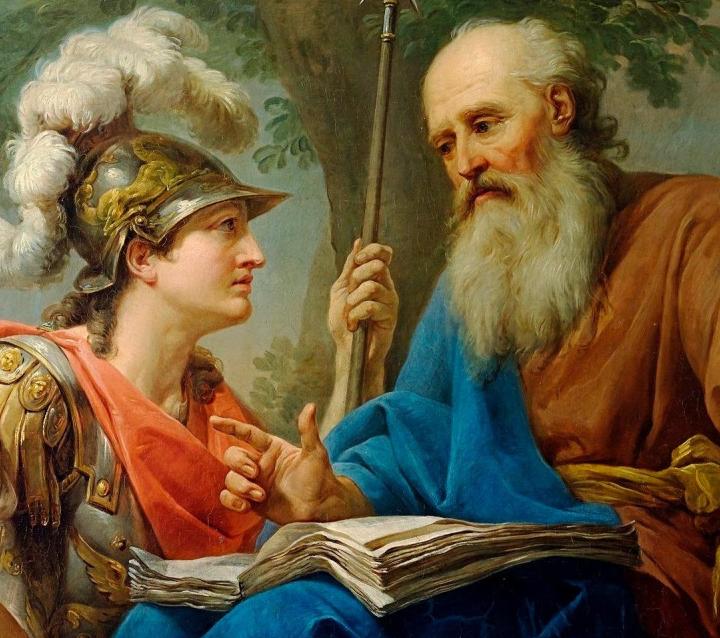
Socratic method
Cooperative questioning that exposes contradictions in our beliefs to reach clearer understanding.
Read the full pageThe Socratic method is a form of argumentative dialogue in which an individual probes a conversation partner on a topic, using questions and clarifications, until the partner is pressed to come to a conclusion on their own, or else their reasoning breaks down and they are forced to admit ignorance. The method is also known as Socratic debate, the maieutic method, or the Socratic dialectic, and sometimes equated with the Greek term elenchus. Socratic dialogues between characters employing this method feature in many of the works of the ancient Greek philosopher Plato, where a fictionalized version of his real-life teacher Socrates debates or expounds upon various philosophical issues with a partner.
In Plato's dialogue Theaetetus, Socrates describes his method as a form of "midwifery" (maieutikós; source of the English adjective maieutic) because it is employed to help his interlocutors develop their understanding and lead it out of them in a way analogous to a child developing in the womb until it is ready for birth. The Socratic method begins with commonly held beliefs and scrutinizes them by way of questioning to determine their internal consistency and their coherence with other beliefs and so to bring everyone closer to the truth.
In modified forms, it is employed today in a variety of pedagogical contexts.
- 3WorkGreek & Romanc. 399 BCE
Apology
Socrates's defence speech at his trial: "the unexamined life is not worth living".
Read the full pageThe Apology of Socrates (Ancient Greek: Ἀπολογία Σωκράτους, Apología Sokrátous; Latin: Apologia Socratis), written by Plato, is a Socratic dialogue of the speech of legal self-defence which Socrates (469–399 BC) spoke at his trial for impiety and corruption in 399 BC.
Specifically, the Apology of Socrates is a defense against the charges of "corrupting the youth" and "not believing in the gods in whom the city believes, but in other daimonia that are novel" to Athens (24b).
Among the primary sources about the trial and death of the philosopher Socrates, the Apology of Socrates is the dialogue that depicts the trial, and is one of four Socratic dialogues, along with Euthyphro, Phaedo, and Crito, through which Plato details the final days of the philosopher Socrates. There are debates among scholars as to the reliability of the Apology's account of the trial.
- 4
 PhilosopherGreek & Romanc. 428 – 348 BCE
Plato
Founder of the Academy whose dialogues defined Western philosophy's agenda: Forms, justice, the soul, knowledge and the ideal state.
- ◆Theory of Forms
- ◆Allegory of the Cave
- ◆Tripartite soul: reason, spirit, appetite
- ◆Knowledge as recollection
- ◆Philosopher-kings
Read the full pageAlfred North Whitehead said the European philosophical tradition "consists of a series of footnotes to Plato". The claim is exaggerated but understandable: Plato's dialogues raised nearly every question philosophy still asks, and did so as literature of the highest order.
Plato was an Athenian aristocrat and devoted follower of Socrates, whose execution turned him from politics to philosophy. Around 387 BCE he founded the Academy, which lasted in some form for centuries. His early dialogues portray Socrates questioning his contemporaries; the middle dialogues — the Phaedo, Symposium and Republic — develop Plato's own theory of Forms: perfect, unchanging realities such as Justice, Beauty and the Good, of which the things we perceive are imperfect copies. Knowledge is of the Forms, reached by reason rather than the senses; learning is a kind of recollection of what the soul knew before birth.
In the Republic Plato argues that justice in the soul — reason ruling spirit and appetite — mirrors justice in a city ruled by philosopher-kings. The Allegory of the Cave pictures humanity as prisoners mistaking shadows for reality. Later dialogues such as the Parmenides, Theaetetus and Timaeus subject the theory of Forms to criticism and extend it to cosmology. Through Neoplatonism, Plato shaped Christian, Islamic and Jewish theology.
- 5ConceptGreek & Roman
Theory of Forms
Plato's view that perfect, eternal, unchanging Forms — Justice, Beauty, the Good — are more real than the changing things that imitate them.
- ◆Particulars participate in Forms
- ◆Forms are known by reason, not the senses
- ◆The Form of the Good is supreme
Read the full pageThe Theory of Forms or Theory of Ideas, also known as Platonic idealism or Platonic realism, is a philosophical theory credited to the Classical Greek philosopher Plato.
A major concept in metaphysics, the theory suggests that the physical world is not as real or true as Forms (or Ideas, typically capitalized): the timeless, absolute, non-physical, and unchangeable essences of all things, which objects and matter in the physical world merely participate in, imitate, or resemble. In other words, Forms are various abstract ideals that exist even outside of human minds and that constitute the basis of reality. Thus, Plato's Theory of Forms is a type of philosophical realism, asserting that certain ideas are literally real, and a type of idealism, asserting that reality is fundamentally composed of ideas, or abstract objects.
Plato describes these entities only through the characters (primarily Socrates) in his dialogues, who sometimes suggest that these Forms are the only objects of study that can provide knowledge (as opposed to mere belief or opinion), and at other times contest the very existence of the Forms. The theory remains a general point of controversy in philosophy; nonetheless, it is considered to be a classical solution to the problem of universals.
- 6
 ArgumentGreek & Roman
Allegory of the Cave
Prisoners chained in a cave mistake shadows for reality; the philosopher escapes into the sunlight of truth.
P1Our senses show us only changing appearances (shadows)
P2True knowledge is of what is unchanging and real (the Forms)
P3Reaching it requires a painful turning away from appearances
∴Education is not filling the mind but turning it toward reality — and the enlightened have a duty to return and govern.
Read the full pageIn Book VII of the Republic, Plato asks us to imagine prisoners chained since birth in a cave, facing a wall. Behind them a fire burns, and between fire and prisoners people carry objects whose shadows fall on the wall. The prisoners take the shadows for the whole of reality.
One prisoner is freed. Turning, he is dazzled by the fire; dragged up into the sunlight he is blinded, then slowly learns to see reflections, objects, and finally the sun itself — the source of light and life. Returning to the cave to free the others, he can no longer see in the dark, and they mock him; if they could, they would kill him.
The allegory pictures education as a turning of the whole soul from appearances toward the Forms, with the sun as the Form of the Good. The final detail is a pointed reminder of the fate of Socrates.
- 7
 WorkGreek & Romanc. 375 BCE
Republic
Plato's masterpiece on justice, the soul and the ideal city — home of the Cave and the philosopher-kings.
- ◆What is justice?
- ◆The tripartite soul
- ◆Philosopher-kings
- ◆Allegory of the Cave
- ◆Ring of Gyges
Read the full pageThe Republic (Ancient Greek: Πολιτεία, romanized: Politeia; Latin: De Republica) is a Socratic dialogue authored by Plato around 375 BC, concerning justice (dikaiosúnē), the order and character of the just city-state, and the just man. It is Plato's best-known work, and one of the world's most influential works of philosophy and political theory, both intellectually and historically.
In the dialogue, Socrates discusses with various Athenians and foreigners the meaning of justice and whether the just man is happier than the unjust man. He considers the natures of existing regimes and then proposes a series of hypothetical cities in comparison, culminating in Kallipolis (Καλλίπολις), a utopian city-state ruled by a class of philosopher-kings. They also discuss aging, love, theory of forms, the immortality of the soul, and the role of the philosopher and of poetry in society. The dialogue's setting seems to be the time of the Peloponnesian War.
The Republic is generally placed in the middle period of Plato's dialogues. However, the distinction of the middle dialogues from the early dialogues is not as clear as the distinction of the late dialogues from all the others. Nonetheless, Ritter, Arnim, and Baron—each adopting separate methodologies—agree that the Republic was well distinguished, along with Parmenides, Phaedrus and Theaetetus.
- 8
 ArgumentGreek & Roman
Ring of Gyges
If a ring made you invisible, would you still be just? Glaucon's challenge in Plato's Republic.
P1A ring makes its wearer invisible, removing all risk of being caught
P2Anyone, just or unjust, who had it would act unjustly
∴People are just only because they fear the consequences of injustice.
Read the full pageThe Ring of Gyges (Ancient Greek: Γύγου δακτύλιος, Gúgou daktúlios, Attic Greek pronunciation: [ˈɡyːˌɡuː dakˈtylios]) is a hypothetical magic ring mentioned by the philosopher Plato in Book 2 of his Republic (2:359a–2:360d). It grants its owner the power to become invisible at will. Using the ring as an example, this section of the Republic considers whether a rational, intelligent person who has no need to fear negative consequences for committing an injustice would nevertheless act justly.
Gyges of Lydia was a historical king, the founder of the Mermnad dynasty of Lydian kings. Various ancient works—the most well-known being The Histories of Herodotus—gave different accounts of the circumstances of his acquisition of power. All, however, agree in asserting that he was originally a subordinate of King Candaules of Lydia, that he killed Candaules and seized the throne, and that he had either seduced Candaules' Queen before killing him, married her afterwards, or both.
In the recounting of the myth by Glaucon (Plato's older brother, as a character of the Republic), an unnamed ancestor of Gyges was a shepherd in the service of the king of Lydia. After an earthquake, a chasm was revealed in a mountainside where he was feeding his flock. Entering the chasm, he discovered that it was in fact a tomb with a bronze horse containing a corpse, larger than that of a man, who wore a golden ring, which he then pocketed. He discovered that by adjusting the ring, he gained the power of invisibility. He then arranged to become one of the king's messengers as to the status of the flocks. Arriving at the palace, he used his new power of invisibility to seduce the queen, and with her help, murder the king, and become king of Lydia himself.
- 9
 ArgumentGreek & Roman
Euthyphro dilemma
Is something good because God commands it, or does God command it because it is good?
P1Either the gods love the pious because it is pious, or it is pious because they love it
P2If the latter, morality is arbitrary
P3If the former, goodness is independent of the gods
∴Divine command cannot be the foundation of morality without either arbitrariness or redundancy.
Read the full pageThe Euthyphro dilemma is found in Plato's dialogue Euthyphro, in which Socrates asks Euthyphro, "Is the pious (τὸ ὅσιον) loved by the gods because it is pious, or is it pious because it is loved by the gods?" (10a)
Although it was originally applied to the ancient Greek pantheon, the dilemma has implications for modern monotheistic religions. Gottfried Leibniz asked whether the good and just "is good and just because God wills it or whether God wills it because it is good and just". Ever since Plato's original discussion, this question has presented a problem for some theists, though others have thought it a false dilemma, and it continues to be an object of theological and philosophical discussion today.
Socrates and Euthyphro discuss the nature of piety in Plato's Euthyphro. Euthyphro proposes (6e) that the pious (τὸ ὅσιον) is the same thing as that which is loved by the gods (τὸ θεοφιλές), but Socrates finds a problem with this proposal: the gods may disagree among themselves (7e). Euthyphro then revises his definition, so that piety is only that which is loved by all of the gods unanimously (9e).
- 10
 PhilosopherGreek & Roman384 – 322 BCE
Aristotle
Plato's student and Alexander's tutor, who systematised logic, ethics, biology, metaphysics and politics — "the master of those who know".
- ◆Substance as form in matter
- ◆The four causes
- ◆Virtue as the mean between extremes
- ◆Eudaimonia — flourishing — as life's goal
- ◆Humans are political animals
- ◆The syllogism
Read the full pageAristotle came to Athens from northern Greece at seventeen and studied in Plato's Academy for twenty years. After tutoring the young Alexander the Great he founded his own school, the Lyceum, where he and his students collected and organised knowledge on an unprecedented scale — from the constitutions of 158 city-states to the anatomy of the octopus.
Against Plato, Aristotle held that forms exist in things, not in a separate realm. A thing's substance is its form realised in matter; to understand it is to grasp its four causes — material, formal, efficient and final (its purpose). He invented formal logic with the syllogism, which remained the core of logic until the nineteenth century.
His ethics asks what the highest human good is and answers: eudaimonia, flourishing or living well, which consists in rational activity in accordance with virtue over a complete life. Virtues of character are stable dispositions at a mean between excess and deficiency — courage between cowardice and recklessness — acquired by practice. In politics he called humans "political animals" who realise their nature only in a community.
- 11
 ConceptGreek & Roman
Four causes
Aristotle's four kinds of explanation: material, formal, efficient and final (purpose).
Read the full pageThe four causes are, in Aristotelian thought, categories of questions that explain "the whys" of something that exists or changes in nature. The four causes are the material cause, the formal cause, the efficient cause, and the final cause. According to Aristotle, knowledge of a thing requires an understanding of its cause. While there are cases in which classifying a cause is difficult, or in which causes coincide, Aristotle held that his four causes provided an analytical scheme of general applicability.
Aristotle's word aitia (αἰτία) has, in philosophical scholarly tradition, been translated as "cause". This technical use of the word differs from its everyday meaning;a closer translation of Aristotle's αἰτία in contemporary English is "explanation".
In Physics II.3, I.7–9 and Metaphysics V.2, Aristotle holds that there are four kinds of answers to "why" questions:
- 12Read the full page
Eudaimonia (also spelled eudaemonia; ; Ancient Greek: εὐδαιμονία [eu̯dai̯moníaː]) is a Greek word literally translating to the state or condition of good spirit, and which is commonly translated as happiness or welfare.
In the works of Aristotle, eudaimonia was the term for the highest human good in older Greek tradition. It is the aim of practical philosophy-prudence, including ethics and political philosophy, to consider and experience what this state really is and how it can be achieved. It is thus a central concept in Aristotelian ethics and subsequent Hellenistic philosophy, along with the terms aretē (most often translated as virtue or excellence) and phronesis ('practical or ethical wisdom').
Discussion of the links between ēthikē aretē (virtue of character) and eudaimonia (happiness) is one of the central concerns of ancient ethics, and a subject of disagreement. As a result, there are many varieties of eudaimonism.
- 13
 ConceptGreek & Roman
Golden mean
Virtue lies between two vices: courage between cowardice and recklessness.
Read the full pageThe golden mean or golden middle way is the desirable middle between two extremes, one of excess and the other of deficiency. It appeared in Greek at least as early as the Delphic maxim "nothing in excess", which was discussed in Plato's Philebus. Aristotle analyzed the golden mean in the Nicomachean Ethics Book II: That virtues of character can be described as means. It was subsequently emphasized in Aristotelian virtue ethics. For example, in the Aristotelian view, courage is a virtue, but if taken to excess would manifest as recklessness, and, in deficiency, cowardice. The middle way form of government for Aristotle was a blend between monarchy, democracy and aristocracy.
The earliest representation of this idea in culture is probably in the mythological Cretan tale of Daedalus and Icarus. Daedalus, a famous artist of his time, built feathered wings for himself and his son so that they might escape the clutches of King Minos. Daedalus warns his beloved son to "fly the middle course", between the sea spray and the sun's heat. Icarus did not heed his father; he flew up and up until the sun melted the wax off his wings. For not heeding the middle course, he fell into the sea and drowned.
Another early elaboration is the Doric saying carved on the front of the temple at Delphi: "Nothing in excess" ("Μηδὲν ἄγαν").
- 14
 WorkGreek & Romanc. 340 BCE
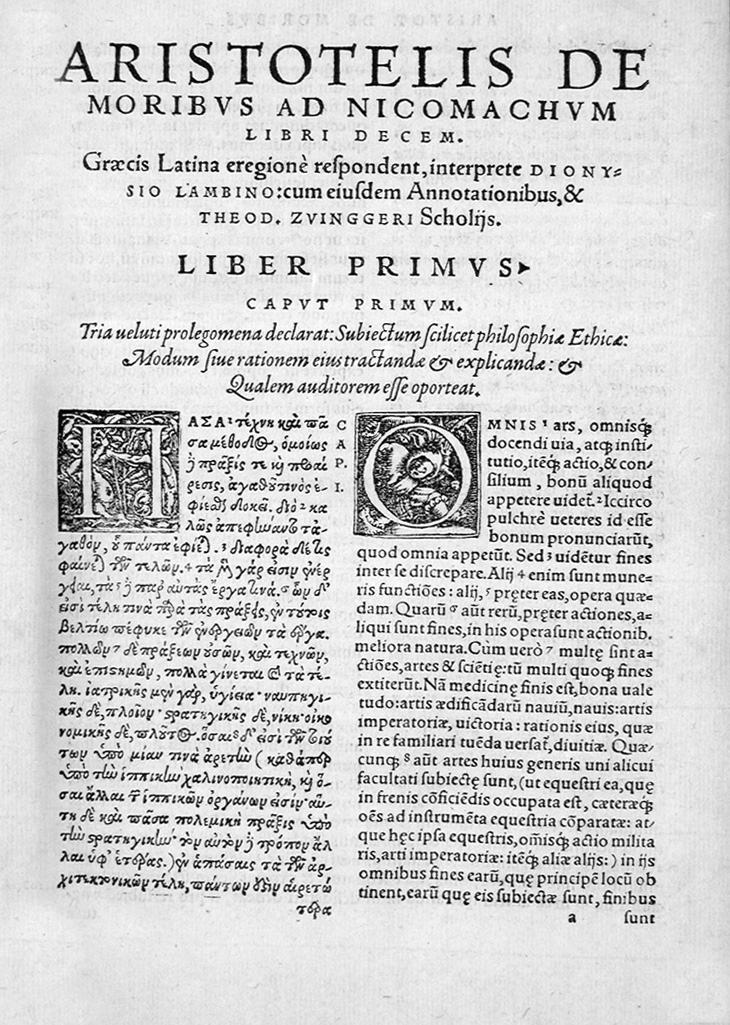
Nicomachean Ethics
Aristotle's inquiry into the good life: happiness, virtue, friendship and contemplation.
Read the full pageThe Nicomachean Ethics (; Ancient Greek: Ἠθικὰ Νικομάχεια, Ēthika Nikomacheia) is Aristotle's best-known work on ethics: the philosophical study of the good for human life, that which is the goal or end at which all our actions aim. It consists of ten sections, referred to as books, and is closely related to Aristotle's Eudemian Ethics. The work is essential for the interpretation of Aristotelian ethics.
The text centers upon the question of how to best live, a theme previously explored in the works of Plato, Aristotle's friend and teacher. In Aristotle's Metaphysics, he describes how Socrates, the friend and teacher of Plato, turned philosophy to human questions, whereas pre-Socratic philosophy had only been theoretical and concerned with natural science. Ethics, Aristotle claimed, is practical rather than theoretical, in the Aristotelian senses of these terms. It is not merely an investigation into what good consists of, but it aims to be of practical help in achieving the good.
It is connected to another of Aristotle's practical works, Politics, which reflects a similar goal: for people to become good, through the creation and maintenance of social institutions. Ethics is about how individuals should best live, while politics adopts the perspective of a law-giver, looking at the good of a whole community.


