The art of living: Stoics, Epicureans, Skeptics
After Alexander, philosophy became therapy. The Stoics taught that virtue is the only good and that we should master our judgements; the Epicureans that tranquil pleasure and friendship make a happy life; the Skeptics that suspending judgement brings peace; the Cynics that convention is a cage.
- 1
 SchoolGreek & Roman400 BCE – 500 CE
Cynicism
Live according to nature, reject convention, wealth and status — as Diogenes did from his barrel.
Read the full pageCynicism (Ancient Greek: κυνισμός) is a school of thought in ancient Greek philosophy, originating in the Classical period and extending into the Hellenistic and Roman Imperial periods. According to Cynicism, people are reasoning animals, and the purpose of life and the way to gain happiness is to achieve virtue, in agreement with nature, following one's natural sense of reason by living simply and shamelessly free from social constraints. The Cynics (Ancient Greek: Κυνικοί, Latin: Cynici) rejected all conventional desires for wealth, power, pleasure, glory, social recognition, conformity, and worldly possessions and even flouted such conventions openly and derisively in public.
The first philosopher to outline these themes was Antisthenes, who had been a pupil of Socrates in the late 400s BC. He was followed by Diogenes, who lived in a ceramic jar on the streets of Athens. Diogenes took Cynicism to its logical extremes with his famous public demonstrations of non-conformity, coming to be seen as the archetypal Cynic philosopher. He was followed by Crates of Thebes, who gave away a large fortune so he could live a life of Cynic poverty in Athens.
Cynicism gradually declined in importance after the 3rd century BC, but it experienced a revival with the rise of the Roman Empire in the 1st century. Cynics could be found begging and preaching throughout the cities of the empire, and similar ascetic and rhetorical ideas appeared in early Christianity. By the 19th century, emphasis on the negative aspects of Cynic philosophy led to the modern understanding of cynicism to mean an attitude of disbelief in the sincerity or goodness of human motives and actions.
- 2
 PhilosopherGreek & Romanc. 412 – 323 BCE
Diogenes of Sinope
The Cynic who lived in a jar, mocked convention and told Alexander the Great to stand out of his sunlight.
- ◆Live according to nature
- ◆Shamelessness against convention
- ◆Cosmopolitan: "citizen of the world"
Read the full pageDiogenes the Cynic, also known as Diogenes of Sinope, was an ancient Greek philosopher during the period of Classical Greece, and one of the founders of Cynicism.
Renowned for his ascetic lifestyle and radical critiques of social conventions, he became a legendary figure whose life and teachings have been recounted, often through anecdote, in both antiquity and modernity. Diogenes advocated a return to nature, the renunciation of wealth, and introduced early ideas of cosmopolitanism by proclaiming himself a "citizen of the world".
Diogenes was born to a prosperous family in Sinope. His life took a dramatic turn following a scandal involving the debasement of coinage, an event that led to his exile and ultimately his radical rejection of conventional values. Embracing a life of poverty and self-sufficiency, he became famous for his unconventional, shameless behaviors that openly challenged societal norms, such as living in a large ceramic jar or wandering public spaces with a lit lantern in daylight, claiming to be "looking for a man", that is to say "for a wise man" (sophos).
- 3
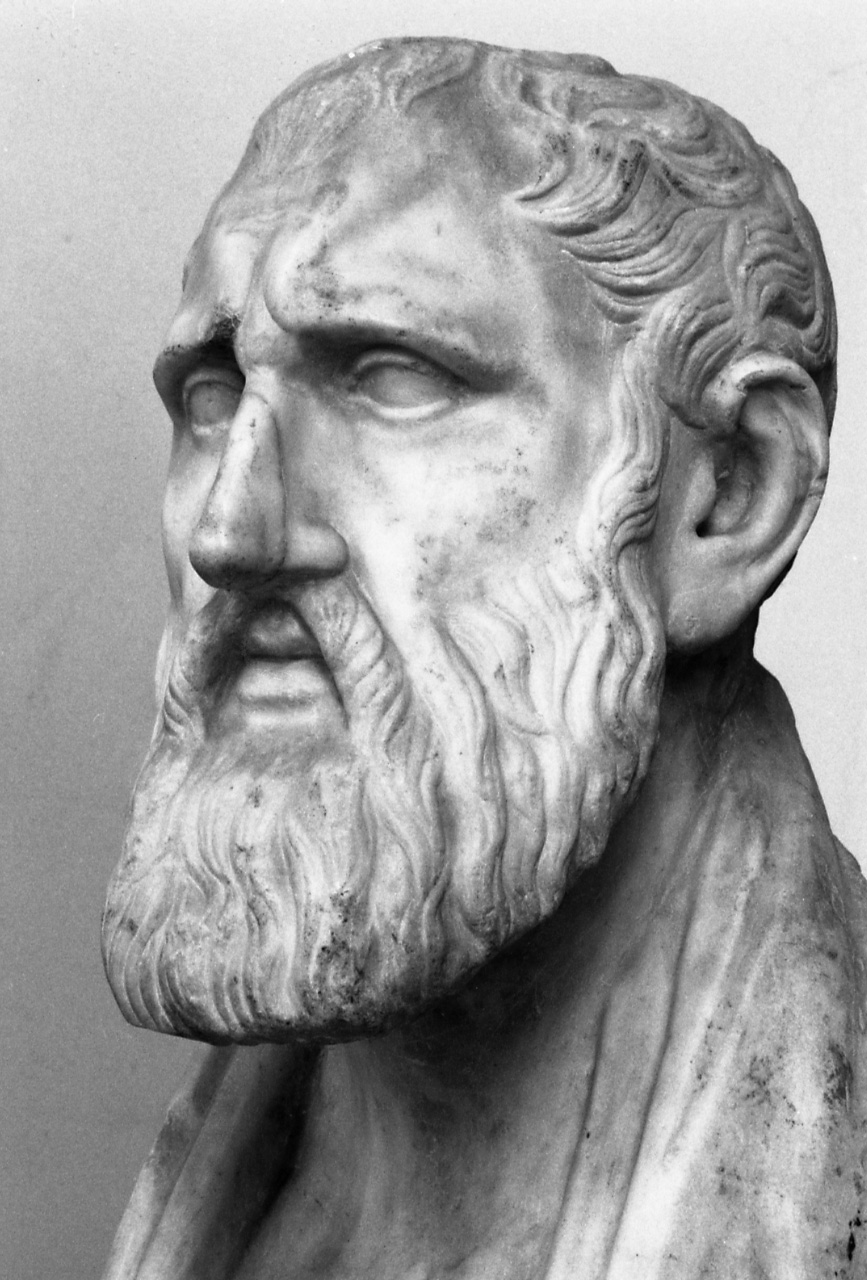 SchoolGreek & Roman300 BCE – 250 CE
Stoicism
Virtue is the only good; focus on what is in your control and accept the rest as the rational order of nature.
- ◆The dichotomy of control
- ◆Virtue is sufficient for happiness
- ◆Live according to nature and reason
- ◆Cosmopolitanism: citizens of the world
Read the full pageStoicism was founded by Zeno of Citium, who taught at the Stoa Poikilē — the Painted Porch — in Athens around 300 BCE. The Stoics held that the universe is a rational whole governed by logos, and that human beings flourish by living in agreement with it.
The central practical teaching is that only virtue — wisdom, justice, courage and moderation — is truly good. Health, wealth and reputation are "preferred indifferents": reasonable to pursue, but irrelevant to happiness. As Epictetus put it, some things are up to us (our judgements, intentions and desires) and some are not; misery comes from confusing the two.
Roman Stoics — Seneca, Musonius Rufus, Epictetus and the emperor Marcus Aurelius — turned the school into a practical art of living, and their writings are more widely read today than at any time since antiquity. Stoic ideas influenced Christianity, natural-law theory, cognitive behavioural therapy and the modern idea of universal human rights.
- 4PhilosopherGreek & Roman334 – 262 BCE
Zeno of Citium
Founder of Stoicism, who taught at the Painted Porch in Athens.
- ◆Stoicism
- ◆three branches of philosophy (physics, ethics, logic)
- ◆Logos
- ◆rationality of human nature
- ◆phantasiai
- ◆katalepsis
Read the full pageZeno of Citium (; Koine Greek: Ζήνων ὁ Κιτιεύς, Zēnōn ho Kitieus; c. 334 – c. 262 BC) was a Hellenistic philosopher from Citium (Κίτιον, Kition), Cyprus. He was the founder of the Stoic school of philosophy, which he taught in Athens from about 300 BC.
Based on the moral ideas of the Cynics, Stoicism laid great emphasis on goodness and peace of mind gained from living a life of virtue in accordance with nature. It proved very popular and flourished as one of the major schools of philosophy from the Hellenistic period through to the Roman era, enjoying revivals in the Renaissance as Neostoicism and in the current era as Modern Stoicism.
Zeno was born c. 334 BC, in the city of Citium in Cyprus.
- 5ConceptGreek & Roman
Dichotomy of control
Some things are up to us — our judgements and choices — and some are not. Focus on the former.
Read the full pageThe Enchiridion of Epictetus opens with a sentence that sums up Stoic practice: "Some things are up to us and some are not." Up to us are our judgements, intentions, desires and aversions — in short, our own actions of mind. Not up to us are our bodies, property, reputation and office — everything that can be taken away.
Distress, the Stoics argued, comes from treating what is not up to us as if it were: staking our happiness on outcomes we cannot guarantee. Freedom comes from placing our good entirely in what is ours — the quality of our choices — while meeting everything else with calm acceptance. Modern readers sometimes add a third category, things partly up to us, where we can control our effort but not the result.
- 6
 PhilosopherGreek & Roman4 BCE – 65 CE
Seneca
Stoic statesman and dramatist whose Letters to Lucilius are a handbook for living.
- ◆On the shortness of life
- ◆Anger as temporary madness
- ◆Rehearsing misfortune
Read the full pageLucius Annaeus Seneca the Younger ( SEN-ik-ə; c. 4 BC – AD 65), usually known mononymously as Seneca, was a Stoic philosopher of Ancient Rome, a statesman, a dramatist, and in one work (Apocolocyntosis) a satirist from the post-Augustan age of Latin literature.
Seneca was born in Colonia Patricia Corduba in Hispania, and was trained in rhetoric and philosophy in Greece. His father was Seneca the Elder, his elder brother was Lucius Junius Gallio Annaeanus, and his nephew was the poet Lucan. In AD 41, Seneca was exiled to the island of Corsica under emperor Claudius, but was allowed to return in 49 to become a tutor to Nero. When Nero became emperor in 54, Seneca became his advisor and, together with the praetorian prefect Sextus Afranius Burrus, provided competent government for the first five years of Nero's reign. Seneca's influence over Nero declined with time, and in 65 Seneca was executed by forced suicide for alleged complicity in the Pisonian conspiracy to assassinate Nero, of which he may have been innocent, although there is still no consensus agreement. His stoic and calm suicide has become the subject of numerous paintings.
As a writer, Seneca is known for his philosophical works, and for his plays, which are all tragedies. His prose works include 12 essays and 124 letters dealing with moral issues. These writings constitute one of the most important bodies of primary material for ancient Stoicism. As a tragedian, he is best known for plays such as his Medea, Thyestes, and Phaedra. Seneca had an immense influence on later generations—during the Renaissance he was viewed as, in the words of E. F. Watling, "an oracle of moral, even of Christian, edification; a master of literary style and a model [for] dramatic art".
- 7
 PhilosopherGreek & Romanc. 50 – 135
Epictetus
A freed slave whose Stoic teaching starts from one rule: distinguish what is up to us from what is not.
- ◆Dichotomy of control
- ◆It is not things that disturb us, but our judgements about them
- ◆Freedom is inner
Read the full pageEpictetus ( EH-pick-TEE-təss; Ancient Greek: Ἐπίκτητος, Epíktētos; c. 50 – c. 135 AD) was a Greek Stoic philosopher. He was born into slavery at Hierapolis, Phrygia (present-day Pamukkale, in western Turkey) and lived in Rome until his banishment, after which he spent the rest of his life in Nicopolis in northwestern Greece.
Epictetus studied Stoic philosophy under Musonius Rufus and after manumission, his formal emancipation from slavery, he began to teach philosophy. When philosophers were banished from Rome by Emperor Domitian toward the end of the first century, Epictetus founded a school of philosophy in Nicopolis. He taught that philosophy is a way of life and not simply a theoretical discipline. To Epictetus, all external events are beyond our control; he argues that we should accept whatever happens calmly and dispassionately. However, he held that individuals are responsible for their own actions, which they can examine and control through rigorous self-discipline. His teachings were written down and published by his pupil Arrian in his Discourses and Enchiridion. They influenced many later thinkers, including Marcus Aurelius, Rabelais, Pascal, Montesquieu, Diderot, and Samuel Johnson.
Having described himself as old in AD 108, Epictetus is presumed to have been born around AD 50, at Hierapolis, Phrygia. The name given by his parents is unknown. The name by which he is known is derived from the word epíktētos (ἐπίκτητος) that in Greek, simply means "gained" or "acquired"; the Greek philosopher Plato, in his Laws, used that term to mean property that is "added to one's hereditary property". Epictetus spent his youth in Rome as a slave to Epaphroditus, a wealthy freedman who was secretary to Nero. Epictetus's social position was thus complicated, combining the low status of a slave with the high status of one with a personal connection to imperial power.
- 8
 PhilosopherGreek & Roman121 – 180
Marcus Aurelius
Roman emperor whose private Stoic notebook, the Meditations, is among the most widely read works of philosophy.
- ◆The obstacle is the way
- ◆Remember you will die
- ◆Do your duty without complaint
- ◆View from above
Read the full pageMarcus Aurelius Antoninus ( or-EE-lee-əs; Latin: [ˈmaːrkʊs au̯ˈreːli.us antoːˈniːnʊs]; 26 April 121 – 17 March 180) was Roman emperor from 161 to 180 and a Stoic philosopher. He was a member of the Nerva–Antonine dynasty, the last of the rulers later known as the Five Good Emperors and the last emperor of the Pax Romana, an age of relative peace, calm, and stability for the Roman Empire lasting from 27 BC to 180 AD. He served as Roman consul in 140, 145, and 161.
Marcus Aurelius was the son of the praetor Marcus Annius Verus and his wife Domitia Calvilla. He was related through marriage to the emperors Trajan and Hadrian. Marcus was three when his father died, and he was raised by his mother and paternal grandfather. After Hadrian's adoptive son, Aelius Caesar, died in 138, Hadrian adopted Marcus's uncle Antoninus Pius as his new heir. In turn, Antoninus adopted Marcus and Lucius, the son of Aelius. Hadrian died that year, and Antoninus became emperor. Now heir to the throne, Marcus studied Greek and Latin under tutors such as Herodes Atticus and Marcus Cornelius Fronto. He married Antoninus's daughter Faustina in 145.
After Antoninus died in 161, Marcus acceded to the throne alongside his adoptive brother, who took the regnal name Lucius Aurelius Verus. Under the reign of Marcus Aurelius, the Roman Empire witnessed much military conflict. In the East, the Romans fought the Parthian War of Lucius Verus with a revitalised Parthian Empire and the rebel Kingdom of Armenia. Marcus defeated the Marcomanni, Quadi, and Iazyges in the Marcomannic Wars. These and other Germanic peoples began to represent a troubling reality for the Empire. He reduced the silver purity of the Roman currency, the denarius. The persecution of Christians in the Roman Empire appears to have increased during his reign, although his involvement is unlikely since there are no Christian sources ascribing him the blame, and he was praised by Justin Martyr and Tertullian. The Antonine Plague broke out in 165 or 166 and devastated the population of the Roman Empire, causing the deaths of five to ten million people. Lucius Verus may have died from the plague in 169. When Marcus himself died in 180, he was succeeded by his son Commodus.
- Read the full page
Meditations (Koine Greek: Τὰ εἰς ἑαυτόν, romanized: Ta eis heauton, lit. ''Things Unto Himself'') is a collection of personal writings by Marcus Aurelius, Roman Emperor from 161–180 AD, which record his private notes to himself and his reflections on Stoic philosophy.
Marcus Aurelius wrote the 12 books of the Meditations in Koine Greek as a source for his own guidance and self-improvement. It is possible that large portions of the work were written at Sirmium (modern-day Sremska Mitrovica, Serbia), where he spent much time planning military campaigns in 170–180 AD. A portion of his work was written while he was on campaign, because internal notes reveal that the first book was "written in the country of the Quadi, at the Granova" (modern-day Hron River in Slovakia) and the second book was written at Carnuntum.
It is unlikely that Marcus Aurelius ever intended the writings to be published. The work has no official title, so "Meditations" is one of several titles commonly assigned to the collection. These writings take the form of quotations varying in length from one sentence to long paragraphs.
- 10
 SchoolGreek & Roman307 BCE – 300 CE
Epicureanism
The good life is a pleasant life — but true pleasure is tranquillity (ataraxia) and freedom from pain, won through friendship, simplicity and understanding nature.
- ◆Pleasure as absence of pain
- ◆Death is nothing to us
- ◆Friendship as the greatest good
- ◆Atomism frees us from fear of the gods
Read the full pageEpicureanism, less commonly Epicurism, is a school of philosophy founded in 307 BC and based upon the teachings of Epicurus, an ancient Greek philosopher. Epicurus was an atomist and materialist, following in the steps of Democritus. His materialism led him to religious skepticism and a general attack on superstition and divine intervention. Epicureanism was originally a challenge to Platonism, and its main opponent later became Stoicism. It is a form of hedonism insofar as it declares pleasure to be its sole intrinsic goal. However, the concept that the absence of pain and fear constitutes the greatest pleasure, and its advocacy of a simple life, make it very different from hedonism as colloquially understood.
Following the Cyrenaic philosopher Aristippus, Epicurus believed that the greatest good was to seek modest, sustainable pleasure in the form of a state of ataraxia (tranquility and freedom from fear) and aponia (the absence of bodily pain) through knowledge of the workings of the world and limiting desires. Correspondingly, Epicurus and his followers generally withdrew from politics because it could lead to frustrations and ambitions that would conflict with their pursuit of virtue and peace of mind.
Few writings by Epicurus have survived. Diogenes Laertius has preserved three instructional letters attributed to Epicurus, as well as a list of the Principal Doctrines of Epicureanism. The letters to Herodotus and to Menoeceus are generally accepted as authentic works written by Epicurus himself. However, the letter addressed to Pythocles, while viewed as authentic by the majority of scholars, is sometimes alternatively viewed to be a compilation by one of his students, likely based on Epicurus' original writings. There are also independent attestations of his ideas from both early opponents such as Clement of Alexandria, Plutarch, and Cicero, and later disciples who defended his views such as a speech of Lucius Manlius Torquatus defending Epicurean ethics and Gaius Velleius's speech defending the Epicurean conception of the gods in the works of Cicero, along with Colotes, who Plutarch responds to in his writings. The epic poem De rerum natura (Latin for "On the Nature of Things") by Lucretius presents the core arguments and theories of Epicureanism in one unified work. Many Epicurean texts have also been found on scrolls unearthed at the Villa of the Papyri in Herculaneum, mostly works written by the Epicurean philosopher Philodemus or his teacher Zeno of Sidon, along with fragments of works by Epicurus himself. Diogenes of Oenoanda, a wealthy Epicurean in the 2nd century CE, had a portico wall inscribed with tenets of the philosophy erected in Oenoanda, Lycia (present-day Turkey).
- 11PhilosopherGreek & Roman341 – 270 BCE
Epicurus
Taught that the goal of life is tranquillity and freedom from pain, found in friendship, simplicity and understanding nature.
- ◆Pleasure as absence of pain (ataraxia)
- ◆Death is nothing to us
- ◆Friendship
- ◆The Epicurean problem of evil
Read the full pageEpicurus (, EH-pih-KURE-əs; Ancient Greek: Ἐπίκουρος Epikouros; 341–270 BC) was an ancient Greek philosopher who founded the philosophical school of Epicureanism, which teaches that management of one's desires, removal of unnecessary fears, friendship, and virtuous living lead to a pleasant life and constant happiness, the highest good.
Epicurus advocated that people were best able to pursue philosophy by living a self-sufficient life surrounded by friends; he and his followers were known for eating simple meals and discussing a wide range of philosophical subjects at "The Garden", the school he established in Athens. Epicurus taught that although the gods exist, they have no involvement in human affairs. Like the earlier philosopher Democritus, Epicurus claimed that all occurrences in the natural world are ultimately the result of tiny, invisible particles known as atoms moving and interacting in empty space, though Epicurus also deviated from Democritus by proposing the idea of atomic "swerve", which holds that atoms may deviate from their expected course, thus permitting humans to possess free will in an otherwise deterministic universe.
Of the over 300 works Epicurus is said to have written about various subjects, the vast majority have been lost. Only a few letters and a collection of quotes—the Principal Doctrines—have survived intact, along with several fragments of his other writings, such as his major work On Nature. Most information about his philosophy comes through later authors, such as Lucretius and Diogenes of Oenoanda.
- 12
 ConceptGreek & Roman
Ataraxia
Tranquillity, freedom from disturbance — the goal of Epicureans and Skeptics.
Read the full pageIn Ancient Greek philosophy, ataraxia (Greek: ἀταραξία, from ἀ- indicating negation or absence and ταρασσ- tarass- 'to disturb, trouble' with the abstract noun suffix -ία), generally translated as 'unperturbedness', 'imperturbability', 'equanimity', or 'tranquility', is a lucid state of robust equanimity characterized by ongoing freedom from distress and worry. In non-philosophical usage, ataraxia was the ideal mental state for soldiers entering battle. Achieving ataraxia is a common goal for Pyrrhonism, Epicureanism, and Stoicism, but the role and value of ataraxia within each philosophy varies in accordance with their philosophical theories. The mental disturbances that prevent one from achieving ataraxia also vary among the philosophies, and each philosophy has a different understanding as to how to achieve ataraxia.
In Pyrrhonism, ataraxia is the intended result of epoché (i.e., suspension of judgment) regarding all matters of dogma (i.e., non-evident belief), which represents the central aim of Pyrrhonist practice, that is necessary to bring about eudaimonia.
Ataraxia is a key component of the Epicurean conception of pleasure (hedone), which they consider the highest good. Epicureans break pleasure down into two categories: the physical and the mental. They consider mental, not physical, pleasures to be of high importance because physical pleasures exist only in the present; while mental pleasures exist in the past, the present, and the future. Epicureans further separate pleasure into what they call kinetic pleasure, those that come about through action or change, and katastematic pleasures, those that come about through an absence of distress. Those who achieved freedom from physical disturbance were said to be in a state of aponia, while those who achieved freedom from mental disturbances were said to be in a state of ataraxia. Ataraxia, as both a mental and katastematic pleasure, is key to a person's happiness.
- 13
 PhilosopherGreek & Roman99 – 55 BCE
Lucretius
Roman poet whose De Rerum Natura set out Epicurean atomism in magnificent verse.
- ◆Naturalistic
Read the full pageTitus Lucretius Carus ( TY-tuhs loo-KREE-shuhs; Latin: [ˈtitʊs lʊˈkreːtɪ.ʊs ˈkaːrʊs]; c. 99 – October 15, 55 BC) was a Roman poet and philosopher. His only known work is the philosophical poem De rerum natura, a didactic work about the tenets and philosophy of Epicureanism, which usually is translated into English as On the Nature of Things—and somewhat less often as On the Nature of the Universe.
Very little is known about Lucretius's life; the only certainty is that he was either a friend or client of Gaius Memmius, to whom the poem was addressed and dedicated. De rerum natura was a considerable influence on the Augustan poets, particularly Virgil (in his Aeneid and Georgics, and to a lesser extent on the Eclogues) and Horace. The work was almost lost during the Middle Ages, but was rediscovered in 1417 in a monastery in Germany by Poggio Bracciolini. It played an important role both in the development of atomism (Lucretius was an important influence on Pierre Gassendi) and the efforts of various figures of the Enlightenment era to construct a new Christian humanism.
Virtually nothing is known about the life of Lucretius, and there is insufficient basis for a confident assertion of the dates of Lucretius's birth or death in other sources. A brief biographical note is found in Aelius Donatus's Life of Virgil, which seems to be derived from an earlier work by Suetonius. The note reads: "The first years of his life Virgil spent in Cremona until the assumption of his toga virilis on his 17th birthday (when the same two men held the consulate as when he was born), and it so happened that on the very same day Lucretius the poet passed away." However, although Lucretius certainly lived and died around the time that Virgil and Cicero flourished, the information in this particular testimony is internally inconsistent: if Virgil was born in 70 BC, his 17th birthday would be in 53. The two consuls of 70 BC, Pompey and Crassus, stood together as consuls again in 55, not 53.
- 14SchoolGreek & Roman320 BCE – 250 CE
Pyrrhonism
Suspend judgement (epochē) on every question and tranquillity follows.
- ◆Equipollence of arguments
- ◆Suspension of judgement
- ◆Tranquillity through not-knowing
Read the full pagePyrrhonism is an Ancient Greek school of philosophical skepticism which rejects dogma and advocates the suspension of judgment over the truth of all beliefs. It was founded by Aenesidemus in the first century BCE, and said to have been inspired by the teachings of Pyrrho and Timon of Phlius in the fourth century BCE.
Pyrrhonism is best known today through the surviving works of Sextus Empiricus, writing in the late second century or early third century CE. The publication of Sextus' works in the Renaissance ignited a revival of interest in Skepticism and played a major role in Reformation thought and the development of early modern philosophy.
Pyrrhonism is named after Pyrrho of Elis, a Greek philosopher in the 4th century BCE who was credited by the later Pyrrhonists with forming the first comprehensive school of skeptical thought. However, ancient testimony about the philosophical beliefs of the historical Pyrrho is minimal, and often contradictory: his teachings were recorded by his student Timon of Phlius, but those works have been lost, and only survive in fragments quoted by later authors, and based on testimonies of later authors such as Cicero. Pyrrho's own philosophy as recorded by Timon may have been much more dogmatic than that of the later school who bore his name. While Pyrrhonism would become the dominant form of skepticism in the early Roman period, in the Hellenistic period, the Platonic Academy was the primary advocate of skepticism until the mid-first century BCE, when Pyrrhonism as a philosophical school was founded by Aenesidemus.
- 15PhilosopherGreek & Romanc. 360 – 270 BCE
Pyrrho
Founder of Greek skepticism, who may have encountered Indian sages on Alexander's campaign.
- ◆Philosophical skepticism
- ◆ataraxia
- ◆adiaphora
- ◆epoché
Read the full pagePyrrho of Elis (; Ancient Greek: Πύρρων ὁ Ἠλεῖος; c. 360 – c. 270 BC) was a Greek philosopher of Classical antiquity, credited as being the first Greek skeptic philosopher and founder of Pyrrhonism.
Pyrrho of Elis is estimated to have lived from around 365/360 until 275/270 BCE. Pyrrho was from Elis, on the Ionian Sea. He was likely a member of the Klytidiai, a clan of seers in Elis who interpreted the oracles of the Temple of Zeus at Olympia where Pyrrho served as a high priest. The Klytidiai were descendants of Klytios, who was the son of Alcmaeon and the grandson of Amphiaraus. In the Python, Pyrrho's student Timon of Phlius describes first meeting Pyrrho on the grounds of an Amphiareion, i.e., a temple of Amphiaraus, while they were both on a pilgrimage to Delphi.
Most biographical information on Pyrrho, as well as some information concerning his demeanor and behavior, come from Diogenes Laertius; his work on Pyrrho's life drew primarily from the works of mid-third century BC biographer Antigonus of Carystus. Unlike the founders of other Hellenistic philosophies, Pyrrho was not substantively influenced by Socrates.


