The first philosophers of Greece
On the Ionian coast and in southern Italy, a string of thinkers tried to explain the whole of nature by a single principle. Their answers — water, the boundless, fire, number, atoms — were less important than the method: explanation by reasons anyone could examine. Parmenides and Zeno then argued that change itself is impossible, setting a puzzle that Plato and Aristotle had to solve.
- 1
 SchoolGreek & Roman600 – 400 BCE
Presocratic philosophy
The first Greek philosophers, who sought a single principle (archē) behind nature.
- ◆Nature explained by natural causes
- ◆Search for the archē
- ◆Change vs permanence
Read the full pagePre-Socratic philosophy, also known as early Greek philosophy, is ancient Greek philosophy before Socrates. Pre-Socratic philosophers were mostly interested in cosmology, the beginning and the substance of the universe, but the inquiries of these early philosophers spanned the workings of the natural world as well as human society, ethics, and religion. They sought explanations based on natural law rather than the actions of gods. Their work and writing has been almost entirely lost. Knowledge of their views comes from testimonia, i.e. later authors' discussions of the work of pre-Socratics. Philosophy found fertile ground in the ancient Greek world because of the close ties with neighboring civilizations and the rise of autonomous civil entities, poleis.
Pre-Socratic philosophy began in the 6th century BC with the three Milesians: Thales, Anaximander, and Anaximenes. They all attributed the arche (a word that could take the meaning of "origin", "substance" or "principle") of the world to, respectively, water, apeiron (the unlimited), and air. Another three pre-Socratic philosophers came from nearby Ionian towns: Xenophanes, Heraclitus, and Pythagoras. Xenophanes is known for his critique of the anthropomorphism of gods. Heraclitus, who was notoriously difficult to understand, is known for his maxim on impermanence, ta panta rhei, and for attributing fire to be the arche of the world. Pythagoras created a cult-like following that advocated that the universe was made up of numbers. The Eleatic school (Parmenides, Zeno of Elea, and Melissus) followed in the 5th century BC. Parmenides claimed that only one thing exists and nothing can change. Zeno and Melissus mainly defended Parmenides' opinion. Anaxagoras and Empedocles offered a pluralistic account of how the universe was created. Leucippus and Democritus are known for their atomism, and their views that only void and matter exist. The Sophists advanced philosophical relativism. The Pre-Socratics have had significant impact on several concepts of Western philosophy, such as naturalism and rationalism, and paved the way for scientific methodology.
Pre-Socratic is a term adopted in the 19th century to refer to this group of philosophers. It was first used by the German philosopher J.A. Eberhard as vorsokratische Philosophie in the late 18th century. In earlier literature they were referred to as physikoi ("physicists", after physis, "nature"), and their activity, as physiologoi (physical or natural philosophers), with this usage arising with Aristotle to differentiate them from theologoi (theologians) and mythologoi (storytellers and bards who conveyed Greek mythology), who attributed a lot of natural phenomena to the gods.
- 2
 PhilosopherGreek & Romanc. 624 – 546 BCE
Thales of Miletus
Often called the first philosopher: he proposed that everything is ultimately water and explained nature without myth.
- ◆Water as the first principle
- ◆Predicted a solar eclipse
- ◆All things are full of gods
Read the full pageThales of Miletus was a pre-Socratic Greek philosopher from Miletus in Ionia, Asia Minor. Thales was one of the Seven Sages, founding figures of Ancient Greece.
Beginning in eighteenth-century historiography, many came to regard him as the first philosopher in the Greek tradition, breaking from the prior use of mythology to explain the world and instead using natural philosophy. He is thus otherwise referred to as the first to have engaged in mathematics, science, and deductive reasoning.
Thales's view that all of nature is based on the existence of a single ultimate substance, which he theorized to be water, was widely influential among the philosophers of his time. Thales thought the Earth floated on water.
- 3
 PhilosopherGreek & Romanc. 610 – 546 BCE
Anaximander
Proposed the boundless (apeiron) as the source of all things and drew the first Greek world map.
- ◆The apeiron
- ◆Earth floating unsupported
- ◆Early evolution of life
Read the full pageAnaximander ( an-AK-sih-MAN-dər; Ancient Greek: Ἀναξίμανδρος Anaximandros; c. 610 – c. 546 BC) was a pre-Socratic Greek philosopher who lived in Miletus, a city of Ionia (in modern-day Turkey). He belonged to the Milesian school and learned the teachings of his master Thales. He succeeded Thales and became the second master of that school, where he counted Anaximenes and, arguably, Pythagoras amongst his pupils.
Little of his life and work is known today. According to available historical documents, he is the first philosopher known to have written down his studies, although only one fragment of his work remains. Fragmentary testimonies found in documents after his death provide a portrait of the man.
Anaximander was an early proponent of science and tried to observe and explain different aspects of the universe, with a particular interest in its origins, claiming that nature is ruled by laws, just like human societies, and anything that disturbs the balance of nature does not last long. Like many thinkers of his time, Anaximander's philosophy included contributions to many disciplines. In astronomy, he attempted to describe the mechanics of celestial bodies in relation to the Earth. In physics, his postulation that the infinite (or apeiron) was the source of all things, led Greek philosophy to a new level of conceptual abstraction. His knowledge of geometry allowed him to introduce the gnomon in Greece. He created a map of the world that contributed greatly to the advancement of geography. Anaximander was involved in the politics of Miletus and was sent as a leader to one of its colonies.
- 4
 PhilosopherGreek & Romanc. 570 – 495 BCE
Pythagoras
Mystic, mathematician and founder of a brotherhood that saw number as the essence of reality.
- ◆All is number
- ◆Transmigration of the soul
- ◆Musical harmony and ratios
Read the full pagePythagoras of Samos (Ancient Greek: Πυθαγόρας; c. 570 – c. 495 BC) was an ancient Ionian Greek philosopher, polymath, and the eponymous founder of Pythagoreanism. His political and religious teachings were well known in Magna Graecia and influenced the philosophies of Plato, Aristotle, and, through them, Western philosophy. Modern scholars disagree regarding Pythagoras's education and influences, but most agree that he travelled to Croton in southern Italy around 530 BC, where he founded a school in which initiates were allegedly sworn to secrecy and lived a communal, ascetic lifestyle.
In antiquity, Pythagoras was credited with mathematical and scientific discoveries, such as the Pythagorean theorem, Pythagorean tuning, the five regular solids, the theory of proportions, the sphericity of the Earth, the identity of the morning and evening stars as the planet Venus, and the division of the globe into five climatic zones. He was reputedly the first man to call himself a philosopher ("lover of wisdom"). Historians debate whether Pythagoras made these discoveries and pronouncements, as some of the accomplishments credited to him likely originated earlier or were made by his colleagues or successors, such as Hippasus and Philolaus.
The teaching most securely identified with Pythagoras is the "transmigration of souls" or metempsychosis, which holds that every soul is immortal and, upon death, enters into a new body. He may have also devised the doctrine of musica universalis, which holds that the planets move according to mathematical ratios and thus resonate to produce an inaudible symphony of music. Following Croton's decisive victory over Sybaris in around 510 BC, Pythagoras's followers came into conflict with supporters of democracy, and their meeting houses were burned. Pythagoras may have been killed during this persecution, or he may have escaped to Metapontum and died there.
- 5
 PhilosopherGreek & Romanc. 535 – 475 BCE
Heraclitus
Everything flows: reality is constant change held together by the logos and the unity of opposites.
- ◆Panta rhei — everything flows
- ◆You cannot step into the same river twice
- ◆Unity of opposites
- ◆Logos as cosmic order
Read the full pageHeraclitus (; Ancient Greek: Ἡράκλειτος, romanized: Hērákleitos; fl. c. 500 BC) was a pre-Socratic Greek philosopher from the city of Ephesus, which was then part of the Persian Empire. He exerts a wide influence on Western philosophy, both ancient and modern, through the works of such authors as Plato, Aristotle, the Stoics, Georg Wilhelm Friedrich Hegel, Friedrich Nietzsche, and Martin Heidegger.
Little is known of Heraclitus's life. He wrote a single work, of which only fragments survive. Even in ancient times, his paradoxical philosophy, appreciation for wordplay, and cryptic, oracular epigrams earned him the epithets "the dark" and "the obscure". He was considered arrogant and depressed, a misanthrope who was subject to melancholia. Consequently, he became known as "the weeping philosopher" in contrast to the ancient atomist philosopher Democritus, who was known as "the laughing philosopher".
The central ideas of Heraclitus's philosophy are the unity of opposites and the concept of change. Heraclitus saw harmony and justice in strife. He viewed the world as constantly in flux, always "becoming" but never "being". He expressed this in sayings like "Everything flows" and "No man ever steps in the same river twice". This insistence upon change contrasts with that of the ancient philosopher Parmenides, who believed in a reality of static "being".
- 6
 PhilosopherGreek & Romanc. 515 – 450 BCE
Parmenides
Argued that what is, is, and cannot not be — so change and plurality are illusions.
- ◆Being is one, eternal, unchanging
- ◆The Way of Truth vs the Way of Opinion
- ◆Reason over the senses
Read the full pageParmenides of Elea (; Ancient Greek: Παρμενίδης ὁ Ἐλεάτης; fl. late sixth or early fifth century BC) was a pre-Socratic Greek philosopher from Elea in Magna Graecia (Southern Italy).
Parmenides was born in the Greek colony of Elea to a wealthy and illustrious family. The exact date of his birth is not known with certainty; on the one hand, according to the doxographer Diogenes Laërtius, Parmenides flourished in the period immediately preceding 500 BC, which would place his year of birth around 540 BC; on the other hand, in the dialogue Parmenides Plato portrays him as visiting Athens at the age of 65, when Socrates was a young man, c. 450 BC, which, if true, suggests a potential year of birth of c. 515 BC. Parmenides is thought to have been in his prime (or "floruit") around 475 BC.
The single known work by Parmenides is a philosophical poem in dactylic hexameter verse whose original title is unknown but which is often referred to as On Nature. Only fragments of it survive, but the integrity of the poem is remarkably higher than what has come down to us from the works of almost all other pre-Socratic philosophers, and therefore classicists can reconstruct the philosophical doctrines with greater precision. In his poem, Parmenides prescribes two views of reality. The first, the way of "Aletheia" or truth, describes how all reality is one, change is impossible, and existence is timeless and uniform. The second view, the way of "Doxa" or opinion, describes the world of appearances, in which one's sensory faculties lead to conceptions that are false and deceitful.
- 7
 PhilosopherGreek & Romanc. 490 – 430 BCE
Zeno of Elea
Defended Parmenides with paradoxes showing motion and plurality lead to absurdity.
- ◆Achilles and the tortoise
- ◆The dichotomy
- ◆The arrow
Read the full pageZeno of Elea (; Ancient Greek: Ζήνων ὁ Ἐλεάτης; c. 490 – c. 430 BC) was a pre-Socratic Greek philosopher from Elea, in what is now Southern Italy (Magna Graecia). He was a student of Parmenides and one of the Eleatics. Zeno defended his instructor's belief in monism, the idea that only one single entity exists that makes up all of reality. He rejected the existence of space, time, and motion. To disprove these concepts, he developed a series of paradoxes to demonstrate why they are impossible. Though his original writings are lost, subsequent descriptions by Plato, Aristotle, Diogenes Laertius, and Simplicius of Cilicia have allowed study of his ideas.
Zeno's arguments are divided into two different types: his arguments against plurality, or the existence of multiple objects, and his arguments against motion. Those against plurality suggest that for anything to exist, it must be divisible infinitely, meaning it would necessarily have both infinite mass and no mass simultaneously. Those against motion invoke the idea that distance must be divisible infinitely, meaning infinite steps would be required to cross any distance.
Zeno's philosophy is still debated in the present day, and no solution to his paradoxes has been agreed upon by philosophers. His paradoxes have influenced philosophy and mathematics, both in ancient and modern times. Many of his ideas have been challenged by modern developments in physics and mathematics, such as atomic theory, mathematical limits, and set theory.
- 8ArgumentGreek & Roman
Zeno's paradoxes
Achilles can never overtake the tortoise, and a flying arrow is at rest — arguments that motion is impossible.
P1To overtake the tortoise, Achilles must first reach where it was
P2By then the tortoise has moved a little further
P3This repeats infinitely
∴Achilles never catches the tortoise — so motion is an illusion.
Read the full pageZeno's paradoxes are a series of philosophical arguments presented by the ancient Greek philosopher Zeno of Elea (c. 490–430 BC), primarily known through the works of Plato, Aristotle, and later commentators like Simplicius of Cilicia. Zeno devised these paradoxes to support his teacher Parmenides's philosophy of monism, which posits that despite people's sensory experiences, reality is singular and unchanging. The paradoxes famously challenge the notions of plurality (the existence of many things), motion, space, and time by suggesting they lead to logical contradictions.
Zeno's work, primarily known from second-hand accounts since his original texts are lost, comprises forty "paradoxes of plurality," which argue against the coherence of believing in multiple existences, and several arguments against motion and change. Of these, only a few are definitively known today, including the renowned "Achilles Paradox", which illustrates the problematic concept of infinite divisibility in space and time. In this paradox, Zeno argues that a swift runner like Achilles cannot overtake a slower moving tortoise with a head start, because the distance between them can be infinitely subdivided, implying Achilles would require an infinite number of steps to catch the tortoise.
These paradoxes have stirred extensive philosophical and mathematical discussion throughout history, particularly regarding the nature of infinity and the continuity of space and time. Initially, Aristotle's interpretation, suggesting a potential rather than actual infinity, was widely accepted. However, modern solutions leveraging the mathematical framework of calculus have provided a different perspective, highlighting Zeno's significant early insight into the complexities of infinity and continuous motion. In the realm of metaphysics, evidence indicates that the "skeptical method" which Zeno adopted to analyze his paradoxes, also influenced the manner in which Immanuel Kant attempted to resolve the paradoxes which were identified within his own antinomies. Zeno's paradoxes remain a pivotal reference point in the philosophical and mathematical exploration of reality, motion, and the infinite, influencing both ancient thought and modern scientific understanding.
- 9
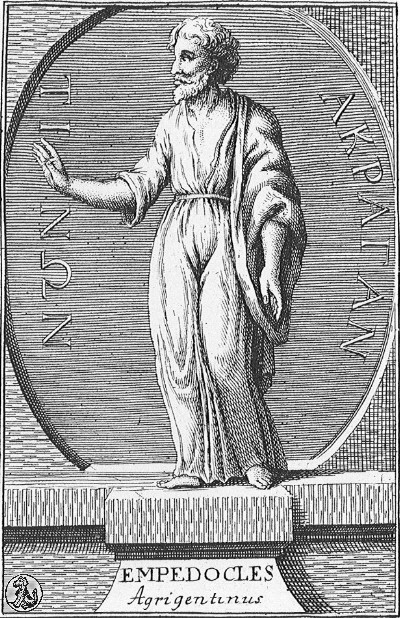 PhilosopherGreek & Romanc. 494 – 434 BCE
Empedocles
Proposed the four elements — earth, water, air and fire — moved by Love and Strife.
- ◆Classical four elements
- ◆fire
- ◆air
- ◆earth
- ◆water
Read the full pageEmpedocles (; Ancient Greek: Ἐμπεδοκλῆς; c. 494 – c. 434 BC, fl. 444–443 BC) was a pre-Socratic Greek philosopher and a native citizen of Akragas, a Greek city in Sicily. Empedocles' philosophy is known best for originating the cosmogonic theory of the four classical elements. He also proposed forces he called Love and Strife which would mix and separate the elements, respectively.
Empedocles challenged the practice of animal sacrifice and killing animals for food. He developed a distinctive doctrine of reincarnation. He is generally considered the last Greek philosopher to have recorded his ideas in verse. Some of his work survives, more than is the case for any other pre-Socratic philosopher. Empedocles' death was mythologized by ancient writers, and has been the subject of a number of literary treatments.
Galen regarded him as the founder of the Sicilian school of medicine.
- 10
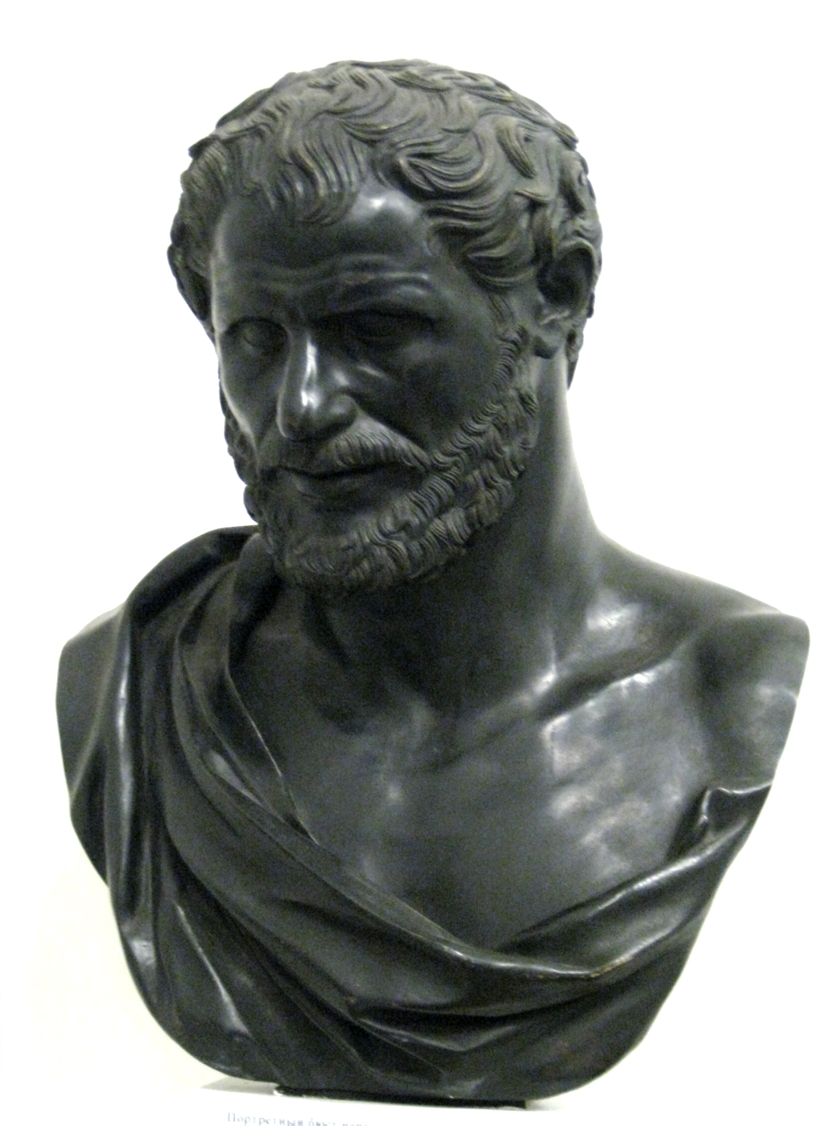 PhilosopherGreek & Romanc. 460 – 370 BCE
Democritus
The "laughing philosopher" who held that the world consists of atoms moving in the void.
- ◆Atoms and void
- ◆Secondary qualities exist only by convention
- ◆Cheerfulness as the goal
Read the full pageDemocritus ( dih-MOK-rih-təs; Greek: Δημόκριτος, Dēmókritos; c. 460 – c. 370 BC) was a pre-Socratic Greek philosopher from Abdera, primarily remembered today for his formulation of an atomic theory of the universe. Democritus wrote extensively on a wide variety of topics.
None of Democritus' original work has survived, except through second-hand references. Many of these references come from Aristotle, who viewed him as an important rival in the field of natural philosophy. He was known in antiquity as the 'laughing philosopher' because of his emphasis on the value of cheerfulness.
Although many anecdotes about Democritus' life survive, their authenticity cannot be verified and modern scholars doubt their accuracy.
- 11SchoolGreek & Roman460 BCE – present
Atomism
Everything is made of indivisible particles moving in the void.
- ◆Atoms and void
- ◆Mechanism without purpose
Read the full pageAtomism (from Ancient Greek ἄτομον (atomon) 'uncuttable, indivisible') is a natural philosophy proposing that the physical universe is composed of fundamental indivisible components known as atoms.
The concept of atomism appeared in both ancient Greek and ancient Indian philosophical traditions. Atomism in multiple different forms originated in ancient Greece. The word atom is derived from the term atomos ("uncuttable") used by the Greek philosophers Leucippus and his pupil Democritus, who developed this idea in the 5th century BC. Leucippus, Democritus, and other ancient Greek atomists argued that nature consists of two fundamental principles: atoms and void. Clusters of different shapes, arrangements, and positions give rise to the various macroscopic substances in the world.A similar idea was developed by Kanāda of the Vaiśeṣika school, who proposed indivisible particles (paramāṇu). Indian Buddhists, such as Dharmakirti (fl. c. 6th or 7th century) and others, developed distinctive theories of atomism, for example, involving momentary (instantaneous) atoms (kalapas) that flash in and out of existence.
The particles of chemical matter for which chemists and other natural philosophers of the early 19th century found experimental evidence were thought to be indivisible, and therefore were given by John Dalton the name "atom", long used by the atomist philosophy. Although the connection to historical atomism is at best tenuous, elementary particles have become a modern analogue of philosophical atoms.
- 12SchoolGreek & Roman450 – 350 BCE
Sophists
Paid teachers of rhetoric and virtue, often relativists — Socrates's great rivals.
- ◆Man is the measure of all things
- ◆Nature vs convention (physis vs nomos)
Read the full pageA sophist (Greek: σοφιστής, romanized: sophistēs) was a professional travelling teacher in ancient Greece in the fifth and fourth centuries BC. Sophists specialized in one or more subject areas, such as philosophy, rhetoric, music, athletics, mathematics, and arete: "virtue" or "excellence". The sophists sold their tutoring expertise predominantly to young statesmen and nobility. Certain sophists are regarded as philosophers in their own right. The first credited sophist, Protagoras, argued that "man is the measure of all things" and openly strove to "make the weaker argument the stronger".
The arts of the sophists were known as sophistry and gained a negative reputation as arbitrary, inauthentic, or deceptive styles of reasoning, beginning with the notable philosophers of Classical Athens who criticized sophists for valuing artistic speech or cleverness in debate over a genuine pursuit of truth and knowledge. Thus, in modern usage, sophism, sophist, and sophistry are used disparagingly. Sophistry, or a sophism, is a fallacious argument, especially one used deliberately to deceive. Today, a sophist is a person who reasons with clever but deceptive or intellectually dishonest arguments.
The Greek word sophós (σοφός) 'a wise man' is related to the noun sophía (σοφία) 'wisdom'. Since the times of Homer, it commonly referred to an expert in his profession or craft. Charioteers, sculptors, or military experts could be referred to as sophoi in their occupations. The word has gradually come to connote general wisdom and especially wisdom in human affairs such as politics, ethics, and household management. This was the meaning ascribed to the Greek Seven Sages of the 7th and 6th centuries BC (such as Solon and Thales), and it was the meaning that appears in the histories of Herodotus.
- 13
 PhilosopherGreek & Romanc. 490 – 420 BCE
Protagoras
Leading Sophist famous for "man is the measure of all things".
- ◆Relativism
- ◆Agnosticism about the gods
Read the full pageProtagoras ( proh-TAG-ər-əs, -ass; Greek: Πρωταγόρας; c. 490 BC – c. 420 BC) was a pre-Socratic Greek philosopher and rhetorical theorist. He is numbered as one of the sophists by Plato. In his dialogue Protagoras, Plato credits him with inventing the role of the professional sophist.
Protagoras is also believed to have created a major controversy during ancient times through his statement that "Of all things the measure is Man, of the things that are, that they are, and of the things that are not, that they are not" which was usually rendered simply as "Man is the measure of all things", interpreted by Plato to mean that there is no objective truth; Protagoras seems to have meant that each person's own personal history, experiences and expectations, developed over their lifetime, determine their judgments, opinions, and statements regarding "truth" (which is the title of the book in which Protagoras made this statement). When a person makes a judgment about a certain thing—good or bad or beautiful or unjust—that person will differ from other people's judgments because their experience has been different.
This concept of individual relativity was intended to be provocative; naturally, it was criticized by Plato and other philosophers, contrasting with both popular opinion and other philosophical doctrine that reality and its truth must have an objective grounding. However, it was part of Protagoras' point that the statement is somewhat counterintuitive. He argued that this concept—believing that others' opinions about the world are valid and must be respected, even if our own experience of truth is different—is necessary for a community to base itself and its decisions on open, democratic debate.