Medieval Christian philosophy
In the new universities, scholars reconciled faith with Aristotle through rigorous disputation. Anselm proved God from a concept; Abelard and Ockham argued about universals; Aquinas built the grand synthesis of the Summa.
- 1
 TraditionMedieval Latin400 – 1450
Medieval philosophy
Latin Christian philosophy from Augustine to Ockham, centred on faith and reason, universals, and the existence and nature of God.
- ◆Faith seeking understanding
- ◆The problem of universals
- ◆Scholastic method of disputation
Read the full pageMedieval philosophy is the philosophy that existed through the Middle Ages, the period roughly extending from the fall of the Western Roman Empire in the 5th century until after the Renaissance in the 13th and 14th centuries. Medieval philosophy, understood as a project of independent philosophical inquiry, began in Baghdad, in the middle of the 8th century, and in France and Germany, in the itinerant court of Charlemagne in Aachen, in the last quarter of the 8th century. It is defined partly by the process of rediscovering the ancient culture developed in Greece and Rome during the Classical period, and partly by the need to address theological problems and to integrate sacred doctrine with secular learning. This is one of the defining characteristics in this time period. Understanding God was the focal point of study of the Jewish, Christian and Muslim Philosophers and Theologians.
The history of medieval philosophy is traditionally divided into two main periods: the period in the Latin West following the Early Middle Ages until the 12th century, when the works of Aristotle and Plato were rediscovered, translated, and studied upon, and the "golden age" of the 12th, 13th and 14th centuries in the Latin West, which witnessed the culmination of the recovery of ancient philosophy, along with the reception of its Arabic commentators, and significant developments in the fields of philosophy of religion, logic, and metaphysics.
The high medieval Scholastic period was disparagingly treated by the Renaissance humanists, who saw it as a barbaric "middle period" between the Classical age of Greek and Roman culture, and the rebirth or renaissance of Classical culture. Modern historians consider the medieval era to be one of philosophical development, heavily influenced by Christian theology. One of the most notable thinkers of the era, Thomas of Aquinas, never considered himself a philosopher, and criticized philosophers for always "falling short of the true and proper wisdom".
- 2
 SchoolMedieval Latin1100 – 1700
Scholasticism
The medieval universities' method of rigorous disputation reconciling Christian doctrine with Aristotle.
Read the full pageScholasticism is a medieval European philosophical movement or methodology that was the predominant education in Europe from about 1100 to 1700. It is known for employing logically precise analyses toward the goal of reconciling classical philosophy (particularly Aristotelian logic) and Catholic Christianity.
The Scholastics, also known as Schoolmen, used dialectical reasoning predicated upon Aristotelianism and the Ten Categories. Scholasticism emerged within the monastic schools that translated medieval Judeo-Islamic philosophies, and rediscovered the collected works of Aristotle. Endeavoring to harmonize Aristotle's metaphysics and Latin Catholic theology, these monastic schools became the basis of the earliest European medieval universities, and thus became the bedrock for the development of modern science and philosophy in the Western world. The rise of scholasticism was closely associated with these schools that flourished in Italy, France, Portugal, Spain and England.
Scholasticism is a method of learning, more than a philosophy or a theology, since it places a strong emphasis on dialectical reasoning to extend knowledge by inference and to resolve contradictions. Scholastic thought is also known for rigorous conceptual analysis and the careful drawing of distinctions. In the classroom and in writing, it often takes the form of explicit disputation: a topic drawn from the tradition is broached in the form of a proposition on a question to be debated, oppositional responses are given, a counterproposal is argued and oppositional arguments rebutted. Because of its emphasis on rigorous dialectical method, scholasticism was eventually applied to many other fields of study.
- 3
 PhilosopherMedieval Latin1033 – 1109
Anselm of Canterbury
Originator of the ontological argument: God is that than which nothing greater can be conceived.
- ◆Faith seeking understanding
- ◆Ontological argument
Read the full pageAnselm of Canterbury (; 1033/4–1109), also known as Anselm of Aosta (French: Anselme d'Aoste, Italian: Anselmo d'Aosta) after his birthplace and Anselm of Bec (French: Anselme du Bec) after his monastery, was a Benedictine abbot, philosopher and theologian who served as Archbishop of Canterbury from 1093 to 1109.
As Archbishop of Canterbury, he defended the Church's interests in England amid the Investiture Controversy. For his resistance to the English kings William II and Henry I, he was exiled twice: once from 1097 to 1100 and then from 1105 to 1107. While in exile, he participated in the Council of Bari, where he helped convince the Greek Catholic bishops of southern Italy to adopt the Roman Rite. In England, he asserted the primacy of Canterbury over the Archbishop of York and over the bishops of Wales, and at the time of his death he appeared to have been successful in this. However, Pope Paschal II later reversed the papal decisions on the matter and restored York's earlier status.
Beginning during his time at Bec, Anselm composed dialogues and treatises with both a mystical and a rational or philosophical approach, this latter aspect causing him sometimes to be credited as the founder of Scholasticism. Despite his lack of recognition in this field in his own lifetime, Anselm is famously regarded as the originator of the ontological argument for the existence of God and of the satisfaction theory of atonement.
- 4
 ArgumentMedieval Latin
Ontological argument
God is that than which nothing greater can be conceived; such a being must exist in reality, not only in the mind.
P1God is that than which nothing greater can be conceived
P2God exists at least in the understanding
P3It is greater to exist in reality than only in the understanding
P4If God existed only in the understanding, something greater could be conceived
∴God exists in reality.
Read the full pageAnselm of Canterbury's argument in the Proslogion (1078) tries to prove God's existence from the concept of God alone, without any appeal to experience.
Even the fool who denies God, Anselm says, understands what "God" means: that than which nothing greater can be conceived. So God exists at least in the understanding. But a being that exists in reality as well as in the mind is greater than one that exists only in the mind. So if God existed only in the mind, we could conceive of something greater — which is contradictory. Therefore God exists in reality.
The monk Gaunilo replied that the same reasoning would prove the existence of a perfect island. Kant objected that "existence is not a real predicate": it adds nothing to the concept of a thing. Descartes, Leibniz and, in the 20th century, Alvin Plantinga (with modal logic) produced new versions; the argument remains one of philosophy's most fascinating puzzles.
- 5
 PhilosopherMedieval Latin1079 – 1142
Peter Abelard
Brilliant Paris logician who argued for conceptualism about universals and an ethics of intention.
- ◆Conceptualism
- ◆limbo
- ◆moral influence theory of atonement
Read the full pagePeter Abelard (12 February 1079 – 21 April 1142) was a French philosopher, logician, theologian, composer, and poet, regarded as one of the most brilliant and controversial theologians of his time. Born at Pallet, near Nantes, he became a popular lecturer in Paris, but his academic career was cut short after his love affair with his student and eventual wife, Héloïse d'Argenteuil. Their relationship and philosophical exchange later became the aspect of his life for which he is best known in history and popular culture.
In philosophy, Abelard challenged the prevailing philosophical orthodoxy and is celebrated for his logical treatment of the problem of universals through nominalism and conceptualism, thereby helping to prepare the way for nominalism, as well as for pioneering the role of intent in ethics. He has often been called the "Descartes of the twelfth century" and has been considered a forerunner of Rousseau, Kant, and Spinoza. He is also sometimes credited as a major forerunner of modern empiricism.
In Catholic theology, Abelard was condemned for his teaching on the Trinity. He is particularly known for developing the concept of limbo and for introducing the moral influence theory of atonement. His doctrine of the atonement emphasized the love of Christ as manifested in his life and Passion, which in turn calls forth a human response of love, and this conception has had a continuing influence. Abelard expressed its underlying purpose in the words: "The purpose and cause of the incarnation was that God might illuminate the world by his wisdom and stir it to the love of himself."
- 6
 ConceptMedieval Latin
Problem of universals
Do properties like "redness" exist apart from red things, only in them, or only as names?
- ◆Realism
- ◆Conceptualism
- ◆Nominalism
Read the full pageThe problem of universals is an ancient question from metaphysics that has inspired a range of philosophical topics and disputes: "Should the properties an object has in common with other objects, such as color and shape, be considered to exist beyond those objects? And if a property exists separately from objects, what is the nature of that existence?"
Universals are qualities or relations found in two or more entities. As an example, if all cup-holders are circular in some way, then circularity may be considered a universal property of cup-holders. Similarly, if one has a set of seven red and three blue balls, it would seem that though the set comprises ten separate entities (balls), there are only two colors therein—each being shared by multiple balls. Many properties can be universal: being human, red, male or female, liquid or solid, big or small, etc.
The problem of universals relates to various inquiries within metaphysics, logic, and epistemology, dating from as far back as Plato and Aristotle, in efforts to understand how the same single property can be (at least apparently) shared across multiple, non-identical objects. Philosophers agree that human beings can talk and think about universals, but disagree on whether universals exist in reality beyond mere thought and speech.
- 7
 PhilosopherMedieval Latin1098 – 1179
Hildegard of Bingen
Abbess, visionary, composer and natural philosopher.
Read the full pageHildegard of Bingen, also known as the "Sibyl of the Rhine", was a German Benedictine abbess and polymath, active during the High Middle Ages as a writer, composer, philosopher, mystic and visionary. She is one of the best-known composers of sacred monophony, as well as the most recorded in modern history. A number of scholars have considered her to be the founder of scientific natural history in Germany.
Hildegard's convent at Disibodenberg elected her as magistra (mother superior) in 1136. She founded the monasteries of Rupertsberg in 1150 and Eibingen in 1165. Hildegard wrote theological, botanical, and medicinal works, as well as letters, hymns, and antiphons for the liturgy. She wrote poems, and supervised miniature illuminations in the Rupertsberg manuscript of her first work, Scivias. There are more surviving chants by Hildegard than by any other composer from the entire Middle Ages, and she is one of the few known composers to have written both the music and the words. One of her works, the Ordo Virtutum, is an early example of liturgical drama and arguably the oldest surviving morality play. She is noted for the invention of a constructed language known as Lingua Ignota.
Although the history of her formal canonization is complicated, regional calendars of the Catholic Church have listed her as a saint for centuries. On 10 May 2012, Pope Benedict XVI extended the liturgical cult of Hildegard to the entire Catholic Church in a process known as "equivalent canonization". On 7 October 2012, he named her a Doctor of the Church, in recognition of "her holiness of life and the originality of her teaching."
- 8
 PhilosopherMedieval Latin1225 – 1274
Thomas Aquinas
The great scholastic synthesiser of Aristotle and Christianity, author of the Summa Theologiae and the Five Ways.
- ◆The Five Ways
- ◆Natural law
- ◆Faith and reason as complementary
- ◆Analogy of being
Read the full pageThomas Aquinas ( ə-KWY-nəs; Italian: Tommaso d'Aquino, lit. 'Thomas of Aquino'; c. 1225 – 7 March 1274) was an Italian Dominican friar and priest, theologian, and philosopher. He is considered one of the most influential thinkers in the history of Catholic theology and Western philosophy. He is the father of a school of thought (encompassing both theology and philosophy) known as Thomism.
A proponent of natural theology, Thomas argued that God is the source of the light of natural reason and the light of faith. He embraced several ideas put forward by Aristotle and sought to synthesize Aristotelian philosophy with the principles of Christianity. Among his best-known ideas include his Five Ways for proving the existence of God, his virtue ethics, and his sacramental theology. In addition to its vast influence on Catholic thought, his philosophy has influenced modern virtue ethics, aesthetics, and cognitive theory.
Thomas's best-known work is the unfinished Summa Theologica, or Summa Theologiae (1265–1274), which is a comprehensive guide to the theology of the Catholic Church. His body of work also includes the Disputed Questions on Truth (1256–1259), the Summa contra Gentiles (1259–1265), and numerous commentaries on Christian Scripture and on Aristotle. He is also known for his Eucharistic hymns, which form a part of the Church's liturgy. In 1323, nearly 50 years after his death, Thomas was canonized as a saint by Pope John XXII.
- 9
 ArgumentMedieval Latin
The Five Ways
Aquinas's five proofs of God: from motion, causation, contingency, degrees of perfection and design.
Read the full pageThe Five Ways, or Quinque viæ, are five short arguments for the existence of God, written by the medieval Christian theologian and philosopher Thomas Aquinas in the 13th century. They appear in his major work, the Summa Theologiae, where Aquinas asks whether God exists and answers yes. Each argument starts from something that people can observe in the world and reasons that it points to God as its source.
Things in the world change and move, and each change seems to be brought about by something else.
Everything that happens has a cause, and causes themselves have causes.
- 10Argument
Cosmological argument
Everything that begins to exist has a cause; the universe began to exist; so it has a cause.
P1Whatever begins to exist (or is contingent) has a cause
P2The universe began to exist (or is contingent)
P3An infinite regress of causes is impossible
∴There is a first cause or necessary being.
Read the full pageIn philosophy of religion, a cosmological argument is an argument for the existence of God based on observational statements concerning the universe and its contents, examined metaphysically through the lenses of causation or motion (change). The universe is determined to be contingent or finite in a manner that substantiates an external foundation for its existence. By referring to reason and observation alone for its premises—and precluding revelation—this category of argument falls within the domain of natural theology. A cosmological argument can also be referred to as an argument from universal causation, a First Cause argument or prime mover argument.
The concept of causation, or causal principle, is a fundamental pillar of most cosmological arguments, especially in affirming the necessity for a First Cause. The latter is identified by philosophical analysis to be God as determined within classical or other specific conceptions of theism. Some formulations of the argument classify the universe as contingent in the metaphysical sense that it has the potential to not exist and lacks a reason for its existence within itself. Other variations expound its finitude in the impossibility of an infinite regress of causal interactions, kinetic interactions between objects in motion or past events, to specify the existence of a First Cause or an unmoved mover.
The origins of the argument date back at least to Aristotle, developed subsequently within the scholarly traditions of Neoplatonism and early Christianity, then under medieval Islamic scholasticism through the 9th to 12th centuries. It would eventually be re-introduced to Christian theology in the 13th century by Thomas Aquinas. In the 18th century, it would become associated with the principle of sufficient reason articulated by Gottfried Leibniz and Samuel Clarke, itself an exposition of the Parmenidean causal principle that "nothing comes from nothing". Contemporary defenders of cosmological arguments include William Lane Craig, Robert Koons, John Lennox, Stephen Meyer, and Alexander Pruss.
- Read the full page
Natural law (Latin: ius naturale, lex naturalis) is a philosophical and legal theory that posits the existence of inherent laws derived from nature and universal moral principles that are discoverable through reason. In ethics, natural law theory asserts that certain rights and moral values are inherent in human nature and can be universally understood, independent of enacted laws or social norms. In jurisprudence, natural law—sometimes referred to as iusnaturalism or jusnaturalism—holds that there are objective legal standards based on morality that underlie the creation, interpretation, and application of human-made laws. This contrasts with positive law (as in legal positivism), which emphasizes that laws are rules created by human authorities and are not necessarily connected to moral principles. Natural law can refer to "theories of ethics, theories of politics, theories of civil law, and theories of religious morality", depending on the context in which naturally-grounded practical principles are claimed to exist.
In the Western tradition, natural law was anticipated by the pre-Socratics, for example, in their search for principles that governed the cosmos and human beings. The concept of natural law was documented in ancient Greek philosophy, including Aristotle, and was mentioned in ancient Roman philosophy by Cicero. References to it are also found in the Old and New Testaments of the Bible, and were later expounded upon in the Middle Ages by Christian philosophers such as Albert the Great and Thomas Aquinas. The School of Salamanca made notable contributions to natural law theory during the Renaissance.
Although the central ideas of natural law had been part of Christian thought since the Roman Empire, its foundation as a consistent system was laid by Aquinas, who synthesized and condensed his predecessors' ideas into his Lex Naturalis (lit. 'natural law'). Aquinas argues that because human beings have reason, and because reason is a spark of the divine, all human lives are sacred and of infinite value compared to any other created object, meaning everyone is fundamentally equal and endowed with an intrinsic basic set of rights that no one can remove.
- 12
 WorkMedieval Latin1265 – 1274
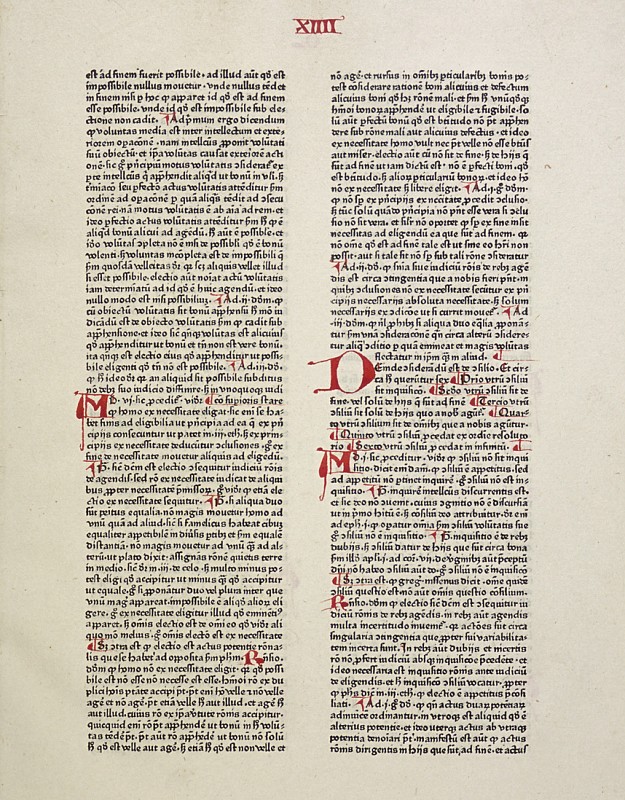
Summa Theologiae
Aquinas's unfinished masterpiece of systematic theology and philosophy, home of the Five Ways.
Read the full pageThe Summa Theologiae or Summa Theologica (transl. 'Summary of Theology'), often referred to simply as the Summa, is the best-known work of Thomas Aquinas (1225–1274), a scholastic theologian and Doctor of the Church. It is a compendium of all of the main theological teachings of the Catholic Church. Presenting the reasoning for almost all points of Christian theology in the West, topics of the Summa follow the following cycle: God; Creation, Man; Man's purpose; Christ; the Sacraments; and back to God.
Although unfinished, it is "one of the classics of the history of philosophy and one of the most influential works of Western literature". It remains Aquinas's "most perfect work, the fruit of his mature years, in which the thought of his whole life is condensed".
The Summa is a more structured and expanded version of Aquinas's earlier Summa contra Gentiles, though the two were written for different purposes. Throughout the Summa, Aquinas aims to reconcile Aristotelian philosophy with Catholic theology. Although he broadly cites the Bible, patristic, scholastic, Islamic, Jewish, and pre-Christian Greek and Roman sources, his most referenced non-scriptural authors are Aristotle (whom he calls "the philosopher") and Augustine.
- 13
 PhilosopherMedieval Latin1266 – 1308
John Duns Scotus
Subtle scholastic of univocity of being and individual "thisness" (haecceity).
Read the full pageJohn Duns Scotus ( dunz SKOH-təs; Ecclesiastical Latin: [duns ˈskɔtus], 'Duns the Scot'; c. 1265/66 – 8 November 1308) was a Scottish Catholic priest and Franciscan friar, university professor, philosopher and theologian. He is considered among the most important philosopher-theologians in Western Christendom during the last part of the medieval period, together with Thomas Aquinas, Bonaventure and William of Ockham. The intellectual tradition derived from Scotus's work is called Scotism.
Duns Scotus has had considerable influence on both Catholic and secular thought. The doctrines for which he is best known are the "univocity of being", that existence is the most abstract concept we have, applicable to everything that exists; the formal distinction, a way of distinguishing between different formalities of the same thing; and the idea of haecceity, the property supposed to be in each individual thing that makes it an individual (i.e., a certain "thisness"). Duns Scotus also developed a complex argument for the existence of God, and argued for the Immaculate Conception of Mary.
Duns Scotus was given the scholastic accolade Doctor Subtilis ('the subtle Doctor') for his penetrating and subtle manner of thought. He was beatified by Pope John Paul II in 1993.
- 14
 PhilosopherMedieval Latin1287 – 1347
William of Ockham
Nominalist famous for Ockham's razor: do not multiply entities beyond necessity.
- ◆Ockham's razor
- ◆Nominalism
Read the full pageWilliam of Ockham or Occam ( OK-əm; Latin: Guillelmus de Ockham; c. 1287 – 9/10 April 1347) was an English Franciscan friar, scholastic philosopher and theologian. He is considered to be one of the major figures of medieval thought and was at the centre of the major intellectual and political controversies of the 14th century. The nominalists of the fifteenth century regarded him as one of the founders of their movement. He is widely known for Occam's razor, the methodological principle that bears his name. He produced significant works on logic, physics and theology. Ockham is remembered in the Church of England with a commemoration corresponding to the commonly ascribed date of his death on 10 April.
William of Ockham was probably born in Ockham, Surrey, around 1287. At an early age he became a member of the Franciscan Order (Order of Friars Minor) and received the first stages of his theological education in the Franciscan school in London. From some undetermined date until probably 1321 he studied in the Franciscan school in the University of Oxford. Although he completed all the requirements for a master's degree in theology, he never was a regent master. Because of this he was later called the Venerabilis Inceptor. (An inceptor was someone recognized by the university as qualified to begin ("incept") as a regent master.)
A scholar seeking to become a Master of Theology was required to give lectures on Peter Lombard's Sentences. These lectures (which were usually in the form of disputed questions) were often copied and circulated, and a "Commentary on the Sentences" was often a theologian's main publication. Ockham's disputations on the Sentences were held probably in the years 1317-1319. His Sentences commentary has been edited in his Opera Theologica.
- 15ConceptMedieval Latin
Ockham's razor
Entities should not be multiplied beyond necessity — prefer the simplest adequate explanation.
Read the full pageIn philosophy, Occam's razor (also spelled Ockham's razor or Ocham's razor; Latin: novacula Occami) is the problem-solving principle that recommends searching for explanations constructed with the smallest possible set of elements. It is also known as the principle of parsimony or the law of parsimony (Latin: lex parsimoniae). Attributed to William of Ockham, a 14th-century English philosopher and theologian, it is frequently cited as Entia non sunt multiplicanda praeter necessitatem, which translates as "Entities must not be multiplied beyond necessity", although Occam never used those words. Popularly, the principle is sometimes paraphrased as "of two competing theories, the simpler explanation of an entity is to be preferred".
The philosophical razor advocates that when presented with competing hypotheses about the same prediction and both hypotheses have equal explanatory power, one should prefer the hypothesis that requires the fewest assumptions, and that this is not meant to be a way of choosing between hypotheses that make different predictions. Similarly, in science, Occam's razor is used as an abductive heuristic in the development of theoretical models rather than as a rigorous arbiter between candidate models.
The phrase Occam's razor did not appear until a few centuries after William of Ockham's death in 1347. Libert Froidmont, in his 1649 Philosophia Christiana de Anima (On Christian Philosophy of the Soul) claimed to have coined the phrase novacula occami when he described Gregory of Rimini, one of Ockham's critics. Ockham did not invent this principle, but its fame – and its association with him – may be due to the frequency and effectiveness with which he used it. Ockham stated the principle in various ways, but the most popular version – "Entities are not to be multiplied without necessity" (Non sunt multiplicanda entia sine necessitate) – was formulated by the Irish Franciscan philosopher John Punch in his 1639 commentary on the works of Duns Scotus.


