
Anselm of Canterbury
Originator of the ontological argument: God is that than which nothing greater can be conceived.
Key ideas
Anselm of Canterbury (; 1033/4–1109), also known as Anselm of Aosta (French: Anselme d'Aoste, Italian: Anselmo d'Aosta) after his birthplace and Anselm of Bec (French: Anselme du Bec) after his monastery, was a Benedictine abbot, philosopher and theologian who served as Archbishop of Canterbury from 1093 to 1109.
As Archbishop of Canterbury, he defended the Church's interests in England amid the Investiture Controversy. For his resistance to the English kings William II and Henry I, he was exiled twice: once from 1097 to 1100 and then from 1105 to 1107. While in exile, he participated in the Council of Bari, where he helped convince the Greek Catholic bishops of southern Italy to adopt the Roman Rite. In England, he asserted the primacy of Canterbury over the Archbishop of York and over the bishops of Wales, and at the time of his death he appeared to have been successful in this. However, Pope Paschal II later reversed the papal decisions on the matter and restored York's earlier status.
Beginning during his time at Bec, Anselm composed dialogues and treatises with both a mystical and a rational or philosophical approach, this latter aspect causing him sometimes to be credited as the founder of Scholasticism. Despite his lack of recognition in this field in his own lifetime, Anselm is famously regarded as the originator of the ontological argument for the existence of God and of the satisfaction theory of atonement.
After his death, Anselm was canonized as a saint; his feast day is 21 April. He was proclaimed a Doctor of the Church by a papal bull of Pope Clement XI in 1720.
Family
Anselm was born in or around Aosta in Upper Burgundy sometime between April 1033 and April 1034. The area now forms part of the Republic of Italy, but Aosta had been part of the post-Carolingian Kingdom of Burgundy until the death of the childless Rudolph III in 1032. The Emperor Conrad II and Odo II, Count of Blois then went to war over the succession. Humbert the White-Handed, Count of Maurienne, so distinguished himself that he was granted a new county carved out of the secular holdings of the bishop of Aosta. Humbert's son Otto was subsequently permitted to inherit the extensive March of Susa through his wife Adelaide in preference to her uncle's families, who had supported the effort to establish an independent Kingdom of Italy under William V, Duke of Aquitaine. Otto and Adelaide's unified lands then controlled the most important passes in the Western Alps and formed the county of Savoy whose dynasty would later rule the kingdoms of Sardinia and Italy.
Records during this period are scanty, but both sides of Anselm's immediate family appear to have been dispossessed by these decisions in favour of their extended relations. His father Gundulph or Gundulf or Gondulphe was a Lombard noble, probably one of Adelaide's Arduinici uncles or cousins; his mother Ermenberge was almost certainly the granddaughter of Conrad the Peaceful, related both to the Anselmid bishops of Aosta and to the heirs of Henry II who had been passed over in favour of Conrad. The marriage was thus probably arranged for political reasons but proved ineffective in opposing Conrad after his successful annexation of Burgundy on 1 August 1034. (Bishop Burchard subsequently revolted against imperial control but was defeated and was ultimately translated to the diocese of Lyon.) Ermenberge appears to have been the wealthier partner in the marriage. Gundulph moved to his wife's town, where she held a palace, most likely near the cathedral, along with a villa in the valley. Anselm's father is sometimes described as having a harsh and violent temper but contemporary accounts merely portray him as having been overgenerous or careless with his wealth; Meanwhile, Anselm's mother Ermenberge, patient and devoutly religious, made up for her husband's faults by her prudent management of the family estates. In later life, there are records of three relations who visited Bec: Folceraldus, Haimo, and Rainaldus. The first repeatedly attempted to exploit Anselm's renown, but was rebuffed since he already had his ties to another monastery, whereas Anselm's attempts to persuade the other two to join the Bec community were unsuccessful.
Early life
At the age of fifteen, Anselm felt the call to enter a monastery but, failing to obtain his father's consent, he was refused by the abbot. The illness he then suffered has been considered by some a psychosomatic effect of his disappointment, but upon his recovery he gave up his studies and for a time lived a carefree life.
Following the death of his mother, probably at the birth of his sister Richera, Anselm's father repented his own earlier lifestyle but professed his new faith with a severity that the boy found likewise unbearable. When Gundulph entered a monastery, Anselm, at age 23, left home with a single attendant, crossed the Alps, and wandered through Burgundy and France for three years. His countryman Lanfranc of Pavia was then prior of the Benedictine abbey of Bec in Normandy. Attracted by Lanfranc's reputation, Anselm reached Normandy in 1059. After spending some time in Avranches, he returned the next year. His father having died, he consulted with Lanfranc as to whether to return to his estates and employ their income in providing alms for the poor or to renounce them, becoming a hermit or a monk at Bec or Cluny. Given what he saw as his own conflict of interest, Lanfranc sent Anselm to Maurilius, the archbishop of Rouen, who convinced him to enter Bec as a novice at the age of 27. Probably in his first year, he wrote his first work on philosophy, a treatment of Latin paradoxes called the Grammarian. Over the next decade, the Rule of Saint Benedict reshaped his thought.
Early years
Three years later, in 1063, Duke William II summoned Lanfranc to serve as the abbot of his new abbey of St Stephen at Caen and the monks of Bec, despite the initial hesitation of some on account of his youth, elected Anselm prior. A notable opponent was a young monk named Osborne. Anselm overcame his hostility first by praising, indulging, and privileging him in all things despite his hostility and then, when his affection and trust were gained, gradually withdrawing all preference until he upheld the strictest obedience. Along similar lines, he remonstrated with a neighbouring abbot who complained that his charges were incorrigible despite being beaten "night and day". After fifteen years, in 1078, Anselm was unanimously elected as Bec's abbot following the death of its founder, the warrior-monk Herluin. He was blessed as abbot by Gilbert d'Arques, Bishop of Évreux, on 22 February 1079.
Under Anselm's direction, Bec became the foremost seat of learning in Europe, attracting students from France, Italy, and elsewhere. During this time, he wrote the Monologion and Proslogion. He then composed a series of dialogues on the nature of truth, free will, and the fall of Satan. When the nominalist Roscelin attempted to appeal to the authority of Lanfranc and Anselm at his trial for the heresy of tritheism at Soissons in 1092, Anselm composed the first draft of De Fide Trinitatis as a rebuttal and as a defence of Trinitarianism and universals. The fame of the monastery grew not only from his intellectual achievements, however, but also from his good example and his loving, kindly method of discipline, particularly with the younger monks. There was also admiration for his spirited defence of the abbey's independence from lay and archiepiscopal control, especially in the face of Robert de Beaumont, Earl of Leicester and the new Archbishop of Rouen, William Bona Anima.
In England
Following the Norman Conquest of England in 1066, devoted lords had given the abbey extensive lands across the Channel. Anselm occasionally visited to oversee the monastery's property, to wait upon his sovereign William I of England (formerly Duke William II of Normandy), and to visit Lanfranc, who had been installed as archbishop of Canterbury in 1070. He was respected by William I and the good impression he made while in Canterbury made him the favourite of its cathedral chapter as a future successor to Lanfranc. Instead, upon the archbishop's death in 1089, King William II—William Rufus or William the Red—refused the appointment of any successor and appropriated the see's lands and revenues for himself. Fearing the difficulties that would attend being named to the position in opposition to the king, Anselm avoided journeying to England during this time. The gravely ill Hugh, Earl of Chester, finally lured him over with three pressing messages in 1092, seeking advice on how best to handle the establishment of the new monastery of St Werburgh at Chester. Hugh had recovered by the time of Anselm's arrival, and Anselm was occupied four or five months organizing the new community. He then travelled to his former pupil Gilbert Crispin, abbot of Westminster, and waited, apparently delayed by the need to assemble the donors of Bec's new lands in order to obtain royal approval of the grants.
At Christmas, William II pledged by the Holy Face of Lucca that neither Anselm nor any other would sit at Canterbury while he lived but in March he fell seriously ill at Alveston. Believing his sinful behavior was responsible, he summoned Anselm to hear his confession and administer last rites. He published a proclamation releasing his captives, discharging his debts, and promising to henceforth govern according to the law. On 6 March 1093, he further nominated Anselm to fill the vacancy at Canterbury; the clerics gathered at court acclaiming him, forcing the crozier into his hands, and bodily carrying him to a nearby church amid a Te Deum. Anselm tried to refuse on the grounds of age and ill-health for months and the monks of Bec refused to give him permission to leave them. Negotiations were handled by the recently restored Bishop William of Durham and Robert, count of Meulan. On 24 August, Anselm gave King William the conditions under which he would accept the position, which amounted to the agenda of the Gregorian Reform: the king would have to return the Catholic Church lands which had been seized, accept his spiritual counsel, and forswear Antipope Clement III in favour of Urban II. William Rufus was exceedingly reluctant to accept these conditions: he consented only to the first and, a few days afterwards, reneged on that, suspending preparations for Anselm's investiture. Public pressure forced William to return to Anselm and in the end they settled on a partial return of Canterbury's lands as his own concession. Anselm received dispensation from his duties in Normandy, did homage to William, and—on 25 September 1093—was enthroned at Canterbury Cathedral. The same day, William II finally returned the lands of the see.
From the mid-8th century, it had become the custom that metropolitan bishops could not be consecrated without a woollen pallium given or sent by the pope himself. Anselm insisted that he journey to Rome for this purpose but William would not permit it. Amid the Investiture Controversy, Pope Gregory VII and Emperor Henry IV had deposed each other twice; bishops loyal to Henry finally elected Guibert, archbishop of Ravenna, as a second pope. In France, Philip I had recognized Gregory and his successors Victor III and Urban II, but Guibert (as "Clement III") held Rome after 1084. William had not chosen a side and maintained his right to prevent the acknowledgement of either pope by an English subject prior to his choice. In the end, a ceremony was held to consecrate Anselm as archbishop on 4 December, without the pallium.
Archbishop of Canterbury
As archbishop, Anselm maintained his monastic ideals, including stewardship, prudence, and proper instruction, prayer and contemplation. Anselm advocated for reform and interests of Canterbury. As such, he repeatedly pressed the English monarchy for support of the reform agenda. His principled opposition to royal prerogatives over the Catholic Church, meanwhile, twice led to his exile from England.
The traditional view of historians has been to see Anselm as aligned with the papacy against lay authority and Anselm's term in office as the English theatre of the Investiture Controversy begun by Pope Gregory VII and the emperor Henry IV. By the end of his life, he had proven successful, having freed Canterbury from submission to the English king, received papal recognition of the submission of wayward York and the Welsh bishops, and gained strong authority over the Irish bishops. He died before the Canterbury–York dispute was definitively settled, however, and Pope Honorius II finally found in favour of York instead.
Although the work was largely handled by Christ Church's priors Ernulf (1096–1107) and Conrad (1108–1126), Anselm's episcopate also saw the expansion of Canterbury Cathedral from Lanfranc's initial plans. The eastern end was demolished and an expanded choir placed over a large and well-decorated crypt, doubling the cathedral's length. The new choir formed a church unto itself with its own transepts and a semicircular ambulatory opening into three chapels.
Conflicts with William Rufus
Anselm's vision was of a Catholic Church with its own internal authority, which clashed with William II's desire for royal control over both church and State. One of Anselm's first conflicts with William came in the month he was consecrated. William II was preparing to wrest Normandy from his elder brother, Robert II, and needed funds. Anselm was among those expected to pay him. He offered £500 but William refused, encouraged by his courtiers to insist on £1000 as a kind of annates for Anselm's elevation to archbishop. Anselm not only refused, he further pressed the king to fill England's other vacant positions, permit bishops to meet freely in councils, and to allow Anselm to resume enforcement of canon law, particularly against incestuous marriages, until he was ordered to silence. When a group of bishops subsequently suggested that William might now settle for the original sum, Anselm replied that he had already given the money to the poor and "that he disdained to purchase his master's favour as he would a horse or ass". The king being told this, he replied Anselm's blessing for his invasion would not be needed as "I hated him before, I hate him now, and shall hate him still more hereafter". Withdrawing to Canterbury, Anselm began work on the Cur Deus Homo.
Upon William's return, Anselm insisted that he travel to the court of Urban II to secure the pallium that legitimized his office. On 25 February 1095, the Lords Spiritual and Temporal of England met in a council at Rockingham to discuss the issue. The next day, William ordered the bishops not to treat Anselm as their primate or as Canterbury's archbishop, as he openly adhered to Urban. The bishops sided with the king, the Bishop of Durham presenting his case and even advising William to depose and exile Anselm. The nobles siding with Anselm, the conference ended in deadlock and the matter was postponed. Immediately following this, William secretly sent William Warelwast and Gerard to Italy, prevailing on Urban to send a legate bearing Canterbury's pallium. Walter, bishop of Albano, was chosen and negotiated in secret with William's representative, the Bishop of Durham. The king agreed to publicly support Urban's cause in exchange for acknowledgement of his rights to accept no legates without invitation and to block clerics from receiving or obeying papal letters without his approval. William's greatest desire was for Anselm to be removed from office. Walter said that "there was good reason to expect a successful issue in accordance with the king's wishes" but, upon William's open acknowledgement of Urban as pope, Walter refused to depose the archbishop. William then tried to sell the pallium to others, failed, tried to extract a payment from Anselm for the pallium, but was again refused. William then tried to personally bestow the pallium to Anselm, an act connoting the church's subservience to the throne, and was again refused. In the end, the pallium was laid on the altar at Canterbury, whence Anselm took it on 10 June 1095.
The First Crusade was declared at the Council of Clermont in November. Despite his service for the king which earned him rough treatment from Anselm's biographer Eadmer, upon the grave illness of the Bishop of Durham in December, Anselm journeyed to console and bless him on his deathbed. Over the next two years, William opposed several of Anselm's efforts at reform—including his right to convene a council—but no overt dispute is known. However, in 1094, the Welsh had begun to recover their lands from the Marcher Lords and William's 1095 invasion had accomplished little; two larger forays were made in 1097 against Cadwgan in Powys and Gruffudd in Gwynedd. These were also unsuccessful and William was compelled to erect a series of border fortresses. He charged Anselm with having given him insufficient knights for the campaign and tried to fine him. In the face of William's refusal to fulfill his promise of church reform, Anselm resolved to proceed to Rome—where an army of French crusaders had finally installed Urban—in order to seek the counsel of the pope. William again denied him permission. The negotiations ended with Anselm being "given the choice of exile or total submission": if he left, William declared he would seize Canterbury and never again receive Anselm as archbishop; if he were to stay, William would impose his fine and force him to swear never again to appeal to the papacy.
First exile
Anselm chose to depart in October 1097. Although Anselm retained his nominal title, William immediately seized the revenues of his bishopric and retained them til death. From Lyon, Anselm wrote to Urban, requesting that he be permitted to resign his office. Urban refused but commissioned him to prepare a defence of the Western doctrine of the procession of the Holy Spirit against representatives from the Greek Church. Anselm arrived in Rome by April and, according to his biographer Eadmer, lived beside the pope during the Siege of Capua in May. Count Roger's Saracen troops supposedly offered him food and other gifts but the count actively resisted the clerics' attempts to convert them to Catholicism.
At the Council of Bari in October, Anselm delivered his defence of the Filioque and the use of unleavened bread in the Eucharist before 185 bishops. Although this is sometimes portrayed as a failed ecumenical dialogue, it is more likely that the "Greeks" present were the local bishops of Southern Italy, some of whom had been ruled by Constantinople as recently as 1071. The formal acts of the council have been lost and Eadmer's account of Anselm's speech principally consists of descriptions of the bishops' vestments, but Anselm later collected his arguments on the topic as De Processione Spiritus Sancti. Under pressure from their Norman lords, the Italian Greeks seem to have accepted papal supremacy and Anselm's theology. The council also condemned William II. Eadmer credited Anselm with restraining the pope from excommunicating him, although others attribute Urban's politic nature.
Anselm was present in a seat of honour at the Easter Council at St Peter's in Rome the next year. There, amid an outcry to address Anselm's situation, Urban renewed bans on lay investiture and on clerics doing homage. Anselm departed the next day, first for Schiavi—where he completed his work Cur Deus Homo—and then for Lyon.
Conflicts with Henry I
Adapted from the Wikipedia article Anselm of Canterbury, available under CC BY-SA 4.0.
In their words
“I do not seek to understand in order that I may believe, but I believe in order to understand.”
Connections
Belongs to
1
Influenced by
1
Influenced
7


Ideas & arguments
1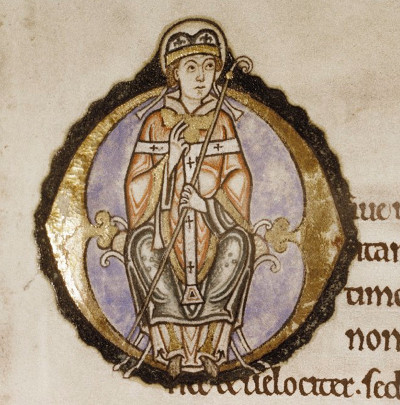
Works
1
You might also explore
 John Duns ScotusMedieval Latin1266 – 1308Subtle scholastic of univocity of being and individual "thisness" (haecceity).
 Aristotle★Greek & Roman384 – 322 BCEPlato's student and Alexander's tutor, who systematised logic, ethics, biology, metaphysics and politics — "the master…
 Plato★Greek & Romanc. 428 – 348 BCEFounder of the Academy whose dialogues defined Western philosophy's agenda: Forms, justice, the soul, knowledge and the…
 René Descartes★Modern European1596 – 1650The father of modern philosophy: he doubted everything he could and found certainty in "I think, therefore I am".
 Thomas Aquinas★Medieval Latin1225 – 1274The great scholastic synthesiser of Aristotle and Christianity, author of the Summa Theologiae and the Five Ways.
 Baruch Spinoza★Jewish1632 – 1677Lens-grinder of Amsterdam who identified God with Nature and wrote an Ethics in geometrical order.