Jewish philosophy
From Philo's allegories to Maimonides's Guide and on to Spinoza, Buber and Levinas, Jewish philosophers have brought scripture into dialogue with Greek, Islamic and modern thought.
- 1
 TraditionJewish20 BCE – present
Jewish philosophy
Reflection on Jewish scripture and law in dialogue with Greek, Islamic and modern thought — from Philo of Alexandria to Maimonides, Spinoza, Buber and Levinas.
- ◆Negative theology: what God is not
- ◆Law and reason as complementary
- ◆Ethics of the encounter with the Other
Read the full pageJewish philosophy (Hebrew: פילוסופיה יהודית) includes all philosophy carried out by Jews or in relation to the religion of Judaism. Until the modern Haskalah (Jewish Enlightenment) and Jewish emancipation, Jewish philosophy was preoccupied with attempts to reconcile coherent new ideas into the tradition of Rabbinic Judaism, thus organizing emergent ideas that are not necessarily Jewish into a uniquely Jewish scholastic framework and worldview. With their admission into broader modern society, Jews with secular educations embraced or developed entirely new philosophies to meet the world's demands in which they now found themselves.
Medieval rediscovery of ancient Greek philosophy among the Geonim of 10th-century Babylonian academies brought rationalist philosophy into Biblical-Talmudic Judaism. During the Geonic period, philosophy was generally in competition with Kabbalah. Both schools would become part of classic Rabbinic literature, though the decline of scholastic rationalism coincided with historical events that drew Jews to the Kabbalistic approach. For the Ashkenazi Jews of Western Europe, emancipation and encounters with secular thought from the 18th century onwards altered how philosophy was viewed. Ashkenazi Jews in Eastern Europe and Sephardi communities had comparatively later, more ambivalent interactions with secular cultures than those of Western Europe. In the varied responses to modernity, Jewish philosophical ideas were developed across a range of emerging religious movements. These developments could be seen as either the continuation of or breaks from the canon of Rabbinic philosophy of the Middle Ages and the other historical dialectic aspects of Jewish thought, resulting in diverse contemporary Jewish attitudes to philosophical methods.
Philo (c. 20 BCE – c. 50 CE) was a Jewish philosopher of antiquity, active in Alexandria and writing in Greek, who sought to harmonize biblical theology with Greek philosophical traditions, particularly Platonism, Pythagoreanism, and Aristotelianism, though he also drew from other Hellenistic schools. He attempted to fuse and harmonize Greek and Jewish philosophy through allegory, which he learned from Jewish exegesis and Stoicism. Philo attempted to make his philosophy the means of defending and justifying Jewish religious truths. These truths he regarded as fixed and determinate, and philosophy was used as an aid to truth, and a means of arriving at it. To this end Philo chose from philosophical tenets of Greeks, refusing those that did not harmonize with Judaism such as Aristotle's doctrine of the eternity and indestructibility of the world.Central to Philo's thought was the concept of the Logos, a divine intermediary between God and the world, through which he explained creation, providence, and human access to the divine. In his ethical philosophy, Philo interpreted the patriarchs as moral archetypes: Abraham as faith guided by reason, Joseph as the model of a wise and just statesman, and Moses as the ideal leader combining the roles of legislator, priest, and prophet. He envisioned the soul's ascent to God through the cultivation of virtue, contemplation, and the rejection of passions.
- 2
 PhilosopherJewishc. 20 BCE – 50 CE
Philo of Alexandria
Interpreted the Hebrew Bible through Greek philosophy, pioneering allegorical reading.
Read the full pagePhilo of Alexandria (; Ancient Greek: Φίλων, romanized: Phílōn; Hebrew: יְדִידְיָה, romanized: Yəḏīḏyāh; c. 20 BC – c. 50 AD), also called Philō Judæus, was a Hellenistic Jewish philosopher who lived in Alexandria, in the Roman province of Egypt.
The only event in Philo's life that can be decisively dated is his representation of the Alexandrian Jews in a delegation to the Roman emperor Caligula in 40 CE following civil strife between the Jewish and Greek communities of Alexandria.
Philo was a leading writer of the Hellenistic Jewish community in Alexandria, Egypt. He wrote expansively in Koine Greek on philosophy, politics, and religion in his time; specifically, he explored the connections between Greek Platonic philosophy and late Second Temple Judaism. For example, he maintained that the Greek-language Septuagint and the Jewish law still being developed by the rabbis of the period together served as a blueprint for the pursuit of individual enlightenment.
- 3
 PhilosopherJewish1138 – 1204
Maimonides
Jewish philosopher and physician whose Guide for the Perplexed reconciled the Torah with Aristotle.
- ◆Negative theology
- ◆Reason and revelation in harmony
- ◆Thirteen principles of faith
Read the full pageMoses ben Maimon (died 12 December 1204), commonly known as Maimonides and also referred to by the Hebrew acronym Rambam, was a Sephardic Jewish rabbi who is widely acknowledged as one of the most prolific and influential Torah scholars of the Middle Ages.
Originally from Córdoba, where he was born on Passover Eve of 1135 or 1138, his family was exiled from Muslim-ruled Spain shortly after the Almohad Caliphate conquered the Almoravid dynasty in 1148. Over the next two decades, Maimonides resided in Fez, Acre, Jerusalem, Alexandria, and Cairo before settling in Fustat between 1168 and 1171. During this period, he advanced his vocations and became renowned for his achievements as an astronomer, philosopher, and physician—even being appointed to serve as personal physician to Saladin of the Ayyubid Sultanate.
Most contemporary Jews as far as Iraq and Yemen acclaimed Maimonides' writings on halakha and Jewish ethics. While he rose to lead the Jewish community in Egypt, he also had many loud critics, particularly in Spain. He continued to live in Fustat until his death in 1204 and is said to have been buried in Tiberias. The Tomb of Maimonides in Tiberias holds importance as a Jewish pilgrimage site.
- 4
 WorkJewish1190
The Guide for the Perplexed
Maimonides reconciles the Torah with Aristotelian philosophy.
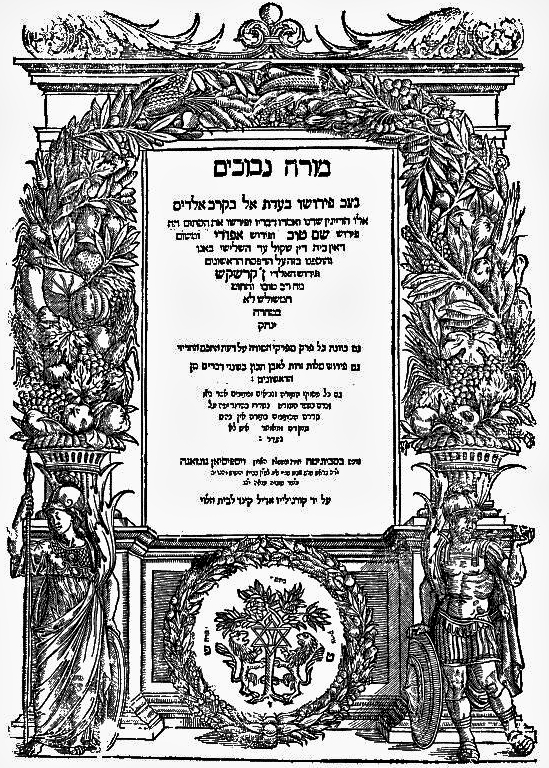
Read the full pageThe Guide for the Perplexed (Judeo-Arabic: דלאלת אלחאירין, romanized: Dalālat al-ḥā'irīn; Arabic: دلالة الحائرين, romanized: Dalālat al-ḥā'irīn; Hebrew: מורה הנבוכים, romanized: Moreh HaNevukhim) is a 12th-century work of Jewish theology by Maimonides. It seeks to reconcile Aristotelianism with Rabbinical Jewish theology by finding rational explanations for many events in the text. It was written in Judeo-Arabic, a dialect of Classical Arabic using the Hebrew alphabet. It was sent originally, part after part, to his student, Rabbi Joseph ben Judah of Ceuta, the son of Rabbi Judah, and is the main source of Maimonides' philosophical views, as opposed to his opinions on Jewish law.
Since many of the philosophical concepts, such as his view of theodicy and the relationship between philosophy and religion, are relevant beyond Judaism, it has been the work most commonly associated with Maimonides in the non-Jewish world and it is known to have influenced several major non-Jewish philosophers. Following its publication, "almost every philosophic work for the remainder of the Middle Ages cited, commented on, or criticized Maimonides' views." Within Judaism, the Guide became widely popular, with many Jewish communities requesting copies of the manuscript, but also quite controversial, with some communities limiting its study or banning it altogether.
The Guide for the Perplexed was originally written sometime between 1185 and 1190 by Maimonides in Judeo-Arabic (Classical Arabic using the Hebrew alphabet). It was first translated in 1204 into Hebrew by a contemporary of Maimonides, Samuel ibn Tibbon. The work is divided into three parts. According to Maimonides, he wrote the Guide "to enlighten a religious man who has been trained to believe in the truth of our holy Law, who conscientiously fulfills his moral and religious duties, and at the same time has been successful in his philosophical studies."
- Read the full page
Apophatic theology, also known as negative theology and the Via Negativa, is a form of theological thinking and religious practice which attempts to approach God, the Divine, by negation, to speak only in terms of what may not be said about God. It is the opposite equivalent of cataphatic theology (also known as affirmative theology), which approaches God or the Divine by affirmations or positive statements about what God is.
The apophatic tradition is often, though not always, allied with the approach of mysticism, which aims at the vision of God, the perception of the divine reality beyond the realm of ordinary perception.
"Apophatic" derives from Ancient Greek: ἀπόφασις (noun); from ἀπόφημι apophēmi, meaning 'to deny'. From Online Etymology Dictionary:
- 6
 PhilosopherJewish1632 – 1677
Baruch Spinoza
Lens-grinder of Amsterdam who identified God with Nature and wrote an Ethics in geometrical order.
- ◆Deus sive Natura — God or Nature
- ◆One substance, infinite attributes
- ◆Freedom as understanding necessity
- ◆Intellectual love of God
Read the full pageBaruch (de) Spinoza (24 November 1632 – 21 February 1677), also known under his Latinized pen name Benedictus de Spinoza, was a philosopher of Portuguese-Jewish origin who was born and lived in the Dutch Republic. A forerunner of the Enlightenment, Spinoza significantly influenced modern biblical criticism, 17th-century rationalism, and Dutch intellectual culture, establishing himself as one of the most important and radical philosophers of the early modern period. Influenced by Stoicism, Thomas Hobbes, René Descartes, and heterodox Christians, Spinoza was a leading philosopher of the Dutch Golden Age.
Spinoza was born in Amsterdam to a marrano family that fled Portugal for the more tolerant Dutch Republic. He received a traditional Jewish education, learning Hebrew and studying sacred texts within the Portuguese-Jewish community, where his father was a prominent merchant. As a young man, Spinoza challenged rabbinic authority and questioned Jewish doctrines, leading to his permanent expulsion from his Jewish community in 1656. Following that expulsion, he distanced himself from all religious affiliations and devoted himself to philosophical inquiry, supporting himself by lens grinding. Spinoza attracted a dedicated circle of followers who gathered to discuss his writings and joined him in the intellectual pursuit of truth.
Spinoza published sparingly during his lifetime to circumvent persecution and the suppression of his works. In his Tractatus Theologico-Politicus, described by Steven Nadler as "one of the most important books of Western thought", Spinoza questioned the divine origin of the Hebrew Bible and the nature of God while arguing that ecclesiastical authority should have no role in a secular, democratic state. Ethics equates God with nature, arguing for a view of God that scholars interpret variously as pantheistic, panentheistic, or atheistic, and it explores the place of human freedom in a world devoid of theological, cosmological, and political moorings. Rejecting messianism and the emphasis on the afterlife, Spinoza emphasized appreciating and valuing life for oneself and others. By advocating for individual liberty in its moral, psychological, and metaphysical dimensions, Spinoza helped establish the genre of political writing called secular theology.
- ◆Philosophy of dialogue
Read the full pageMartin Buber (German: [ˈmaʁtiːn ˈbuːbɐ] ; Hebrew: מרטין בובר; Yiddish: מארטין בובער; 8 February 1878 – 13 June 1965) was an Austrian-Israeli philosopher best known for his philosophy of dialogue, a form of existentialism centered on the distinction between the I–Thou relationship and the I–It relationship.
Born in Vienna, Buber came from a family of observant Jews, but broke with Jewish custom to pursue secular studies in philosophy. He produced writings about Zionism and worked with various bodies within the Zionist movement extensively over a nearly 50-year period spanning his time in Europe and the Near East. In 1923, Buber wrote his famous essay on existence, Ich und Du (later translated into English as I and Thou), and in 1925 he began translating the Hebrew Bible into the German language.
He was nominated for the Nobel Prize in Literature ten times, and the Nobel Peace Prize seven times.
- 8
 PhilosopherJewish1906 – 1995
Emmanuel Levinas
Ethics is first philosophy: the face of the Other commands responsibility.
- ◆"The Other"
- ◆"The Face"
Read the full pageEmmanuel Levinas (born Emanuelis Levinas ; French: [ɛmanɥɛl levinas]; 12 January 1906 – 25 December 1995) was a French philosopher of Lithuanian Jewish ancestry who is known for his work within Jewish philosophy, existentialism, and phenomenology, focusing on the relationship of ethics to metaphysics and ontology.
Levinas was born on 12 January 1906, into a middle-class Litvak family in Kaunas, in present-day Lithuania, then Kovno district, at the Western edge of the Russian Empire. Because of the disruptions of World War I, the family moved to Kharkiv in Ukraine in 1916, where they stayed during the Russian revolutions of February and October 1917. In 1920, his family returned to the Republic of Lithuania. Levinas's early education was in secular, Russian-language schools in Kaunas and Kharkiv. Upon his family's return to the Republic of Lithuania, Levinas spent two years at a Jewish gymnasium before departing for France, where he commenced his university education.
Levinas began his philosophical studies at the University of Strasbourg in 1923, and his lifelong friendship with the French philosopher Maurice Blanchot. In 1928, he went to the University of Freiburg for two semesters to study phenomenology under Edmund Husserl. At Freiburg he also met Martin Heidegger, whose philosophy greatly impressed him. Levinas would in the early 1930s be one of the first French intellectuals to draw attention to Heidegger and Husserl by translating, in 1931, Husserl's Cartesian Meditations (with the help of Gabrielle Peiffer and with advice from Alexandre Koyré) and by drawing on their ideas in his own philosophy, in works such as La théorie de l'intuition dans la phénoménologie de Husserl (The Theory of Intuition in Husserl's Phenomenology; his 1929/30 doctoral thesis), De l'Existence à l'Existant (From Existence to Existents; 1947), and En Découvrant l’Existence avec Husserl et Heidegger (Discovering Existence with Husserl and Heidegger; first edition, 1949, with additions, 1967). In 1929, he was awarded his doctorate (Doctorat d'université degree) by the University of Strasbourg for his thesis on the meaning of intuition in the philosophy of Husserl, published in 1930.


