
Maimonides
Jewish philosopher and physician whose Guide for the Perplexed reconciled the Torah with Aristotle.
Key ideas
Moses ben Maimon (died 12 December 1204), commonly known as Maimonides and also referred to by the Hebrew acronym Rambam, was a Sephardic Jewish rabbi who is widely acknowledged as one of the most prolific and influential Torah scholars of the Middle Ages.
Originally from Córdoba, where he was born on Passover Eve of 1135 or 1138, his family was exiled from Muslim-ruled Spain shortly after the Almohad Caliphate conquered the Almoravid dynasty in 1148. Over the next two decades, Maimonides resided in Fez, Acre, Jerusalem, Alexandria, and Cairo before settling in Fustat between 1168 and 1171. During this period, he advanced his vocations and became renowned for his achievements as an astronomer, philosopher, and physician—even being appointed to serve as personal physician to Saladin of the Ayyubid Sultanate.
Most contemporary Jews as far as Iraq and Yemen acclaimed Maimonides' writings on halakha and Jewish ethics. While he rose to lead the Jewish community in Egypt, he also had many loud critics, particularly in Spain. He continued to live in Fustat until his death in 1204 and is said to have been buried in Tiberias. The Tomb of Maimonides in Tiberias holds importance as a Jewish pilgrimage site.
To date, Maimonides is recognized as one of the foremost rabbinic decisors and his copious work comprises a cornerstone of Jewish scholarship. His fourteen-volume Mishneh Torah still carries significant canonical authority in Judaism as a codification of halakha, as do his thirteen principles of faith. Maimonides' era is considered by many to mark the end of the Jewish Golden Age in Spain, owing to the ubiquitous persecution of his family and the Sephardic Jewish community in general. Others assert that it lasted until the Christian Reconquista concluded in the 15th century.
Aside from being revered by Jewish historians, Maimonides features very prominently in the history of Islamic science. Influenced by Aristotle, al-Farabi, ibn Sina, and his contemporary ibn Rushd, his work as a polymath contributed to the Islamic Golden Age and was regarded highly in many parts of the Muslim world.
Name
Maimonides' Hebrew name was Moses son of Rabbi Maimon the Spaniard (Hebrew: מֹשֶׁה בֵּרַבִּי מַיְמוֹן הַסְּפָרדִּי, romanized: Mōše bēRabbî Maymōn has-Səfārdî). In Medieval Hebrew, he was usually called ר״ם (Ram), which is short for "our Rabbi Moshe"; he is oftentimes referred to as רמב״ם (Rambam), which is short for "our Rabbi, Moshe son of Maimon".
His Arabic name was Abū ʿImrān Mūsā bin Maimūn bin ʿUbaydallāh al-Qurṭubī (Arabic: أَبُو عِمْرَان مُوسَى بْن مَيْمُون بْن عُبَيْد ٱللّٰه ٱلْقُرْطُبِيّ, Moses "father of Amram" son of Maymun, son of Obadiah the Cordoban), or oftentimes more simply, as Moses son of Maymun (موسى بن ميمون).
In Greek, the Hebrew ben ('son of') becomes the patronymic suffix -ίδης (-ides), forming Μωυσής Μαϊμωνίδης "Mōusēs Maimōnidēs".
He is sometimes known as "The Great Eagle" (Hebrew: הנשר הגדול, romanized: haNesher haGadol).
Early life
Maimonides was born 1138 (or 1135) in Córdoba in the Muslim-ruled Almoravid dynasty, at the end of the Golden Age of Jewish culture in Spain after the first centuries of Muslim rule. His father, Maimon ben Joseph, was a dayyan or rabbinic judge.
Maimonides studied Torah under his father, who had studied under Joseph ibn Migash, a student of Isaac Alfasi. At an early age, Maimonides developed an interest in contemporary science and philosophy. He read ancient Greek philosophy accessible via Arabic translations and was deeply immersed in the sciences and learning of Islamic culture.
Exile from Spain
A Berber dynasty, the Almohads, conquered Córdoba in 1148 and abolished dhimmi status (i.e., state protection of non-Muslims) in some territories. The loss of this status forced Jewish and Christian communities to choose between conversion to Islam, martyrdom, or exile. Many Jews were forced to convert, but due to suspicion by the authorities of fake conversions, the new converts had to wear identifying clothing that set them apart.
Maimonides' family, along with many other Jews, chose exile. For the next ten years, Maimonides moved about in southern Spain and North Africa, eventually settling in Fas. Some say that his teacher in Fez was Yehuda Ha-Cohen Ibn Susan, until the latter was killed in 1165.
During this time, he composed his acclaimed commentary on the Mishnah during 1166–1168.
Sojourn to the Holy Land
Following this sojourn in Morocco, he lived in Acre with his father and brother, arriving on May 16, 1165. They lived there for five months. In October, he visited Jerusalem, where he prayed at the Temple Mount. He wrote that this day of visiting the Temple Mount was a day of holiness for him and his descendants. He then visited the Cave of the Patriarchs in Hebron.
Settlement in Egypt
He and his family settled in Fustat in Fatimid Caliphate-controlled Egypt by 1168. There is mention that Maimonides first settled in Alexandria, and moved to Fustat only in 1171. While in Cairo, he studied in a yeshiva attached to a small synagogue, which now bears his name.
Maimonides was soon instrumental in helping rescue Jews taken captive during the Christian Amalric of Jerusalem's siege of the southeastern Nile Delta town of Bilbeis. He sent five letters to the Jewish communities of Lower Egypt asking them to pool money together to pay the ransom. The money was collected and then given to two judges sent to the Kingdom of Jerusalem to negotiate with the Crusaders. The captives were eventually released.
Death of his brother David
Following this success, the Maimonides family, hoping to increase their wealth, gave their savings to his brother, the youngest son David ben Maimon, a merchant. Maimonides directed his brother to procure goods only at the port of ʿAydhab along the Red Sea. After a long, arduous trip through the desert, David was unimpressed by the goods on offer there. Against his brother's wishes, David boarded a ship for India, since great wealth was to be found in the East. Before he could reach his destination, David drowned at sea sometime between 1169 and 1177. The death of his brother caused Maimonides to become sick with grief.
In a letter discovered in the Cairo Geniza, he wrote:
The greatest misfortune that has befallen me during my entire life—worse than anything else—was the demise of the saint, may his memory be blessed, who drowned in the Indian sea, carrying much money belonging to me, to him, and to others, and left with me a little daughter and a widow. On the day I received that terrible news I fell ill and remained in bed for about a year, suffering from a sore boil, fever, and depression, and was almost given up. About eight years have passed, but I am still mourning and unable to accept consolation. And how should I console myself? He grew up on my knees, he was my brother, [and] he was my student.
Leadership of Egypt's Jewish community
Around 1171, Maimonides was appointed the nagid of the Egyptian Jewish community. Shelomo Dov Goitein believes the leadership he displayed during the ransoming of the Crusader captives led to this appointment. He was replaced by Sar Shalom ben Moses in 1173. During Sar Shalom's controversial appointment, during which Sar Shalom was accused of tax farming, Maimonides excommunicated and fought with him for several years until Maimonides was appointed Nagid in 1195. Abraham bar Hillel wrote a scathing description of Sar Shalom in his Megillat Zutta while praising Maimonides as "the light of east and west and unique master and marvel of the generation."
Physician for the Ayyubid dynasty
With the loss of the family funds tied up in David's business venture, Maimonides assumed the vocation of physician, for which he was to become famous. He had trained in medicine in both Spain and in Fez. Gaining widespread recognition, he was appointed court physician to Qadi al-Fadil, the chief secretary to Sultan Saladin, then to Saladin himself; after whose death he remained a physician to the Ayyubid dynasty.
In his medical writings, Maimonides described many conditions, including asthma, diabetes, hepatitis, and pneumonia, and he emphasized moderation and a healthy lifestyle. His treatises became influential for generations of physicians. He was knowledgeable about Greek and Arabic medicine, and followed the principles of humorism in the tradition of Galen. He did not blindly accept authority but used his own observation and experience. Julia Bess Frank indicates that Maimonides in his medical writings sought to interpret works of authorities so that they could become acceptable.
Maimonides displayed in his interactions with patients attributes that today would be called intercultural awareness and respect for the patient's autonomy. Although he frequently wrote of his longing for solitude in order to come closer to God and to extend his reflections—elements considered essential in his philosophy to the prophetic experience—he gave over most of his time to caring for others. In a famous letter, Maimonides describes his daily routine. After visiting the Sultan's palace, he would arrive home exhausted and hungry, where "I would find the antechambers filled with gentiles and Jews [...] I would go to heal them, and write prescriptions for their illnesses [...] until the evening [...] and I would be extremely weak."
As he goes on to say in this letter, even on Shabbat he would receive members of the community. Still, he managed to write extended treatises, including not only medical and other scientific studies but some of the most systematically thought-through and influential treatises on halakha (rabbinic law) and Jewish philosophy of the Middle Ages.
In 1172–74, Maimonides wrote his famous Epistle to Yemen. It has been suggested that his "incessant travail" undermined his own health and brought about his death at 69 (although this is a normal lifespan).
Death and burial place
Maimonides died on 12 December 1204 (20th of Tevet 4965) in Fustat. A variety of medieval sources beginning with al-Qifti maintain that his body was interred near the Sea of Galilee, though there is no contemporary evidence for his removal from Egypt. Gedaliah ibn Yahya ben Joseph records that "He was buried in the Upper Galilee with elegies upon his gravestone. In the time of Kimhi, when the sons of Belial rose up to besmirch [Maimonides] . . . they did evil. They altered his gravestone, which previously had been inscribed 'choicest of the human race (מבחר המין האנושי)', so that instead it read 'the excommunicated heretic (מוחרם ומין)'. But later, after the provocateurs had repented of their act, and praised this great man, a student repaired the gravestone to read 'choicest of the Israelites (מבחר המין הישראלי)'". Today, Tiberias hosts the Tomb of Maimonides, on which is inscribed "From Moses to Moses arose none like Moses."
He is buried in the Tomb of Maimonides in Tiberias. Other notable rabbis are also buried in this complex: Isaiah Horowitz, Eliezer ben Hurcanus, Yohanan ben Zakkai, and Joshua ben Hananiah.
Ancestry and descendants
Maimonides is sometimes said to be a descendant of David, although he never made such a claim.
Aaron ben Jacob ha-Kohen later wrote that he had traced Maimonides' descent back to Simeon ben Judah ha-Nasi from the Davidic line. His ancestry, going back four generations, is given in his Epistle to Yemen as Moses ben Maimon ben Joseph ben Isaac ben Obadiah. At the end of his commentary on the Mishnah, however, a longer, slightly different genealogy is given: Moses ben Maimon ben Joseph ben Isaac ben Joseph ben Obadiah ben Solomon ben Obadiah.
Maimonides and his wife, the daughter of Mishael ben Yeshayahu Halevi, had one child who survived into adulthood, Abraham Maimonides, who became recognized as a great scholar, but his scholarship and career was overshadowed by his father's importance. He succeeded Maimonides as Nagid and as court physician at the age of eighteen. Throughout his career, he defended his father's writings against all critics. The office of Nagid was held by the Maimonides family for four successive generations, until the end of the 14th century.
Philosophical and theological commentary
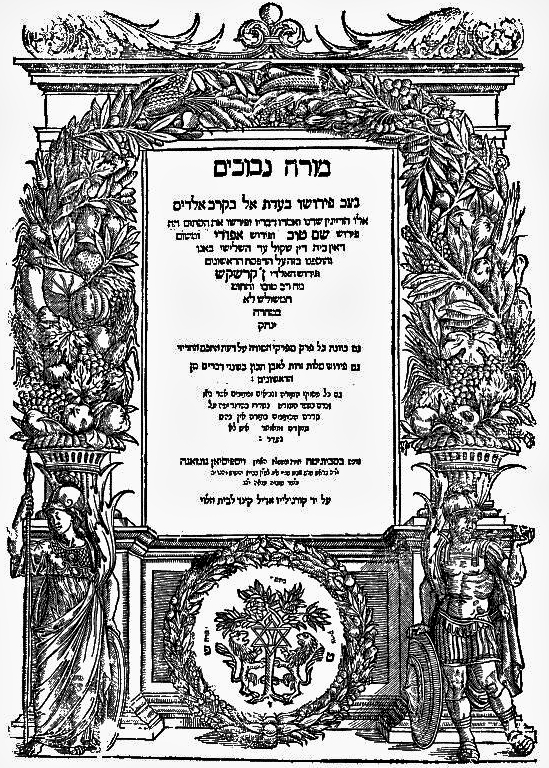
Through The Guide for the Perplexed, Mishneh Torah, and the philosophical introductions to sections of his commentaries on the Mishnah, Maimonides exerted an important influence on the Scholastic philosophers, especially on Albertus Magnus, Thomas Aquinas and Duns Scotus. He was a Jewish Scholastic. Educated more by reading the works of Arab Muslim philosophers than by personal contact with Arabian teachers, he acquired an intimate acquaintance not only with Arab Muslim philosophy, but with the doctrines of Aristotle. Maimonides strove to reconcile Aristotelianism and science with the teachings of the Torah.
In his Guide for the Perplexed, he often explains the function and purpose of the statutory provisions contained in the Torah against the backdrop of the historical conditions. The book was highly controversial in its day, and was banned by French rabbis, who burnt copies of the work in Montpellier.
Thirteen principles of faith in Judaism
In his commentary on the Mishnah (Tractate Sanhedrin, chapter 10), Maimonides formulates his "13 principles of faith"; and that these principles summarized what he viewed as the required beliefs of Judaism:
The existence of God.
God's unity and indivisibility into elements.
God's spirituality and incorporeality.
God's eternity.
God alone should be the object of worship.
Revelation through God's prophets.
The preeminence of Moses among the prophets.
That the entire Torah (both the Written and Oral law) are of Divine origin and were dictated to Moses by God on Mt. Sinai.
The Torah given by Moses is permanent and will not be replaced or changed.
God's awareness of all human actions and thoughts.
Reward of righteousness and punishment of evil.
The coming of the Messiah.
The resurrection of the dead.
Maimonides is said to have compiled the principles from various Talmudic sources. These principles were controversial when first proposed, evoking criticism by Rabbis Hasdai Crescas and Joseph Albo, and were effectively ignored by much of the Jewish community for the next few centuries. However, these principles have become widely held and are considered to be the cardinal principles of faith for Orthodox Jews. Two poetic restatements of these principles (Ani Ma'amin and Yigdal) eventually became canonized in many editions of the Siddur (Jewish prayer book).
The omission of a list of these principles as such within his later works, the Mishneh Torah and The Guide for the Perplexed, has led some to suggest that either he retracted his earlier position, or that these principles are descriptive rather than prescriptive.
Nature of the God of Abraham
Maimonides equated the God of Abraham to what philosophers refer to as the Necessary Being. God is unique in the universe, and the Torah commands that one love and fear God (Deut 10:12) on account of that uniqueness. To Maimonides, this meant that one ought to contemplate God's works and to marvel at the order and wisdom that went into their creation. When one does this, one inevitably comes to love God and to sense how insignificant one is in comparison to God. This is the basis of the Torah.
The principle that inspired his philosophical activity was identical to a fundamental tenet of scholasticism: there can be no contradiction between the truths which God has revealed and the findings of the human mind in science and philosophy. Maimonides primarily relied upon the science of Aristotle and the teachings of the Talmud, commonly claiming to find a basis for the latter in the former.
Maimonides' admiration for the Neoplatonic commentators led him to doctrines which the later Scholastics did not accept. For instance, Maimonides was an adherent of apophatic theology. In this theology, one attempts to describe God through negative attributes. For example, one should not say that God exists in the usual sense of the term; it can be said that God is not non-existent. One should not say that "God is wise"; but it can be said that "God is not ignorant," i.e., in some way, God has some properties of knowledge. One should not say that "God is One," but it can be stated that "there is no multiplicity in God's being." In brief, the attempt is to gain and express knowledge of God by describing what God is not, rather than by describing what God "is."
Maimonides argued adamantly that God is not corporeal. This was central to his thinking about the sin of idolatry. Maimonides insisted that all of the anthropomorphic phrases pertaining to God in sacred texts are to be interpreted metaphorically. A related tenet of Maimonidean theology is the notion that the commandments, especially those pertaining to sacrifices, are intended to help wean the Israelites away from idolatry.
Maimonides also argued that God embodied reason, intellect, science, and nature, and was omnipotent and indescribable. He said that science, the growth of scientific fields, and discovery of the unknown by comprehension of nature was a way to appreciate God.
Morality in character development
Maimonides taught about the developing of one's moral character. Although his life predated the modern concept of a personality, Maimonides believed that each person has an innate disposition along an ethical and emotional spectrum. Although one's disposition is often determined by factors outside of one's control, human beings have free will to choose to behave in ways that build character.
He wrote, "One is obligated to conduct his affairs with others in a gentle and pleasing manner." Maimonides advised that those with antisocial character traits should identify those traits and then make a conscious effort to behave in the opposite way. For example, an arrogant person should practice humility. If the circumstances of one's environment are such that it is impossible to behave ethically, one must move to a new location.
The "prophetic" state
Maimonides agreed with "the Philosopher" (Aristotle) that the use of logic is the "right" way of thinking. He claimed that in order to understand how to know God, every human being must, by study, and meditation attain the degree of perfection required to reach the prophetic state. Despite his rationalistic approach, he does not explicitly reject the previous ideas (as portrayed, for example, by Yehuda Halevi in his Kuzari) that in order to become a prophet, God must intervene. Maimonides teaches that prophecy is the highest purpose of the most learned and refined individuals.
Problem of evil in spite of God's presence
Maimonides wrote on theodicy (the philosophical attempt to reconcile the existence of a God with the existence of evil). He took the premise that an omnipotent and good God exists. In The Guide for the Perplexed, Maimonides writes that all the evil that exists within human beings stems from their individual attributes, while all good comes from a universally shared humanity (Guide 3:8). He says that there are people who are guided by higher purpose, and there are those who are guided by physicality and must strive to find the higher purpose with which to guide their actions.
To justify the existence of evil, assuming God is both omnipotent and omnibenevolent, Maimonides postulates that one who created something by causing its opposite not to exist is not the same as creating something that exists; so evil is merely the absence of good. God did not create evil, rather God created good, and evil exists where good is absent (Guide 3:10). Therefore, all good is divine invention, and evil both is not and comes secondarily.
Adapted from the Wikipedia article Maimonides, available under CC BY-SA 4.0.
Connections
Belongs to
1
Influenced by
6


Influenced
8



Ideas & arguments
3

Contributed to
1
Places
1
You might also explore
 Ibn Rushd (Averroes)★Islamic1126 – 1198"The Commentator" on Aristotle, who defended philosophy against al-Ghazālī and argued reason and revelation cannot…
 Aristotle★Greek & Roman384 – 322 BCEPlato's student and Alexander's tutor, who systematised logic, ethics, biology, metaphysics and politics — "the master…
 Ibn Sīnā (Avicenna)★Islamic980 – 1037Physician-philosopher whose Floating Man and distinction between essence and existence shaped Islamic and European…
 Plato★Greek & Romanc. 428 – 348 BCEFounder of the Academy whose dialogues defined Western philosophy's agenda: Forms, justice, the soul, knowledge and the…
 Ibn TufaylIslamic1110 – 1185Ibn Ṭufayl was an Arab Andalusian Muslim polymath: a writer, physician, philosopher, theologian, astronomer, and…
 Baruch Spinoza★Jewish1632 – 1677Lens-grinder of Amsterdam who identified God with Nature and wrote an Ethics in geometrical order.