
Philo of Alexandria
Interpreted the Hebrew Bible through Greek philosophy, pioneering allegorical reading.
Philo of Alexandria (; Ancient Greek: Φίλων, romanized: Phílōn; Hebrew: יְדִידְיָה, romanized: Yəḏīḏyāh; c. 20 BC – c. 50 AD), also called Philō Judæus, was a Hellenistic Jewish philosopher who lived in Alexandria, in the Roman province of Egypt.
The only event in Philo's life that can be decisively dated is his representation of the Alexandrian Jews in a delegation to the Roman emperor Caligula in 40 CE following civil strife between the Jewish and Greek communities of Alexandria.
Philo was a leading writer of the Hellenistic Jewish community in Alexandria, Egypt. He wrote expansively in Koine Greek on philosophy, politics, and religion in his time; specifically, he explored the connections between Greek Platonic philosophy and late Second Temple Judaism. For example, he maintained that the Greek-language Septuagint and the Jewish law still being developed by the rabbis of the period together served as a blueprint for the pursuit of individual enlightenment.
Philo used philosophical allegory to harmonize the Hebrew Bible, mainly the Torah, with Greek philosophy. His method followed the practices of both Jewish exegesis and Stoicism. His allegorical exegesis was important for many Christian Church Fathers, but he had very little reception history within Rabbinic Judaism.. Many critics of Philo assumed his allegorical perspective, in contrast to Biblical Literalism, would lend credibility to the notion of legend over historicity. However, Philo often advocated a literal understanding of the Torah and the historicity of such described events, while at other times favoring allegorical readings.
Some scholars hold that his concept of the Logos as God's creative principle influenced early Christology. Other scholars deny direct influence but say that Philo and Early Christianity borrow from a common source.
Life
Philo's dates of birth and death are unknown but can be judged by Philo's description of himself as "old" when he was part of the delegation to Gaius Caligula in 38 CE. Jewish history professor Daniel R. Schwartz estimates his birth year as sometime between 15 and 10 BCE. Philo's reference to an event under the reign of Emperor Claudius indicates that he died sometime between 45 and 50 CE. Philo also recounts that he visited the Second Temple in Jerusalem at least once in his lifetime.
Family
Although the names of his parents are unknown, it is known that Philo came from a family which was noble, honourable and wealthy. Either his father or paternal grandfather was granted Roman citizenship by Roman dictator Gaius Julius Caesar. Jerome wrote that Philo came de genere sacerdotum (from a priestly family). His ancestors and family had social ties and connections to the priesthood in Judea, the Hasmonean dynasty, the Herodian dynasty and the Julio-Claudian dynasty in Rome.
Philo had one brother, Alexander Lysimachus, who was the general tax administrator of customs in Alexandria. He accumulated an immense amount of wealth, becoming not only the richest man in that city but also in the entire Hellenistic world. Alexander was so rich that he gave a loan to the wife of king Herod Agrippa, as well as gold and silver to overlay the nine gates of the temple in Jerusalem. Due to his extreme wealth, Alexander was also influential in imperial Roman circles as a friend of emperor Claudius. Through Alexander, Philo had two nephews, Tiberius Julius Alexander and Marcus Julius Alexander. The latter was the first husband of the Herodian princess Berenice. Marcus died in 43 or 44. Some scholars identify Alexander Lysimachus as the Alexander referenced in the Book of Acts, who presided over the Sanhedrin trial of John and Peter.
Diplomacy
Philo lived in an era of increasing ethnic tension in Alexandria, exacerbated by the new strictures of imperial rule. Some expatriate Hellenes (Greeks) in Alexandria condemned the Jews for a supposed alliance with Rome, even as Rome was seeking to suppress Jewish national and cultural identity in the Roman province of Judaea. In Antiquities of the Jews, Josephus tells of Philo's selection by the Alexandrian Jewish community as their principal representative before the Roman emperor Gaius Caligula. He says that Philo agreed to represent the Alexandrian Jews about the civil disorder that had developed between the Jews and the Greeks. Josephus also tells us that Philo was skilled in philosophy and that he was brother to the alabarch Alexander. According to Josephus, Philo and the larger Jewish community refused to treat the emperor as a god, to erect statues in honour of the emperor, and to build altars and temples to the emperor. Josephus says Philo believed that God actively supported this refusal.
Josephus' complete comments about Philo:
There was now a tumult arisen at Alexandria, between the Jewish inhabitants and the Greeks; and three ambassadors were chosen out of each party that were at variance, who came to Gaius. Now one of these ambassadors from the people of Alexandria was Apion, (29) who uttered many blasphemies against the Jews; and, among other things that he said, he charged them with neglecting the honors that belonged to Caesar; for that while all who were subject to the Roman empire built altars and temples to Gaius, and in other regards universally received him as they received the gods, these Jews alone thought it a dishonorable thing for them to erect statues in honor of him, as well as to swear by his name. Many of these severe things were said by Apion, by which he hoped to provoke Gaius to anger at the Jews, as he was likely to be. But Philo, the principal of the Jewish embassage, a man eminent on all accounts, brother to Alexander the Alabarch, (30) and one not unskillful in philosophy, was ready to betake himself to make his defense against those accusations; but Gaius prohibited him, and bid him begone; he was also in such a rage, that it openly appeared he was about to do them some very great mischief. So Philo being thus affronted, went out, and said to those Jews who were about him, that they should be of good courage, since Gaius's words indeed showed anger at them, but in reality had already set God against himself.
This event is also described in Book 2, Chapter 5 of Eusebius's Historia Ecclesiae.
Education
Philo along with his brothers received a thorough education. They were educated in the Hellenistic culture of Alexandria and the culture of ancient Rome, to a degree in Ancient Egyptian religion and particularly in the traditions of Judaism, in the study of Jewish traditional literature and in Greek philosophy.
In his works, Philo shows extensive influence not only from philosophers such as Plato and the Stoics, but also poets and orators, especially Homer, Euripides, and Demosthenes. Philo's largest philosophical influence was Plato, drawing heavily from the Timaeus and the Phaedrus, and also from the Phaedo, Theaetetus, Symposium, Republic, and Laws.
The extent of Philo's knowledge of Hebrew, however, is debated. Philo was more fluent in Greek than in Hebrew and read the Jewish Scriptures chiefly from the Septuagint, a Koine Greek translation of Hebraic texts later compiled as the Hebrew Bible and the deuterocanonical books. His numerous etymologies of Hebrew names, which are along the lines of the etymologic midrash to Genesis and of the earlier rabbinism, although not modern Hebrew philology, suggest some familiarity. Philo offers for some names three or four etymologies, sometimes including the correct Hebrew root (e.g., Hebrew: י־ר־ד, romanized: y-r-d, lit. 'descend' as the origin of the name Jordan). However, his works do not display much understanding of Hebrew grammar, and they tend to follow the translation of the Septuagint more closely than the Hebrew version.
Philo identified the angel of the Lord (in the singular) with the Logos. In the text attributed to Philo, he "consistently uses Κύριος as a designation for God". According to David B. Capes, "the problem for this case, however, is that Christian scholars are responsible for copying and transmitting Philo's words to later generations", and adds,
George Howard surveys evidence and concludes: "Although it is improbable that Philo varied from the custom of writing the Tetragram when quoting from Scripture, it is likely that he used the word Κύριος when making a secondary reference to the divine name in his exposition". James Royse concludes:(1) the exegete [Philo] knows and reads biblical manuscripts in which the tetragram is written in palaeo-Hebrew or Aramaic script and not translated by kyrios and that (2) he quotes scriptures in the same way he would have pronounced it, that is, by translating it as kurios."
Philosophy
Philo selectively incorporated Greek philosophical ideas that were compatible with Jewish religious teachings rather than accepting Greek philosophy in its entirety. Philo represents the apex of Jewish-Hellenistic syncretism. His work attempts to combine Plato and Moses into one philosophical system.
Allegorical interpretation
Philo bases his doctrines on the Hebrew Bible, which he considers the source and standard not only of religious truth but of all truth. Its pronouncements are the ἱερὸς λόγος, θεῖος λόγος, and ὀρθὸς λόγος (holy word, godly word, righteous word), uttered sometimes directly and sometimes through the mouth of a prophet, and especially through Moses, whom Philo considers the true medium of revelation. However, he distinguishes between the words uttered by God himself, such as the Ten Commandments, and the edicts of Moses (as the special laws).
Philo regards the Bible as the source not only of religious revelation but also of philosophical truth. Philo claims that Moses learned mathematics from the Egyptians, astronomy and astrology from the Chaldeans, and other subjects from the Greeks. He says that Moses advanced beyond his teachers, leading them to learn from him instead. Philo believed the Greeks such as Heraclitus took ideas from Mosaic law. By applying the Stoic mode of allegorical interpretation to the Hebrew Bible, he interpreted the stories of the first five books as elaborate metaphors and symbols to demonstrate that Greek philosophers' ideas had preceded them in the Bible: Heraclitus's concept of binary oppositions, according to Who is the Heir of Divine Things? § 43 [i. 503]; and the conception of the wise man expounded by Zeno of Citium, the founder of Stoicism, in Every Good Man is Free, § 8 [ii. 454]. Philo did not reject the subjective experience of ancient Judaism; yet, he repeatedly explained that the Septuagint cannot be understood as a concrete, objective history.
Philo's allegorical interpretation of scripture allows him to grapple with morally disturbing events and impose a cohesive explanation of stories. Specifically, Philo interprets the characters of the Bible as aspects of the human being and the stories of the Bible as episodes from universal human experience. For example, Adam represents the mind and Eve, the senses. Noah represents tranquility, a stage of "relative"—incomplete but progressing—righteousness. According to Josephus, Philo was inspired mainly in this by Aristobulus of Alexandria and the Alexandrian school.
Numerology
Philo frequently engaged in Pythagorean-inspired numerology, explaining at length the importance of the first 10 numerals:
One is God’s number and the basis for all numbers.
Two is the number of schism, that which has been created, and death.
Three is the number of the body ("De Allegoriis Legum", i. 2 [i. 44]) or of the Divine Being in connection with its fundamental powers ("De Sacrificiis Abelis et Caini", § 15 [i. 173]).
Four is potentially what ten is actually: the perfect number ("De Opificio Mundi", §§ 15, 16 [i. 10, 11], etc.); but in an evil sense, four is the number of the passions, πάθη ("De Congressu Quærendæ Eruditionis Gratia". § 17 [i. 532]).
Five is the number of the senses and of sensibility ("De Opificio Mundi", § 20 [i. 14], etc.).
Six, the product of the masculine and feminine numbers 3×2 and in its parts equal to 3+3, is the symbol of the movement of organic beings ("De Allegoriis Legum", i. 2 [i. 44]).
Seven has the most various attributes ("De Opiticio Mundi", §§ 30-43 [i. 21 et seq.]; comp. I. G. Müller, "Philo und die Weltschöpfung", 1841, p. 211).
Eight, the number of the cube, has many of the attributes determined by the Pythagoreans ("Quæstiones in Genesin", iii. 49 [i. 223, Aucher]).
Nine is the number of strife, according to Gen. xiv. ("De Congressu Qu. Eruditionis Gratia", § 17 [i. 532]).
Ten is the number of perfection ("De Plantatione Noë", § 29 [i. 347]).
Philo also determines the values of the numbers 50, 70, 100, 12, and 120. There is also extensive symbolism of objects. Philo elaborates on the extensive symbolism of proper names, following the example of the Bible and the Midrash, to which he adds many new interpretations.
Theology
Philo stated his theology both through the negation of opposing ideas and through detailed, positive explanations of the nature of God; he contrasted the nature of God with the nature of the physical world. Philo did not consider God similar to Heaven, the world, or man; he affirmed a transcendent God without physical features or emotional qualities resembling those of human beings. Following Plato, Philo equates matter to nothingness and sees its effect in fallacy, discord, damage, and decay of things. Only God's existence is specific; no appropriate predicates can be conceived. To Philo, God exists beyond time and space and does not make special interventions into the world because God already encompasses the entire cosmos.
Philo also integrated select theology from the rabbinic tradition, including God's transcendence, and humankind's inability to behold an ineffable God. He argued that God has no attributes (ἁπλοῡς)—in consequence, no name (ἅρρητος)—and, therefore, that God cannot be perceived by man (ἀκατάληπτος). Furthermore, he posited that God cannot change (ἅτρεπτος): God is always the same (ἀΐδιος). God needs no other being (χρῄζει γὰρ οὐδενὸς τὸ παράπαν) for self-existence or the creation of material things, and God is self-sufficient (ἑαυτῷ ἱκανός). God can never perish (ἅφθαρτος), is self-existent (ὁ ὤν, τὸ ὄν), and has no relations with any other being (τὸ γὰρ ὄν, ᾗ ὄν ἐστιν, οὐχὶ τῶν πρός τι).
Anthropomorphism
Philo considered the anthropomorphism of the Bible to be an impiety that was incompatible with the Platonic conception of "God in opposition to matter", instead interpreting the ascription to God of hands and feet, eyes and ears, tongue and windpipe, as allegories. In Philo's interpretation, Hebrew scripture adapts itself to human conceptions, and so God is occasionally represented as a man for pedagogic reasons. The same holds true for God's anthropopathic attributes. God, as such, is untouched by unreasonable emotions, as appears in Exodus 32:12, wherein Moses, torn by his feelings, perceives God alone to be calm. He is free from sorrow, pain, and other affections. But God is frequently represented as endowed with human emotions, and this serves to explain expressions referring to human repentance in the ancient Jewish context.
Similarly, God cannot exist or change in space. He has no "where" (πού, obtained by changing the accent in Genesis 3:9: "Adam, where [ποῡ] art thou?"), is not in any place. He is Himself the place; the dwelling-place of God means the same as God Himself, as in the Mishnah = "God is" (comp. Freudenthal, "Hellenistische Studien", p. 73), corresponding to the tenet of Greek philosophy that the existence of all things is summed up in God. God as such is motionless, as the Bible indicates by the phrase "God stands".
Divine attributes
Philo endeavored to find the Divine Being active and acting in the world, in agreement with Stoicism, yet his Platonic
conception of Matter as evil required that he place God outside of the world in order to prevent God from having any contact with evil. Hence, he was obliged to separate from the Divine Being the activity displayed in the world and to transfer it to the divine powers, which accordingly were sometimes inherent in God and at other times exterior to God. In order to balance these Platonic and Stoic conceptions, Philo conceived of these divine attributes as types or patterns of actual things ("archetypal ideas") in keeping with Plato, but also regarded them as the efficient causes that not only represent the types of things, but also produce and maintain them. Philo endeavored to harmonize this conception with the Bible by designating these powers as angels. Philo conceives the powers both as independent hypostases and as immanent attributes of a Divine Being.
In the same way, Philo contrasts the two divine attributes of goodness and power (ἄγαθότης and ἀρχή, δίναμις χαριστική and συγκολαστική) as expressed in the names of God; designating "Yhwh" as Goodness, Philo interpreted "Elohim" (LXX. Θεός) as designating the "cosmic power"; and as he considered the Creation the most important proof of divine goodness, he found the idea of goodness especially in Θεός.
Logos
Philo also treats the divine powers of God as a single independent being, or demiurge, which he designates "Logos". Philo's conception of the Logos is influenced by Heraclitus' conception of the "dividing Logos" (λόγος τομεύς), which calls the various objects into existence by the combination of contrasts ("Quis Rerum Divinarum Heres Sit", § 43 [i. 503]), as well as the Stoic characterization of the Logos as the active and vivifying power.
But Philo followed the Platonic distinction between imperfect matter and perfect Form, and Philo's conception of the Logos is directly related to the Middle Platonic view of God as unmoved and utterly transcendent; therefore, intermediary beings were necessary to bridge the enormous gap between God and the material world. The Logos was the highest of these intermediary beings and was called by Philo "the first-born of God."
Philo also adapted Platonic elements in designating the Logos as the "idea of ideas" and the "archetypal idea". Philo identified Plato's Ideas with the demiurge's thoughts. These thoughts make the contents of Logos; they were the seals for making sensual things during world creation. Logos resembles a book with creature paradigms. An Architect's design before the construction of a city serves to Philo as another simile of Logos. Since creation, Logos binds things together. As the receptacle and holder of ideas, Logos is distinct from the material world. At the same time, Logos pervades the world, supporting it. This image of God is the type for all other things (the "Archetypal Idea" of Plato), a seal impressed upon things. The Logos is a kind of shadow cast by God, having the outlines but not the blinding light of the Divine Being. He calls the Logos "second god [deuteros theos]" the "name of God,"
Adapted from the Wikipedia article Philo, available under CC BY-SA 4.0.
Connections
Belongs to
1Influenced by
2


Places
1
Related
1You might also explore
 Plato★Greek & Romanc. 428 – 348 BCEFounder of the Academy whose dialogues defined Western philosophy's agenda: Forms, justice, the soul, knowledge and the…
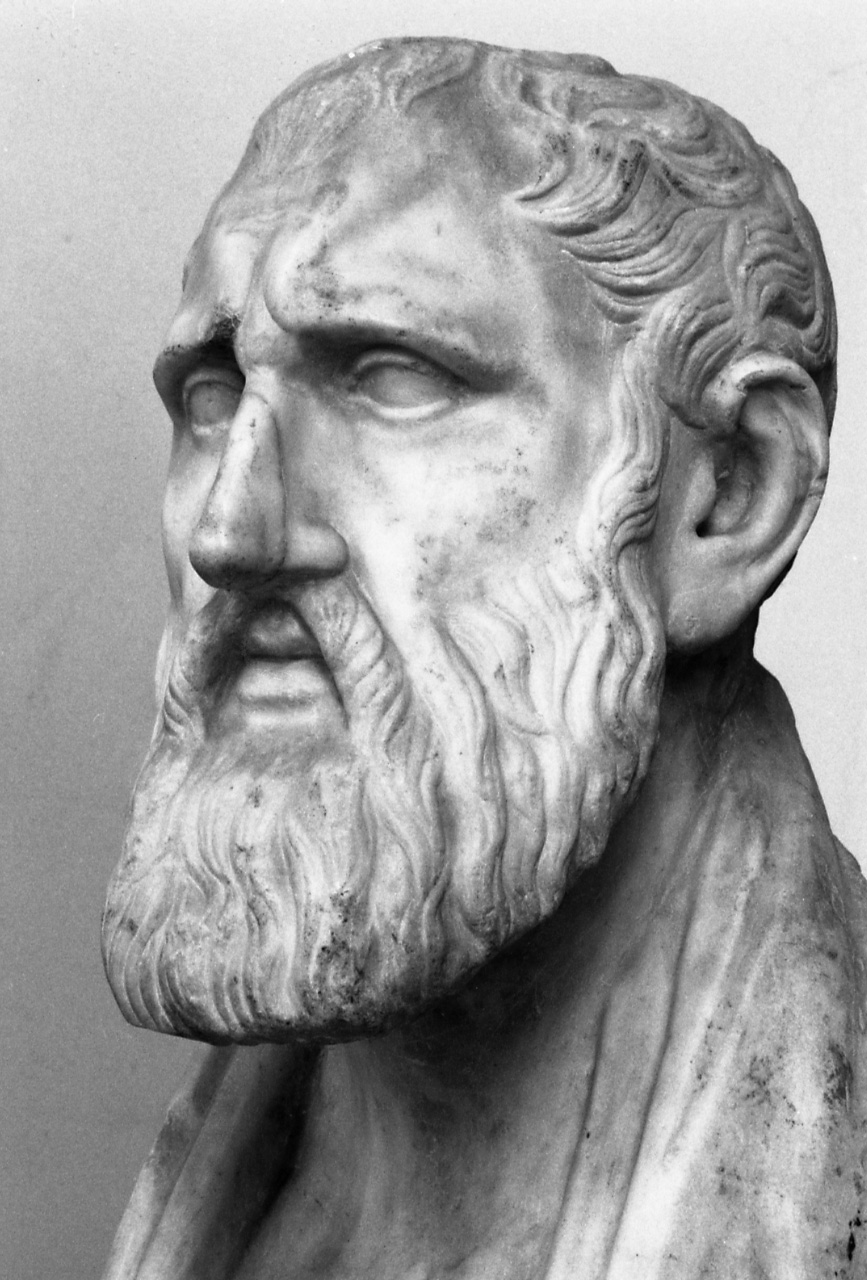 Zeno of CitiumGreek & Roman334 – 262 BCEFounder of Stoicism, who taught at the Painted Porch in Athens.
 OrigenGreek & Roman185 – 254Origen of Alexandria, also known as Origen Adamantius, was an early Christian theologian and ascetic. He was a prolific…Antiochus of AscalonGreek & Roman130 – 68 BCEAntiochus of Ascalon was a 1st-century BC Platonist philosopher. He rejected skepticism, blended Stoic doctrines with…
 Seneca★Greek & Roman4 BCE – 65 CEStoic statesman and dramatist whose Letters to Lucilius are a handbook for living.HypatiaGreek & Romanc. 355 – 415Neoplatonist philosopher and mathematician of Alexandria, killed by a Christian mob.