Great books: ancient: Nicomachean Ethics to On the Nature of Things
- 1
 WorkGreek & Romanc. 340 BCE
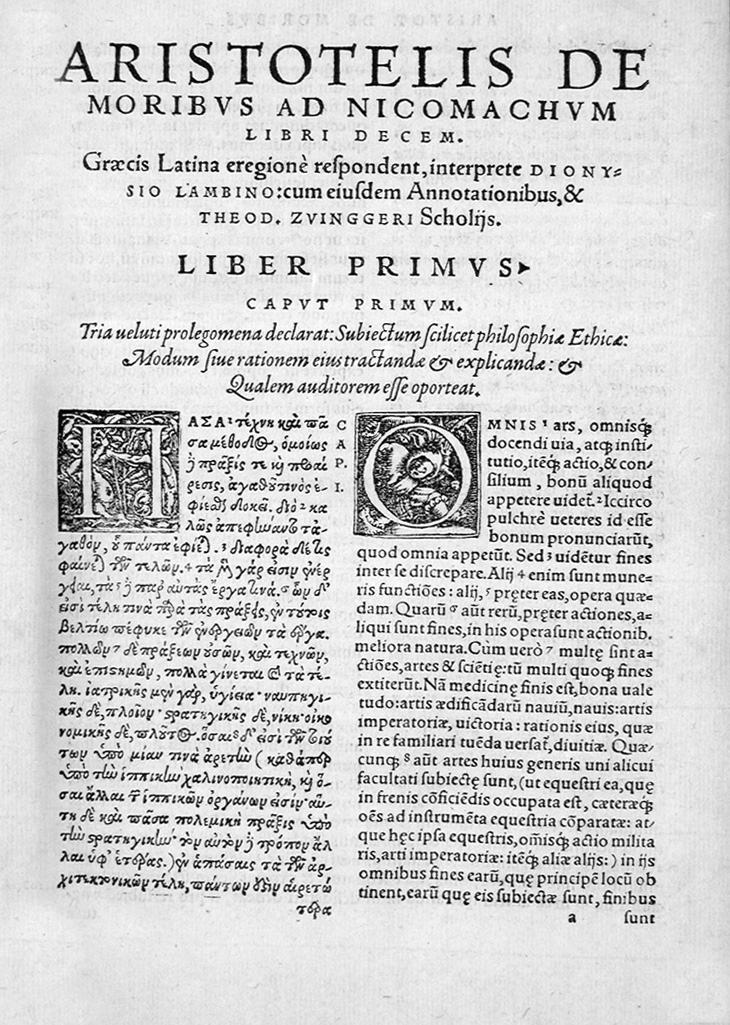
Nicomachean Ethics
Aristotle's inquiry into the good life: happiness, virtue, friendship and contemplation.
Read the full pageThe Nicomachean Ethics (; Ancient Greek: Ἠθικὰ Νικομάχεια, Ēthika Nikomacheia) is Aristotle's best-known work on ethics: the philosophical study of the good for human life, that which is the goal or end at which all our actions aim. It consists of ten sections, referred to as books, and is closely related to Aristotle's Eudemian Ethics. The work is essential for the interpretation of Aristotelian ethics.
The text centers upon the question of how to best live, a theme previously explored in the works of Plato, Aristotle's friend and teacher. In Aristotle's Metaphysics, he describes how Socrates, the friend and teacher of Plato, turned philosophy to human questions, whereas pre-Socratic philosophy had only been theoretical and concerned with natural science. Ethics, Aristotle claimed, is practical rather than theoretical, in the Aristotelian senses of these terms. It is not merely an investigation into what good consists of, but it aims to be of practical help in achieving the good.
- 2
 WorkGreek & Romanc. 340 BCE
Metaphysics
Aristotle's "first philosophy": being qua being, substance and the unmoved mover.
Read the full pageMetaphysics (Greek: τὰ μετὰ τὰ φυσικά, "those after the physics"; Latin: Metaphysica) is one of the principal works of Aristotle, in which he develops the doctrine that he calls First Philosophy. The work is a compilation of various texts treating abstract subjects, notably substance theory, different kinds of causation, form and matter, the existence of mathematical objects and the cosmos, which together constitute much of the branch of philosophy later known as metaphysics.
Many of Aristotle's works are extremely compressed, and many scholars believe that in their current form, they are likely lecture notes. Subsequent to the arrangement of Aristotle's works by Andronicus of Rhodes in the first century BC, a number of his treatises were referred to as the writings "after ("meta") the Physics", the origin of the current title for the collection Metaphysics. Some scholars, such as Eduard Zeller, Werner Jaeger, and Jonathan Barnes, have interpreted the expression “meta” to imply that the subject of the work goes “beyond” that of Aristotle’s Physics or that it is metatheoretical in relation to the Physics.. But other scholars, including Alexander Grant, W. D. Ross, and contemporary commentators such as those cited in modern bibliographies, believe that “meta” referred simply to the work’s place in the canonical arrangement of Aristotle’s writings, which is at least as old as Andronicus of Rhodes or even Hermippus of Smyrna. In other surviving works of Aristotle, the metaphysical treatises are referred to as "the [writings] concerning first philosophy"; which was the term Aristotle used for metaphysics.
- 3Read the full page
Politics (Ancient Greek: Πολιτικά, romanized: Politiká) is a work of political philosophy by Aristotle, a 4th-century BC Greek philosopher.
At the end of the Nicomachean Ethics, Aristotle declared that the inquiry into ethics leads into a discussion of politics. The two works are frequently considered to be parts of a larger treatise – or perhaps connected lectures – dealing with the "philosophy of human affairs". In Aristotle's hierarchical system of philosophy he considers politics, the study of communities, to be of higher priority than ethics, which concerns individuals.
- Read the full page
The Dhammapada (Pali: धम्मपद; Sanskrit: धर्मपद, romanized: Dharmapada) is a collection of sayings of the Buddha in verse form and one of the most widely read and best known Buddhist scriptures. The original version of the Dhammapada is in the Khuddaka Nikāya, a division of the Pāli Canon of Theravāda Buddhism.
The Buddhist scholar and commentator Buddhaghosa explains that each saying recorded in the collection was made on a different occasion in response to a unique situation that had arisen in the life of the Buddha and his monastic community. His translation of the commentary, the Dhammapada Aṭṭhakatha, presents the details of these events and is a rich source of legend for the life and times of the Buddha.
- 5Read the full page
Kautilya's Arthashastra (IAST: Kauṭilyam Arthaśāstram; transl. Kautilya's compendium on worldly affairs) is an Ancient Indian Sanskrit treatise on statecraft, politics, economic policy and military strategy. The text is likely the work of several authors over centuries, starting as a compilation of Arthashastras, texts which according to Olivelle date from the 2nd c. BCE to the 1st c. CE. These earlier treatises were compiled and amended in a new treatise, according to McClish and Olivelle in the 1st century CE by either an anonymous author or Kautilya, though earlier and later dates have also been proposed. While often regarded as created by a single author, McClish and Olivelle argue that this compilation, possibly titled Daņdanīti, served as the basis for a major expansion and redaction in the 2nd or 3rd century CE by either Kautilya or an anonymous author, when several books, dialogical comments, and the disharmonious chapter-division were added, and a stronger Brahmanical ideology was brought in. The text thus became a proper arthashastra, and was retitled to Kautilya's Arthashastra.
Two names for the text's compilor or redactor are used in the text, Kauṭalya (Kautilya) and Vishnugupta. Chanakya (375–283 BCE), the legendary counsellor of Chandragupta Maurya, is implied in a later interpolation, reinforced by Gupta-era and medieval traditions, which explicitly identified Kautilya with Chanakya. This identification started during the Gupta reign (c. 240 – c. 579), strengthening the Gupta's ideological presentation as heirs of the Mauryas. However, the identification has been questioned by scholarship, and rejected by the main studies on the topic since 1965, because of stylistic differences within the text which point to multiple authorship, as well as historical elements which are anachronistic for the Mauryan period, but fit in the first centuries of the Common Era. The Arthashastra was influential until the 12th century, when it disappeared. It was rediscovered in 1905 by R. Shamasastry, who published it in 1909. The first English translation, also by Shamasastry, was published in 1915.
- Read the full page
The Mencius is an anthology of conversations and anecdotes attributed to the Confucian philosopher Mencius (c. 371 – c. 289 BC). The book is one of the Chinese Thirteen Classics, and explores Mencius's views on the topics of moral and political philosophy, often as a dialogue with the ideas presented by Confucianism. The interviews and conversations are depicted as being either between Mencius and the various rulers of the Warring States period (c. 475 – 221 BC), or with his students and other contemporaries. The book documents Mencius's travel across the states, and his philosophical conversations and debates with those he meets on his journey. A number of scholars suggest that the text was not written by Mencius himself, but rather by his disciples. The text is believed to have been written during the late 4th century BC.
Mencius's core ideas on education and human nature were largely shaped during the Warring States period. When the Zhou dynasty was ended by the Qin, Mencius and other scholars went to the different kingdoms and advised the rulers and people like in the Jixia Academy. It was during this time that Mencius was able to access, and further developed the philosophical doctrines of Confucius. The creation of the Mencius, serves as a further elaboration on the Confucian school of thought called 'subjective idealism'. Through this work, Mencius developed the theory of natural goodness (xingshan), that confers that all people have intrinsic cardinal virtues, and that these virtues are developed in the same way that knowledge is cultivated.
- 7
 WorkChinesec. 300 BCE
Zhuangzi
Witty, paradoxical Daoist stories: the butterfly dream, Cook Ding, the useless tree.
Read the full pageThe Zhuangzi (historically romanized Chuang Tzŭ) is an ancient Chinese text that is one of the two foundational texts of Taoism, alongside the Tao Te Ching. It was written during the late Warring States period (476–221 BC) and is named for its traditional author, Zhuang Zhou, who is customarily known as "Zhuangzi" ("Master Zhuang").
The Zhuangzi consists of stories and maxims that exemplify the nature of the ideal Taoist sage. It recounts many anecdotes, allegories, parables, and fables, often expressed with irreverence or humor. Recurring themes include embracing spontaneity and achieving freedom from the human world and its conventions. The text aims to illustrate the arbitrariness and ultimate falsity of dichotomies normally embraced by human societies, such as those between good and bad, large and small, life and death, or human and nature. In contrast with the focus on good morals and personal duty expressed by many Chinese philosophers of the period, Zhuang Zhou promoted carefree wandering and following nature, through which one would ultimately become one with the "Way" (Tao).
- 8
 WorkIndianc. 200 BCE – 200 CE
Bhagavad Gītā
Krishna's counsel to the warrior Arjuna on duty, action without attachment, knowledge and devotion.
- ◆Act without attachment to results
- ◆Three paths: action, knowledge, devotion
- ◆The self cannot be slain
Read the full pageThe Bhagavad Gita, often referred to as the Gita (IAST: Gītā), is a Hindu scripture, likely composed in the second or first century BCE, which forms part of the epic poem Mahabharata. The Bhagavad Gita is a synthesis of various strands of Indian religious thought, including the Vedic concept of dharma (duty, rightful action); Sankhya-based yoga and jñana (knowledge); and bhakti (devotion). Among the Hindu traditions, the Bhagavad Gita holds a unique pan-Hindu influence as the most prominent sacred text and is a central text in the Vedanta and Vaishnava traditions.
While traditionally attributed to the sage Veda Vyasa, the Bhagavad Gita is historiographically regarded as a composite work by multiple authors. Incorporating teachings from the Upanishads and the Samkhya Yoga philosophy, the Bhagavad Gita is set in a framework of dialogue between the Pandava prince Arjuna and his charioteer guide Krishna, an avatar of Vishnu, at the onset of the Kurukshetra War.
- Read the full page
De rerum natura (Latin: [deː ˈreːrʊn naːˈtuːraː]; On the Nature of Things) is a first-century BCE didactic poem by the Roman poet and philosopher Lucretius (c. 99 – c. 55 BCE) with the goal of explaining Epicurean philosophy to a Roman audience. The poem, written in some 7,400 dactylic hexameters, is divided into six untitled books, and explores Epicurean physics through poetic language and metaphors. Namely, Lucretius explores the principles of atomism; the nature of the mind and soul; explanations of sensation and thought; the development of the world and its phenomena; and explains a variety of celestial and terrestrial phenomena. The universe described in the poem operates according to these physical principles, guided by fortuna ("chance"), and not the divine intervention of the traditional Roman deities.
To the Greek philosopher Epicurus, the unhappiness and degradation of humans arose largely from the dread which they had of the power of the deities and terror of their wrath. This wrath was supposed to be displayed by the misfortunes inflicted in this life and by the everlasting tortures that were the lot of the guilty in a future state or, where these feelings were not strongly developed, from a vague dread of gloom and misery after death. Epicurus thus made it his mission to remove these fears, so as to establish tranquility in the minds of his readers. To do this, Epicurus invoked the atomism of Democritus to demonstrate that the material universe was formed not by a Supreme Being but by the mixing of elemental particles which had existed from all eternity, governed by certain simple laws. He argued that the deities (whose existence he did not deny) lived forever in the enjoyment of absolute peace—strangers to all the passions, desires and fears, which affect humans—and are totally indifferent to the world and its inhabitants, unmoved alike by their virtues and their crimes. This meant that humans had nothing to fear from them.


