Great books: ancient: Ṛgveda to Republic
- 1
 WorkIndianc. 1500 – 1000 BCE
Ṛgveda
The oldest Indian scripture; its Hymn of Creation asks "who really knows?" how the world began.
Read the full pageThe Rigveda or Rig Veda (Sanskrit: ऋग्वेद, IAST: ṛgvedá, from ऋच्, "praise" and वेद, "knowledge") is an ancient Indian collection of Vedic Sanskrit hymns (sūktas). It is one of the four sacred canonical Hindu texts (śruti) known as the Vedas. Only one Shakha of the many survive today, namely the Śakalya Shakha. Much of the contents contained in the remaining Shakhas are now lost or are not available in the public forum.
The Rigveda is the oldest known Vedic Sanskrit text. Its early layers are among the oldest extant texts in any Indo-European language. Most scholars believe that the sounds and texts of the Rigveda have been orally transmitted with precision since the 2nd millennium BCE, through methods of memorisation of exceptional complexity, rigour and fidelity, though the dates are not confirmed and remain contentious until concrete evidence surfaces. Philological and linguistic evidence indicates that the bulk of the Rigveda Samhita was composed in the northwestern region of the Indian subcontinent (see Rigvedic rivers), most likely between c. 1500 and 1000 BCE, although a wider approximation of c. 1900–1200 BCE has also been given.
- 2
 WorkIndianc. 800 – 200 BCE
Upaniṣads
Dialogues on the self and ultimate reality that close the Vedas and found Vedānta: "you are that".
Read the full pageThe Upanishads are Sanskrit texts of the late Vedic and post-Vedic periods that "document the transition from the archaic ritualism of the Veda into new religious ideas and institutions" and the emergence of the central religious concepts of Hinduism. They are the most recent addition to the Vedas, the oldest scriptures of Hinduism, and deal with meditation, philosophy, consciousness, and ontological knowledge. Earlier parts of the Vedas dealt with mantras, benedictions, rituals, ceremonies, and sacrifices.
While among the most important literature in the history of Indian religions and culture, the Upanishads document a wide variety of "rites, incantations, and esoteric knowledge" departing from Vedic ritualism and interpreted in various ways in the later commentarial traditions. The Upanishads are widely known, and their diverse ideas, interpreted in various ways, informed later traditions of Hinduism. The central concern of all Upanishads is to discover the relations between ritual, cosmic realities (including gods), and the human body/person, postulating Ātman and Brahman as the "summit of the hierarchically arranged and interconnected universe", but various ideas about the relation between Atman and Brahman can be found.
- Read the full page
The Art of War is an ancient Chinese military treatise dating from the late Spring and Autumn period (roughly 5th century BC). The work, which is attributed to the ancient Chinese military strategist Sun Tzu ("Master Sun"), is composed of 13 chapters. Each chapter is devoted to a different set of skills or arts related to warfare, finance and how they apply to military strategy and tactics. For almost 1,500 years, it was the lead text in an anthology that was formalized as the Seven Military Classics by Emperor Shenzong of Song in 1080. The Art of War remains one of the most influential works on strategy of all time and has shaped both East Asian and Western military theory and thinking.
The treatise comprises a detailed explanation and analysis of the 5th-century BC Chinese military, from weapons, environmental conditions, financial logistics and strategy to morale, rank and discipline. Sun portrays war as a costly, destructive last resort; prolonged warfare erodes the state faster than the enemy ever could. Sun uses diplomacy and economic principles in explaining how to keep war brief, contained, controlled, and as cheap as possible by minimizing financial exposure. Sun also stresses the importance of intelligence operatives and espionage to both the war effort and the prevention of war. Considered one of history's finest military tacticians and analysts, his teachings and strategies formed the basis of advanced military training throughout the world.
- 4
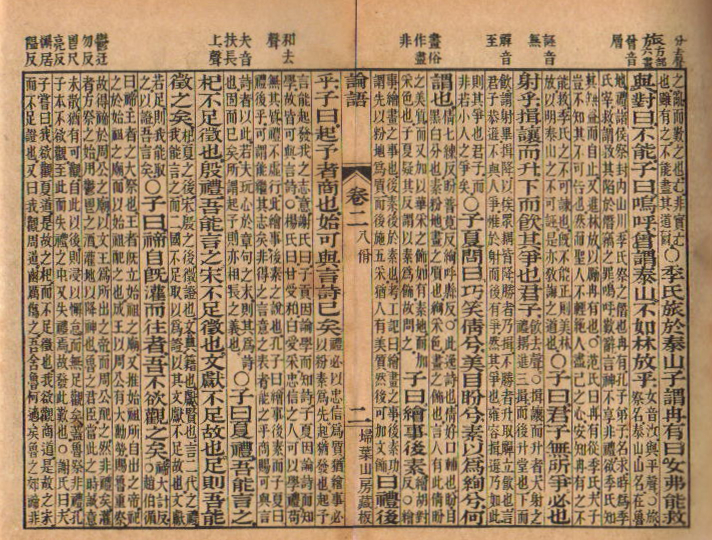 WorkChinesec. 475 – 221 BCE
Analects
Sayings of Confucius and his disciples on virtue, ritual, learning and government.
Read the full pageThe Analects, also known as the Sayings of Confucius, is an ancient Chinese philosophical text composed of sayings and ideas attributed to Confucius and his contemporaries, traditionally believed to have been compiled by his followers.
The consensus among scholars is that large portions of the text were composed during the Warring States period (475–221 BCE), and that the work achieved its final form during the mid-Han dynasty (206 BCE – 220 CE). During the early Han, the Analects was merely considered to be a commentary on the Five Classics. However, by the dynasty's end the status of the Analects had grown to become a central text of Confucianism.
- 5
 WorkChinesec. 400 BCE
Daodejing
81 short chapters on the Dao and its virtue — one of the most translated books in the world.
Read the full pageThe Tao Te Ching or Dào Dé Jīng, (traditional Chinese: 道德經; simplified Chinese: 道德经; lit. 'Classic of the Way and its Virtue') also known simply as the Laozi, is an ancient Chinese classic text traditionally attributed to the sage Laozi. It is regarded as the foundational Taoist text alongside the Zhuangzi. Central to both philosophical and religious Taoism, it has been "profoundly influential" more broadly in Chinese culture, art and medicine.
The texts' authorship and dating is debated, with several similar early versions recovered. Traceable as far back as the early to mid fourth century BCE, Alan Chan of the Stanford Encyclopedia argues that archaeology indicates that "bodies of sayings" attributed to Laozi were put into writing "probably from the second half of the fifth century B.C.E.", with different overlapping collections gradually consolidated during the fourth century BCE (400-300 BCE). Questionable as a single unified text, its oldest excavated manuscript fragments, the Guodian Chu slips, date to around 300 BCE, the latter half of the Warring States period (475 – 221 BCE). They are taken as dating back to the fourth century BCE. A conservative estimation would date relatively complete modern versions of the text to the mid third century BCE, or late Warring States period.
- 6WorkGreek & Romanc. 399 BCE
Apology
Socrates's defence speech at his trial: "the unexamined life is not worth living".
Read the full pageThe Apology of Socrates (Ancient Greek: Ἀπολογία Σωκράτους, Apología Sokrátous; Latin: Apologia Socratis), written by Plato, is a Socratic dialogue of the speech of legal self-defence which Socrates (469–399 BC) spoke at his trial for impiety and corruption in 399 BC.
Specifically, the Apology of Socrates is a defense against the charges of "corrupting the youth" and "not believing in the gods in whom the city believes, but in other daimonia that are novel" to Athens (24b).
- 7
 WorkGreek & Romanc. 385 BCE
Symposium
Speeches on love at a drinking party, ending with Diotima's ladder of beauty.
Read the full pageThe Symposium (Ancient Greek: Συμπόσιον, Symposion) is a Socratic dialogue by Plato, dated c. 385 – 370 BC. It depicts a friendly contest of extemporaneous speeches given by a group of notable Athenian men attending a banquet. The men include the philosopher Socrates, the general and statesman Alcibiades, and the comic playwright Aristophanes. The panegyrics are to be given in praise of Eros, the god of love and sex.
In the Symposium, Eros is recognized both as erotic lover and as a phenomenon capable of inspiring courage, valor, great deeds and works, and vanquishing man's natural fear of death. It is seen as transcending its earthly origins and attaining spiritual heights. The extraordinary elevation of the concept of love raises a question of whether some of the most extreme extents of meaning might be intended as humor or farce. Eros is almost always translated as "love", and the English word has its own varieties and ambiguities that provide additional challenges to the effort to understand the Eros of ancient Athens.
- 8
 Read the full page
Phaedo ( ; Ancient Greek: Φαίδων, Phaidōn) is a dialogue written by Plato, in which Socrates discusses the immortality of the soul and the nature of the afterlife with his friends in the hours leading up to his death. Socrates explores various arguments for the soul's immortality with the Pythagorean philosophers Simmias and Cebes of Thebes in order to show that there is an afterlife in which the soul will dwell following death. The dialogue concludes with a mythological narrative of the descent into Tartarus and an account of Socrates' execution.
The dialogue is set in 399 BCE, in an Athenian prison, during the last hours prior to the death of Socrates. It is presented within a frame story by Phaedo of Elis, who is recounting the events to Echecrates, a Pythagorean philosopher.
- 9
 WorkGreek & Romanc. 375 BCE
Republic
Plato's masterpiece on justice, the soul and the ideal city — home of the Cave and the philosopher-kings.
- ◆What is justice?
- ◆The tripartite soul
- ◆Philosopher-kings
- ◆Allegory of the Cave
- ◆Ring of Gyges
Read the full pageThe Republic (Ancient Greek: Πολιτεία, romanized: Politeia; Latin: De Republica) is a Socratic dialogue authored by Plato around 375 BC, concerning justice (dikaiosúnē), the order and character of the just city-state, and the just man. It is Plato's best-known work, and one of the world's most influential works of philosophy and political theory, both intellectually and historically.
In the dialogue, Socrates discusses with various Athenians and foreigners the meaning of justice and whether the just man is happier than the unjust man. He considers the natures of existing regimes and then proposes a series of hypothetical cities in comparison, culminating in Kallipolis (Καλλίπολις), a utopian city-state ruled by a class of philosopher-kings. They also discuss aging, love, theory of forms, the immortality of the soul, and the role of the philosopher and of poetry in society. The dialogue's setting seems to be the time of the Peloponnesian War.


