Great books: ancient: Letters to Lucilius to Confessions
- Read the full page
Epistulae Morales ad Lucilium (Latin for "Moral Letters to Lucilius"), also known as the Moral Epistles and Letters from a Stoic, is a letter collection of 124 extant letters that Seneca the Younger wrote at the end of his life, during his retirement, after he had worked for the Emperor Nero for more than ten years. They are addressed to Lucilius Junior, the then procurator of Sicily, who is known only through Seneca's writings.
The letters often begin with an observation on daily life, and then proceed to an issue or principle abstracted from that observation. The result is like a diary, or handbook of philosophical meditations. The letters focus on many traditional themes of Stoic philosophy such as the contempt of death, the stout-heartedness of the sage, and virtue as the supreme good.
- Read the full page
The Yoga Sutras of Patañjali (Sanskrit: पतञ्जलि योगसूत्रम्, romanised: Patañjali yogasūtram) is a compilation "from a variety of sources" of Sanskrit sutras (aphorisms) on the practice of yoga – 195 sutras (according to Vyāsa and Krishnamacharya) and 196 sutras (according to others, including B. K. S. Iyengar). The Yoga Sutras were compiled in India in the early centuries CE by the sage Patanjali, who collected and organized knowledge about yoga from Samkhya, Buddhism, and older Yoga traditions, and possibly another compiler who may have added the fourth chapter. He may also be the author of the Yogabhashya, a commentary on the Yoga Sutras, traditionally attributed to the legendary Vedic sage Vyasa, but possibly forming a joint work of Patanjali called the Pātañjalayogaśāstra.
The Yoga Sutras draw from three distinct traditions from the 2nd century BCE to the 1st century CE, namely Samkhya, Buddhism traditions, and "various older ascetic and religious strands of speculation." The Yoga Sutras are built on Samkhya notions of purusha and prakriti, and are often seen as complementary to them. They are closely related to Buddhism, incorporating some of its terminology. While there is "an apparent lack of unity and coherence", there is a "straightforward unity to the text", which focuses on "one-pointed awareness" (ekagrata) and "content-free awareness" (nirvikalpa samadhi); the means to acquire these, namely kriya yoga ("action yoga") and ashtanga yoga (eight-limb yoga); the results acquired from the attainment of these levels of awareness; and the final goal of yoga, namely kaivalya and liberation.
- Read the full page
The Enchiridion or Handbook of Epictetus (Ancient Greek: Ἐγχειρίδιον Ἐπικτήτου, Enkheirídion Epiktḗtou) is a short manual of Stoic ethical advice compiled by Arrian, a 2nd-century disciple of the Greek philosopher Epictetus. Although the content is mostly derived from the Discourses of Epictetus, it is not a summary of the Discourses but rather a compilation of practical precepts. Eschewing metaphysics, Arrian focuses his attention on Epictetus's work applying philosophy to daily life. Thus, the book is a manual to show the way to achieve mental freedom and happiness in all circumstances.
The Enchiridion was well known in the medieval world and was specially adapted for use in Greek-speaking monasteries. In the 15th century it was translated into Latin, and then, with the advent of printing, into multiple European languages. It reached the height of popularity in the 17th century, in parallel with the Neostoicism movement.
- Read the full page
Meditations (Koine Greek: Τὰ εἰς ἑαυτόν, romanized: Ta eis heauton, lit. ''Things Unto Himself'') is a collection of personal writings by Marcus Aurelius, Roman Emperor from 161–180 AD, which record his private notes to himself and his reflections on Stoic philosophy.
Marcus Aurelius wrote the 12 books of the Meditations in Koine Greek as a source for his own guidance and self-improvement. It is possible that large portions of the work were written at Sirmium (modern-day Sremska Mitrovica, Serbia), where he spent much time planning military campaigns in 170–180 AD. A portion of his work was written while he was on campaign, because internal notes reveal that the first book was "written in the country of the Quadi, at the Granova" (modern-day Hron River in Slovakia) and the second book was written at Carnuntum.
- 5WorkIndianc. 200
Mūlamadhyamakakārikā
Nāgārjuna's "Fundamental Verses on the Middle Way", the root text of Madhyamaka.
Read the full pageThe Mūlamadhyamakakārikā (Devanagari: मूलमध्यमककारिका, lit. 'Verses on the Root of the Middle Way'), abbreviated as MMK, is the foundational text of the Madhyamaka school of Mahāyāna Buddhist philosophy. It was composed by the Indian philosopher Nāgārjuna (around roughly 150 CE).
The MMK makes use of reductio arguments to show how all phenomena (dharmas) are empty of svabhava (which has been variously translated as essence, own-being, or inherent existence). The MMK is widely regarded as one of the most influential and widely studied texts in the history of Buddhist philosophy. The MMK had a major impact on the subsequent development of Buddhist thought, especially in Tibetan Buddhism and East Asian Buddhism.
- Read the full page
The Enneads (; Ancient Greek: Ἐννεάδες), fully The Six Enneads, is the collection of writings of the philosopher Plotinus, edited and compiled by his student Porphyry (c. AD 270). Plotinus was a student of Ammonius Saccas, and together they were founders of Neoplatonism. His work, through Augustine of Hippo, the Cappadocian Fathers, Pseudo-Dionysius the Areopagite and several subsequent Christian and Muslim thinkers, has greatly influenced Western and Near-Eastern thought.
Porphyry edited the writings of Plotinus in fifty-four treatises, which vary greatly in length and number of chapters, mostly because he split original texts and joined others together to match this very number. Then, he proceeded to set the fifty-four treatises in groups of nine (Greek. ennea) or Enneads. He also collected The Enneads into three volumes. The first volume contained the first three Enneads (I, II, III), the second volume has the Fourth (IV) and the Fifth (V) Enneads, and the last volume was devoted to the remaining Ennead. After correcting and naming each treatise, Porphyry wrote a biography of his master, Life of Plotinus, intended to be an introduction to the Enneads.
- 7
 WorkMedieval Latin400
Confessions
Augustine's autobiography of conversion, with famous reflections on memory and time.
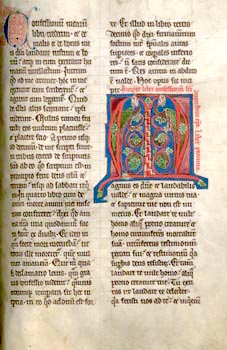
Read the full pageConfessions (Latin: Confessiones) is an autobiographical work by Augustine of Hippo, consisting of 13 books written in Latin between AD 397 and 400. The work outlines Augustine's sinful youth and his conversion to Christianity. Modern English translations are sometimes published under the title The Confessions of Saint Augustine in order to distinguish it from other books with similar titles. Its original title was Confessions in Thirteen Books; it was composed to be read out loud, with each book being a complete unit.
Confessions is generally considered one of Augustine's most important texts. It is widely regarded as one of the earliest and most influential works of spiritual autobiography in Western literature, and was an influential model for Christian writers throughout the Middle Ages. Henry Chadwick wrote that Confessions will "always rank among the great masterpieces of western literature".


