Politics
On the city-state, constitutions and citizenship.
Politics (Ancient Greek: Πολιτικά, romanized: Politiká) is a work of political philosophy by Aristotle, a 4th-century BC Greek philosopher.
At the end of the Nicomachean Ethics, Aristotle declared that the inquiry into ethics leads into a discussion of politics. The two works are frequently considered to be parts of a larger treatise – or perhaps connected lectures – dealing with the "philosophy of human affairs". In Aristotle's hierarchical system of philosophy he considers politics, the study of communities, to be of higher priority than ethics, which concerns individuals.
The title of Politics literally means "the things concerning the πόλις (polis)", and is the origin of the modern English word politics. As Aristotle explains, this is understood by him to be a study of how people should best live together in communities – the polis being seen by him as the best and most natural community for humans.
The history of Greek city-states, their wars and intrigues and political churning, was well-documented. In addition to such documentation, Aristotle pursued a research project of collecting 158 constitutions of various city-states in order to examine them for their strong and weak points. This evidence-based, descriptive approach to the study of politics was a hallmark of Aristotle's method, and a contrast with the more idealistic from-first-principles approach of Plato, as seen for example in the Republic.
As with the Nicomachean Ethics, the Politics is not a polished work as Aristotle would have written it for publication. There are various theories about the text which has come down to us. It may have been assembled from a set of shorter works on certain political themes, combined with or interlaced with his marginal notes or with the notes taken by those who attended his Lyceum lectures.
Political context
Aristotle was of Greek extraction, born in the town of Stagira within the Chalcidian League (modern-day northeastern Greece). He attended Plato's Academy in Athens for about twenty years. He returned to Macedonia for a while, in part to tutor a young Alexander the Great, and then went back to Athens to found his own school, the Lyceum. Though he spent most of his life and career in Athens, Aristotle was never an Athenian citizen, but rather resided there as a metic. Indeed, throughout his life, he was never a fully-fledged citizen of any Greek polis.
Athenian citizenship was usually limited to a minority of adult males. it was based on the obligations citizens had towards the community rather than the more passive citizenship of modern times which grants indivudals basic rights. And it usually assumed that those who were citizens shared common goals, a common outlook, and a mutual interest in the success of the polis.
Greece was divided politically into territories ruled by many independent city-states. These often formed alliances and sometimes centrally-governed confederations (particularly in times of war). Some developed colonies, both as ways of finding new agricultural land and as ways of giving a restive underclass something to do at some distance from the ruling class.
There is a reference in the Politics to the assassination of Philip II of Macedon, which happened in 336 BC. This implies that at least some of the work was composed after the expansion of the Macedonian kingdom under Philip II, which resulted in its dominion over Athens and much of the rest of Greece, subordinating Greece's many city-states to a foreign empire.
As a Macedonian and tutor to Alexander the Great, Aristotle was well-placed to be in the good graces of the political leadership of his time, until Athens challenged Macedonian power towards the end of Aristotle's life, which led his departure from Athens to Chalcis, Euboea, in order to avoid the anti-Macedonian sentiments.
Structure
Aristotle's Politics is divided into eight books, which are each further divided into chapters. Citations of this work, as with the rest of the works of Aristotle, are often made by referring to the Bekker section numbers. Politics spans the Bekker sections 1252a to 1342b.
Book I
In the first book, Aristotle discusses the city (πόλις, polis) or "political community" (κοινωνία πολιτική, koinōnía politikē) in comparison with other types of communities and partnerships such as the household (οἶκος, oikos), the master/slave relationship, and the village.
The highest form of community is the polis. Aristotle comes to this conclusion because he believes the public life is far more virtuous than the private and because "man is by nature a political animal". He begins with the relationship between the city and man, and then specifically discusses the household.
He takes issue with the view that political rule, kingly rule, and rule over a household or village are only different in size, but rule over slaves was a different kind of rule. He then examines in what way the city may be said to be natural. He concludes that "the state is a creation of nature":
[W]hile the state came about as a means of securing life itself, it continues in being to secure the good life.… This association is the end of those others [the household and the village], and nature is itself an end; for whatever is the end-product of the coming into existence of any object, that is what we call its nature… Moreover the aim and the end is perfection; and self-sufficiency [αὐτάρκεια, autarkeia] is both end and perfection.
Aristotle discusses the parts of the household, which includes slaves. He considers whether slavery can ever be just and better for the person enslaved or is always unjust and bad. He distinguishes between those who are slaves because the law says they are and those who are slaves by nature, saying the inquiry hinges on whether there are any such natural slaves.
Only someone as different from other people as the body is from the soul or beasts are from human beings would be a slave by nature, Aristotle concludes, all others being slaves solely by law or convention. Some scholars have therefore concluded that the qualifications for natural slavery preclude the existence of such a being (though Aristotle was convinced that natural slaves existed).
Aristotle then moves to the question of property in general, arguing that the acquisition of property does not form a part of household management (οἰκονομική, oikonomikē) and criticizing those who engage in excessive chrematistics. Wealth accumulation is necessary to a point, but that does not make it a part of household management any more than it makes medicine a part of household management just because health is necessary.
He criticizes income based upon trade and upon interest, saying that those who become avaricious do so because they forget that money merely symbolizes wealth without being wealth, and that interest is "contrary to nature" because it increases by itself not through exchange.
Book I concludes with Aristotle's assertion that the proper object of household rule is the virtuous character of one's wife and children, not the management of slaves or the acquisition of property. Rule over the slaves is despotic, rule over children kingly, and rule over one's wife political (except there is no rotation in office). Aristotle questions whether it is sensible to speak of the "virtue" of a slave and whether the "virtues" of a wife and children are the same as those of a man. He thinks that such people have their own sort of virtues, though not the same set as those of free men, and that even to the extent that they have virtues with the same names as those of free men, they mean somewhat different things.
Book II
Book II examines various views concerning the best regime. It opens with an analysis of the regime presented in Plato's Republic. Aristotle maintains that, contrary to Plato's assertions, communal share of property between the guardians will increase rather than decrease dissensions, and sharing of wives and children will destroy natural affection. He concludes that common sense is against this arrangement for good reason, and claims that experiment shows it to be impractical. He next analyzes the regime presented in Plato's Laws. Aristotle then discusses the systems presented by two other philosophers, Phaleas of Chalcedon (who promoted methods of enforcing wealth egalitarianism) and Hippodamus of Miletus (who had detailed plans for utopian communities).
After addressing regimes invented by theorists, Aristotle moves to the examination of three existing regimes that were commonly held to be well managed. These are the Spartan, Cretan, and Carthaginian. The book concludes with some observations on regimes and legislators, and on the reforms of Solon in Athens.
Book III
Aristotle considers citizenship and who counts as a citizen. He asserts that a citizen is anyone who is "entitled to participate in office, deliberative or judicial". This excludes honorary citizens, resident aliens, slaves, women, foreigners even if they have some access to the legal system through commercial treaties, boys too young for military service, or people who have been exiled or stripped of their citizenship. Aristotle is also doubtful about whether citizenship should extend to the banausos or working classes.
He next considers what sort of entity a state is, whether it is a single thing, and under what circumstances it can be considered to have changed or, alternatively, to have been supplanted by a new state. He then turns to the question of how the virtues of a person qua person line up with the virtues of a person qua citizen: where they are coincident and where they may differ.
Next, Aristotle classifies varieties of constitution, in their good and bad forms (in good ones, the rulers rule in the interest of the common good; in bad ones, for the benefit of the rulers themselves).
Adapted from the Wikipedia article Politics (Aristotle), available under CC BY-SA 4.0.
Quotations
“Man is by nature a political animal.”
Connections
Author
1

You might also explore
 The Communist Manifesto★Modern European1848"The history of all hitherto existing society is the history of class struggles."
 The Art of War★Chinesec. 500 BCESunzi's classic of strategy: "to win without fighting is best".
 RepublicGreek & Romanc. 375 BCEPlato's masterpiece on justice, the soul and the ideal city — home of the Cave and the philosopher-kings.
 The PrinceModern European1513Machiavelli's handbook of power: it is safer to be feared than loved.
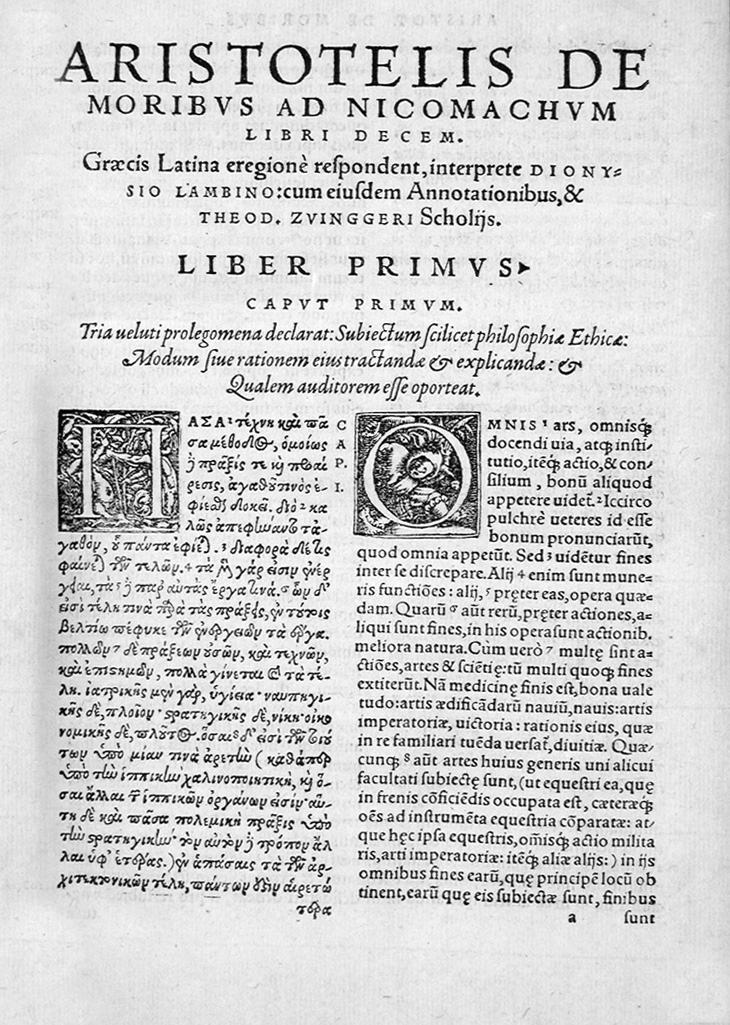 Nicomachean EthicsGreek & Romanc. 340 BCEAristotle's inquiry into the good life: happiness, virtue, friendship and contemplation.ArthaśāstraIndianc. 300 BCE – 300 CETreatise on statecraft, economics and military strategy.