Thinkers across traditions: Gorakhnath to Gautama
- 1
 Philosopher1100 – 1200
Gorakhnath
Gorakhnath was a Hindu yogi, mahasiddha and saint who was the founder of the Nath Hindu monastic movement in India. He is considered one of the two disciples of Matsyendranath.
- ◆Hatha yoga
Read the full pageGorakhnath (also known as Gorakshanath (Sanskrit: Gorakṣanātha) (Devanagari : गोरक्षनाथ / गोरखनाथ), c. early 11th century) was a Hindu yogi, mahasiddha and saint who was the founder of the Nath Hindu monastic movement in India. He is considered one of the two disciples of Matsyendranath. His followers are known as Jogi, Gorakhnathi, Darshani or Kanphata.
Gorakhnath is considered a Maha-yogi (or "great yogi") in Hindu tradition. He was one of nine saints, or Navnath, in the spiritual lineage of nine masters with Shiva as their first direct teacher. Hagiographies describe him to be a person outside the laws of time who appeared on earth during different ages. He did not emphasize a specific metaphysical theory or a particular Truth, but emphasized that the unbiased search for truth is a valuable and normal goal of man. Gorakhnath championed Yoga, spiritual discipline and guidance of an enlightened master (Guru) as the means to reaching samadhi or spiritual liberation.
- 2Philosopher1270 – 1320
Radulphus Brito
Radulphus Brito was an influential grammarian and philosopher, based in Paris. He is usually identified as Raoul le Breton, though this is disputed by some.
Read the full pageRadulphus Brito (c. 1270 – 1320) was an influential grammarian and philosopher, based in Paris. He is usually identified as Raoul le Breton, though this is disputed by some. Besides works of grammatical speculation he wrote on Aristotle, Boethius and Priscian.
Radulphus was Master of Arts in the University of Paris in 1296, and joined the theology faculty in 1311. Very few of his works are edited, although he was a prolific and influential writer. He was one of a group of grammarians called the Modistae or modists who flourished around Paris from about 1260 to 1310, so-called because they wrote on the mode of signifying.
- 3Philosopher1300 – 1300
Isaac Albalag
Isaac Albalag (Hebrew: יצחק אלבלג) was a Jewish philosopher and translator of the second half of the 13th century.
Read the full pageIsaac Albalag (Hebrew: יצחק אלבלג) was a Jewish philosopher and translator of the second half of the 13th century.
According to Moritz Steinschneider (Hebräische Uebersetzungen. pp. 299–306), Albalag probably lived in northern Spain or southern France. Heinrich Graetz makes him a native of southern Spain. His liberal views, especially his interpretations of the Biblical account of the Creation in accordance with the Aristotelian theory of the eternity of the world, stamped him in the eyes of many as a heretic.
- 4Philosopher1300 – 1300
Lambert of Auxerre
Lambert of Auxerre was a medieval 13th century logician best known for writing the book "Summa Lamberti" or simply "Logica" in the mid 1250s which became an authoritative textbook on logic in the Western tradition. He was a Dominican in the Dominican house at Auxerre.
Read the full pageLambert of Auxerre was a medieval 13th century logician best known for writing the book "Summa Lamberti" or simply "Logica" in the mid 1250s which became an authoritative textbook on logic in the Western tradition. He was a Dominican in the Dominican house at Auxerre. His contemporaries were Peter of Spain, William of Sherwood, and Roger Bacon.
Logica (Summa Lamberti), First edition of the Latin text by Franco Alessio, Firenze, La Nuova Italia, 1971.
- 5
 Philosopher1594 – 1651
Shabdrung Ngawang Namgyal
Ngawang Namgyal, known colloquially as The Bearded Lama, was a Tibetan Buddhist Drukpa Kagyu school Rinpoche, and the unifier of Bhutan as a nation-state. He was later granted the honorific title Zhabdrung Rinpoche, approximately "at whose feet one submits".
Read the full pageNgawang Namgyal (Tibetan: ཞབས་དྲུང་ངག་དབང་རྣམ་རྒྱལ་, Wylie: zhabs drung ngag dbang rnam rgyal; alternative spellings include Zhabdrung Ngawang Namgyel; 1594–1651), known colloquially as The Bearded Lama, was a Tibetan Buddhist Drukpa Kagyu school Rinpoche, and the unifier of Bhutan as a nation-state. He was later granted the honorific title Zhabdrung Rinpoche, approximately "at whose feet one submits". In addition to unifying the various warring fiefdoms for the first time in the 1630s, he also sought to create a distinct Bhutanese cultural identity separate from the Tibetan culture from which it was derived.
Zhabdrung Ngawang Namgyal was born at Ralung Monastery (Wylie: rwa lung), Tibet, as the son of the Drukpa Kagyu lineage-holder Mipham Tenpa’i Nyima (Wylie: 'brug pa mi pham bstan pa'i nyi ma, 1567–1619) and Sönam Pelgyi Butri (Wylie: bsod nams dpal gyi bu khrid), daughter of the local ruler of Kyishö (Wylie: sde pa skyid shod pa) in Tibet. Through his father’s line, Ngawang Namgyal was a direct descendant of Tsangpa Gyare (1161–1211), the founder of the Drukpa Lineage.
- 6
 Philosopher
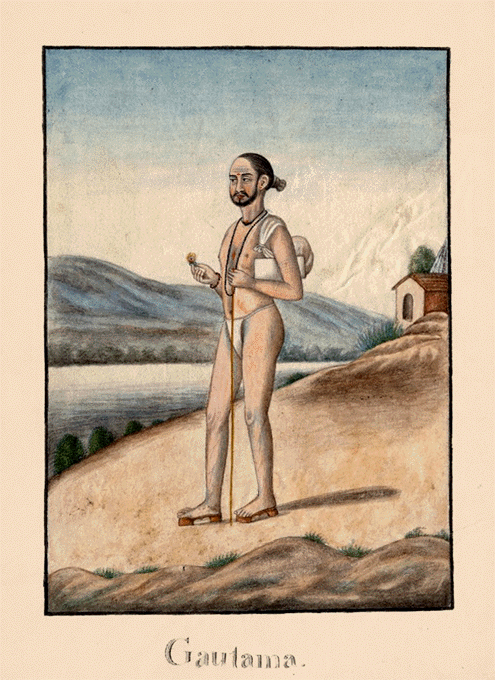
Gautama
Gautama (Sanskrit: महर्षिः गौतम, IAST: Maharṣiḥ Gautama) was a sage in Hinduism and son of Brahmin sage Dirghatamas who is also mentioned in Jainism and Buddhism. Gautama is mentioned in the Yajurveda, Ramayana, and Gaṇeśa Pūrana and is known for cursing his wife Ahalyā.
Read the full pageGautama (Sanskrit: महर्षिः गौतम, IAST: Maharṣiḥ Gautama) was a sage in Hinduism and son of Brahmin sage Dirghatamas who is also mentioned in Jainism and Buddhism. Gautama is mentioned in the Yajurveda, Ramayana, and Gaṇeśa Pūrana and is known for cursing his wife Ahalyā. Another important story related to Gautama is about the creation of river Godavari, which is also known as Gautami.
According to the Ramayana, Gautama's eldest son with Ahalya is Shatananda. But according to the Adi Parva of Mahabharata, he had two sons named Sharadvana and Cirakari. Sharadvana was also known as Gautama, hence his children Kripa and Kripi were called Gautama and Gautami respectively. A daughter of Gautama is referred too, but her name is never disclosed in the epic. In the Sabha Parva, he is described to beget many children through Aushinara (daughter of Ushinara), amongst whom the eldest in Kakshivata. Gautama and Aushinara's wedding takes place at Magadha, the kingdom of Jarasandha. According to the Vamana Purana, he had three daughters named Jaya, Jayanti, and Aparajita.