Medieval Latin thinkers: Vitry to Kilwardby
- 1
 PhilosopherMedieval Latin1160 – 1240
Jacques de Vitry
James of Vitry was a French canon regular who was a noted theologian and chronicler of his era. He was elected bishop of Acre in 1214 and made cardinal in 1229.
Read the full pageJames of Vitry (French: Jacques de Vitry; Latin: Iacobus de Vitriaco; c. 1160/70 – 1 May 1240) was a French canon regular who was a noted theologian and chronicler of his era.
He was elected bishop of Acre in 1214 and made cardinal in 1229.
- 2PhilosopherMedieval Latin1165 – 1236
Philip the Chancellor
Philip the Chancellor, (French: Philippe le Chancelier) also known as "Philippus Cancellarius Parisiensis" (Philip, Chancellor of Paris) was a French theologian, Latin lyric poet, and possibly a composer as well. He was Chancellor of Notre-Dame de Paris starting in 1217 until his death, and was also Archdeacon of Noyon
Read the full pagePhilip the Chancellor, (French: Philippe le Chancelier) also known as "Philippus Cancellarius Parisiensis" (Philip, Chancellor of Paris) (c 1160–December 26, 1236) was a French theologian, Latin lyric poet, and possibly a composer as well. He was Chancellor of Notre-Dame de Paris starting in 1217 until his death, and was also Archdeacon of Noyon. Philip is portrayed as an enemy to the Mendicant orders becoming prevalent at the time, but this has been greatly exaggerated. He may have even joined the Franciscan order soon before his death.
Philip was one of the most prolific Medieval lyric poets. He was the subject of Henri d'Andeli's Dit du Chancelier Philippe. Philip's most influential work was his Summa de Bono.
- 3
 PhilosopherMedieval Latin1175 – 1253
Robert Grosseteste
Robert Grosseteste, also known as Robert Greathead or Robert of Lincoln, was an English statesman, scholastic philosopher, theologian, scientist and Bishop of Lincoln. He was born of humble parents in Suffolk (according to the early 14th-century chronicler Nicholas Trivet), but the association with the village of Strad
Read the full pageRobert Grosseteste ( GROHS-test; Latin: Robertus Grosseteste; c. 1168–70 – 8 or 9 October 1253), also known as Robert Greathead or Robert of Lincoln, was an English statesman, scholastic philosopher, theologian, scientist and Bishop of Lincoln. He was born of humble parents in Suffolk (according to the early 14th-century chronicler Nicholas Trivet), but the association with the village of Stradbroke is a post-medieval tradition. Upon his death, he was revered as a saint in England, but attempts to procure a formal canonisation failed. A. C. Crombie called him "the real founder of the tradition of scientific thought in medieval Oxford, and in some ways, of the modern English intellectual tradition". As a theologian, however, he contributed to increasing hostility to Jews and Judaism, and spread the accusation that Jews had purposefully suppressed prophetic knowledge of the coming of Christ, through his translation of the Testaments of the Twelve Patriarchs.
There is very little direct evidence about Grosseteste's education. He may have received a liberal arts education at Lincoln and appears as a witness for the bishop of Lincoln in the late 1180s or early 1190s, where he is identified as a Master. From about 1195 he was active in the household of the Bishop of Hereford William de Vere; a letter from Gerald of Wales to William extolling Grosseteste's skills survives. Grosseteste appears not to have received any form of benefice from Bishop William, and on the latter's death in 1198, the household dissolved. There is no evidence that Grosseteste held any position in the households of William's successors, but it is possible that he was supported by Hugh Foliot, Archdeacon of Shropshire in the north of Hereford diocese. Grosseteste's movements are not clear in the next two decades or so, but he seems to have spent some time in France during the years of the interdict over England (1208–14), and acted as a papal judge-delegate, in company with Hugh Foliot, in or around 1216.
- 4
 PhilosopherMedieval Latin1180 – 1249
William of Auvergne
William of Auvergne, also known as William of Paris, was a French theologian and philosopher who served as Bishop of Paris from 1228 until his death. He was one of the first western high medieval European philosophers to engage with and comment extensively upon Aristotelian and Islamic philosophy.
Read the full pageWilliam of Auvergne (Latin: Guilielmus Alvernus; French: Guillaume d'Auvergne; 1180/90–1249), also known as William of Paris, was a French theologian and philosopher who served as Bishop of Paris from 1228 until his death. He was one of the first western high medieval European philosophers to engage with and comment extensively upon Aristotelian and Islamic philosophy.
Very little is known of William's early life. He was born in Aurillac and the likely date range for his birth is reckoned from the fact that a professor of Theology normally needed to be at least 35 years old. If that holds good, then William could have been born as early as 1180 or as late as 1190.
- 5
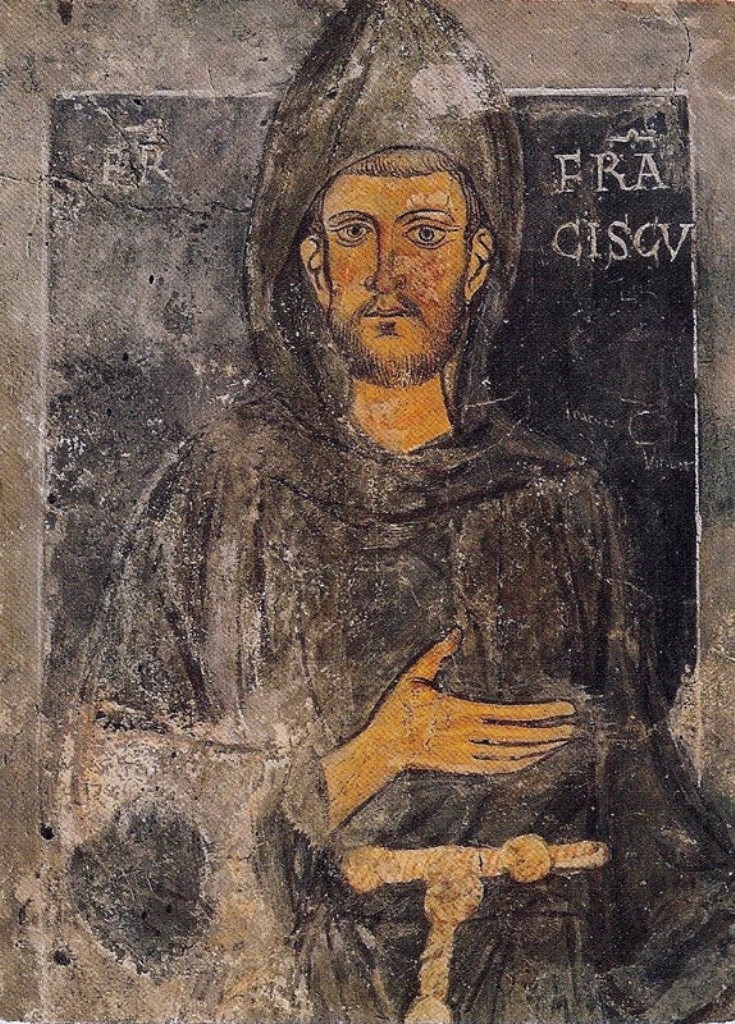 PhilosopherMedieval Latin1182 – 1226
Francis of Assisi
Giovanni di Pietro di Bernardone, venerated as Saint Francis of Assisi (Italian: Francesco d'Assisi), was an Italian mystic, poet and Catholic friar who founded the religious order of the Franciscans. Born into a wealthy family in Assisi, Italy, he was inspired towards a life of poverty and religious devotion as a youn
Read the full pageGiovanni di Pietro di Bernardone (c. 19 August 1181 – 3 October 1226), venerated as Saint Francis of Assisi (Italian: Francesco d'Assisi), was an Italian mystic, poet and Catholic friar who founded the religious order of the Franciscans.
Born into a wealthy family in Assisi, Italy, he was inspired towards a life of poverty and religious devotion as a young man and began his efforts by repairing chapels and caring for the sick in his hometown. Soon after, he gathered a band of followers in the city who joined in his lifestyle, and following a journey to Rome to meet Pope Innocent III, he received approval for the foundation of the Order of Friars Minor, which is commonly known as the Franciscan Order.
- 6
 PhilosopherMedieval Latin1193 – 1280
Albertus Magnus
Albertus Magnus, also known as Saint Albert the Great, Albert of Swabia, Albert von Bollstadt, or Albert of Cologne, was a German Dominican friar, philosopher, scientist, and bishop. He is considered one of the greatest medieval philosophers and thinkers.
Read the full pageAlbertus Magnus (c. 1200 – 15 November 1280), also known as Saint Albert the Great, Albert of Swabia, Albert von Bollstadt, or Albert of Cologne, was a German Dominican friar, philosopher, scientist, and bishop. He is considered one of the greatest medieval philosophers and thinkers.
Canonized in 1931, he was known during his lifetime as Doctor universalis and Doctor expertus; late in his life the sobriquet Magnus was appended to his name. Scholars such as James A. Weisheipl and Joachim R. Söder have referred to him as the greatest German philosopher and theologian of the Middle Ages. The Catholic Church distinguishes him as one of the Doctors of the Church.
- 7
 PhilosopherMedieval Latin1194 – 1253
Clare of Assisi
Chiara Offreduccio, known as Clare of Assisi (sometimes spelled Clara, Clair or Claire; Italian: Chiara d'Assisi), is an Italian saint who was one of the first followers of Francis of Assisi. Inspired by the teachings of St.
Read the full pageChiara Offreduccio (16 July 1194 – 11 August 1253), known as Clare of Assisi (sometimes spelled Clara, Clair or Claire; Italian: Chiara d'Assisi), is an Italian saint who was one of the first followers of Francis of Assisi.
Inspired by the teachings of St. Francis, St. Clare founded the Order of Poor Ladies, a monastic religious order for women in the Franciscan tradition. The Order of Poor Ladies was different from any other order or convent because it followed a rule of strict poverty. Clare wrote their Rule of Life, the first set of monastic guidelines known to have been written by a woman. Following her death, the order she founded was renamed in her honor as the Order of Saint Clare, commonly referred to today as the Poor Clares. Her feast day is on the 11th of August every year.
- 8
 PhilosopherMedieval Latin1200 – 1260
Hadewijch
Hadewijch (Dutch pronunciation: [ˈɦaːdəʋɪx]), sometimes referred to as Hadewych or Hadewig (of Brabant or of Antwerp), was a 13th-century poet and mystic. Most of her extant writings are in a Brabantian form of Middle Dutch and she probably lived in the Duchy of Brabant.
Read the full pageHadewijch (Dutch pronunciation: [ˈɦaːdəʋɪx]), (1200 – 1260) sometimes referred to as Hadewych or Hadewig (of Brabant or of Antwerp), was a 13th-century poet and mystic. Most of her extant writings are in a Brabantian form of Middle Dutch and she probably lived in the Duchy of Brabant. Her writings include visions, prose letters and poetry. Hadewijch was one of the most important direct influences on John of Ruysbroeck.
She was born in 1200 in Antwerp.
- 9PhilosopherMedieval Latin1200 – 1272
William of Sherwood
William of Sherwood or William Sherwood, with numerous variant spellings, was a medieval English scholastic philosopher, logician, and teacher. Little is known of his life, but he is thought to have studied in Paris, was a master at Oxford in 1252, treasurer of Lincoln from 1254/1258 onwards, and a rector of Aylesbury.
Read the full pageWilliam of Sherwood or William Sherwood (Latin: Guillielmus de Shireswode; c. 1200 – c. 1272), with numerous variant spellings, was a medieval English scholastic philosopher, logician, and teacher. Little is known of his life, but he is thought to have studied in Paris, was a master at Oxford in 1252, treasurer of Lincoln from 1254/1258 onwards, and a rector of Aylesbury.
He was the author of two books which were an important influence on the development of scholastic logic: Introductiones in Logicam (Introduction to Logic), and Syncategoremata. These are the first known works to deal in a systematic way with what is now called supposition theory, known in William's time as the logica moderna.
- 10PhilosopherMedieval Latin1201 – 1500
Isaac ben Joseph ibn Pulgar
Isaac ben Joseph ibn Pulgar or Isaac ben Joseph ibn Polkar or Isaac Polqar was a Spanish Jewish philosopher, poet, and controversialist, who flourished in the first half of the fourteenth century.
Read the full pageIsaac ben Joseph ibn Pulgar or Isaac ben Joseph ibn Polkar or Isaac Polqar was a Spanish Jewish philosopher, poet, and controversialist, who flourished in the first half of the fourteenth century.
Where he lived is not known, for though "Avilla" is given at the end of his translation of Al-Ghazali's Maqasid, the town-name as well as the date is probably the copyist's. He was a warm defender of Isaac Albalag, and continued his translation of Al-Ghazali's-work. It seems from his Ezer ha-Dat that he had been a friend of Abner of Burgos; but when the latter, after conversion, sent him one of his anti-Jewish writings, he replied in a stinging satirical poem.
- 11
 PhilosopherMedieval Latin1207 – 1282
Mechthild of Magdeburg
Mechthild (or Mechtild, Matilda, Matelda) of Magdeburg, a Beguine, was a Catholic Christian mystic of the Middle Ages whose book, Das fließende Licht der Gottheit (The Flowing Light of the Godhead), is a compendium of visions, prayers, dialogues and mystical accounts. She was the first mystic to write in Low German.
Read the full pageMechthild (or Mechtild, Matilda, Matelda) of Magdeburg (c. 1207 – c. 1282/1294), a Beguine, was a Catholic Christian mystic of the Middle Ages whose book, Das fließende Licht der Gottheit (The Flowing Light of the Godhead), is a compendium of visions, prayers, dialogues and mystical accounts. She was the first mystic to write in Low German.
Definite biographical information about Mechthild is scarce; what is known of her life comes largely from scattered hints in her work. She was born into a noble Saxon family. She had her first vision of the Holy Spirit at the age of twelve according to Flowing Light 4.2. In 1230, she left her home and “renounced worldly honour and worldly riches” to become a Beguine at Magdeburg. There, as with Hadewijch, she appears to have held a position of authority within a Beguine community, according to Flowing Light 6.7. In Magdeburg, she became acquainted with the Dominicans and became a Dominican tertiary. It seems clear that she read many of the Dominican writers; see, for example, the influence of the friars in Flowing Light 4.20-22. It was her Dominican confessor, Henry of Halle, who encouraged and helped Mechthild to compose The Flowing Light.
- 12
 PhilosopherMedieval Latin1215 – 1279
Robert Kilwardby
Robert Kilwardby OP was an Archbishop of Canterbury in England and a cardinal. Kilwardby was the first member of a mendicant order to attain a high ecclesiastical office in the English Church.
Read the full pageRobert Kilwardby OP (c. 1215 – 11 September 1279) was an Archbishop of Canterbury in England and a cardinal. Kilwardby was the first member of a mendicant order to attain a high ecclesiastical office in the English Church.
Kilwardby studied at the University of Paris, then was a teacher of grammar and logic there. He then joined the Dominican Order and studied theology, and became regent at Oxford University before 1261, probably by 1245. He was named provincial prior of the Dominicans for England in 1261, and in October 1272 Pope Gregory X appointed him as Archbishop of Canterbury to end a dispute over the election. Kilwardby was provided to the archbishopric on 11 October 1272, given the temporalities on 12 December 1272, and consecrated on 26 February 1273.