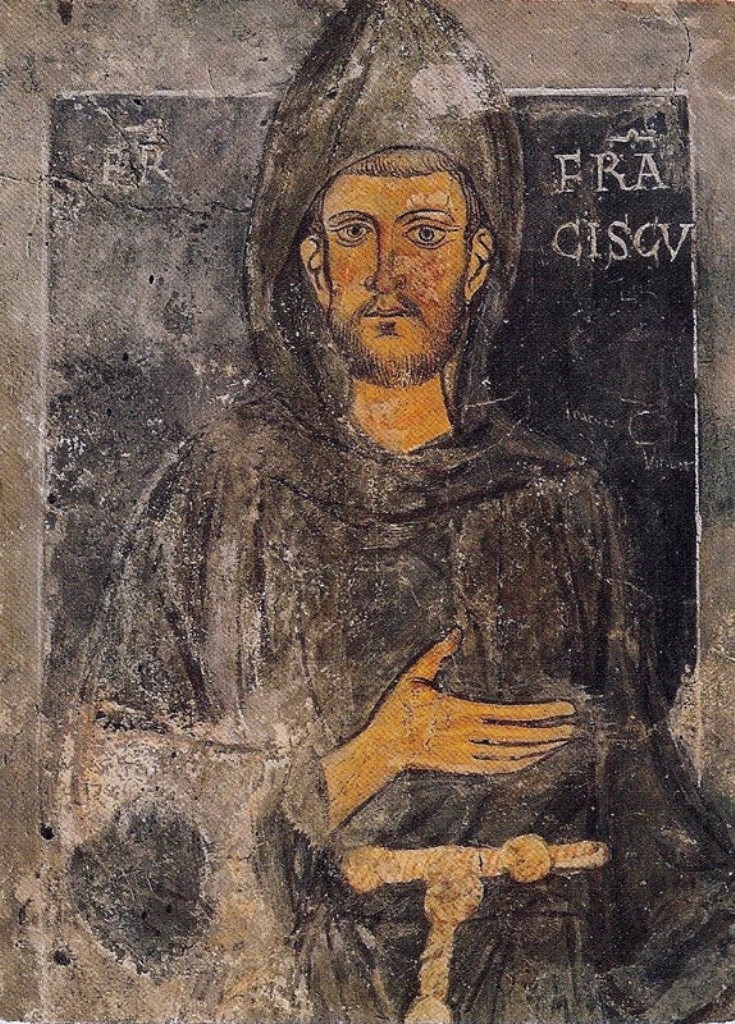
Francis of Assisi
Giovanni di Pietro di Bernardone, venerated as Saint Francis of Assisi (Italian: Francesco d'Assisi), was an Italian mystic, poet and Catholic friar who founded the religious order of the Franciscans. Born into a wealthy family in Assisi, Italy, he was inspired towards a life of poverty and religious devotion as a youn
Giovanni di Pietro di Bernardone (c. 19 August 1181 – 3 October 1226), venerated as Saint Francis of Assisi (Italian: Francesco d'Assisi), was an Italian mystic, poet and Catholic friar who founded the religious order of the Franciscans.
Born into a wealthy family in Assisi, Italy, he was inspired towards a life of poverty and religious devotion as a young man and began his efforts by repairing chapels and caring for the sick in his hometown. Soon after, he gathered a band of followers in the city who joined in his lifestyle, and following a journey to Rome to meet Pope Innocent III, he received approval for the foundation of the Order of Friars Minor, which is commonly known as the Franciscan Order.
Under his leadership, the order rapidly increased in size. Notable events in his religious career include his meeting with Clare of Assisi, who founded the Second Order of St. Francis commonly known as the Poor Clares, his journey to Egypt in 1219 in an attempt to convert the sultan Al-Kamil and put an end to the conflict of the Fifth Crusade, and his arrangement of the first live nativity scene as part of the annual Christmas celebration in Greccio. According to Christian tradition, Francis displayed stigmata resembling the wounds on the hands and feet of crucified Christ during the apparition of a seraphic angel in a religious ecstasy in 1224 and died two years later in 1226 at the age of 44.
One of the most venerated figures in Christianity, Francis was canonized by Pope Gregory IX on 16 July 1228. He is commonly portrayed wearing a brown habit with a rope tied around his waist, featuring three knots symbolizing the evangelical counsels of poverty, chastity, and obedience. Francis is associated with patronage of animals and the environment and, along with Catherine of Siena, is patron saint of Italy.
Names
Francis (Italian: Francesco d'Assisi; Latin: Franciscus Assisiensis) was named Giovanni by his mother. The rest of his birth name is a patronymic from his father, Pietro di Bernardone, as was the usage of the time among upper classes. His father was in France on business when Francis was born in Assisi, a small town in Umbria, central Italy. Upon his return, Pietro took to calling his son Francesco ('Free man' or 'Frenchman'), possibly in honour of his commercial success and enthusiasm for all things French, or because the mother herself was French.
Early life
Francis of Assisi was born c. 1181, one of the children of an Italian father, Pietro di Bernardone dei Moriconi, a prosperous silk merchant, and a French mother, Pica di Bourlemont, about whom little is known except that she was a noblewoman originally from Provence.
Indulged by his parents, Francis lived a high-spirited life, typical of a wealthy young man. As a youth, he became a devotee of troubadours and was fascinated with all things Transalpine. Francis was handsome, witty, gallant and delighted in fine clothes. He spent money lavishly. Although many hagiographers remark about Francis' bright clothing, rich friends, and love of pleasures, his displays of disillusionment toward the world that surrounded Francis came fairly early in his life, as is shown in the "story of the beggar". In this account, Francis was selling cloth and velvet in the marketplace on behalf of his father when a beggar came to him and asked for alms. At the end of his business deal, Francis abandoned his wares and ran after the beggar. When he found him, Francis gave the man everything he had in his purse. Francis' friends mocked him for his charity while his father scolded him in rage.
Around 1202, Francis joined a military expedition against Perugia and was taken as a prisoner at Collestrada. He spent a year as a captive, during which an illness caused Francis to re-evaluate his life. However, upon his return to Assisi in 1203, Francis returned to his carefree life. Two years later, Francis left for Apulia to enlist in the army of Walter III, Count of Brienne. A strange vision made him return to Assisi and lose interest in worldly life. According to hagiographic accounts, thereafter Francis began to avoid the sports and feasts of his former companions. A friend asked him whether he was thinking of marrying, to which Francis answered: "Yes, a fairer bride than any of you have ever seen", meaning his "Lady Poverty".
On a pilgrimage to Rome, Francis joined the poor in begging at St. Peter's Basilica. He spent some time in lonely places, asking God for divine illumination. Francis said that he had a mystical vision of Jesus Christ in the forsaken country chapel of San Damiano, just outside Assisi, in which the Icon of Christ Crucified said to him, "Francis, Francis, go and repair My church which, as you can see, is falling into ruins." Francis took this to mean the ruined church in which he was presently praying, so Francis sold some cloth taken from his father's store to assist the priest there. When the priest refused to accept the ill-gotten gains, an indignant Francis threw the coins on the floor.
In order to avoid his father's wrath, Francis hid in a cave near San Damiano for about a month. When he returned to town, hungry and dirty, Francis was dragged home by his father, beaten, bound, and locked in a small storeroom. Freed by his mother during Bernardone's absence, Francis returned at once to San Damiano, where he found shelter with the officiating priest, but Francis was soon cited before the city consuls by his father. The latter, not content with having recovered the scattered gold from San Damiano, sought also to force his son to forgo his inheritance by way of restitution. In the midst of legal proceedings before the Bishop of Assisi, Francis renounced his father and his patrimony. Some accounts report that Francis stripped himself naked in token of this renunciation and the bishop covered him with his own cloak.
For the next couple of months, Francis wandered as a beggar in the hills behind Assisi. He spent some time at a neighbouring monastery working as a scullion. Francis then went to Gubbio, where a friend gave him alms, the cloak, girdle and staff of a pilgrim. Returning to Assisi, Francis traversed the city, begging stones for the restoration of St. Damiano. These he carried to the old chapel, set in place himself, and rebuilt it over time. Over the course of two years, Francis embraced the life of a penitent, during which he restored several ruined chapels in the countryside around Assisi, among them San Pietro in Spina (in the area of San Petrignano in the valley about a kilometre from modern Rivotorto, on private property and once again in ruin); and the Porziuncola, the little chapel of St. Mary of the Angels in the plain just below the town. This later became Francis' favorite abode. By degrees, he took to nursing lepers, in the leper colonies near Assisi.
Order of Friars Minor (OFM)
One morning in February 1208, Francis was taking part in a Mass in the chapel of St. Mary of the Angels, near which he had by then built himself a hut. The Gospel of the day was the "Commissioning of the Twelve" from the Book of Matthew, in which Jesus' disciples are commissioned to go and proclaim that the Kingdom of God is at hand. Francis was inspired to devote himself to a life of poverty. Having obtained a coarse woollen tunic, the dress then worn by the poorest Umbrian peasants, Francis tied it around himself with a knotted rope and went about exhorting the people of the countryside to penance, brotherly love and peace. His preaching to ordinary people was unusual as Francis had no license to do so.
Francis' example attracted others. Within a year, he had 11 followers. The brothers lived a simple life in the deserted leper colony of Rivo Torto near Assisi. They spent much of their time wandering through the mountainous districts of Umbria, and through their earnestness toward people they encountered, often deeply impressed them.
In 1209, Francis composed a simple rule for his followers ("friars"), the Regula primitiva or "Primitive Rule", which came from verses in the Bible. The rule was "to follow the teachings of our Lord Jesus Christ and to walk in his footsteps." He then led 11 followers to Rome to seek permission from Pope Innocent III to found a new religious order. Upon entry to Rome, the brothers encountered Bishop Guido of Assisi, who had in his company Giovanni di San Paolo, the Cardinal Bishop of Sabina. The Cardinal, who was the confessor of Pope Innocent III, was immediately sympathetic to Francis and agreed to represent Francis to the Pope. After several days, the Pope agreed to admit the group informally, adding that when God increased the group in grace and number, they could return for an official audience. The group was tonsured.
Seeking the pope's authority was important because it demonstrated Francis's recognition of the Church's authority, preventing his followers from accusations of heresy, as had happened to the Waldensians decades earlier. The pope initially hesitated, but after he had a dream in which he saw Francis holding up the Lateran Basilica, he endorsed his order via oral approbation. Per tradition, this occurred on 16 April 1210 and constituted the official founding of the Franciscan Order. The group, then the "Lesser Brothers" (Order of Friars Minor also known as the Franciscan Order or the Seraphic Order), were centred in the Porziuncola and preached first in Umbria, before expanding throughout Italy. Francis was later ordained a deacon, but not a priest.
Poor Clares and Third Order
From then on, the new order grew quickly. Hearing Francis preaching in the church of San Rufino in Assisi in 1211, the young noblewoman Clare of Assisi sought to live like them. Her cousin Rufino also sought to join. On the night of Palm Sunday, 28 March 1212, Clare clandestinely left her family's palace. Francis received her at the Porziuncola and thereby established the Order of Poor Clares. He gave Clare a religious habit, a garment similar to his own, before lodging her, her younger sister Caterina, and other young women in a nearby monastery of Benedictine nuns until Francis could provide a suitable monastery. Later, he transferred them to San Damiano, to a few small huts or cells. This became the first monastery of the Second Franciscan Order, currently known as Poor Clares.
For those who could not leave their affairs, Francis later formed the Third Order of Brothers and Sisters of Penance, a fraternity composed of either laity or clergy whose members neither withdrew from the world nor took religious vows. Instead, they observed the principles of Franciscan life in their daily lives. Before long, the Third Order – currently titled the Secular Franciscan Order – grew beyond Italy.
Missionary work during the Fifth Crusade
In the late spring of 1212, Francis set out for Jerusalem, but was shipwrecked by a storm on the Dalmatian coast, forcing him to return to Italy. On 8 May 1213, Francis was given the use of the mountain of La Verna (Alverna) as a gift from Count Orlando di Chiusi, who described it as "eminently suitable for whoever wishes to do penance in a place remote from mankind". The mountain would become one of his favourite retreats for prayer.
During the Fifth Crusade in 1219, Francis went to Egypt where a Crusader army had been encamped for over a year besieging the walled city of Damietta. He was accompanied by Friar Illuminatus of Arce and hoped to convert the Sultan of Egypt or be martyred in the attempt. The Sultan, Al-Kamil, a nephew of Saladin, had succeeded his father as Sultan of Egypt in 1218 and was encamped upstream of Damietta. A bloody and futile attack on the city was launched by the Christians on 29 August 1219, following which both sides agreed to a ceasefire that lasted four weeks. Probably during this interlude, Francis and his companion crossed the Muslims' lines and were brought before the Sultan, remaining in his camp for a few days. Reports give no information about what transpired during the encounter beyond noting that the Sultan received Francis graciously and that Francis preached to the Muslims. He returned unharmed. No known Arab sources mention the visit.
According to some late sources, the Sultan gave Francis permission to visit the sacred places in the Holy Land and even to preach there. All that can safely be asserted is that Francis and his companion left the Crusader camp for Acre, from where they embarked for Italy in the latter half of 1220. Drawing on a 1267 sermon by Bonaventure, later sources report that the Sultan secretly converted or accepted a death-bed baptism as a result of meeting Francis.
Whatever transpired as a result of Francis' and al-Kamil's meeting the Franciscans have maintained a presence in the Holy Land almost uninterrupted since 1217 and remain there (see Custody of the Holy Land). They received concessions from the Mameluke Sultan in 1333 with regard to certain Holy Places in Jerusalem and Bethlehem and (so far as concerns the Catholic Church) jurisdictional privileges from Pope Clement VI in 1342.
Reorganization of the Franciscan Order
The growing order of friars was divided into provinces; groups were sent to France, Germany, Hungary and Spain and to the East. Upon receiving a report of the martyrdom of five brothers in Morocco, Francis returned to Italy via Venice. Cardinal Ugolino di Conti was then nominated by the pope as the protector of the order. Another reason for Francis' return to Italy was that the Franciscan Order had grown at an unprecedented rate compared to previous religious orders, but its organizational sophistication had not kept up with this growth and had little more to govern it than Francis' example and simple rule. To address this problem, Francis prepared a new and more detailed Rule, the "First Rule" or "Rule Without a Papal Bull" (Regula prima, Regula non bullata), which again asserted devotion to poverty and the apostolic life. However, it also introduced a greater institutional structure, though this was never officially endorsed by the pope.
Brother Peter was succeeded by Brother Elias as Vicar of Francis. Two years later, Francis modified the "First Rule", creating the "Second Rule" or "Rule With a Bull", which was approved by Pope Honorius III on 29 November 1223. As the order's official rule, it called on the friars "to observe the Holy Gospel of our Lord Jesus Christ, living in obedience without anything of our own and in chastity". In addition, it set regulations for discipline, preaching and entering the order. Once the rule was endorsed by the pope, Francis withdrew increasingly from external affairs. In 1221 and 1222, he crossed Italy, first as far south as Catania in Sicily and afterwards as far north as Bologna.
Stigmata, final days and sainthood
While Francis was praying on the mountain of Verna, during a 40-day fast in preparation for Michaelmas (29 September), he is said to have had a vision on 17 September 1224, three days after the feast of the Exaltation of the Cross, following which Francis displayed stigmata resembling the wounds on the hands and feet of crucified Christ. Brother Leo, who had been with Francis at the time, left a clear and simple account of the event, the first definite account of the phenomenon of stigmata. "Suddenly he saw a vision of a seraph, a six-winged angel on a cross. This angel gave him the gift of the five wounds of Christ." The apparent stigmata have been thought to be due to purpura on the hands and feet, a known complication of the quartan malaria Francis is thought to have suffered from.
Suffering from these stigmata and from trachoma, Francis received care in several cities (Siena, Cortona, Nocera) to no avail. He began to go blind and the bishop of Ostia ordered that his eyes be operated on which meant cauterizing the eyes with hot irons. Francis claims to have felt nothing at all when this was done. In the end, he was brought back to a hut next to the Porziuncola. Here, Francis spent his last days dictating his spiritual testament. Francis died on the evening of Saturday, 3 October 1226, singing Psalm 141, "Voce mea ad Dominum".
On 16 July 1228, Francis was declared a saint by Pope Gregory IX (the former cardinal Ugolino di Conti, a friend of Francis and Cardinal Protector of the Order). The next day, the pope laid the foundation stone for the Basilica of St. Francis in Assisi. Francis was buried on 25 May 1230, under the Lower Basilica, but his tomb was soon hidden on orders of Brother Elias to protect it from Saracen invaders. Francis' burial place remained unknown until it was rediscovered in 1818. Pasquale Belli then constructed a crypt for the remains in the Lower Basilica. It was refashioned between 1927 and 1930 into its present form by Ugo Tarchi. In 1978, the remains of Francis were examined and confirmed by a commission of scholars appointed by Pope Paul VI and put into a glass urn in the ancient stone tomb. His skeleton was put on public display for the first time in 2026.
In 1935, Edward Frederick Hartung concluded that Francis had probably contracted trachoma while in Egypt, and had died, aged 45, of quartan malaria. This interpretation was published in the Annals of Medical History.
Testament
Francis of Assisi dictated a spiritual document shortly before his death in the autumn of 1226. The text is a source for reconstructing his religious experience and Christian mission, serving as a foundational reference for the identity of the Order of Friars Minor. According to Francis, the Testament was not intended to be a new rule, but rather a "remembrance, admonition, and exhortation" designed to assist the friars in more faithfully observing the Rule of Saint Francis and living according to the Gospels. The Testament was composed during the final months of Francis's life, a period when he no longer held administrative authority within the Franciscan community. The document addresses both his contemporaries and future generations of friars, seeking to preserve the original spirit of the movement. It functions as a personal spiritual legacy rather than a juridical or normative text, intended to accompany the Rule as a permanent guide for the order.
Francis begins his Testament by attributing his conversion to the direct action of divine grace. He identifies his encounter with lepers as the decisive catalyst for his internal transformation, noting that what had previously seemed "bitter" was subsequently changed into "sweetness of soul and body." This experience led to his definitive renunciation of the world and the adoption of a life centered on Gospel values. The text emphasizes an absolute adherence to the Catholic Church and to priests who live according to the precepts of the Roman Church. Francis asserts his veneration for priests as his "lords", regardless of their poverty or moral failings, due to their unique sacramental office. Central to this devotion is his Eucharistic piety; he states that he cannot perceive the Son of God physically in this world except through his most holy Body and Blood. This belief forms the basis of his reverence for both the clergy and the written sacred words, which he insists must be preserved in dignified settings. Reflecting on the early days of the order, Francis describes the arrival of his first companions as a gift from God, noting that initially, no one had instructed him on how to structure their communal life. He maintains that the Most High revealed to him that he was to live "according to the form of the holy Gospel." Consequently, Franciscan life is characterized by radical poverty, itinerancy, manual labor, and the status of "strangers and pilgrims" in the world. In this framework, labor is viewed as a means of subsistence and witness rather than a source of profit. When the fruits of labor prove insufficient, the friars are to rely on alms—a practice Francis identifies as the "table of the Lord".
The Testament emphasizes the obedience owed to the Minister General and local guardians, alongside the strict observance of liturgical prayer as prescribed by the Rule. Francis expressed significant concern regarding potential liturgical or doctrinal deviations, establishing rigorous procedures for friars who failed to remain faithful to the Catholic faith. Those deemed "non-Catholic" were to be surrendered to the Order's authorities and subsequently to the Cardinal Protector; this measure effectively prohibited individual members of the community from exercising private judicial functions. Francis explicitly stated that the Testament did not constitute a new Rule, but was intended as a "remembrance, admonition, and encouragement" to facilitate a more faithful adherence to the Rule promised to the Lord. Furthermore, he prohibited the addition of glosses or interpretations to the text, mandating that the Testament be read alongside the Rule during all chapters of the fraternity.
The Testament holds partial normative value, even though Francis explicitly denied it possessed formal legislative character. Its authority is derived from its status as the founder's final spiritual legacy and his express mandate that the text should permanently accompany the Franciscan Rule. Historiography has often characterized this document as a "difficult legacy", defined by rigorous demands regarding absolute poverty, obedience, and strict adherence to Roman Catholic orthodoxy. The papal bull Quo elongati, promulgated in late 1230, officially clarified the non-binding nature of the Testament. It established that the only mandatory norms for the friars were those contained in the Regula bullata of 1223. This rule had succeeded the more extensive Regula non bullata (1221), which had failed to receive official approval due to its length and lack of legal formalization. The decisive influence of Ugolino of Ostia (the future Gregory IX) in drafting the Regula bullata underscores his role in the institutionalization of the Franciscan Order. Under his guidance, the movement transitioned from a small charismatic community into an organized institution legally bound to the Catholic Church through a Cardinal Protector. The granting of the Privilegium paupertatis to Clare in 1228—following Francis's canonization via the bull Mira circa nos—illustrates her defense of the original Franciscan ideal of poverty against the standardizing efforts of the Curia. By securing this privilege, Clare successfully preserved Francis's primitive vision during a critical phase of the Order's consolidation.
The "Little Testament"
The "Little Testament", also known as the "Testament of Siena", was dictated to Brother Benedict in the spring of 1226. At the time, Francis was in a state of physical decline, suffering from severe hemorrhaging and chronic pain. In this brief document, he imparted three fundamental exhortations to his friars: the practice of fraternal charity, the strict observance of apostolic poverty, and unwavering fidelity to the prelates and clergy of the Catholic Church. Under these mandates, fraternal charity required the friars to regard one another as divine gifts, practicing charitable correction and mutual forgiveness. The observance of poverty dictated a complete detachment from material goods and a life of solidarity with the marginalized. Finally, his emphasis on obedience and "minority" (minoritas) underscored a commitment to ecclesiastical loyalty, even during periods of moral crisis within the institution, urging the friars to accept the clergy with humility rather than judgment. The Little Testament serves as a concise synthesis of the Franciscan charism and the saint's spiritual priorities in the final months of his life.
Francis' character
Francis set out to replicate Christ and literally to carry out his work. This is important in understanding Francis' character, his affinity for the Eucharist, and his respect for the priests who carried out the sacrament. Francis preached: "Your God is of your flesh, He lives in your nearest neighbour, in every man."
Francis and his followers celebrated and even venerated poverty, which was so central to his character that in his last written work, the Testament, Francis said that absolute personal and corporate poverty was the essential lifestyle for the members of his order. Pope Leo XIV identifies several dimensions in which Francis' life embodied a "self-emptying" approach: "from the palace to the leper, from eloquence to silence, from possession to total gift".
Francis believed that nature itself was the mirror of God. He called all creatures his "brothers" and "sisters"; he even preached to the birds, and supposedly persuaded a wolf in Gubbio to stop attacking some locals if they agreed to feed the wolf. Francis' deep sense of brotherhood under God embraced others and he declared that "he considered himself no friend of Christ if he did not cherish those for whom Christ died".
Francis's visit to Egypt and attempted rapprochement with the Muslim world had far-reaching consequences, long past his own death, since after the fall of the Crusader Kingdom, it would be the Franciscans, of all Catholics, who would be allowed to stay on in the Holy Land and be recognized as "Custodians of the Holy Land" on behalf of the Catholic Church.
At Greccio near Assisi, around 1220, Francis celebrated Christmas by setting up the first known presepio or crèche (Nativity scene). His nativity imagery reflected the scene in traditional paintings. Francis used real animals to create a living scene so that the worshipers could contemplate the birth of the child Jesus in a direct way, making use of the senses, especially sight. Both Thomas of Celano and Bonaventure, biographers of Francis, tell how he used only a straw-filled manger (feeding trough) set between a real ox and donkey. According to Thomas, it was beautiful in its simplicity, with the manger acting as the altar for the Christmas Mass.
Nature and the environment
Francis preached the Christian doctrine that the world was created good and beautiful by God but suffers a need for redemption because of human sin. As someone who saw God reflected in nature, "St. Francis was a great lover of God's creation ..." In the Canticle of the Sun, he gives God thanks for Brother Sun, Sister Moon, Brother Wind, Water, Fire and Earth, all of which he sees as rendering praise to God.
Many of the stories that surround the life of Francis say that he had a great love for animals and the environment. The Fioretti ("Little Flowers") is a collection of legends and folklore that sprang up after Francis' death. One account describes how one day, while Francis was travelling with some companions, they happened upon a place in the road where birds filled the trees on either side. Francis told his companions to "wait for me while I go to preach to my sisters the birds." The birds surrounded him, intrigued by the power of his voice and not one of them flew away. He is often portrayed with a bird, typically in his hand.
Another legend from the Fioretti tells that in the city of Gubbio, where Francis lived for some time, was a wolf "terrifying and ferocious, who devoured men as well as animals". Francis went up into the hills and when he found the wolf, he made the sign of the cross and commanded the wolf to come to him and hurt nobody. Then Francis led the wolf into the town and surrounded by startled citizens made a pact between them and the wolf. Because the wolf had "done evil out of hunger", the townsfolk were to feed the wolf regularly. In return, the wolf would no longer prey upon them or their flocks. In this manner, Gubbio was freed from the menace of the predator.
Some modern commentators and animal rights advocates have mistakenly portrayed Francis as a vegetarian. However, historical records indicate that he did consume meat, and his earliest biographers make no mention of Francis adhering to a meatless diet. Francis' favourite dish was shrimp pie.
On 29 November 1979, Pope John Paul II declared Francis the patron saint of ecology. On 28 March 1982, John Paul II said that Francis' love and care for creation was a challenge for contemporary Catholics and a reminder "not to behave like dissident predators where nature is concerned, but to assume responsibility for it, taking all care so that everything stays healthy and integrated, so as to offer a welcoming and friendly environment even to those who succeed us." The same Pope wrote on the occasion of the World Day of Peace, 1 January 1990, that Francis "invited all of creation – animals, plants, natural forces, even Brother Sun and Sister Moon – to give honour and praise to the Lord. The poor man of Assisi gives us striking witness that when we are at peace with God we are better able to devote ourselves to building up that peace with all creation which is inseparable from peace among all peoples."
In 2015, Pope Francis published his encyclical letter Laudato si', about the ecological crisis and "care for our common home", which takes its name from the Canticle of the Sun, which Francis of Assisi composed. It presents Francis as "the example par excellence of care for the vulnerable and of an integral ecology lived out joyfully and authentically". This inspired the birth of the Laudato Si' Movement, a global network of nearly 1000 organizations promoting the Laudato si' message and the Franciscan approach to ecology.
Feast day
Francis' feast day is observed on 4 October. A secondary feast in honor of the stigmata received by Francis, celebrated on 17 September, was inserted in the General Roman Calendar in 1585 (later than the Tridentine calendar) and suppressed in 1604, but was restored in 1615. In the New Roman Missal of 1969, it was removed again from the General Calendar, as something of a duplication of the main feast on 4 October and left to the calendars of certain localities and of the Franciscan Order. Wherever the Tridentine Missal is used, however, the feast of the Stigmata remains in the General Calendar.
Francis is honoured in the Catholic Church, the Evangelical Lutheran Churches, the Anglican Communion (with a Lesser Festival in the Church of England, the Anglican Church of Canada, and the Episcopal Church USA) and the Old Catholic Churches, among other churches and religious communities on 4 October.
The Feast Day of Francis of Assisi marks the conclusion of the season of Creationtide in various Christian Churches that begins on the Feast of Creation (1 September). It is a popular practice on Francis' feast day for people to bring their pets and other animals to church for a blessing.
Papal name
On 13 March 2013, upon his election as Pope, Archbishop and Cardinal Jorge Mario Bergoglio of Argentina chose "Francis" as his papal name in honour of Francis of Assisi, becoming Pope Francis.
At his first audience on 16 March 2013, Pope Francis told journalists that he had chosen the name in honour of Francis of Assisi because of his concern for the poor. He recounted that Cardinal Cláudio Hummes had told him, "Don't forget the poor", right after the election; that made Bergoglio think of Francis. It was the first time a pope had taken the name.
Patronage
On 18 June 1939, Pope Pius XII named Francis a joint patron saint of Italy along with Catherine of Siena with the apostolic letter "Licet Commissa". Pope Pius also mentioned the two saints in the laudative discourse he pronounced on 5 May 1949, in the Church of Santa Maria sopra Minerva.
Francis is the patron of animals and ecology. As such, he is the patron saint of the Laudato Si' Movement, a network that promotes the Franciscan ecological paradigm as outlined in the encyclical Laudato Si'.
Adapted from the Wikipedia article Francis of Assisi, available under CC BY-SA 4.0.
Connections
Influenced
1
You might also explore
 Alexander of HalesMedieval Latin1175 – 1245Alexander of Hales—known also as Doctor Irrefragibilis, or "Irrefutable Teacher" (so-called by Pope Alexander IV in the…
 Aristotle★Greek & Roman384 – 322 BCEPlato's student and Alexander's tutor, who systematised logic, ethics, biology, metaphysics and politics — "the master…
 Dante Alighieri★Medieval Latin1265 – 1321Dante Alighieri, widely known mononymously as Dante, was an Italian poet, writer, and philosopher. His Divine Comedy…
 Augustine of Hippo★Medieval Latin354 – 430North African bishop whose Confessions and City of God fused Platonism with Christianity and shaped Western thought for…
 Cicero★Greek & Roman106 – 43 BCERoman statesman who brought Greek philosophy into Latin and shaped natural-law thinking.
 Søren Kierkegaard★Modern European1813 – 1855Danish father of existentialism: truth is subjectivity, and faith a leap beyond reason.