Scholasticism: Canterbury to Aquinas
The medieval universities' method of rigorous disputation reconciling Christian doctrine with Aristotle.
- 1
 SchoolMedieval Latin1100 – 1700
Scholasticism
The medieval universities' method of rigorous disputation reconciling Christian doctrine with Aristotle.
Read the full pageScholasticism is a medieval European philosophical movement or methodology that was the predominant education in Europe from about 1100 to 1700. It is known for employing logically precise analyses toward the goal of reconciling classical philosophy (particularly Aristotelian logic) and Catholic Christianity.
The Scholastics, also known as Schoolmen, used dialectical reasoning predicated upon Aristotelianism and the Ten Categories. Scholasticism emerged within the monastic schools that translated medieval Judeo-Islamic philosophies, and rediscovered the collected works of Aristotle. Endeavoring to harmonize Aristotle's metaphysics and Latin Catholic theology, these monastic schools became the basis of the earliest European medieval universities, and thus became the bedrock for the development of modern science and philosophy in the Western world. The rise of scholasticism was closely associated with these schools that flourished in Italy, France, Portugal, Spain and England.
- 2
 PhilosopherMedieval Latin1033 – 1109
Anselm of Canterbury
Originator of the ontological argument: God is that than which nothing greater can be conceived.
- ◆Faith seeking understanding
- ◆Ontological argument
Read the full pageAnselm of Canterbury (; 1033/4–1109), also known as Anselm of Aosta (French: Anselme d'Aoste, Italian: Anselmo d'Aosta) after his birthplace and Anselm of Bec (French: Anselme du Bec) after his monastery, was a Benedictine abbot, philosopher and theologian who served as Archbishop of Canterbury from 1093 to 1109.
As Archbishop of Canterbury, he defended the Church's interests in England amid the Investiture Controversy. For his resistance to the English kings William II and Henry I, he was exiled twice: once from 1097 to 1100 and then from 1105 to 1107. While in exile, he participated in the Council of Bari, where he helped convince the Greek Catholic bishops of southern Italy to adopt the Roman Rite. In England, he asserted the primacy of Canterbury over the Archbishop of York and over the bishops of Wales, and at the time of his death he appeared to have been successful in this. However, Pope Paschal II later reversed the papal decisions on the matter and restored York's earlier status.
- 3PhilosopherMedieval Latin1070 – 1121
William of Champeaux
Guillaume de Champeaux, known in English as William of Champeaux and Latinised to Gulielmus de Campellis, was a French philosopher and theologian.
- ◆Realist
- ◆universals
Read the full pageGuillaume de Champeaux (French: Guillaume de Champeaux; c. 1070 – 18 January 1121), known in English as William of Champeaux and Latinised to Gulielmus de Campellis, was a French philosopher and theologian.
William was born at Champeaux near Melun. After studying under Anselm of Laon and Roscellinus, he taught in the school of the cathedral of Notre-Dame, of which he was made canon in 1103. Among his pupils was Peter Abelard, whom he had a disagreement with because Abelard challenged some of his ideas, and because William thought Abelard was too arrogant. Abelard calls him the "supreme master" of dialectic after he replaced his master as the new teacher. In 1108 he resigned his positions as archdeacon of Paris and master of Notre Dame, and retreated to the shrine of St Victor, outside the city walls of Paris, where, under his influence, there formed what would become the abbey of St Victor.
- 4
 PhilosopherMedieval Latin1075 – 1160
Adelard of Bath
Adelard of Bath was a 12th-century English natural philosopher. He is known both for his original works and for translating many important Greek scientific works of astrology, astronomy, philosophy, alchemy and mathematics into Latin from Arabic versions, which were then introduced to Western Europe.
Read the full pageAdelard of Bath (Latin: Adelardus Bathensis; c. 1080? – c. 1142–1152?) was a 12th-century English natural philosopher. He is known both for his original works and for translating many important Greek scientific works of astrology, astronomy, philosophy, alchemy and mathematics into Latin from Arabic versions, which were then introduced to Western Europe. The oldest surviving Latin translation of Euclid's Elements is a 12th-century translation by Adelard from an Arabic version. He is known as one of the first to introduce the Arabic numeral system to Europe. He stands at the convergence of three intellectual schools: the traditional learning of French schools, the Greek culture of Southern Italy, and the Arabic science of the East.
Adelard's biography was incomplete in places, and leaves some aspects open to interpretation. Consequently, much of what is ascribed to Adelard is a product of his own testimony.
- 5
 PhilosopherMedieval Latin1079 – 1142
Peter Abelard
Brilliant Paris logician who argued for conceptualism about universals and an ethics of intention.
- ◆Conceptualism
- ◆limbo
- ◆moral influence theory of atonement
Read the full pagePeter Abelard (12 February 1079 – 21 April 1142) was a French philosopher, logician, theologian, composer, and poet, regarded as one of the most brilliant and controversial theologians of his time. Born at Pallet, near Nantes, he became a popular lecturer in Paris, but his academic career was cut short after his love affair with his student and eventual wife, Héloïse d'Argenteuil. Their relationship and philosophical exchange later became the aspect of his life for which he is best known in history and popular culture.
In philosophy, Abelard challenged the prevailing philosophical orthodoxy and is celebrated for his logical treatment of the problem of universals through nominalism and conceptualism, thereby helping to prepare the way for nominalism, as well as for pioneering the role of intent in ethics. He has often been called the "Descartes of the twelfth century" and has been considered a forerunner of Rousseau, Kant, and Spinoza. He is also sometimes credited as a major forerunner of modern empiricism.
- 6
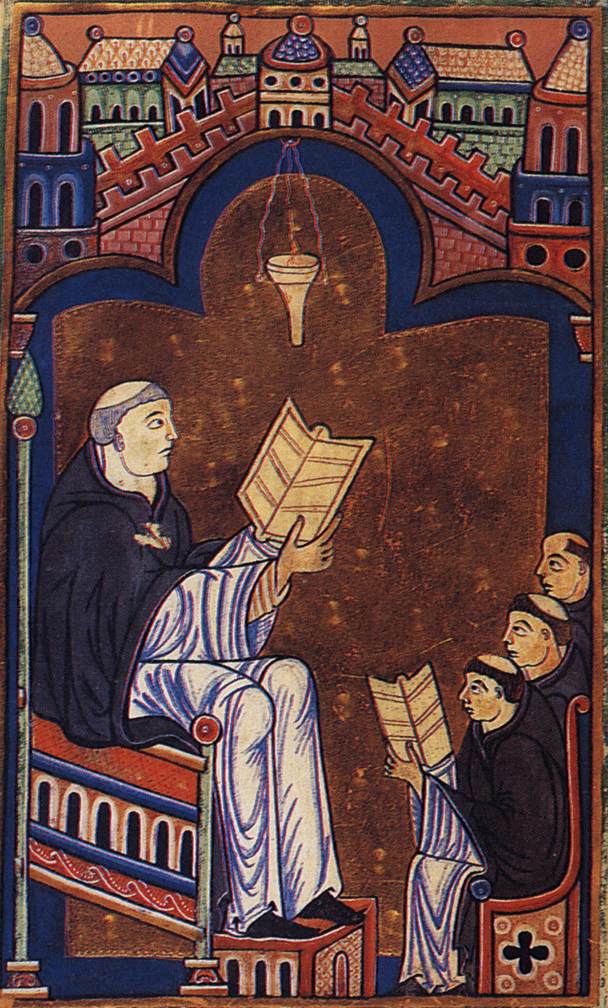 PhilosopherMedieval Latin1096 – 1141
Hugh of Saint Victor
Hugh of Saint Victor was a German canon regular and a leading theologian and writer on mystical theology.
Read the full pageHugh of Saint Victor (c. 1096 – 11 February 1141) was a German canon regular and a leading theologian and writer on mystical theology.
As with many medieval figures, little is known about Hugh's early life. He was probably born in the 1090s. His homeland may have been the Duchy of Saxony. Some sources say that his birth occurred in the Harz district, being the eldest son of Baron Conrad of Blankenburg. Over the protests of his family, he entered the Priory of St. Pancras, a community of canons regular, where he had studied, located at Hamerleve or Hamersleben, near Halberstadt.
- 7
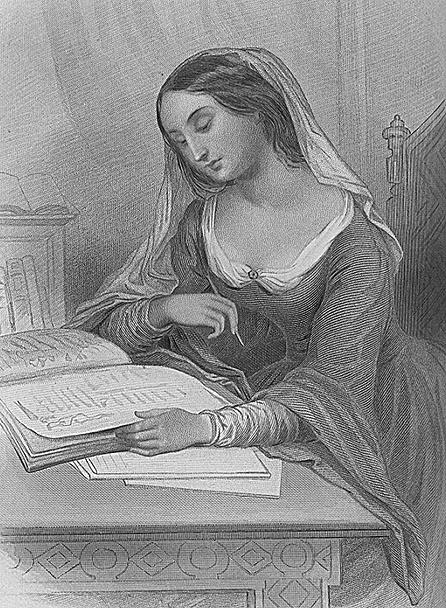 PhilosopherMedieval Latin1101 – 1164
Héloïse d’Argenteuil
Héloïse, variously Héloïse d'Argenteuil or Héloïse du Paraclet, was a French nun, philosopher, writer, scholar, and abbess. Héloïse was a renowned "woman of letters" and philosopher of love and friendship, as well as an eventual high ranking abbess in the Catholic Church.
Read the full pageHéloïse (French: [elɔ.iz]; c. 1101 – 16 May 1164), variously Héloïse d'Argenteuil or Héloïse du Paraclet, was a French nun, philosopher, writer, scholar, and abbess.
Héloïse was a renowned "woman of letters" and philosopher of love and friendship, as well as an eventual high ranking abbess in the Catholic Church. She achieved approximately the level and political power of a bishop in 1147 when she was granted the rank of prelate nullius.
- 8
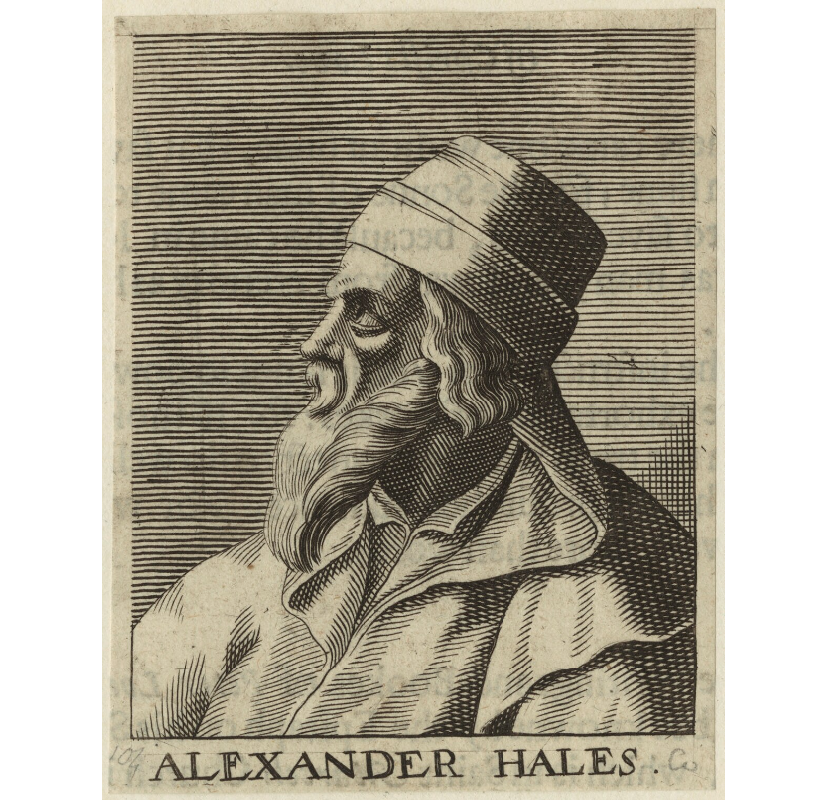 PhilosopherMedieval Latin1175 – 1245
Alexander of Hales
Alexander of Hales—known also as Doctor Irrefragibilis, or "Irrefutable Teacher" (so-called by Pope Alexander IV in the bull De Fontibus Paradisi), and as Theologorum Monarcha (or "King of Theologians")—was a Franciscan friar, theologian, and philosopher instrumental to the development of scholasticism.
Read the full pageAlexander of Hales (also Halensis, Alensis, Halesius, Alesius ; c. 1185 – 21 August 1245)—known also as Doctor Irrefragibilis, or "Irrefutable Teacher" (so-called by Pope Alexander IV in the bull De Fontibus Paradisi), and as Theologorum Monarcha (or "King of Theologians")—was a Franciscan friar, theologian, and philosopher instrumental to the development of scholasticism.
Alexander was born at Hales, Shropshire (today Halesowen, West Midlands), England, between 1180 and 1186. He came from a rather wealthy country family, studied at the University of Paris, and became a master of arts sometime before 1210. He began to read theology in 1212 or 1213, and became a regent master in 1220 or 1221. He introduced the Sentences of Peter Lombard as the basic textbook for the study of theology. During the University strike of 1229, Alexander participated in an embassy to Rome to discuss the place of Aristotle in the curriculum. Having held a prebend at Holborn (prior to 1229) and a canonry of St. Paul's in London (1226–1229), he visited England in 1230 and received a canonry and an archdeaconry in Coventry and Lichfield, his native diocese. He taught at Paris in the academic year 1232–33, but was appointed to a delegation by Henry III of England in 1235, along with Simon Langton and Fulk Basset, to negotiate the renewal of the peace between England and France.
- 9
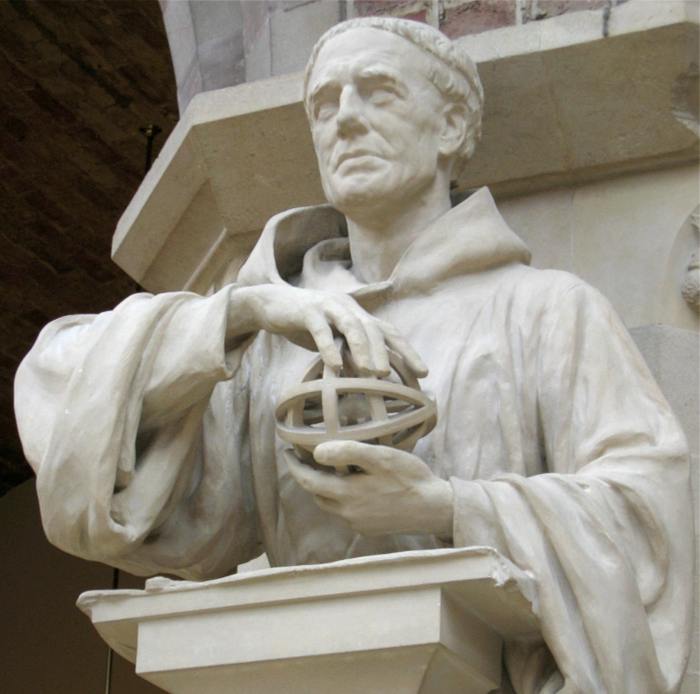 PhilosopherMedieval Latin1220 – 1292
Roger Bacon
Roger Bacon, also known by the scholastic accolade Doctor Mirabilis, was a medieval English polymath, philosopher, scientist, theologian and Franciscan friar who placed considerable emphasis on the study of nature through empiricism. Intertwining his Catholic faith with scientific thinking, Roger Bacon is considered on
- ◆Experimental science
Read the full pageRoger Bacon (; Latin: Rogerus or Rogerius Baconus, Baconis, also Frater Rogerus; c. 1219/20 – c. 1292), also known by the scholastic accolade Doctor Mirabilis, was a medieval English polymath, philosopher, scientist, theologian and Franciscan friar who placed considerable emphasis on the study of nature through empiricism. Intertwining his Catholic faith with scientific thinking, Roger Bacon is considered one of the greatest polymaths of the medieval period.
In the early modern era, he was regarded as a wizard and particularly famed for the story of his mechanical or necromantic brazen head. He is credited as one of the earliest European advocates of the modern scientific method, along with his teacher Robert Grosseteste. Bacon applied the empirical method of Ibn al-Haytham (Alhazen) to observations in texts attributed to Aristotle. Bacon discovered the importance of empirical testing when the results he obtained were different from those that would have been predicted by Aristotle.
- 10
 PhilosopherMedieval Latin1225 – 1274
Thomas Aquinas
The great scholastic synthesiser of Aristotle and Christianity, author of the Summa Theologiae and the Five Ways.
- ◆The Five Ways
- ◆Natural law
- ◆Faith and reason as complementary
- ◆Analogy of being
Read the full pageThomas Aquinas ( ə-KWY-nəs; Italian: Tommaso d'Aquino, lit. 'Thomas of Aquino'; c. 1225 – 7 March 1274) was an Italian Dominican friar and priest, theologian, and philosopher. He is considered one of the most influential thinkers in the history of Catholic theology and Western philosophy. He is the father of a school of thought (encompassing both theology and philosophy) known as Thomism.
A proponent of natural theology, Thomas argued that God is the source of the light of natural reason and the light of faith. He embraced several ideas put forward by Aristotle and sought to synthesize Aristotelian philosophy with the principles of Christianity. Among his best-known ideas include his Five Ways for proving the existence of God, his virtue ethics, and his sacramental theology. In addition to its vast influence on Catholic thought, his philosophy has influenced modern virtue ethics, aesthetics, and cognitive theory.
