Scholasticism: Scotus to Vanini
- 1
 PhilosopherMedieval Latin1266 – 1308
John Duns Scotus
Subtle scholastic of univocity of being and individual "thisness" (haecceity).
Read the full pageJohn Duns Scotus ( dunz SKOH-təs; Ecclesiastical Latin: [duns ˈskɔtus], 'Duns the Scot'; c. 1265/66 – 8 November 1308) was a Scottish Catholic priest and Franciscan friar, university professor, philosopher and theologian. He is considered among the most important philosopher-theologians in Western Christendom during the last part of the medieval period, together with Thomas Aquinas, Bonaventure and William of Ockham. The intellectual tradition derived from Scotus's work is called Scotism.
Duns Scotus has had considerable influence on both Catholic and secular thought. The doctrines for which he is best known are the "univocity of being", that existence is the most abstract concept we have, applicable to everything that exists; the formal distinction, a way of distinguishing between different formalities of the same thing; and the idea of haecceity, the property supposed to be in each individual thing that makes it an individual (i.e., a certain "thisness"). Duns Scotus also developed a complex argument for the existence of God, and argued for the Immaculate Conception of Mary.
- 2
 PhilosopherMedieval Latin1275 – 1342
Marsilius of Padua
Marsilius of Padua was an Italian scholar, trained in medicine, who practised a variety of professions. He was also an important 14th-century political figure.
- ◆plenitude of power
Read the full pageMarsilius of Padua (Italian: Marsilio da Padova; born Marsilio Mainardi, Marsilio de i Mainardini or Marsilio Mainardini; c. 1275 – c. 1342) was an Italian scholar, trained in medicine, who practised a variety of professions. He was also an important 14th-century political figure. His political treatise Defensor pacis (The Defender of Peace), an attempt to refute papal claims to a "plenitude of power" in affairs of both church and state, is seen by some scholars as the most revolutionary political treatise written in the later Middle Ages. It is one of the first examples of a trenchant critique of ultramontanism in Western Europe. Marsilius is sometimes seen as a forerunner of the Protestant reformation, because many of his beliefs were later adopted by John Calvin and Martin Luther.
Marsilius was born in Padua, an important city near Venice, circa 1275. He probably studied medicine at the University of Padua and later went to the University of Paris, where he became a devoted admirer of Aristotle, whom he called 'the divine philosopher". He served as rector of the University of Paris approximately 1312–1313. It is probable that he taught at the University of Paris before and after his tenure as rector.
- 3
 PhilosopherMedieval Latin1287 – 1347
William of Ockham
Nominalist famous for Ockham's razor: do not multiply entities beyond necessity.
- ◆Ockham's razor
- ◆Nominalism
Read the full pageWilliam of Ockham or Occam ( OK-əm; Latin: Guillelmus de Ockham; c. 1287 – 9/10 April 1347) was an English Franciscan friar, scholastic philosopher and theologian. He is considered to be one of the major figures of medieval thought and was at the centre of the major intellectual and political controversies of the 14th century. The nominalists of the fifteenth century regarded him as one of the founders of their movement. He is widely known for Occam's razor, the methodological principle that bears his name. He produced significant works on logic, physics and theology. Ockham is remembered in the Church of England with a commemoration corresponding to the commonly ascribed date of his death on 10 April.
William of Ockham was probably born in Ockham, Surrey, around 1287. At an early age he became a member of the Franciscan Order (Order of Friars Minor) and received the first stages of his theological education in the Franciscan school in London. From some undetermined date until probably 1321 he studied in the Franciscan school in the University of Oxford. Although he completed all the requirements for a master's degree in theology, he never was a regent master. Because of this he was later called the Venerabilis Inceptor. (An inceptor was someone recognized by the university as qualified to begin ("incept") as a regent master.)
- 4
 PhilosopherMedieval Latin1300 – 1358
Gregory of Rimini
Gregory of Rimini, O.E.S.A. was an Italian Augustinian friar and one of the great scholastic philosophers and theologians of the Middle Ages. He was the first scholastic writer to unite the Oxonian and Parisian traditions in 14th-century philosophy, and his work had a lasting influence in the Late Middle Ages and Refor
Read the full pageGregory of Rimini, O.E.S.A. (Latin: Gregorius de Arimino or Ariminiensis; c. 1300 – November 1358) was an Italian Augustinian friar and one of the great scholastic philosophers and theologians of the Middle Ages. He was the first scholastic writer to unite the Oxonian and Parisian traditions in 14th-century philosophy, and his work had a lasting influence in the Late Middle Ages and Reformation. His scholastic nicknames were Doctor Acutus, Doctor Authenticus, and Doctor Subtilissimus.
Blessed Gregory was born in Rimini around 1300. He joined the Order of the Hermits of Saint Augustine before studying theology in the 1320s at the University of Paris, where he encountered the ideas of the late Franciscan Peter Auriol. In the 1330s he taught at Augustinian schools in Bologna, Padua and Perugia, where he became familiar with the recent work of Oxford thinkers such as Adam Wodeham, William Ockham, and Walter Chatton. He returned to Paris in 1342 to prepare his lectures on Peter Lombard's Sentences, which he delivered in 1342–1344. Because of his familiarity with English philosophy during this time, he effectively transmitted contemporary Oxford ideas—with an Augustinian tinge—to Paris. He became a Master of Theology in 1345 and subsequently taught at schools in Padua and Rimini.
- 5PhilosopherMedieval Latin1301
William Crathorn
William Crathorn was an English Dominican philosopher, from Oxford. He was a philosopher who immediately followed in the intellectual tradition of William of Ockham and worked to strengthen his philosophical works.
Read the full pageWilliam Crathorn (fl. c. 1330) was an English Dominican philosopher, from Oxford. He was a philosopher who immediately followed in the intellectual tradition of William of Ockham and worked to strengthen his philosophical works. Crathorn created unique theories in the philosophy of language and psychology, as well as in epistemology by focusing on the claims of skeptics. Other areas of Crathorn's philosophy, which have not been extensively studied, show promise is revealing more about his life and his work.
Almost nothing is certain about Crathorn's life outside of his position as lecturer at Oxford. Crathorn was born in Yorkshire and served as a Dominican friar, lecturing on a book from Peter the Lombard entitled Sentences. Crathorn is also known to have lectured on the Bible during his time teaching. His date of birth and death are unknown; the year in which he lectured is known only by an eclipse mentioned in his manuscripts which is known to have occurred in July 1330.
- 6
 PhilosopherMedieval Latin1323 – 1382
Nicole Oresme
Nicole Oresme, also known as Nicolas Oresme, Nicholas Oresme, or Nicolas d'Oresme, was a French philosopher of the later Middle Ages. He wrote influential works on economics, mathematics, physics, astrology, astronomy, philosophy, and theology.
- ◆co-ordinates
- ◆divergence
- ◆harmonic series
- ◆mean speed theorem
Read the full pageNicole Oresme (; French: [nikɔl ɔʁɛm]; c. 1325 – 11 July 1382), also known as Nicolas Oresme, Nicholas Oresme, or Nicolas d'Oresme, was a French philosopher of the later Middle Ages. He wrote influential works on economics, mathematics, physics, astrology, astronomy, philosophy, and theology. He was Bishop of Lisieux, a translator, a counselor of King Charles V of France, and one of the most original thinkers of 14th-century Europe.
Nicole Oresme was born c. 1320–1325 in the village of Allemagne (today's Fleury-sur-Orne) in the vicinity of Caen, Normandy, in the diocese of Bayeux. Practically nothing is known concerning his family. The fact that Oresme attended the royally sponsored and subsidised College of Navarre, an institution for students too poor to pay their expenses while studying at the University of Paris, makes it probable that he came from a peasant family.
- 7
 PhilosopherMedieval Latin1369 – 1429
Paul of Venice
Paul of Venice was a Catholic philosopher, theologian, logician and metaphysician of the Order of Saint Augustine.
Read the full pagePaul of Venice (or Paulus Venetus; 1369–1429) was a Catholic philosopher, theologian, logician and metaphysician of the Order of Saint Augustine.
Paul was born, according to the chroniclers of his order, at Udine, about 1369 and died at Venice on 15 June 1429, as Paolo Nicoletti. He joined the Augustinian Order at the age of 14, at the convent of Santo Stefano in Venice. In 1390 he is said to have been sent to Oxford for his studies in theology, but returned to Italy, and finished his course at the University of Padua, becoming a Doctor of Arts and Theology in 1405. He lectured in the Universities of Padua, Siena, Perugia, and Bologna during the first quarter of the fifteenth century. He was also a teacher to Paolo da Pergola.
- 8
 PhilosopherModern European1548 – 1617
Francisco Suárez
Francisco Suárez was a Spanish Jesuit priest, philosopher and theologian, one of the leading figures of the School of Salamanca movement. His work is considered a turning point in the history of second scholasticism, marking the transition from its Renaissance to its Baroque phases.
- ◆being
Read the full pageFrancisco Suárez (; 5 January 1548 – 25 September 1617) was a Spanish Jesuit priest, philosopher and theologian, one of the leading figures of the School of Salamanca movement. His work is considered a turning point in the history of second scholasticism, marking the transition from its Renaissance to its Baroque phases. According to Christopher Shields and Daniel Schwartz, "figures as distinct from one another in place, time, and philosophical orientation as Leibniz, Grotius, Pufendorf, Schopenhauer and Heidegger, all found reason to cite him as a source of inspiration and influence."
Francisco Suárez was born in Granada, Andalusia (southern Spain), on 5 January 1548. He was the youngest son of a noble family formed by the lawyer Gaspar Suárez de Toledo and his wife Antonia Vázquez de Utiel.
- 9
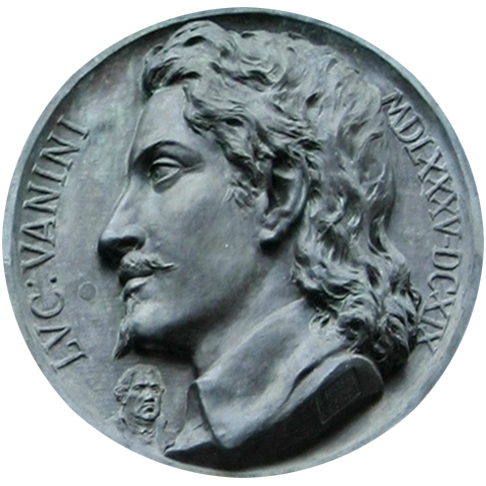 PhilosopherModern European1585 – 1619
Giulio Cesare Vanini
Lucilio Vanini, who, in his works, styled himself Giulio Cesare Vanini, was an Italian philosopher, physician and free-thinker, who was one of the first significant representatives of intellectual libertinism. He was among the first modern thinkers who viewed the universe as an entity governed by natural laws (nomologi
- ◆Nomological determinism
- ◆pantheism
- ◆immortality of the soul
Read the full pageLucilio Vanini (1585 – 9 February 1619), who, in his works, styled himself Giulio Cesare Vanini, was an Italian philosopher, physician and free-thinker, who was one of the first significant representatives of intellectual libertinism. He was among the first modern thinkers who viewed the universe as an entity governed by natural laws (nomological determinism). He was also an early literate proponent of biological evolution, maintaining that humans and other apes have common ancestors. He was executed in Toulouse.
Vanini was born at Taurisano near Lecce, and studied philosophy and theology at Naples. Afterwards, he applied himself to the physical studies, chiefly medicine and astronomy, which had come into vogue with the Renaissance. Like Giordano Bruno, he attacked scholasticism.