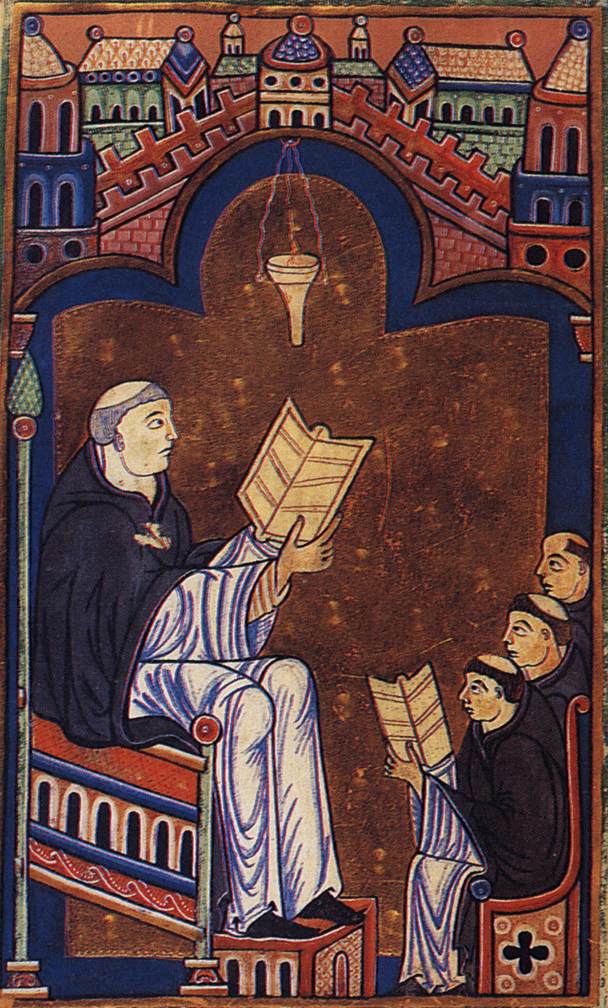
Hugh of Saint Victor
Hugh of Saint Victor was a German canon regular and a leading theologian and writer on mystical theology.
Hugh of Saint Victor (c. 1096 – 11 February 1141) was a German canon regular and a leading theologian and writer on mystical theology.
Life
As with many medieval figures, little is known about Hugh's early life. He was probably born in the 1090s. His homeland may have been the Duchy of Saxony. Some sources say that his birth occurred in the Harz district, being the eldest son of Baron Conrad of Blankenburg. Over the protests of his family, he entered the Priory of St. Pancras, a community of canons regular, where he had studied, located at Hamerleve or Hamersleben, near Halberstadt.
Due to civil unrest shortly after his entry to the priory, Hugh's uncle, Reinhard of Blankenburg, who was the local bishop, advised him to transfer to the Abbey of Saint Victor in Paris, where he himself had studied theology. He accepted his uncle's advice and made the move at a date which is unclear, possibly 1115–18 or around 1120. He spent the rest of his life there, advancing to head the school.
Philosophy and theology
The early Didascalicon was an elementary, encyclopedic approach to God and Christ, in which Hugh avoided controversial subjects and focused on what he took to be commonplaces of Catholic Christianity. In it he outlined three types of philosophy or "science" [scientia] that can help mortals improve themselves and advance toward God: theoretical philosophy (theology, mathematics, physics) provides them with truth, practical philosophy (ethics, economics, politics) aids them in becoming virtuous and prudent, and "mechanical" or "illiberal" philosophy (e.g., carpentry, agriculture, medicine) yields physical benefits. A fourth philosophy, logic, is preparatory to the others and exists to ensure clear and proper conclusions in them. Hugh's deeply mystical bent did not prevent him from seeing philosophy as a useful tool for understanding the divine, or from using it to argue on behalf of faith.
Hugh was heavily influenced by Augustine's exegesis of Genesis. Divine Wisdom was the archetypal form of creation. The creation of the world in six days was a mystery for man to contemplate, perhaps even a sacrament. God's forming order from chaos to make the world was a message to humans to rise up from their own chaos of ignorance and become creatures of Wisdom and therefore beauty. This kind of mystical-ethical interpretation was typical for Hugh, who tended to find Genesis interesting for its moral lessons rather than as a literal account of events.
Along with Jesus, the sacraments were divine gifts that God gave man to redeem himself, though God could have used other means. Hugh separated everything along the lines of opus creationis and opus restaurationis. Opus Creationis was the works of the creation, referring to God's creative activity, the true good natures of things, and the original state and destiny of humanity. The opus restaurationis was that which dealt with the reasons for God sending Jesus and the consequences of that. Hugh believed that God did not have to send Jesus and that He had other options open to Him. Why he chose to send Jesus is a mystery we are to meditate on and is to be learned through revelation, with the aid of philosophy to facilitate understanding.
Legacy
Within the Abbey of St Victor, many scholars who followed him are often known as the 'School of St Victor'. Andrew of St Victor studied under Hugh. Others, who probably entered the community too late to be directly educated by Hugh, include Richard of Saint Victor and Godfrey. One of Hugh's ideals that did not take root in St Victor, however, was his embracing of science and philosophy as tools for approaching God.
His works are in hundreds of libraries all across Europe. He is quoted in many other publications after his death, and Bonaventure praises him in De reductione artium ad theologiam.
He was also an influence on the critic Erich Auerbach, who cited this passage (from Book Three: Chapter Nineteen of The Didascalion) in his essay "Philology and World Literature":
All the world is a foreign soil to those who philosophize….
It is a great source of virtue for the disciplined mind to learn, bit by bit, first to change in visible and transitory things, so that later it may leave them behind altogether. One to whom his homeland is sweet is a tender beginner; one at home in every land is already strong; truly perfect is he to whom the whole world is exile. The first has focused his love of the world, the second has extended it, the last has extinguished it.
I have lived in exile since boyhood, and I know with what grief sometimes the soul takes leave of the narrow hearth of a peasant’s hut, and I know too the freedom with which, thereafter, it disdains marble halls and paneled ceilings.
Adapted from the Wikipedia article Hugh of Saint Victor, available under CC BY-SA 4.0.
Connections
Belongs to
1
Teachers
1Contributed to
1
You might also explore
 Peter AbelardMedieval Latin1079 – 1142Brilliant Paris logician who argued for conceptualism about universals and an ethics of intention.
 Pythagoras★Greek & Romanc. 570 – 495 BCEMystic, mathematician and founder of a brotherhood that saw number as the essence of reality.
 Thomas Aquinas★Medieval Latin1225 – 1274The great scholastic synthesiser of Aristotle and Christianity, author of the Summa Theologiae and the Five Ways.
 PlotinusGreek & Roman204 – 270Founder of Neoplatonism: all reality flows from the One, and the soul can return to it.
 William of OckhamMedieval Latin1287 – 1347Nominalist famous for Ockham's razor: do not multiply entities beyond necessity.
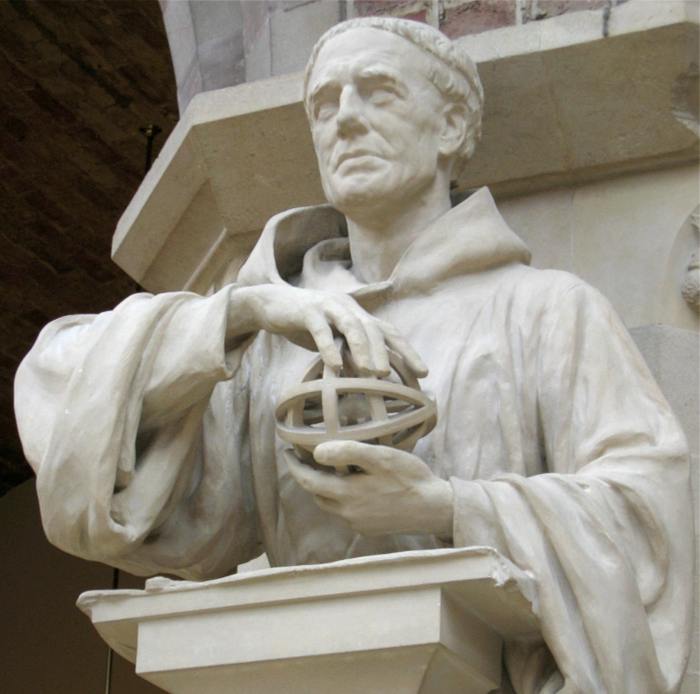 Roger BaconMedieval Latin1220 – 1292Roger Bacon, also known by the scholastic accolade Doctor Mirabilis, was a medieval English polymath, philosopher…