Continental philosophy: Bauman to Eco
- 1
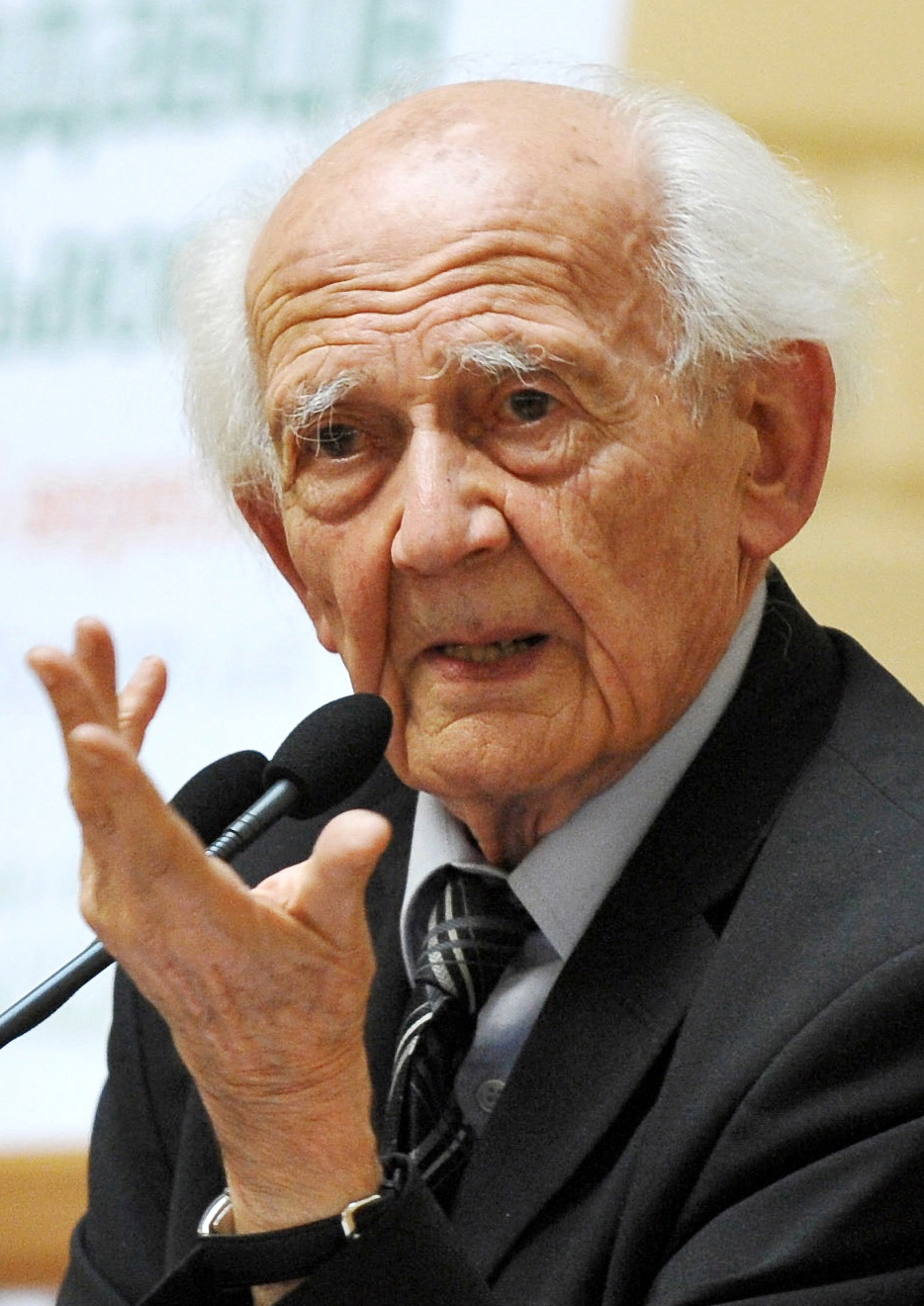 PhilosopherModern European1925 – 2017
Zygmunt Bauman
Zygmunt Bauman was a Polish–British sociologist and philosopher. During the 1968 Polish political crisis he was driven out of the Polish People's Republic, was forced to give up his Polish citizenship, and emigrated to Israel.
- ◆the Holocaust
- ◆liquid modernity
- ◆allosemitism
Read the full pageZygmunt Bauman (; Polish: [ˈbauman]; 19 November 1925 – 9 January 2017) was a Polish–British sociologist and philosopher.
During the 1968 Polish political crisis he was driven out of the Polish People's Republic, was forced to give up his Polish citizenship, and emigrated to Israel.
- 2
 PhilosopherModern European1926 – 1984
Michel Foucault
Historian of power and knowledge — prisons, madness, sexuality and the disciplined self.
- ◆Biopower
- ◆biopolitics
- ◆disciplinary institution
- ◆discourse analysis
- ◆discursive formation
- ◆dispositif
Read the full pagePaul-Michel Foucault, known as Michel Foucault, (UK: FOO-koh, US: foo-KOH; French: [pɔl miʃɛl fuko]; 15 October 1926 – 25 June 1984) was a French philosopher, literary critic, and historian of ideas who analyzed the relationships between power, knowledge, and liberty, and how they are used as a form of social control through institutions. Sometimes called a structuralist or postmodernist, he rejected these labels and sought to critique authority without limiting himself. His thought has influenced academics in many areas of study, including anthropology, communication studies, criminology, cultural studies, feminism, literary theory, psychology, and sociology. His arguments against homophobia, racial prejudice, and other ideological doctrines have also shaped scholarship on critical theory and Marxism.
Born in Poitiers, France, into an upper-middle-class family, Foucault was educated at the Lycée Henri-IV, at the École Normale Supérieure, developing an interest in philosophy and coming under the influence of his tutors Jean Hyppolite and Louis Althusser. At the University of Paris (Sorbonne), he earned degrees in philosophy and psychology. After several years as a cultural diplomat abroad, he returned to France and published his first major book, The History of Madness (1961). While working at the University of Clermont-Ferrand (1960–66), he produced The Birth of the Clinic (1963) and The Order of Things (1966), which have a structuralist affinity from which he later distanced himself. These first three histories exemplified "archeology", a historiographical technique he was developing.
- 3
 PhilosopherModern European1927 – 2009
Leszek Kołakowski
Leszek Kołakowski was a Polish philosopher and historian of ideas. He is best known for his critical analysis of contemporary Marxist thought and theory, as in his three-volume history of Marxist philosophy Main Currents of Marxism.
- ◆Humanist
- ◆Marx
- ◆Criticism of Marxism
Read the full pageLeszek Kołakowski (; Polish: [ˈlɛʂɛk kɔwaˈkɔfskʲi]; 23 October 1927 – 17 July 2009) was a Polish philosopher and historian of ideas. He is best known for his critical analysis of contemporary Marxist thought and theory, as in his three-volume history of Marxist philosophy Main Currents of Marxism (1976). In his later work, Kołakowski increasingly focused on religious questions. In his 1986 Jefferson Lecture, he asserted that "we learn history not in order to know how to behave or how to succeed, but to know who we are".
Kołakowski was initially a Marxist humanist, but he came to renounce it. Owing to his criticism of Marxism and of the Communist state system, Kołakowski was effectively exiled from Poland in 1968. He spent most of the remainder of his career at the University of Oxford, as a Fellow of All Souls College. Despite being in exile, Kołakowski was a major inspiration to the Solidarity movement which flourished in Poland in the 1980s and is credited by some as having helped bring about the collapse of the Soviet Union. Bronisław Geremek dubbed him as the "awakener of human hopes". Among many awards, he was a laureate of the MacArthur Fellowship and Erasmus Prize in 1983, the 2003 Kluge Prize, and in 2007, the Jerusalem Prize.
- 4
 PhilosopherModern Europeanborn 1929
Jürgen Habermas
Theorist of communicative action and deliberative democracy.
- ◆Communicative action
- ◆Communicative rationality
- ◆Constitutional patriotism
- ◆Discourse ethics
- ◆Ideal speech situation
- ◆Performative contradiction
Read the full pageJürgen Habermas (18 June 1929 – 14 March 2026) was a German philosopher and social theorist in the tradition of critical theory and pragmatism. His work addressed communicative rationality and the public sphere. He held professorships at Heidelberg University and Goethe University Frankfurt and directed the Max Planck Institute in Starnberg.
Associated with the Frankfurt School, Habermas's work focused on the foundations of epistemology and social theory, the analysis of advanced capitalism and democracy, the rule of law in a critical social-evolutionary context, and contemporary politics, particularly German politics. His major works include The Structural Transformation of the Public Sphere (1962), a social history of the emergence and decline of bourgeois public discourse, and The Theory of Communicative Action (1981), which advanced a theory of rationality grounded in interpersonal linguistic communication rather than in instrumental or strategic reason.
- 5
 PhilosopherModern European1929 – 2007
Jean Baudrillard
Jean Baudrillard was a French sociologist and philosopher with an interest in cultural studies. He is best known for his analyses of media, contemporary culture, and technological communication, as well as his formulation of concepts such as hyperreality.
- ◆Hyperreality
- ◆Sign value
Read the full pageJean Baudrillard (UK: , US: ; French: [ʒɑ̃ bodʁijaʁ]; 27 July 1929 – 6 March 2007) was a French sociologist and philosopher with an interest in cultural studies. He is best known for his analyses of media, contemporary culture, and technological communication, as well as his formulation of concepts such as hyperreality. Baudrillard wrote about diverse subjects, including consumerism, critique of economy, social history, aesthetics, Western foreign policy, and popular culture.
Among his best-known works are Forget Foucault (1977), Seduction (1978), Simulacra and Simulation (1981), America (1986), and The Gulf War Did Not Take Place (1991). His work is frequently associated with postmodernism and specifically post-structuralism. Nevertheless, Baudrillard had opposed post-structuralism and distanced himself from postmodernism, skeptical of it really existing.
- 6
 PhilosopherModern European1929 – 2019
Ágnes Heller
Ágnes Heller was a Hungarian philosopher and lecturer. She was a core member of the Budapest School philosophical forum in the 1960s and later taught political theory for 25 years at the New School for Social Research in New York City.
- ◆Revolution
- ◆everyday life
- ◆personality
Read the full pageÁgnes Heller (12 May 1929 – 19 July 2019) was a Hungarian philosopher and lecturer. She was a core member of the Budapest School philosophical forum in the 1960s and later taught political theory for 25 years at the New School for Social Research in New York City. She lived, wrote and lectured in Budapest.
Ágnes Heller was born on 12 May 1929, to Pál Heller and Angéla "Angyalka" Ligeti. They were a middle-class Jewish family. During World War II her father used his legal training and knowledge of German to help people get the necessary paperwork to emigrate from Nazi Europe. In 1944, Heller's father was deported to the Auschwitz concentration camp where he died before the war ended. Heller and her mother managed to avoid deportation.
- 7
 PhilosopherModern European1930 – 2004
Jacques Derrida
Founder of deconstruction, exposing hidden hierarchies in texts and concepts.
- ◆Deconstruction
- ◆différance
- ◆phallogocentrism
- ◆free play
- ◆arche-writing
- ◆metaphysics of presence
Read the full pageJacques Derrida (; French: [ʒak dɛʁida]; born Jackie Élie Derrida; 15 July 1930 – 9 October 2004) was a French philosopher. He developed the philosophy of deconstruction, which he applied in some of his texts, and which he developed through close readings of the linguistics of Ferdinand de Saussure and Husserlian and Heideggerian phenomenology. He is one of the major figures associated with post-structuralism and postmodern philosophy although he distanced himself from post-structuralism and disavowed the word "postmodernity".
During his career, Derrida published over 40 books, together with hundreds of essays and public presentations. He has had a significant influence on the humanities and social sciences, including philosophy, literature, law, anthropology, historiography, applied linguistics, sociolinguistics, psychoanalysis, music, architecture, and political theory.
- 8PhilosopherModern Europeanborn 1930
Luce Irigaray
Luce Irigaray is a Belgian-born French feminist, philosopher, linguist, psycholinguist, psychoanalyst, and cultural theorist who examines the uses and misuses of language in relation to women. She is considered one of the founders of French difference feminism.
- ◆sexual difference
- ◆phallogocentric arguments
Read the full pageLuce Irigaray (born 3 May 1930) is a Belgian-born French feminist, philosopher, linguist, psycholinguist, psychoanalyst, and cultural theorist who examines the uses and misuses of language in relation to women. She is considered one of the founders of French difference feminism.
Irigaray's first and most well known book, published in 1974, was Speculum of the Other Woman (1974), which analyzes the texts of Freud, Hegel, Plato, Aristotle, Descartes, and Kant through the lens of phallocentrism. Irigaray is the author of works analyzing many thinkers, including This Sex Which Is Not One (1977), which discusses Lacan's work as well as political economy; Elemental Passions (1982) can be read as a response to Maurice Merleau-Ponty's article “The Intertwining—The Chiasm” in The Visible and the Invisible, and in The Forgetting of Air in Martin Heidegger (1999), Irigaray critiques Heidegger's emphasis on the element of earth as the ground of life and speech and his "oblivion" or forgetting of air.
- 9
 PhilosopherModern European1930 – 2019
Michel Serres
Michel Serres was a French philosopher and historian of science. Member of the Académie française and the European Academy of Sciences and Arts, he published more than 70 authoritative works during his lifetime in the fields of anthropology of science and technology, the philosophy of communication and digital technolo
- ◆Hermes
Read the full pageMichel Serres (; French: [miʃɛl sɛʁ]; 1 September 1930 – 1 June 2019) was a French philosopher and historian of science. Member of the Académie française and the European Academy of Sciences and Arts, he published more than 70 authoritative works during his lifetime in the fields of anthropology of science and technology, the philosophy of communication and digital technologies, the philosophy of education, and the philosophy of ecology. Michel Serres's work is characterized by a transversal and interdisciplinary approach, connecting hard sciences and the humanities. He developed an original and innovative line of thought that has profoundly influenced contemporary philosophy.
Michel Serres was born on September 1, 1930, in Agen (France). He is the son of Jean Serres, who ran a dredging company on the Garonne River in Agen. He married in 1952 and had four children.
- 10
 PhilosopherAmericas1930 – 1992
Allan Bloom
Allan David Bloom was an American philosopher, classicist, and academician. He studied under David Grene, Leo Strauss, Richard McKeon, and Alexandre Kojève.
- ◆relativism
- ◆The Closing of the American Mind
Read the full pageAllan David Bloom (September 14, 1930 – October 7, 1992) was an American philosopher, classicist, and academician. He studied under David Grene, Leo Strauss, Richard McKeon, and Alexandre Kojève. He subsequently taught at Cornell University, the University of Toronto, Tel Aviv University, Yale University, the École Normale Supérieure, and the University of Chicago.
Bloom championed the idea of Great Books education and became famous for his criticism of contemporary American higher education, expressing his views in his bestselling 1987 book, The Closing of the American Mind. Characterized as a conservative in the popular media, Bloom denied the label, asserting that what he sought to defend was the "theoretical life". Saul Bellow wrote Ravelstein, a roman à clef based on Bloom, his friend and colleague at the University of Chicago.
- 11
 PhilosopherModern European1932 – 2016
Umberto Eco
Umberto Eco was an Italian medievalist, philosopher, semiotician, novelist, cultural critic, and political and social commentator. In the English-speaking world, he is best known for his popular 1980 novel The Name of the Rose, a historical mystery combining semiotics in fiction with biblical analysis, medieval studies
- ◆The open work (''opera aperta'')
- ◆the intention of the reader (''intentio lectoris'')
- ◆Umberto Eco
- ◆''Interpretation and Overinterpretation''
- ◆Cambridge University Press
- ◆1992
Read the full pageUmberto Eco (5 January 1932 – 19 February 2016) was an Italian medievalist, philosopher, semiotician, novelist, cultural critic, and political and social commentator. In the English-speaking world, he is best known for his popular 1980 novel The Name of the Rose, a historical mystery combining semiotics in fiction with biblical analysis, medieval studies and literary theory, as well as Foucault's Pendulum, his 1988 novel which touches on the history of occultism and its contemporary interpretation through the new age movement.
Eco wrote prolifically throughout his life, with his output including children's books, translations from French and English, in addition to a twice-monthly newspaper column "La Bustina di Minerva" (Minerva's Matchbook) in the magazine L'Espresso beginning in 1985, with his last column (a critical appraisal of the Romantic paintings of Francesco Hayez) appearing 27 January 2016. At the time of his death, he was an Emeritus professor at the University of Bologna, where he taught for much of his life. In the 21st century, he has continued to gain recognition for his 1995 essay "Ur-Fascism", where Eco lists fourteen general properties he believes comprise fascist ideologies.