
Slavoj Žižek
Slovenian philosopher mixing Hegel, Lacan and Marx in a critique of ideology and pop culture.
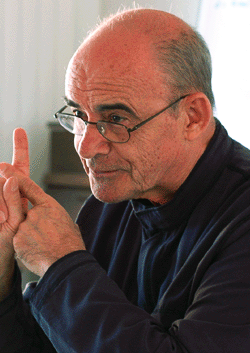
Slavoj Žižek (born 21 March 1949) is a Slovenian philosopher, cultural theorist and public intellectual.
Žižek is a Global Distinguished Professor of German at New York University, professor of philosophy and psychoanalysis at the European Graduate School and senior researcher at the Institute for Sociology and Philosophy at the University of Ljubljana. He was the international director of the Birkbeck Institute for the Humanities at the University of London from 2004 until September 2025. He primarily works on continental philosophy (particularly Hegelianism, Lacanian psychoanalysis and Marxism) and political theory, as well as film criticism and theology.
Žižek is an associate of the Ljubljana School of Psychoanalysis, a group of Slovenian academics working on German idealism, Lacanian psychoanalysis, ideology critique, and media criticism. His first book in English is The Sublime Object of Ideology (1989), which was used in the introduction of the Ljubljana School's thought to English-speaking audiences. He has written over 50 books in multiple languages and speaks Slovene, Serbo-Croatian, English, German, and French. The idiosyncratic style of his public appearances, frequent magazine op-eds, and academic works, characterised by the use of obscene jokes and pop cultural examples, as well as politically incorrect provocations, have gained him fame, controversy, and criticism both in and outside academia.
Early life
Žižek was born in Ljubljana, PR Slovenia, Yugoslavia, into a middle-class family. His father Jože Žižek was an economist and civil servant from the region of Prekmurje in eastern Slovenia. His mother Vesna, a native of the Gorizia Hills in the Slovenian Littoral, was an accountant in a state enterprise. His parents were atheists. He spent most of his childhood in the coastal town of Portorož, near the Italian border. In the comparatively liberal environment of Yugoslav communism, Žižek was exposed to Western film, theory and popular culture. When Žižek was a teenager, his family moved back to Ljubljana where he attended Bežigrad High School. Originally wanting to become a filmmaker himself, he abandoned these ambitions and chose to pursue philosophy instead.
Education
In 1967, during an era of liberalization in Titoist Yugoslavia, Žižek enrolled at the University of Ljubljana and studied philosophy and sociology. Žižek was in Prague in 1968 during the Prague Spring, where in a 2003 interview he said that he witnessed demonstrators confronting Soviet tanks.
Žižek had already begun reading French structuralists prior to entering university, and in 1967 he published the first translation of a text by Jacques Derrida into Slovenian. Žižek frequented the circles of dissident intellectuals, including the Heideggerian philosophers Tine Hribar and Ivo Urbančič, and published articles in alternative magazines, such as Praxis, Tribuna and Problemi, which he also edited. In 1971, he accepted a job as an assistant researcher with the promise of tenure, but was dismissed after his Master's thesis was denounced by the authorities as being "non-Marxist".
Žižek spent the next few years in what was described as "professional wilderness", spending four years doing national service in the Yugoslav People's Army in Karlovac and four years unemployed.
In 1977 he got a job as a recording clerk at the Slovenian Marxist Centre, run by the League of Communists of Slovenia. There he became involved with scholars of Lacanian psychoanalysis, and co-founded the Society for Theoretical Psychoanalysis in Ljubljana. Members of this society included Renata Salecl and Mladen Dolar. In 1979 he became a researcher at the Institute for Sociology, and in 1981 graduated from the University of Ljubljana with a Doctor of Arts in Philosophy for his dissertation entitled The Theoretical and Practical Relevance of French Structuralism.
Early career
During the 1980s, Žižek edited and translated Jacques Lacan, Sigmund Freud, and Louis Althusser. He used Lacan's work to interpret Hegelian and Marxist philosophy. He travelled to Paris for the first time in 1981 and met some of the thinkers whose work he had been engaged with, including Jacques-Alain Miller (who was Lacan's son-in-law).
In 1985, Žižek completed a second doctorate, a Doctor of Philosophy in psychoanalysis, at the University of Paris VIII under Miller, entitled "La philosophie entre le symptôme et le fantasme".
Žižek wrote the introduction to Slovene translations of G. K. Chesterton's and John le Carré's detective novels. In 1988, he published his first book dedicated entirely to film theory, Pogled s strani. The following year, he achieved international recognition as a social theorist with the 1989 publication of his first book in English, The Sublime Object of Ideology.
In the late 1980s, Žižek came to public attention as a columnist for the alternative youth magazine Mladina, which was critical of Tito's policies and Yugoslav politics, especially the militarization of society. He was a member of the League of Communists of Slovenia until October 1988, when he quit in protest against the JBTZ trial together with 32 other Slovenian intellectuals. Between 1988 and 1990, he was actively involved in several political and civil society movements which fought for the democratization of Slovenia, most notably the Committee for the Defence of Human Rights. In the first free elections in 1990, he ran as the Liberal Democratic Party's candidate for the former four-person collective presidency of Slovenia. He only slightly missed becoming elected, receiving the fifth-most votes.
Since 1990
Žižek has been publishing in journals such as Lacanian Ink and In These Times in the United States, the New Left Review and The London Review of Books in the United Kingdom, and with the Slovenian left-liberal magazine Mladina and newspapers Dnevnik and Delo. He also cooperates with the Polish leftist magazine Krytyka Polityczna, regional southeast European left-wing journal Novi Plamen, and serves on the editorial board of the psychoanalytical journal Problemi. Žižek is a series editor of the Northwestern University Press series Diaeresis that publishes works that "deal not only with philosophy, but also will intervene at the levels of ideology critique, politics, and art theory".
In 2003, Žižek wrote the text to accompany Bruce Weber's photographs in a catalog for Abercrombie & Fitch. Questioned as to the seemliness of a major intellectual writing ad copy, Žižek told The Boston Globe, "If I were asked to choose between doing things like this to earn money and becoming fully employed as an American academic, kissing ass to get a tenured post, I would with pleasure choose writing for such journals!"
Žižek and his thought have been the subject of several documentaries. The 1996 Liebe Dein Symptom wie Dich selbst! is a German documentary on him. In the 2004 The Reality of the Virtual, Žižek gave an hour-long lecture on his interpretation of Lacan's tripartite thesis of the imaginary, the symbolic, and the real. Zizek! is a 2005 documentary by Astra Taylor on his philosophy. The 2006 The Pervert's Guide to Cinema and 2012 The Pervert's Guide to Ideology also portray Žižek's ideas and cultural criticism. Examined Life (2008) features Žižek speaking about his conception of ecology at a garbage dump. He was also featured in the 2011 Marx Reloaded, directed by Jason Barker.
Žižek is a member of the Democracy in Europe Movement 2025 (DiEM25) founded in 2016.
In 2019, Žižek began hosting a mini-series called How to Watch the News with Slavoj Žižek on the RT network. In April, Žižek debated psychology professor Jordan Peterson at the Sony Centre in Toronto, Canada over happiness under capitalism versus Marxism.
Personal life
Žižek has been married four times and has two adult sons, Tim and Kostja. His second wife was Slovene philosopher and socio-legal theorist Renata Salecl, fellow member of the Ljubljana school of psychoanalysis. His third wife was Argentinian model Analia Hounie, whom he married in 2005. Currently, he is married to Slovene journalist, author and philosopher, Jela Krečič.
In early 2018, Žižek experienced Bell's palsy on the right side of his face. He went on to give several lectures and interviews with this condition; on March 9 of that year, during a lecture on political revolutions in London, he commented on the treatment he had been receiving, and used his paralysis as a metaphor for political idleness.
Aside from his native Slovene, Žižek is a fluent speaker of Serbo-Croatian, French, German and English.
Taste
In the 2012 Sight & Sound critics' poll, Žižek listed his 10 favourite films: 3:10 to Yuma, Dune, The Fountainhead, Hero, Hitman, Nightmare Alley, On Dangerous Ground, Opfergang, The Sound of Music, and We the Living. On this list, he clarified: "I opted for pure madness: the list contains only 'guilty pleasures'". In his tour of The Criterion Collection closet, he chose Trouble in Paradise, Sweet Smell of Success, Picnic at Hanging Rock, Murmur of the Heart, The Joke, The Ice Storm, Great Expectations, Roberto Rossellini's history films, City Lights, a box set of Carl Theodor Dreyer's films, Y tu mamá también and Antichrist.
In an article called "My Favourite Classics", Žižek states that Arnold Schoenberg's Gurre-Lieder is the piece of music he would take to a desert island. He goes on to list other favourites, including Beethoven's Fidelio, Schubert's Winterreise, Mussorgsky's Khovanshchina and Donizetti's L'elisir d'amore. He expresses a particular love for Wagner, particularly Das Rheingold and Parsifal. He ranks Schoenberg over Stravinsky, and insists on Eisler's importance among Schoenberg's followers.
Adapted from the Wikipedia article Slavoj Žižek, available under CC BY-SA 4.0.
Connections
Belongs to
1Ideas & arguments
5Contributed to
6

Related
1
You might also explore
 Slavoj ŽižekModern Europeanborn 1949Slavoj Žižek is a Slovenian philosopher, cultural theorist and public intellectual.
Žižek is a Global Distinguished…
 Jean-Paul Sartre★Modern European1905 – 1980Existentialist who declared that existence precedes essence and that we are condemned to be free.
 Friedrich Engels★Modern European1820 – 1895Friedrich Engels was a German philosopher, social and political theorist, and revolutionary socialist. He is best known…
 Max StirnerModern European1806 – 1856Johann Caspar Schmidt, known by the pen name Max Stirner (; German: [ˈʃtɪʁnɐ]), was a German philosopher, dealing…
 Antonio LabriolaModern European1843 – 1904Antonio Labriola was an Italian Marxist theoretician and philosopher. Although an academic philosopher and never an…
 Jean-Luc NancyModern European1940 – 2021Jean-Luc Nancy was a French philosopher. Nancy's first book, published in 1973, was Le titre de la lettre, a reading of…