
Pseudo-Dionysius the Areopagite
Pseudo-Dionysius the Areopagite, Dionysius the Pseudo-Areopagite or Pseudo-Denys is the pseudonymous name used by a Syrian or Greek monk, Christian theologian and Neoplatonic philosopher of the late 5th to early 6th century, who wrote a set of works known as the Corpus Areopagiticum or Corpus Dionysiacum. Through his w
Pseudo-Dionysius the Areopagite, Dionysius the Pseudo-Areopagite or Pseudo-Denys is the pseudonymous name used by a Syrian or Greek monk, Christian theologian and Neoplatonic philosopher of the late 5th to early 6th century, who wrote a set of works known as the Corpus Areopagiticum or Corpus Dionysiacum. Through his writing in Mystical Theology, he has been identified as the "progenitor of apophatic or negative theology."
The author identifies himself in the corpus as "Dionysios", seemingly portraying himself as the 1st century Dionysius the Areopagite, an Athenian convert of Paul the Apostle mentioned in Acts 17:34. Modern historical-critical scholarship and philological research since 1895 has maintained a consensus that the texts adapt the late Neoplatonic philosophy of Proclus, attributing these works to an anonymous individual influenced by Neoplatonism and writing with Byzantine Greek in post-Chalcedonian Syria, being dated to around 485–528 AD.
Historical confusion
In the early sixth century, a series of writings of a mystical nature, employing Neoplatonic language to elucidate Christian theological and mystical ideas, was ascribed to the Areopagite. They have long been recognized as pseudepigrapha, and their author is now called "Pseudo-Dionysius the Areopagite".
Dating
In the Ecclesiastical Hierarchy Dionysius twice seems to allude to the recitation of the Creed in the course of the liturgy (EH 3.2 and 3.III.7). It is often asserted that Peter the Fuller first mandated the inclusion of the Nicene Creed in the liturgy in 476, thus providing an earliest date for the composition of the Corpus. Bernard Capelle argues that it is far more likely that Timothy, patriarch of Constantinople, was responsible for this liturgical innovation, around 515—thus suggesting a later date for the Corpus.
It is often suggested that because Dionysius seems to eschew divisive Christological language, he was probably writing after the Henoticon of Zeno was in effect, sometime after 482. It is also possible that Dionysius eschewed traditional Christological formulae in order to preserve an overall apostolic ambience for his works, rather than because of the influence of the Henoticon. Also, given that the Henoticon was rescinded in 518, if Dionysius was writing after this date, he may have been untroubled by this policy.
In terms of the latest date for the composition of the Corpus, the earliest datable reference to Dionysius' writing comes in 528, the year in which the treatise of Severus of Antioch entitled Adversus apologiam Juliani was translated into Syriac—though it is possible the treatise may originally have been composed up to nine years earlier.
Another widely cited latest date for Dionysius' writing comes in 532, when, in a report on a colloquy held between two groups (dyophysite and miaphysite) debating the decrees of the Council of Chalcedon, Severus of Antioch and his miaphysite supporters cited Dionysius' Fourth Letter in defence of their view. It is possible that pseudo-Dionysius was himself a member of this group, though debate continues over whether his writings do in fact reveal a miaphysite understanding of Christ. It seems likely that the writer was located in Syria, as revealed, for example, by the accounts of the sacramental rites he gives in The Ecclesiastical Hierarchy, which seem only to bear resemblance to Syriac rites.
Authorship
The author pseudonymously identifies himself in the corpus as "Dionysios", portraying himself as the figure of Dionysius the Areopagite, the Athenian convert of Paul the Apostle mentioned in Acts 17:34.
Various legends existed surrounding the figure of Dionysius, who became emblematic of the spread of the gospel to the Greek world. A tradition quickly arose that he became the first bishop of Cyprus or of Milan, or that he was the author of the Epistle to the Hebrews; according to Eusebius, he was also said to be the first bishop of Athens. It is therefore not surprising that that author of these works would have chosen to adopt the name of this otherwise briefly mentioned figure.
Initial disputes
The authorship of the Dionysian Corpus was initially disputed; Severus and his party affirmed its apostolic dating, largely because it seemed to agree with their Christology. This dating was disputed by Hypatius of Ephesus, who met the monophysite party during the 532 meeting with Emperor Justinian I; Hypatius denied its authenticity on the ground that none of the Fathers or Councils ever cited or referred to it. Hypatius condemned it along with the Apollinarian texts, distributed during the Nestorian controversy under the names of Pope Julius and Athanasius, which the monophysites entered as evidence supporting their position.
The first defense of its authenticity is undertaken by John of Scythopolis, whose commentary on the Dionysian Corpus, the Scholia (c. 540), constitutes the first defense of its apostolic dating. In it, John specifically argues that the work is neither Apollinarian nor a forgery, probably in response both to monophysites and Hypatius—although even he, given his unattributed citations of Plotinus in interpreting Dionysius, might have known better. Dionysius' authenticity is criticized later in the century, and defended by Theodore of Raithu; and by the 7th century, it is taken as demonstrated, affirmed by both Maximus the Confessor and the Lateran Council of 649. From that point until the Renaissance, the authorship was less questioned, though Thomas Aquinas, Peter Abelard and Nicholas of Cusa expressed suspicions about its authenticity; their concerns were generally ignored.
Historical-critical and philological overview
The Florentine humanist Lorenzo Valla (d. 1457), in his 1457 commentaries on the New Testament, did much to establish that the author of the Corpus Areopagiticum could not have been St. Paul's convert, though he was unable to identify the actual historical author. William Grocyn pursued Valla's lines of textual criticism, and Valla's critical viewpoint of the authorship of the highly influential Corpus was accepted and publicized by Erasmus from 1504 onward, for which he was criticized by Catholic theologians. In the Leipzig disputation with Martin Luther, in 1519, Johann Eck used the Corpus, specifically the Angelic Hierarchy, as argument for the apostolic origin of papal supremacy, pressing the Platonist analogy, "as above, so below".
During the 19th century Catholic historians too came generally to accept that the author must have lived after the time of Proclus. The author became known as 'Pseudo-Dionysius the Areopagite' only after the philological work of J. Stiglmayr and H. Koch, whose papers, published independently in 1895, demonstrated the thoroughgoing dependence of the Corpus upon Proclus. Both showed that Dionysius had used, in his treatise on evil in Chapter 4 of The Divine Names, the De malorum subsistentia of Proclus.
Dionysius' identity is still disputed. Corrigan and Harrington find pseudo-Dionysius to be most probably...
... a pupil of Proclus, perhaps of Syrian origin, who knew enough of Platonism and the Christian tradition to transform them both. Since Proclus died in 485, and since the first clear citation of Dionysius' works is by Severus of Antioch between 518 and 528, then we can place Dionysius' authorship between 485 and 518-28. Ronald Hathaway provides a table listing most of the major identifications of Dionysius: e.g., Ammonius Saccas, Pope Dionysius of Alexandria, Peter the Fuller, Dionysius the Scholastic, Severus of Antioch, Sergius of Reshaina, unnamed Christian followers of everyone from Origen to Basil of Caesarea, Eutyches to Proclus.
In the past half-century, Alexander Golitzin, Georgian academician Shalva Nutsubidze and Belgian professor Ernest Honigmann have all proposed identifying pseudo-Dionysius the Areopagite with Peter the Iberian. A more recent identification is with Damascius, the last scholarch of the Neoplatonic Academy of Athens. There is therefore no current scholarly consensus on the question of pseudo-Dionysius' identification.
The Stanford Encyclopedia of Philosophy claims:
It must also be recognized that "forgery" is a modern notion. Like Plotinus and the Cappadocian Fathers before him, Dionysius does not claim to be an innovator, but rather a communicator of a tradition. Other scholars such as Bart D. Ehrman disagree, see for example Forged. While pseudo-Dionysius can be seen as a communicator of tradition, he can also be seen as a polemicist, who tried to alter Neo-Platonic tradition in a novel way for the Christian world that would make notions of complicated Divine Hierarchies more of an emphasis than notions of direct relationship with the figure of Christ as Mediator.
Religious defenses of traditional attribution
Romanian Orthodox theologian and professor Dumitru Stăniloae, and English translator Reverend John Parker, had argued in favour of a traditional composition date in the late 1st to early 2nd century. Similarly, Evangelos Nikitopoulos and Patrick Craig Truglia argue for the corpus having a composition date prior to the 3rd century, basing their case primarily on the text's internal self-identification as Paul's disciple and asserting that pagan Neoplatonists borrowed from early Christian thought. Nikitopoulos also posits that there is theological vocabulary which aligns the language use with that of Justin Martyr. These views are rejected by mainstream scholarship and historians, who date the works to 5th or 6th century Syria due to their direct textual reliance on Proclus and an absence from the historical record prior to 532 AD.
Thought
Adapted from the Wikipedia article Pseudo-Dionysius the Areopagite, available under CC BY-SA 4.0.
Connections
Belongs to
1Influenced
1
Ideas & arguments
2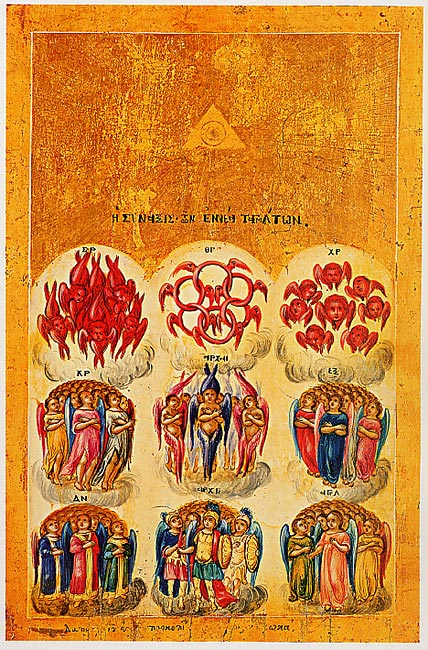

Contributed to
1
You might also explore
 Søren Kierkegaard★Modern European1813 – 1855Danish father of existentialism: truth is subjectivity, and faith a leap beyond reason.
 MaimonidesJewish1138 – 1204Jewish philosopher and physician whose Guide for the Perplexed reconciled the Torah with Aristotle.
 Friedrich Wilhelm Joseph SchellingModern European1775 – 1854Friedrich Wilhelm Joseph Schelling was a German philosopher. Standard histories of philosophy make him the midpoint in…
 OrigenGreek & Roman185 – 254Origen of Alexandria, also known as Origen Adamantius, was an early Christian theologian and ascetic. He was a prolific…
 Baltasar GraciánModern European1604 – 1658Baltasar Gracián y Morales, better known as Baltasar Gracián, was a Spanish Jesuit priest and Baroque prose writer and…
 Nikolai BerdyaevModern European1874 – 1948Nikolai Alexandrovich Berdyaev was a Russian philosopher, theologian, and Christian existentialist who emphasized the…