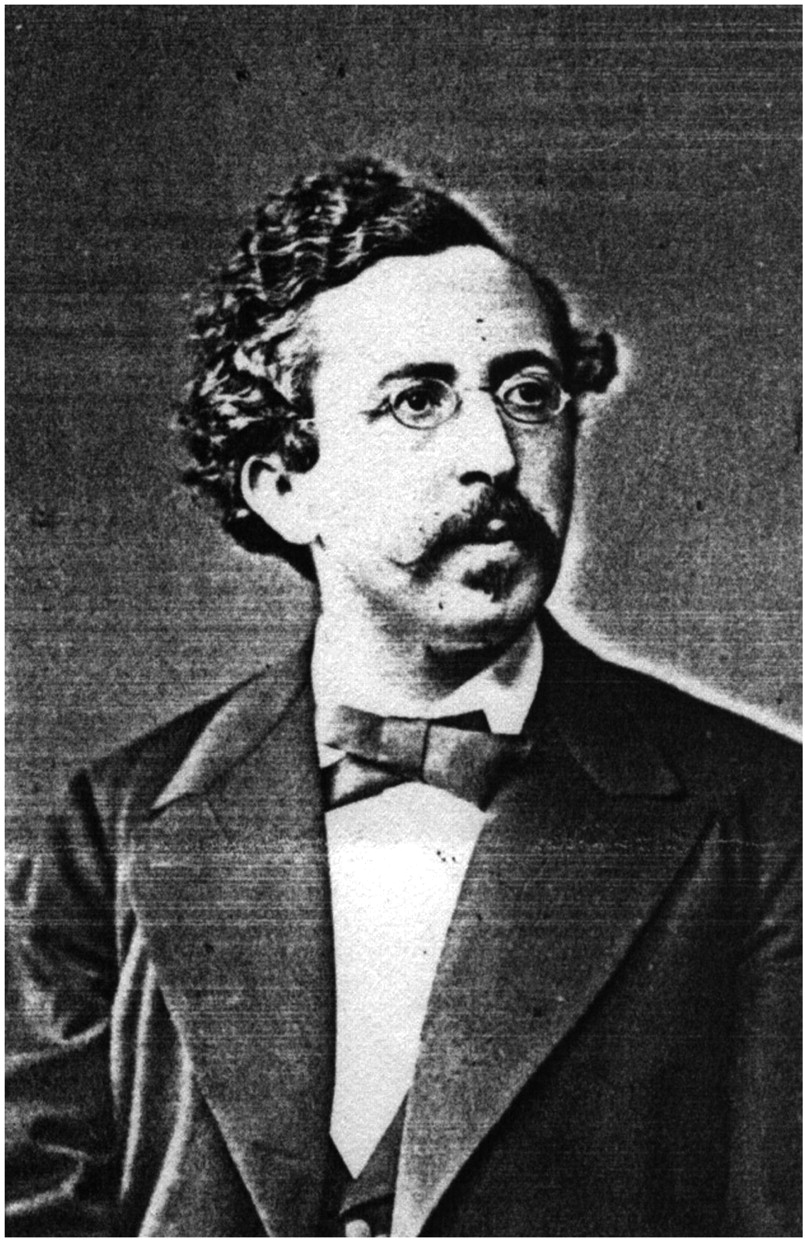
Hermann Cohen
Hermann Cohen was a German Jewish philosopher, one of the founders of the Marburg school of neo-Kantianism, and he is often held to be "probably the most important Jewish philosopher of the nineteenth century".
Hermann Cohen (; German: [ˈkoːən]; 4 July 1842 – 4 April 1918) was a German Jewish philosopher, one of the founders of the Marburg school of neo-Kantianism, and he is often held to be "probably the most important Jewish philosopher of the nineteenth century".
Biography
Cohen was born on 4 July 1842, in Coswig, in Anhalt-Bernburg. He began to study philosophy early on, and soon became known as a profound Kant scholar. He was educated at the Gymnasium at Dessau, at the Jewish Theological Seminary of Breslau, and at the universities of Breslau, Berlin, and Halle. In 1873, he became Privatdozent in the philosophical faculty of the University of Marburg; the habilitation thesis with which he obtained the venia legendi being Die systematischen Begriffe in Kant's vorkritischen Schriften nach ihrem Verhältniss zum kritischen Idealismus. Cohen was elected professor extraordinarius at Marburg in 1875 and professor ordinarius the following year.
He was one of the founders of the Gesellschaft zur Förderung der Wissenschaft des Judenthums, which held its first meeting in Berlin in November 1902.
Cohen edited and published Friedrich Albert Lange's final philosophical work, Logische Studien (Leipzig, 1877), and edited and wrote several versions of a long introduction and critical supplement to Lange's Geschichte des Materialismus.
In 1878 the thirty-six-year-old Hermann Cohen married the eighteen-year-old pianist Martha Lewandowski (1860-1942). She was the daughter of Louis Lewandowski, the chief cantor of Berlin and a celebrated composer of Jewish liturgical music. Martha was deeply connected to Hermann’s life and intellectual legacy, surviving him long after his death in 1918. Tragically, as an elderly widow decades later, she became a victim of the Nazi regime and died in the Theresienstadt concentration camp during the Holocaust. The marriage between Hermann and Martha Cohen was childless.
He devoted three early volumes to the interpretation of Kant (Kant's Theory of Experience, Kant's Foundations of Ethics, and Kant's Foundations of Aesthetics). In 1902 he began publishing the three volumes of his own systematic philosophy: Logik der reinen Erkenntnis (1902), Ethik des reinen Willens (1904) and Ästhetik des reinen Gefühls (1912). The planned fourth volume on psychology was never written.
Cohen's writings relating more especially to Judaism include several pamphlets, among them "Die Kulturgeschichtliche Bedeutung des Sabbat" (1881) and "Ein Bekenntniss in der Judenfrage" (1880); as well as the following articles: "Das Problem der Jüdischen Sittenlehre" in the "Monatsschrift" xliii. (1899), pp. 385–400, 433–449; "Liebe und Gerechtigkeit in den Begriffen Gott und Mensch" in "Jahrbuch für Jüdische Geschichte und Litteratur", III. (1900), pp. 75–132; and "Autonomie und Freiheit" in Gedenkbuch für David Kaufmann (1900).
Cohen's most famous Jewish works include: Religion der Vernunft aus den Quellen des Judentums (Religion of Reason out of the Sources of Judaism, 1919), Deutschtum und Judentum, Die Naechstenliebe im Talmud, and Die Ethik des Maimonides.
His essay "Die Nächstenliebe im Talmud" was written at the request of the Marburg Königliches Landgericht (3d ed., Marburg, 1888).
Cohen's Jewish writings are collected in his Jüdische Schriften (3 vols. ed. Bruno Strauss, Berlin 1924). There is an ongoing new academic edition of Cohen's works, edited by Helmut Holzhey, Hartwig Wiedebach u.a. (Olms, Hildesheim 1977 ff.). Selected writings have published in English translation in Hermann Cohen: Writings on Neo-Kantianism and Jewish Philosophy (ed. by Samuel Moyn and Robert S. Schine, 2021) and in Reason and Hope: Selections from the Jewish Writings of Hermann Cohen, translated by Eva Jospe (1971).
Cohen was an outspoken critic of Zionism, as he argued that its aspiration to create a Jewish state would lead to "return the Jews to History". In his view, Judaism was inherently a-historical, with a spiritual and moral mission far transcending the national aims of Zionism.
Despite his attitude, Tel Aviv has a Hermann Cohen Street.
Cohen is buried in the Weißensee Cemetery in Berlin.
Adapted from the Wikipedia article Hermann Cohen, available under CC BY-SA 4.0.
Connections



You might also explore
 Baruch Spinoza★Jewish1632 – 1677Lens-grinder of Amsterdam who identified God with Nature and wrote an Ethics in geometrical order.
 Aristotle★Greek & Roman384 – 322 BCEPlato's student and Alexander's tutor, who systematised logic, ethics, biology, metaphysics and politics — "the master…
 Friedrich Nietzsche★Modern European1844 – 1900Diagnostician of nihilism who proclaimed the death of God and called for a revaluation of all values.
 Arthur Schopenhauer★Modern European1788 – 1860Pessimist who saw the world as blind Will and found relief in art, compassion and Indian philosophy.
 Plato★Greek & Romanc. 428 – 348 BCEFounder of the Academy whose dialogues defined Western philosophy's agenda: Forms, justice, the soul, knowledge and the…
 René Descartes★Modern European1596 – 1650The father of modern philosophy: he doubted everything he could and found certainty in "I think, therefore I am".