
Edmund Burke
Edmund Burke was an Anglo-Irish writer, philosopher, and politician who is widely credited as the founder of the cultural and political philosophy of conservatism. Regarded as one of the most influential conservative thinkers and political writers of the 18th century, Burke spent the majority of his career in Great Bri
Edmund Burke (; 12 January [NS] 1729 – 9 July 1797) was an Anglo-Irish writer, philosopher, and politician who is widely credited as the founder of the cultural and political philosophy of conservatism. Regarded as one of the most influential conservative thinkers and political writers of the 18th century, Burke spent the majority of his career in Great Britain and was elected as a member of Parliament (MP) from 1766 to 1794 in the House of Commons of Great Britain with the Whig Party. His writings played a significant role in influencing public views and opinions in both Great Britain and France following the French Revolution in 1789, and he remains a major figure in modern conservative circles.
Burke was a proponent of underpinning virtues with manners in society and of the importance of religious institutions for the moral stability and good of the state. These views were expressed in his satirical work, A Vindication of Natural Society (1756). He also criticised the actions of the British government towards the American colonies, including its taxation policies. Burke supported the rights of the colonists to resist metropolitan authority, although he opposed the attempt to achieve independence. He is particularly remembered for his long-term support for Catholic emancipation, his opposition to the French Revolution, and leading the attempt at impeachment of Warren Hastings from the East India Company. In 1774, Burke was elected a member of Parliament for Bristol.
In his Reflections on the Revolution in France (1790), Burke asserted that the revolution was destroying the fabric of good society and traditional institutions of state and society, and he condemned the persecution of the Catholic Church that resulted from it. This led to him becoming a popular leading figure within the conservative faction of the Whig Party, which he dubbed the Old Whigs as opposed to the pro-French Revolution New Whigs led by Charles James Fox. Burke had a close relation with some of the public intellectuals of his time, including Samuel Johnson, David Garrick, Oliver Goldsmith, and Joshua Reynolds. In his debates, he often argued against unrestricted ruling power and the importance of political parties having the ability to maintain a principled opposition that was capable of preventing abuse of power.
In the 19th century, Burke was praised by both conservatives and liberals. Subsequently, in the 20th century, he became widely regarded, especially in the United States and the United Kingdom, as the philosophical founder of conservatism, along with his French ultra-royalist and ultramontanist counterpart Joseph de Maistre. His writings and literary publications influenced British conservative thought to a great extent, and helped establish the earliest foundations for modern conservatism and liberal democracy.
Early life
Burke was born in Dublin, Ireland. His mother Mary, née Nagle, was a Roman Catholic who hailed from a County Cork family and a cousin of the Catholic educator Nano Nagle, whereas his father Richard, a successful solicitor, was a member of the Church of Ireland. It remains unclear whether this is the same Richard Burke who converted from Catholicism. The Burgh (Burke) dynasty descends from the Anglo-Norman knight William de Burgh, who arrived in Ireland in 1185 following Henry II's 1171 invasion of Ireland and is among the "chief Gall or Old English families that assimilated into Gaelic society" (the surname de Burgh (latinised as de Burgo) was gaelicised in Irish as de Búrca or Búrc, which over the centuries became Burke).
Burke adhered to his father's faith and remained a practising Anglican throughout his life, unlike his sister Juliana, who was brought up as and remained a Roman Catholic. Later, his political enemies repeatedly accused him of having been educated at the Jesuit College of St Omer, near Calais, France; and of harbouring secret Catholic sympathies at a time when membership in the Catholic Church would disqualify him from public office per Penal Laws in Ireland. As Burke told Frances Crewe:
Mr. Burke's Enemies often endeavoured to convince the World that he had been bred up in the Catholic Faith, & that his Family were of it, & that he himself had been educated at Saint-Omer—but this was false, as his father was a regular practitioner of the Law at Dublin, which he could not be unless of the Established Church: & it so happened that though Mr. B was twice at Paris, he never happened to go through the Town of Saint-Omer.
After being elected to the House of Commons, Burke took the required oath of allegiance and abjuration, the oath of supremacy and the declaration against transubstantiation.
As a child, Burke sometimes spent time away from the unhealthy air of Dublin with his mother's family near Killavullen in the Blackwater Valley in County Cork. He received his early education at a Quaker school in Ballitore, County Kildare, some 67 kilometres (42 mi) from Dublin; and possibly like his cousin Nano Nagle at a hedge school near Killavullen. He remained in correspondence with his schoolmate from there, Mary Leadbeater, the daughter of the school's owner, throughout his life.
In 1744, Burke started at Trinity College Dublin, a Protestant establishment which up until 1793 did not permit Catholics to take degrees. In 1747, he set up a debating society, Edmund Burke's Club, which in 1770 merged with Trinity's Historical Club to form the College Historical Society, the oldest undergraduate society in the world. The minutes of the meetings of Burke's Club remain in the collection of the Historical Society. Burke graduated from Trinity in 1748. Burke's father wanted him to read Law and with this in mind, he went to London in 1750, where he entered the Middle Temple, before soon giving up legal study to travel in Continental Europe. After eschewing the Law, he pursued a livelihood through writing.
Early writing
The late Lord Bolingbroke's Letters on the Study and Use of History was published in 1752 and his collected works appeared in 1754. This provoked Burke into writing his first published work, A Vindication of Natural Society: A View of the Miseries and Evils Arising to Mankind, appearing in Spring 1756. Burke imitated Bolingbroke's style and ideas in a reductio ad absurdum of his arguments for deistic rationalism in order to demonstrate their absurdity.
Burke stated that Bolingbroke's arguments against revealed religion could apply to all social and civil institutions as well. Lord Chesterfield and Bishop Warburton as well as others initially thought that the work was genuinely by Bolingbroke rather than a satire. All the reviews of the work were positive, with critics especially appreciative of Burke's quality of writing. Some reviewers failed to notice the ironic nature of the book which led to Burke stating in the preface to the second edition (1757) that it was a satire.
Richard Hurd believed that Burke's imitation was near-perfect and that this defeated his purpose, arguing that an ironist "should take care by a constant exaggeration to make the ridicule shine through the Imitation. Whereas this Vindication is everywhere enforc'd, not only in the language, and on the principles of L. Bol., but with so apparent, or rather so real an earnestness, that half his purpose is sacrificed to the other". A minority of scholars have taken the position that in fact Burke did write the Vindication in earnest, later disowning it only for political reasons.
In 1757, Burke published a treatise on aesthetics titled A Philosophical Enquiry into the Origin of Our Ideas of the Sublime and Beautiful that attracted the attention of prominent Continental thinkers such as Denis Diderot and Immanuel Kant. It was his only purely philosophical work, completed in 1753. When asked by Sir Joshua Reynolds and French Laurence to expand it thirty years later, Burke replied that he was no longer fit for abstract speculation.
On 25 February 1757, Burke signed a contract with Robert Dodsley to write a "history of England from the time of Julius Caesar to the end of the reign of Queen Anne", its length being eighty quarto sheets (640 pages), nearly 400,000 words. It was to be submitted for publication by Christmas 1758. Burke completed the work to the year 1216 and stopped; it was not published until after Burke's death, in an 1812 collection of his works, An Essay Towards an Abridgement of the English History. G. M. Young did not value Burke's history and claimed that it was "demonstrably a translation from the French". On commenting on the story that Burke stopped his history because David Hume published his, Lord Acton said "it is ever to be regretted that the reverse did not occur".
During the year following that contract, Burke founded with Dodsley the influential Annual Register, a publication in which various authors evaluated the international political events of the previous year. The extent to which Burke contributed to the Annual Register is unclear. In his biography of Burke, Robert Murray quotes the Register as evidence of Burke's opinions, yet Philip Magnus in his biography does not cite it directly as a reference. Burke remained the chief editor of the publication until at least 1789 and there is no evidence that any other writer contributed to it before 1766.
On 12 March 1757, Burke married Jane Mary Nugent (1734–1812), daughter of Dr. Christopher Nugent, a Catholic physician who had provided him with medical treatment at Bath. Their son Richard was born on 9 February 1758 while a second son, Christopher (born that December), died in infancy. Burke also helped raise a ward, Edmund Nagle (later Admiral Sir Edmund Nagle), the son of a maternal cousin orphaned in 1763.
At about this same time, Burke was introduced to William Gerard Hamilton (known as "Single-speech Hamilton"). When Hamilton was appointed Chief Secretary for Ireland, Burke accompanied him to Dublin as his private secretary, a position he held for three years. In 1765, Burke became private secretary to the liberal Whig politician Charles, Marquess of Rockingham, then Prime Minister of Great Britain, who remained Burke's close friend and associate until his death in 1782.
Member of Parliament
In December 1765, Burke entered the House of Commons of the British Parliament as Member for Wendover in Buckinghamshire, a pocket borough in the gift of Lord Fermanagh, later 2nd Earl Verney and a close political ally of Rockingham. After Burke delivered his maiden speech, William Pitt the Elder said he had "spoken in such a manner as to stop the mouths of all Europe" and that the Commons should congratulate itself on acquiring such a Member.
The first great subject Burke addressed was the controversy with the American colonies which soon developed into war and ultimate separation. In reply to the 1769 Grenvillite pamphlet The Present State of the Nation, he published his own pamphlet titled Observations on a Late State of the Nation. Surveying the finances of France, Burke predicts "some extraordinary convulsion in that whole system".
During the same year, with mostly borrowed money, Burke purchased Gregories, a 600-acre (2.4 km2) estate near Beaconsfield. Although the estate included saleable assets such as art works by Titian, Gregories proved a heavy financial burden in the following decades and Burke was never able to repay its purchase price in full. His speeches and writings, having made him famous, led to the suggestion that he was the author of the Letters of Junius.
At about this time, Burke joined the circle of leading intellectuals and artists in London of whom Samuel Johnson was the central luminary. This circle also included David Garrick, Oliver Goldsmith and Joshua Reynolds. Edward Gibbon described Burke as "the most eloquent and rational madman that I ever knew". Although Johnson admired Burke's brilliance, he found him a dishonest politician.
Burke took a leading role in the debate regarding the constitutional limits to the executive authority of the king. He argued strongly against unrestrained royal power and for the role of political parties in maintaining a principled opposition capable of preventing abuses, either by the monarch or by specific factions within the government. His most important publication in this regard was his Thoughts on the Cause of the Present Discontents of 23 April 1770. Burke identified the "discontents" as stemming from the "secret influence" of a neo-Tory group he labelled as the "king's friends", whose system "comprehending the exterior and interior administrations, is commonly called, in the technical language of the Court, Double Cabinet". Britain needed a party with "an unshaken adherence to principle, and attachment to connexion, against every allurement of interest". Party divisions, "whether operating for good or evil, are things inseparable from free government".
During 1771, Burke wrote a bill that would have given juries the right to determine what was libel, if passed. Burke spoke in favour of the bill, but it was opposed by some, including Charles James Fox, not becoming law. When introducing his own bill in 1791 in opposition, Fox repeated almost verbatim the text of Burke's bill without acknowledgement. Burke was prominent in securing the right to publish debates held in Parliament.
Speaking in a Parliamentary debate on the prohibition on the export of grain on 16 November 1770, Burke argued in favour of a free market in corn: "There are no such things as a high, & a low price that is encouraging, & discouraging; there is nothing but a natural price, which grain brings at an universal market". In 1772, Burke was instrumental in the passing of the Repeal of Certain Laws Act 1772 which repealed various old laws against dealers and forestallers in corn.
In the Annual Register for 1772 (published in July 1773), Burke condemned the partition of Poland. He saw it as "the first very great breach in the modern political system of Europe" and as upsetting the balance of power in Europe.
On 3 November 1774, Burke was elected Member for Bristol, at the time "England's second city" with a large constituency in a genuine electoral contest. At the conclusion of the poll, he made his Speech to the Electors of Bristol at the Conclusion of the Poll, a remarkable disclaimer of the constituent-imperative form of democracy, for which he substituted his statement of the "representative mandate" form. He failed to win re-election for that seat in the subsequent 1780 general election.
In May 1778, Burke supported a Parliamentary motion revising restrictions on Irish trade. His constituents, citizens of the great trading city of Bristol, urged Burke to oppose free trade with Ireland. Burke resisted their protestations and said: "If, from this conduct, I shall forfeit their suffrages at an ensuing election, it will stand on record an example to future representatives of the Commons of England, that one man at least had dared to resist the desires of his constituents when his judgment assured him they were wrong."
Burke published Two Letters to Gentlemen of Bristol on the Bills relative to the Trade of Ireland in which he espoused "some of the chief principles of commerce; such as the advantage of free intercourse between all parts of the same kingdom ... the evils attending restriction and monopoly ... and that the gain of others is not necessarily our loss, but on the contrary an advantage by causing a greater demand for such wares as we have for sale."
Burke also supported the attempts of Sir George Savile to repeal some of the penal laws against Catholics. Burke also called capital punishment "the Butchery which we call justice" in 1776 and in 1780 condemned the use of the pillory for two men convicted for attempting to practice sodomy.
This support for unpopular causes, notably free trade with Ireland and Catholic emancipation, led to Burke losing his seat in 1780. For the remainder of his Parliamentary career, Burke represented Malton, another pocket borough under the Marquess of Rockingham's patronage.
American War of Independence
Burke expressed his support for the grievances of the American Thirteen Colonies under the government of King George III and his appointed representatives. On 19 April 1774, Burke made a speech, "On American Taxation" (published in January 1775), on a motion to repeal the tea duty:
Again and again, revert to your old principles—seek peace and ensue it; leave America, if she has taxable matter in her, to tax herself. I am not here going into the distinctions of rights, nor attempting to mark their boundaries. I do not enter into these metaphysical distinctions; I hate the very sound of them. Leave the Americans as they anciently stood, and these distinctions, born of our unhappy contest, will die along with it ... Be content to bind America by laws of trade; you have always done it ... Do not burthen them with taxes ... But if intemperately, unwisely, fatally, you sophisticate and poison the very source of government by urging subtle deductions, and consequences odious to those you govern, from the unlimited and illimitable nature of supreme sovereignty, you will teach them by these means to call that sovereignty itself in question ... If that sovereignty and their freedom cannot be reconciled, which will they take? They will cast your sovereignty in your face. No body of men will be argued into slavery.
On 22 March 1775, Burke delivered in the House of Commons a speech (published in May 1775) on reconciliation with America. Burke appealed for peace as preferable to civil war and reminded the House of Commons of America's growing population, its industry and its wealth. He warned against the notion that the Americans would back down in the face of force since most Americans were of British descent:
[T]he people of the colonies are descendants of Englishmen ... They are therefore not only devoted to liberty, but to liberty according to English ideas and on English principles. The people are Protestants ... a persuasion not only favourable to liberty, but built upon it ... My hold of the colonies is in the close affection which grows from common names, from kindred blood, from similar privileges, and equal protection. These are ties which, though light as air, are as strong as links of iron. Let the colonies always keep the idea of their civil rights associated with your government—they will cling and grapple to you, and no force under heaven will be of power to tear them from their allegiance. But let it be once understood that your government may be one thing and their privileges another, that these two things may exist without any mutual relation—the cement is gone, the cohesion is loosened, and everything hastens to decay and dissolution. As long as you have the wisdom to keep the sovereign authority of this country as the sanctuary of liberty, the sacred temple consecrated to our common faith, wherever the chosen race and sons of England worship freedom, they will turn their faces towards you. The more they multiply, the more friends you will have; the more ardently they love liberty, the more perfect will be their obedience. Slavery they can have anywhere. It is a weed that grows in every soil. They may have it from Spain, they may have it from Prussia. But, until you become lost to all feeling of your true interest and your natural dignity, freedom they can have from none but you.
Burke prized peace with America above all else, pleading with the House of Commons to remember that the interest by way of money received from the American colonies was far more attractive than any sense of putting the colonists in their place:
The proposition is peace. Not peace through the medium of war, not peace to be hunted through the labyrinth of intricate and endless negotiations, not peace to arise out of universal discord ... [I]t is simple peace, sought in its natural course and in its ordinary haunts. It is peace sought in the spirit of peace, and laid in principles purely pacific.
Burke was not merely presenting a peace agreement to Parliament, but rather he stepped forward with four reasons against using force, carefully reasoned. He laid out his objections in an orderly manner, focusing on one before moving to the next. His first concern was that the use of force would have to be temporary and that the uprisings and objections to British governance in Colonial America would not be. Second, Burke worried about the uncertainty surrounding whether Britain would win a conflict in America. "An armament," Burke said, "is not a victory." Third, Burke brought up the issue of impairment, stating that it would do the British government no good to engage in a scorched earth war and have the object they desired (America) become damaged or even useless. The American colonists could always retreat into the mountains, but the land they left behind would most likely be unusable, whether by accident or design. The fourth and final reason to avoid the use of force was experience, as the British had never attempted to rein in an unruly colony by force and they did not know if it could be done, let alone accomplished thousands of miles away from home. Not only were all of these concerns reasonable, but some turned out to be prophetic—the American colonists did not surrender, even when things looked extremely bleak and the British were ultimately unsuccessful in their attempts to win a war fought on American soil.
It was not temporary force, uncertainty, impairment, or even experience that Burke cited as the primary reason for avoiding war with the American colonies. Rather, it was the character of the American people themselves: "In this character of Americans, a love of freedom is the predominating feature which marks and distinguishes the whole ... [T]his fierce spirit of liberty is stronger in the English colonies, probably, than in any other people of the earth ... [The] men [are] acute, inquisitive, dextrous, prompt in attack, ready in defence, full of resources." Burke concludes with another plea for peace and a prayer that Britain might avoid actions which in Burke's words "may bring on the destruction of this Empire."
Burke proposed six resolutions to settle the American conflict peacefully:
Allow the American colonists to elect their own representatives, settling the dispute about taxation without representation.
Acknowledge this wrongdoing and apologise for grievances caused.
Procure an efficient manner of choosing and sending these delegates.
Set up a General Assembly in America itself, with powers to regulate taxes.
Stop gathering taxes by imposition (or law) and start gathering them only when they are needed.
Grant needed aid to the colonies.
Had they been passed, though the effect of these resolutions can never be known, they might have quelled the colonials' revolutionary spirit. Unfortunately, Burke delivered this speech less than a month before the explosive conflict at Concord and Lexington. As these resolutions were not enacted, little was done that would help to prevent armed conflict.
Among the reasons this speech was so greatly admired was its passage on Lord Bathurst (1684–1775) in which Burke describes an angel in 1704 prophesying to Bathurst the future greatness of England and also of America: "Young man, There is America—which at this day serves little more than to amuse you with stories of savage men, and uncouth manners; yet shall, before you taste of death, shew itself equal to the whole of that commerce which now attracts the envy of the world." Samuel Johnson was so irritated at hearing it continually praised that he made a parody of it, where the devil appears to a young Whig and predicts that in a short time Whiggism will poison even the paradise of America.
The administration of Lord North (1770–1782) tried to defeat the colonist rebellion by military force. British and American forces clashed in 1775 and in 1776 came the United States Declaration of Independence. Burke was appalled by celebrations in Britain of the defeat of the Americans in New York and Pennsylvania. He claimed the English national character was being changed by this authoritarianism. Burke wrote: "As to the good people of England, they seem to partake every day more and more of the Character of that administration which they have been induced to tolerate. I am satisfied, that within a few years there has been a great Change in the National Character. We seem no longer that eager, inquisitive, jealous, fiery people, which we have been formerly."
In Burke's view, the British government was fighting "the American English" ("our English Brethren in the Colonies"), employing "the hireling sword of German boors and vassals" to destroy the "English privileges" of the colonists. On American independence, Burke wrote: "I do not know how to wish success to those whose Victory is to separate from us a large and noble part of our Empire. Still less do I wish success to injustice, oppression and absurdity."
During the Gordon Riots in 1780, Burke became a target of hostility and his home was placed under armed guard by the military.
Paymaster of the Forces
The fall of North led to Rockingham being recalled to power in March 1782. Burke was appointed Paymaster of the Forces and a Privy Counsellor, but without a seat in Cabinet. Rockingham's unexpected death in July 1782 and replacement with Shelburne as Prime Minister put an end to his administration after only a few months, but Burke did manage to introduce two Acts.
The Paymaster General Act 1782 ended the post as a lucrative sinecure. Previously, Paymasters had been able to draw on money from HM Treasury at their discretion. Instead, now they were required to put the money they had requested to withdraw from the Treasury into the Bank of England, from where it was to be withdrawn for specific purposes. The Treasury would receive monthly statements of the Paymaster's balance at the Bank. This Act was repealed by Shelburne's administration, but the Act that replaced it repeated verbatim almost the whole text of the Burke Act.
The Civil List and Secret Service Money Act 1782 was a watered-down version of Burke's original intentions as outlined in his famous Speech on Economical Reform of 11 February 1780. However, he managed to abolish 134 offices in the royal household and civil administration. The third Secretary of State and the Board of Trade were abolished and pensions were limited and regulated. The Act was anticipated to save £72,368 a year.
In February 1783, Burke resumed the post of Paymaster of the Forces when Shelburne's government fell and was replaced by a coalition headed by North that included Charles James Fox. That coalition fell in 1783 and was succeeded by the long Tory administration of William Pitt the Younger which lasted until 1801. Accordingly, having supported Fox and North, Burke was in opposition for the remainder of his political life.
Representative government
In 1774, Burke's Speech to the Electors at Bristol at the Conclusion of the Poll was noted for its defence of the principles of representative government against the notion that those elected to assemblies like Parliament are, or should be, merely delegates:
Certainly, Gentlemen, it ought to be the happiness and glory of a Representative, to live in the strictest union, the closest correspondence, and the most unreserved communication with his constituents. Their wishes ought to have great weight with him; their opinion, high respect; their business, unremitted attention. It is his duty to sacrifice his repose, his pleasures, his satisfactions, to theirs; and above all, ever, and in all cases, to prefer their interest to his own. But his unbiassed opinion, his mature judgment, his enlightened conscience, he ought not to sacrifice to you, to any man, or to any sett of men living. These he does not derive from your pleasure; no, nor from the Law and the Constitution. They are a trust from Providence, for the abuse of which he is deeply answerable. Your Representative owes you, not his industry only, but his judgment; and he betrays, instead of serving you, if he sacrifices it to your opinion.My worthy Colleague says, his Will ought to be subservient to yours. If that be all, the thing is innocent. If Government were a matter of Will upon any side, yours, without question, ought to be superior. But Government and Legislation are matters of reason and judgement, and not of inclination; and, what sort of reason is that, in which the determination precedes the discussion; in which one sett of men deliberate, and another decide; and where those who form the conclusion are perhaps three hundred miles distant from those who hear the arguments?To deliver an opinion is the right of all men; that of constituents is a weighty and respectable opinion which a Representative ought always to rejoice to hear; and which he ought always most seriously to consider. But authoritative instructions; mandates issued, which the member is bound blindly and implicitly to obey, to vote, and to argue for, though contrary to the clearest conviction of his judgment and conscience; these are things utterly unknown to the laws of this land, and which arise from a fundamental mistake of the whole order and tenour of our constitution.Parliament is not a congress of ambassadors from different and hostile interests; which interests each must maintain, as an agent and advocate, against other agents and advocates; but Parliament is a deliberative assembly of one nation, with one interest, that of the whole; where, not local purposes, not local prejudices ought to guide, but the general good, resulting from the general reason of the whole. You choose a member, indeed; but when you have chosen him, he is not a member of Bristol, but he is a member of Parliament.
It is often forgotten in this connection that Burke, as detailed below, was an opponent of slavery, and therefore his conscience was refusing to support a trade in which many of his Bristol electors were lucratively involved.
Political scientist Hanna Pitkin points out that Burke linked the interest of the district with the proper behaviour of its elected official, explaining: "Burke conceives of broad, relatively fixed interest, few in number and clearly defined, of which any group or locality has just one. These interests are largely economic or associated with particular localities whose livelihood they characterize, in his over-all prosperity they involve".
Burke was a leading sceptic with respect to democracy. While admitting that theoretically in some cases it might be desirable, he insisted a democratic government in Britain in his day would not only be inept, but also oppressive. He opposed democracy for three basic reasons. First, government required a degree of intelligence and breadth of knowledge of the sort that occurred rarely among the common people. Second, he thought that if they had the vote, common people had dangerous and angry passions that could be aroused easily by demagogues, fearing that the authoritarian impulses that could be empowered by these passions would undermine cherished traditions and established religion, leading to violence and confiscation of property. Third, Burke warned that democracy would create a tyranny over unpopular minorities, who needed the protection of the upper classes.
Opposition to the slave trade
Adapted from the Wikipedia article Edmund Burke, available under CC BY-SA 4.0.
Connections


You might also explore
 Martin Heidegger★Modern European1889 – 1976Asked the question of the meaning of Being; analysed human existence (Dasein) as being-in-the-world and…
 Plato★Greek & Romanc. 428 – 348 BCEFounder of the Academy whose dialogues defined Western philosophy's agenda: Forms, justice, the soul, knowledge and the…
 René Descartes★Modern European1596 – 1650The father of modern philosophy: he doubted everything he could and found certainty in "I think, therefore I am".
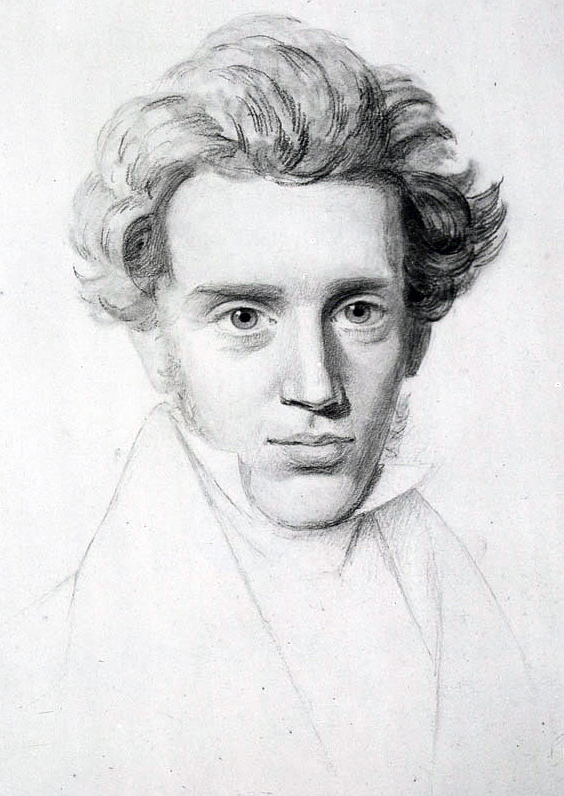 Søren Kierkegaard★Modern European1813 – 1855Danish father of existentialism: truth is subjectivity, and faith a leap beyond reason.
 George BerkeleyModern European1685 – 1753Irish bishop who argued that to be is to be perceived — there is no mind-independent matter.
 Aristotle★Greek & Roman384 – 322 BCEPlato's student and Alexander's tutor, who systematised logic, ethics, biology, metaphysics and politics — "the master…