Neoplatonism and the Church Fathers
Plotinus built a mystical system in which everything flows from the One. Through Augustine, Platonism fused with Christianity; Boethius consoled himself with philosophy before his execution. Hypatia's murder marked the end of an era in Alexandria.
- 1
 SchoolGreek & Roman250 – 600
Neoplatonism
Plotinus's system in which all reality emanates from the ineffable One.
- ◆The One, Intellect and Soul
- ◆Emanation
- ◆Mystical return to the source
Read the full pageNeoplatonism is a version of Platonic philosophy that emerged in the 3rd century AD against the background of Hellenistic philosophy and religion. The term does not encapsulate a set of distinct ideas based on a form of Platonism as much as a series of Platonic thinkers coming primarily from a certain ancient historical period. Among the common ideas it maintains is monism, the doctrine that all of reality can be derived from a single principle, "the One".
Neoplatonism began with Ammonius Saccas and his student Plotinus (c. AD 205 – 271) and stretched to the sixth century. After Plotinus there were three distinct periods in the history of Neoplatonism: the work of his student Porphyry (third to early fourth century); that of Iamblichus (third to fourth century); and the period in the fifth and sixth centuries, when the academies in Alexandria and Athens flourished.
Neoplatonism had an enduring influence on the subsequent history of Western philosophy and religion. In the Middle Ages, Neoplatonic ideas were studied and discussed by Christian, Jewish, and Muslim thinkers. In the Islamic cultural sphere, Neoplatonic texts were available in Arabic and Persian translations, and notable philosophers such as al-Farabi, Solomon ibn Gabirol (Avicebron), Avicenna (Ibn Sina), and Maimonides incorporated Neoplatonic elements into their own thinking.
- 2
 PhilosopherGreek & Roman204 – 270
Plotinus
Founder of Neoplatonism: all reality flows from the One, and the soul can return to it.
- ◆Emanation
- ◆the One
- ◆hypostases
- ◆Intellect
- ◆Soul
- ◆Henosis
Read the full pagePlotinus (; Ancient Greek: Πλωτῖνος, Plōtînos; c. 204/5 – 270 AD) was an ancient Greek philosopher, born and raised in Roman Egypt. He is widely regarded by modern scholars as the founder of Neoplatonism.
Plotinus was a student of the self-taught philosopher Ammonius Saccas, who belonged to the Platonic tradition. Historians in the 19th century coined the term "Neoplatonism" to describe Plotinus and his philosophy. This philosophical tradition was vastly influential during late antiquity, the Middle Ages, and the Renaissance.
In his metaphysical writings, Plotinus described three fundamental principles: the One, the Intellect, and the Soul. His works have inspired generations of pagan, Jewish, Christian, Gnostic, and early Islamic metaphysicians and mystics. His ideas shaped metaphysical works, particularly his work on duality of the One. These ideas later influenced several mainstream theological concepts within different religions.
- 3PhilosopherGreek & Romanc. 355 – 415
Hypatia
Neoplatonist philosopher and mathematician of Alexandria, killed by a Christian mob.
Read the full pageHypatia (born c. 350–370 – March 415 AD) was a Neoplatonist philosopher, astronomer, and mathematician who lived in Alexandria, at that time in the province of Egypt and a major city of the Roman Empire. In Alexandria, Hypatia was a prominent thinker who taught subjects including philosophy and astronomy, and in her lifetime was renowned as a great teacher and a wise counselor. Not the only fourth century Alexandrian female mathematician, Hypatia was preceded by Pandrosion. However, Hypatia is the first female polymath, whose life is reasonably well recorded. She wrote a commentary on Diophantus's thirteen-volume Arithmetica, which may survive in part, having been interpolated into Diophantus's original text, and another commentary on Apollonius of Perga's treatise on conic sections, which has not survived. Many modern scholars also believe that Hypatia may have edited the surviving text of Ptolemy's Almagest, based on the title of her father Theon's commentary on Book III of the Almagest.
Hypatia constructed astrolabes and hydrometers, but did not invent either of these, which were both in use long before she was born. She was tolerant toward Christians and taught many Christian students, including Synesius, the future bishop of Ptolemais. Ancient sources record that Hypatia was widely beloved by pagans and Christians alike and that she established great influence with the political elite in Alexandria. Toward the end of her life, Hypatia advised Orestes, the Roman prefect of Alexandria, who was in the midst of a political feud with Cyril, the bishop of Alexandria. Rumors spread accusing her of preventing Orestes from reconciling with Cyril and, in March 415 AD, she was murdered by a mob of Christians led by a lector named Peter.
Hypatia's murder shocked the empire and transformed her into a "martyr for philosophy", leading future Neoplatonists such as the historian Damascius (c. 458 – c. 538) to become increasingly fervent in their opposition to Christianity. During the Middle Ages, Hypatia was co-opted as a symbol of Christian virtue and scholars believe she was part of the basis for the legend of Saint Catherine of Alexandria. During the Age of Enlightenment, she became a symbol of opposition to Catholicism. In the nineteenth century, European literature, especially Charles Kingsley's 1853 novel Hypatia, romanticized her as "the last of the Hellenes". In the twentieth century, Hypatia became seen as an icon for women's rights and a precursor to the feminist movement. Since the late twentieth century, some portrayals have associated Hypatia's death with the destruction of the Library of Alexandria, despite the historical fact that the library no longer existed during Hypatia's lifetime.
- 4
 PhilosopherJewishc. 20 BCE – 50 CE
Philo of Alexandria
Interpreted the Hebrew Bible through Greek philosophy, pioneering allegorical reading.
Read the full pagePhilo of Alexandria (; Ancient Greek: Φίλων, romanized: Phílōn; Hebrew: יְדִידְיָה, romanized: Yəḏīḏyāh; c. 20 BC – c. 50 AD), also called Philō Judæus, was a Hellenistic Jewish philosopher who lived in Alexandria, in the Roman province of Egypt.
The only event in Philo's life that can be decisively dated is his representation of the Alexandrian Jews in a delegation to the Roman emperor Caligula in 40 CE following civil strife between the Jewish and Greek communities of Alexandria.
Philo was a leading writer of the Hellenistic Jewish community in Alexandria, Egypt. He wrote expansively in Koine Greek on philosophy, politics, and religion in his time; specifically, he explored the connections between Greek Platonic philosophy and late Second Temple Judaism. For example, he maintained that the Greek-language Septuagint and the Jewish law still being developed by the rabbis of the period together served as a blueprint for the pursuit of individual enlightenment.
- 5
 PhilosopherMedieval Latin354 – 430
Augustine of Hippo
North African bishop whose Confessions and City of God fused Platonism with Christianity and shaped Western thought for a millennium.
- ◆Evil as privation of good
- ◆Free will and grace
- ◆Time as a distension of the mind
- ◆"If I am mistaken, I exist"
Read the full pageAugustine of Hippo ( uh-GUST-in or aw-GUST-in, US also AW-gə-steen; Latin: Aurelius Augustinus Hipponensis; 13 November 354 – 28 August 430), also well-known as Saint Augustine, was a Christian theologian and philosopher from Thagaste, Numidia Cirtensis and the Bishop of Hippo Regius. He is generally regarded as one of the most influential philosophers in the history of the Western world, and is viewed as one of the most important Church Fathers of the Latin Church in the Patristic Period.
In his youth he was drawn to the Manichaean faith, and later to the Hellenistic philosophy of Neoplatonism. After his conversion to Christianity and baptism in 386 by Saint Ambrose, Augustine developed his own approach to philosophy and theology, making significant contributions in a wide variety of areas. He is known as Doctor Gratiae ("Doctor of Grace") for the vast influence of his views on the necessity of unmerited, prevenient grace, for salvation and the nature of original sin.
Additionally, he made important contributions in ecclesiology, noting the validity of sacraments regardless of the merit of the celebrant against the views of the Donatists. In his book The City of God, Augustine imagined the Church as a spiritual City, distinct from the material Earthly City, against the backdrop of the fall of the Western Roman Empire. He is also widely recognized for his contributions to just war theory. His other notable works include On the Trinity, On Christian Doctrine, and Confessions, the latter of which was the first Western autobiography.
- 6
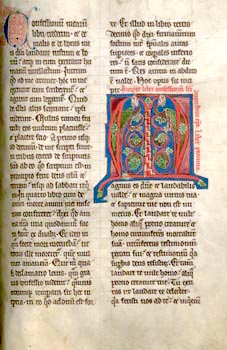 WorkMedieval Latin400
Confessions
Augustine's autobiography of conversion, with famous reflections on memory and time.
Read the full pageConfessions (Latin: Confessiones) is an autobiographical work by Augustine of Hippo, consisting of 13 books written in Latin between AD 397 and 400. The work outlines Augustine's sinful youth and his conversion to Christianity. Modern English translations are sometimes published under the title The Confessions of Saint Augustine in order to distinguish it from other books with similar titles. Its original title was Confessions in Thirteen Books; it was composed to be read out loud, with each book being a complete unit.
Confessions is generally considered one of Augustine's most important texts. It is widely regarded as one of the earliest and most influential works of spiritual autobiography in Western literature, and was an influential model for Christian writers throughout the Middle Ages. Henry Chadwick wrote that Confessions will "always rank among the great masterpieces of western literature".
The work is not a complete autobiography, as it was written during Augustine's early 40s and he lived long afterwards, producing another important work, The City of God. Nonetheless, it gives a detailed first-person account of his early life, intellectual development, and conversion to Christianity. It is a significant theological work, featuring spiritual meditations and insights.
- 7
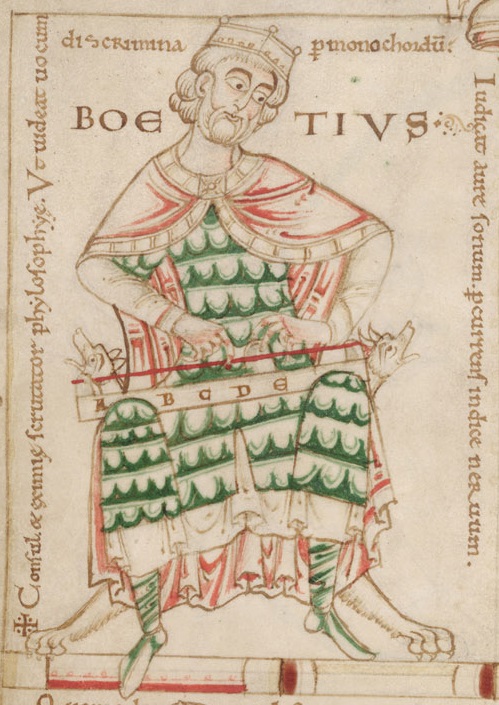 PhilosopherMedieval Latin477 – 524
Boethius
Roman statesman who wrote The Consolation of Philosophy while awaiting execution.
Read the full pageAnicius Manlius Severinus Boethius, commonly known simply as Boethius (; Latin: Boetius; c. 480 – 524 AD), was a Roman senator, consul, magister officiorum, polymath, historian, and philosopher of the Early Middle Ages. He was a central figure in the translation of the Greek classics into Latin, a precursor to the Scholastic movement, and, along with Cassiodorus, one of the two leading Christian scholars of the 6th century. The local cult of Boethius in the Diocese of Pavia was sanctioned by the Sacred Congregation of Rites in 1883, confirming the diocese's custom of honoring him on 23 October.
Boethius was born in Rome a few years after the forced abdication of the last Western Roman emperor, Romulus Augustulus. A member of the Anicii family, he was orphaned following the family's sudden decline and was raised by Quintus Aurelius Memmius Symmachus, a later consul. After mastering both Latin and Greek in his youth, Boethius rose to prominence as a statesman during the Ostrogothic Kingdom, becoming a senator by age 25, a consul by age 33, and later chosen as a personal advisor to Theodoric the Great.
In seeking to reconcile the teachings of Plato and Aristotle with Christian theology, Boethius sought to translate the entirety of the Greek classics for Western scholars. He published numerous transcriptions and commentaries of the works of Nicomachus, Porphyry, and Cicero, among others, and wrote extensively on matters concerning music, mathematics, and theology. Though his translations were unfinished following an untimely death, it is largely due to them that the works of Aristotle survived into the Renaissance.
- 8
 WorkMedieval Latin524
The Consolation of Philosophy
Lady Philosophy consoles the imprisoned Boethius on fortune, happiness and providence.
Read the full pageOn the Consolation of Philosophy (Latin: De consolatione philosophiae), often titled as The Consolation of Philosophy or simply the Consolation, is a philosophical work by the Roman philosopher and Christian theologian Boethius. Written in 523 while he was imprisoned and awaiting execution by the Ostrogothic King Theodoric, it is often described as the last great Western work of the Classical Period. Boethius's Consolation heavily influenced the philosophy of late antiquity, as well as Medieval and early Renaissance Christianity.
On the Consolation of Philosophy was written in AD 523 during a one-year imprisonment Boethius served while awaiting trial—and eventual execution—for the alleged crime of treason under the Ostrogothic King Theodoric the Great. Boethius was at the very heights of power in Rome, holding the prestigious office of magister officiorum, and was brought down by treachery. This experience inspired the text, which reflects on how evil can exist in a world governed by God (an example of theodicy), and how happiness is still attainable amidst fickle fortune, while also considering the nature of happiness and God. In 1891, the academic Hugh Fraser Stewart described the work as "by far the most interesting example of prison literature the world has ever seen."
Boethius writes the book as a conversation between himself and a female personification of philosophy, referred to as "Lady Philosophy". Philosophy consoles Boethius by discussing the transitory nature of wealth, fame, and power ("no man can ever truly be secure until he has been forsaken by Fortune"), and the ultimate superiority of things of the mind, which she calls the "one true good". She contends that happiness comes from within, and that virtue is all that one truly has because it is not imperiled by the vicissitudes of fortune.
