Contemporary debates
Rawls revived political philosophy; Singer and Nussbaum changed applied ethics; philosophers of mind confronted the hard problem of consciousness and the possibility of thinking machines.
- 1
 PhilosopherAmericas1921 – 2002
John Rawls
The most important political philosopher of the 20th century: justice as fairness chosen behind a veil of ignorance.
- ◆Veil of ignorance
- ◆Original position
- ◆Difference principle
- ◆Justice as fairness
Read the full pageJohn Bordley Rawls (; February 21, 1921 – November 24, 2002) was an American philosopher, most active in moral, legal, and political philosophy. Rawls has been described as one of the most influential modern liberal political philosophers of the 20th century.
In 1990, Will Kymlicka wrote in his introduction to the field that "it is generally accepted that the recent rebirth of normative political philosophy began with the publication of John Rawls's A Theory of Justice in 1971". Rawls's theory of "justice as fairness" recommends equal basic liberties, equality of opportunity, and facilitating the maximum benefit to the least advantaged members of society in any case where inequalities may occur. His argument for these principles of social justice uses a thought experiment called the "original position", in which people deliberatively select what kind of society they would choose to live in if they did not know which social position they would personally occupy. In his later work Political Liberalism (1993), he addresses the question of how political power can be exercised legitimately in a society where citizens hold diverse and often conflicting moral, religious, and philosophical points of view.
Rawls received both the Schock Prize for Logic and Philosophy and the National Humanities Medal in 1999. The latter was presented by President Bill Clinton in recognition of how his works "revived the disciplines of political and ethical philosophy with his argument that a society in which the most fortunate help the least fortunate is not only a moral society but a logical one".
- 2
 ArgumentAmericas
Veil of ignorance
Choose the principles of society without knowing who you will be in it.
P1Fair principles are those chosen in a fair situation
P2Behind a veil of ignorance no one knows their class, talents, race or conception of the good
P3Rational choosers there would protect the worst-off position
∴Justice requires equal basic liberties and inequalities only if they benefit the least advantaged (the difference principle).
Read the full pageIn philosophy, the original position is a hypothetical position from which members of society would consider which principles they would select for the basic structure of their society if they had no knowledge ahead of time regarding the position which they would end up occupying in that society. The idea of having no such knowledge, because everyone is behind a veil of ignorance, represents a thought experiment often associated with the work of the American philosopher John Rawls.
In this "original position", the "veil of ignorance" prevents everyone from knowing their ethnicity, social status, gender, and (crucially in Rawls's formulation) their or anyone else's ideas of how to lead a good life. Ideally, this would force participants acting rationally to adopt an "initial agreement" on the principles impartially.
In Rawls's theory the original position plays the same role as the "state of nature" does in the social contract tradition of Thomas Hobbes and John Locke. The original position figures prominently in Rawls's 1971 book, A Theory of Justice. It has influenced a variety of thinkers from a broad spectrum of philosophical orientations.
- 3
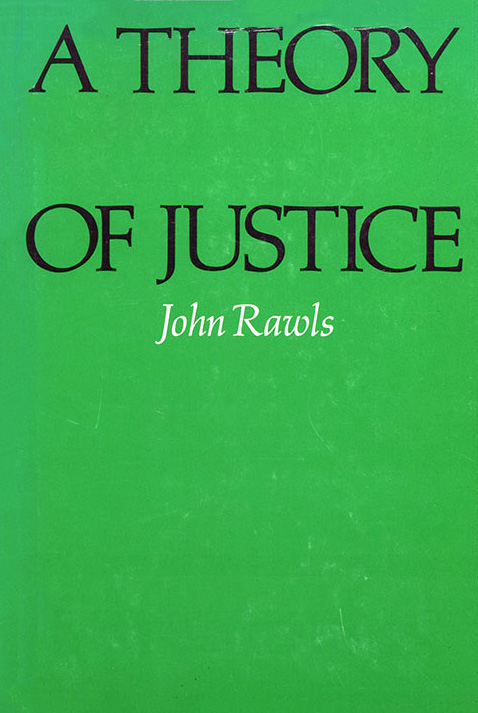 WorkAmericas1971
A Theory of Justice
Rawls's justice as fairness: the original position and the difference principle.
Read the full pageA Theory of Justice is a 1971 work of political philosophy and ethics by the philosopher John Rawls (1921–2002) in which the author attempts to provide a moral theory alternative to utilitarianism and that addresses the problem of distributive justice (the socially just distribution of goods in a society).
The theory uses an updated form of Kantian philosophy and a variant form of conventional social contract theory. Rawls's theory of justice is fully a political theory of justice as opposed to other forms of justice discussed in other disciplines and contexts.
The resultant theory was challenged and refined several times in the decades following its original publication in 1971. A significant reappraisal was published in the 1985 essay "Justice as Fairness" and the 2001 book Justice as Fairness: A Restatement in which Rawls further developed his two central principles for his discussion of justice. Together, they assert that society should be structured to provide the greatest possible degree of liberty to its members, limited only by the principle that one individual's liberty must not infringe upon the liberty of others. Secondly, inequalities – either social or economic – are only to be allowed if the worst off will be better off than they might be under an equal distribution. Finally, if an inequality is to be justified on the grounds of its benefits, it must not create additional barriers for those without resources to access positions of power, such as public office.
- 4
 PhilosopherAmericas1938 – 2002
Robert Nozick
Libertarian critic of Rawls and inventor of the experience machine.
- ◆Utility monster
- ◆experience machine
- ◆entitlement theory
- ◆justice
- ◆night-watchman state
- ◆Lockean proviso
Read the full pageRobert Nozick (; November 16, 1938 – January 23, 2002) was an American philosopher. He held the Joseph Pellegrino University Professorship at Harvard University, and was president of the American Philosophical Association. He is best known for his book Anarchy, State, and Utopia (1974), a libertarian answer to John Rawls' A Theory of Justice (1971), in which Nozick proposes his minimal state as the only justifiable form of government. His later work Philosophical Explanations (1981) advanced notable epistemological claims, namely his counterfactual theory of knowledge. It won Phi Beta Kappa society's Ralph Waldo Emerson Award the following year.
Nozick's other work involved ethics, decision theory, philosophy of mind, metaphysics and epistemology. His final work before his death, Invariances (2001), introduced his theory of evolutionary cosmology, by which he argues invariances, and hence objectivity itself, emerged through evolution across possible worlds.
Nozick was born in Brooklyn to a family of Jewish descent. His mother was born Sophie Cohen; his father, also born with the name Cohen, came from a Russian shtetl and ran a small business.
- 5ArgumentAmericas
Experience machine
Would you plug into a machine that gives you any experiences you want for life? If not, pleasure is not all that matters.
Read the full pageThe experience machine or pleasure machine is a thought experiment put forward by philosopher Robert Nozick in his 1974 book Anarchy, State, and Utopia. It is an attempt to refute ethical hedonism by imagining a choice between everyday reality and an apparently preferable simulated reality.
A primary thesis of hedonism is that "pleasure is the only good", which leads to the argument that any component of life that is not pleasurable does nothing directly to increase one's well-being. This is a view held by many value theorists, but most famously by some classical utilitarians. Nozick attacks the thesis by means of a thought experiment. If he can show that there is something other than pleasure that has value and thereby increases well-being, then hedonism is refuted.
Nozick describes a machine that could provide whatever desirable or pleasurable experiences a subject could want. In this thought experiment, psychologists have figured out a way to stimulate a person's brain to induce pleasurable experiences that the subject could not distinguish from those they would have apart from the machine. He then asks, if given the choice, would the subject prefer the machine to real life?
- 6PhilosopherModern European1919 – 2001
G. E. M. Anscombe
Revived virtue ethics and coined "consequentialism"; Wittgenstein's translator.
- ◆Acting under a description
- ◆Brute fact
- ◆consequentialism
- ◆Direction of fit
- ◆virtue ethics
Read the full pageGertrude Elizabeth Margaret Anscombe (; 18 March 1919 – 5 January 2001), usually cited as G. E. M. Anscombe or Elizabeth Anscombe, was a British analytic philosopher. She wrote on the philosophy of mind, philosophy of action, philosophical logic, philosophy of language, and ethics. She was a prominent figure of analytical Thomism, a fellow of Somerville College, Oxford, and a professor of philosophy at the University of Cambridge.
Anscombe was a student of Ludwig Wittgenstein and became an authority on his work and edited and translated many books drawn from his writings, above all his Philosophical Investigations. Anscombe's 1958 article "Modern Moral Philosophy" introduced the term consequentialism into the language of analytic philosophy, and had a seminal influence on contemporary virtue ethics. Her monograph Intention (1957) was described by Donald Davidson as "the most important treatment of action since Aristotle". It is "widely considered a foundational text in contemporary philosophy of action" and has also had influence in the philosophy of practical reason."
Anscombe was born to Captain Allen Wells Anscombe and Gertrude Elizabeth (née Thomas) on 18 March 1919 in Limerick, Ireland, where her father had been stationed with the Royal Welch Fusiliers during the Irish War of Independence. Both her mother and father were involved with education. Her mother was a headmistress and her father headed the science and engineering side at Dulwich College.
- 7
- ◆Trolley problem
- ◆virtue ethics
- ◆non-cognitivism
Read the full pagePhilippa Ruth Foot (née Bosanquet; 3 October 1920 – 3 October 2010) was an English philosopher and one of the founders of contemporary virtue ethics. Her work was inspired by Aristotelian ethics. Along with Judith Jarvis Thomson, she is credited with inventing the trolley problem.
Born Philippa Ruth Bosanquet in Owston Ferry, North Lincolnshire, she was the daughter of Esther Cleveland (1893–1980) and Captain William Sidney Bence Bosanquet (1893–1966) of the Coldstream Guards of the British Army. Her paternal grandfather was barrister and judge Sir Frederick Albert Bosanquet, Common Serjeant of London from 1900 to 1917. Her maternal grandfather was the 22nd and 24th President of the United States, Grover Cleveland.
Foot was educated privately and at Somerville College, Oxford, 1939–1942, where she attained a first-class degree in philosophy, politics, and economics.
- 8
 ArgumentModern European
Trolley problem
Would you divert a runaway trolley to kill one person instead of five? Would you push someone off a bridge to do it?
P1Five will die unless the trolley is diverted
P2Diverting it kills one
∴If only outcomes matter, you should divert — and also push the man. If you won't push, something besides outcomes matters.
Read the full pageA runaway trolley is heading toward five people tied to the track. You can pull a lever to divert it onto a side track, where it will kill one person. Should you?
Most people say yes. But now imagine you are on a footbridge above the track. The only way to stop the trolley is to push a large stranger off the bridge into its path. Most people say no — even though the numbers are the same.
Philippa Foot introduced the case in 1967 to discuss abortion and the doctrine of double effect; Judith Jarvis Thomson developed the footbridge variant. The puzzle is to explain the difference. Is it the distinction between killing and letting die, between intending harm and foreseeing it, or between using a person as a means and merely redirecting a threat? The trolley problem now shapes debates about self-driving cars and AI.
- 9
 PhilosopherAmericasborn 1946
Peter Singer
Utilitarian ethicist of animal liberation and effective altruism.
- ◆Equal consideration of interests
- ◆Speciesism
- ◆Drowning child analogy
- ◆Effective altruism
- ◆Argument from marginal cases
- ◆Personism
Read the full pagePeter Albert David Singer (born 6 July 1946) is an Australian moral philosopher who is Emeritus Ira W. DeCamp Professor of Bioethics at Princeton University. Singer's work specialises in applied ethics, approaching the subject from a secular, utilitarian perspective. His book Animal Liberation (1975) criticized intensive animal farming and speciesism, and shaped the animal rights movement. His essay "Famine, Affluence, and Morality" argues for the moral imperative of donating to help the global poor, using the drowning child analogy. For most of his career he was a preference utilitarian. He revealed in The Point of View of the Universe (2014), co-authored with Katarzyna de Lazari-Radek, that he had become a hedonistic utilitarian. His books The Life You Can Save (2009) and The Most Good You Can Do (2015) are influential in the effective altruism movement.
On two occasions, Singer served as chair of the philosophy department at Monash University, where he founded its Centre for Human Bioethics. In 1996, he stood unsuccessfully as a Greens candidate for the Australian Senate. In 2004, Singer was recognised as the Australian Humanist of the Year by the Council of Australian Humanist Societies. In 2005 The Sydney Morning Herald placed him among Australia's ten most influential public intellectuals. Singer is a co-founder of Animals Australia and the founder of the non-profit organisation The Life You Can Save.
Peter Albert David Singer was born in Melbourne, Victoria, Australia, on 6 July 1946. His parents were Austrian Jews who immigrated to Australia from Vienna after Austria's annexation (Anschluss) by Nazi Germany in 1938, and settled in Melbourne. His paternal grandparents were taken by the Nazis to Łódź, and were most likely murdered, since they were never heard from again. His maternal grandfather, the educator and psychologist David Ernst Oppenheim (1881–1943), was murdered in the Theresienstadt concentration camp. Oppenheim was a member of the Vienna Psychoanalytic Society and wrote a joint article with Sigmund Freud, before joining the Adlerian Society for Individual Psychology. Singer later wrote a biography of Oppenheim.
- 10
 ArgumentAmericas
Drowning child
If you would ruin your shoes to save a drowning child, why not give to save a distant child's life?
P1Suffering and death from lack of food and medicine are bad
P2If we can prevent something bad without sacrificing anything of comparable moral importance, we ought to
P3Distance makes no moral difference
∴Affluent people are obliged to give much more to effective causes than they do.
Read the full page"Famine, Affluence, and Morality" is an essay written by Peter Singer in 1971 and published in Philosophy & Public Affairs in 1972. It argues that affluent persons are morally obligated to donate far more resources to humanitarian causes than is considered normal in Western cultures. The essay was inspired by the starvation of Bangladesh Liberation War refugees, and uses their situation as an example, although Singer's argument is general in scope and not limited to the example of Bangladesh. The essay is anthologized widely as an example of Western ethical thinking.
One of the core arguments of this essay is that, if one can use one's wealth to reduce suffering—for example, by aiding famine-relief efforts—without any significant reduction in the well-being of oneself or others, it is immoral not to do so. Singer raises a drowning child analogy in his essay: inaction is clearly immoral if a child is drowning in a shallow pond and someone can save them but chooses not to. If saving the child would mean "getting my clothes muddy", this is not of "comparable moral importance", as the death of the child would "presumably be a very bad thing". He argues further that placing greater geographical distance between the person in need and the potential helper does not reduce the latter's moral obligations:
It makes no moral difference whether the person I can help is a neighbor's child ten yards away from me or a Bengali whose name I shall never know, ten thousand miles away. ... The moral point of view requires us to look beyond the interests of our own society. Previously, ... this may hardly have been feasible, but it is quite feasible now. From the moral point of view, the prevention of the starvation of millions of people outside our society must be considered at least as pressing as the upholding of property norms within our society.
- 11
 PhilosopherAmericasborn 1947
Martha Nussbaum
Philosopher of the capabilities approach, emotions and Greek ethics.
- ◆Capabilities approach
- ◆Emotions as judgements of value
Read the full pageMartha C. Nussbaum (; née Craven; born May 6, 1947) is an American philosopher and the Ernst Freund Distinguished Service Professor of Law and Ethics at the University of Chicago, where she is jointly appointed in the law school and the philosophy department.
Nussbaum's work has concerned ancient Greek and Roman philosophy, political philosophy, existentialism, feminism, and ethics, such as animal rights. She holds associate appointments in classics, divinity, and political science, and is a member of the Committee on Southern Asian Studies and a board member of the Human Rights Program. She previously taught at Harvard and Brown.
Nussbaum has written more than two dozen books, including The Fragility of Goodness (1986). She received the 2016 Kyoto Prize in Arts and Philosophy, the 2018 Berggruen Prize, and the 2021 Holberg Prize. In the early 2020s, she was considered a candidate for the Nobel Prize in Literature.
- 12
 PhilosopherAmericasborn 1937
Thomas Nagel
Asked "What is it like to be a bat?" — the subjective character of consciousness.
- ◆Panpsychism
- ◆subjective character of experience
Read the full pageThomas Nagel (; born July 4, 1937) is an American philosopher. He is a professor of philosophy, a professor of law, and University Professor of Philosophy and Law Emeritus at New York University. From 2001 to 2003, he was the Fiorello LaGuardia Professor of Law at the New York University School of Law. His main areas of philosophical interest are political philosophy, ethics, and philosophy of mind.
After earning his doctorate from Harvard University under John Rawls, Nagel was a professor of philosophy at the University of California, Berkeley, from 1963 to 1966 and a professor at Princeton University from 1966 to 1980. In 1967, he and Robert Nozick co-founded an influential group of philosophers known as the Society for Ethical and Legal Philosophy. In the 1970s, Nagel also co-founded the philosophy journal Philosophy & Public Affairs.
Nagel is known for his critique of material reductionist accounts of the mind, particularly in his essay "What Is It Like to Be a Bat?" (1974), and for his contributions to liberal moral and political theory in The Possibility of Altruism (1970) and subsequent writings. He continued the critique of reductionism in Mind and Cosmos (2012), in which he argues against the neo-Darwinian view of the emergence of consciousness.
- 13
 ArgumentAmericas
What Is It Like to Be a Bat?
Nagel's argument that the subjective character of experience escapes objective physical description.
Read the full page"What Is It Like to Be a Bat?" is a paper by American philosopher Thomas Nagel, first published in The Philosophical Review in October 1974, and later in Nagel's Mortal Questions (1979). The paper presents several difficulties posed by phenomenal consciousness, including the potential insolubility of the mind–body problem owing to "facts beyond the reach of human concepts", the limits of objectivity and reductionism, the "phenomenological features" of subjective experience, the limits of human imagination, and what it means to be a particular, conscious thing.
Nagel asserts that "an organism has conscious mental states if and only if there is something that it is like to be that organism—something it is like for the organism." This assertion has achieved special status in consciousness studies as "the standard 'what it's like' locution". Daniel Dennett, while sharply disagreeing on some points, acknowledged Nagel's paper as "the most widely cited and influential thought experiment about consciousness".
Nagel challenges the possibility of explaining "the most important and characteristic feature of conscious mental phenomena" by reductive materialism (the philosophical position that all statements about the mind and mental states can be translated, without any loss or change in meaning, into statements about the physical). For example, a reductive physicalist's solution to the mind–body problem holds that whatever "consciousness" is, it can be fully described via physical processes in the brain and body.
- 14
 PhilosopherAmericasborn 1943
Frank Jackson
Australian philosopher behind the "Mary's Room" knowledge argument.
- ◆Mary's room
Read the full pageFrank Cameron Jackson (born 31 August 1943) is an Australian analytic philosopher and Emeritus Professor in the School of Philosophy (Research School of Social Sciences) at Australian National University (ANU) where he had spent most of the latter part of his career. His primary research interests include epistemology, metaphysics, meta-ethics and the philosophy of mind. In the latter field he is best known for the "Mary's room" knowledge argument, a thought experiment that is one of the most discussed challenges to physicalism.
Frank Cameron Jackson was born on 31 August 1943 in Melbourne, Australia. His parents were both philosophers. His mother Ann E. Jackson, who rose to the rank of senior tutor, taught philosophy at the University of Melbourne from 1961 to 1984. His atheistic father Allan Cameron Jackson (1911–1990) had been a student of Ludwig Wittgenstein (having gone to Cambridge in 1946 for Ph.D. studies). F. C. Jackson, in interview with Graham Oppy, reports of his parents that; they were both "philosophers in the Old School, by which I mean the Wittgensteinian School. Philosophy was part of your life."
Despite his self-reported enjoyment of the philosophical conversation of his household it was with view to becoming a mathematician that Jackson went to the University of Melbourne to study maths and science. And it was only in his final year of those studies that he chose to also take some philosophy which he found he better enjoyed and proved significantly more able. He passed his B.Sc. but went on to achieve Honours in a B.A. whose main subject was philosophy. During his time at Melbourne he was a resident at Trinity College, a Clarke Scholar, and a member of the 2nd XVIII football team.
- 15
 ArgumentAmericas
Mary's Room
A scientist who knows all physical facts about colour sees red for the first time — does she learn something new?
P1Mary knows every physical fact about colour vision
P2On seeing red for the first time, she learns something new
∴Not all facts are physical facts — physicalism is false.
Read the full pageIn philosophy of mind, the knowledge argument (also known as Mary's Room, Mary the Colour Scientist, or Mary the super-scientist) is a thought experiment proposed by Frank Jackson in his article "Epiphenomenal Qualia" (1982), and extended in "What Mary Didn't Know" (1986).
The thought experiment describes Mary, a scientist who exists in a black-and-white world where she has extensive access to physical descriptions of color, but no actual perceptual experience of color. Mary has learned everything there is to learn about color, but she has never actually experienced it for herself. The central question of the thought experiment is whether Mary will gain new knowledge when she goes outside the colorless world and experiences seeing in color.
The thought experiment is intended to argue against physicalism—the view that the universe, including all that is mental, is entirely physical. Jackson says that the "irresistible conclusion" is that "there are more properties than physicalists talk about". Jackson would eventually call himself a physicalist and say, in 2023, "I no longer accept the argument" though he feels that the argument should be "addressed really seriously if you are a physicalist".
- 16
 PhilosopherAmericas1932 – 2025
John Searle
Philosopher of mind and language; author of the Chinese Room argument.
- ◆Indirect speech acts
- ◆Chinese room
- ◆Biological naturalism
- ◆Direction of fit
Read the full pageJohn Rogers Searle ( ; July 31, 1932 – September 17, 2025) was an American philosopher widely noted for contributions to the philosophy of language, philosophy of mind, and social philosophy. He was the Willis S. and Marion Slusser Professor of the Philosophy of Mind and Language at the University of California, Berkeley, until 2019. He was relieved of his position after disciplinary proceedings found he had violated the university's sexual harassment policies.
Searle's early work on speech acts, influenced by J. L. Austin and Ludwig Wittgenstein, helped establish his reputation. His most famous philosophical contribution is the "Chinese room" argument, which attempts to refute the possibility of "strong" artificial intelligence.
Searle was born in Denver on July 31, 1932. His father, G. W. Searle, an electrical engineer, was employed by AT&T Corporation; his mother, Hester Beck Searle, was a physician.
- 17ArgumentAmericas
Chinese Room
A person following rules to manipulate Chinese symbols seems to understand Chinese but does not — so can a computer?
P1Programs are purely syntactic (formal symbol manipulation)
P2Minds have semantics (meaning)
P3Syntax by itself is not sufficient for semantics
∴Running a program is not sufficient for having a mind.
Read the full pageThe Chinese room argument holds that a computer executing a program cannot have a mind, understanding, or consciousness, regardless of how intelligently or human-like the program may make the computer behave. The argument was presented in a 1980 paper by the American philosopher John Searle, entitled "Minds, Brains, and Programs" and published in the journal Behavioral and Brain Sciences. Precursor arguments had been made by Gottfried Wilhelm Leibniz, Peter Winch, Anatoly Dneprov, et al.; Searle's version has been widely discussed in the years since.
The centerpiece of Searle's argument is the "Chinese room" thought experiment. Searle supposes a computer program which receives and outputs Chinese characters, carrying out instructions so perfectly that humans cannot distinguish it from a Chinese-speaking person. Searle then supposes he is in a room, receiving Chinese characters slipped under the door. He follows an English version of the computer program step-by-step, which instructs him to return output Chinese characters. Searle argues that as he would not understand the conversation, and there is no essential difference between his role and the computer's, that a computer is not capable of understanding.
The argument is directed against the philosophical positions of functionalism and computationalism, which hold that the mind may be viewed as an information-processing system operating on formal symbols, and that simulation of a given mental state is sufficient for its presence. Specifically, the argument is intended to refute a position Searle calls the strong AI hypothesis: "The appropriately programmed computer with the right inputs and outputs would thereby have a mind in exactly the same sense human beings have minds."
- ◆Hard problem of consciousness
- ◆extended mind
- ◆two-dimensional semantics
- ◆naturalistic dualism
- ◆philosophical zombie
- ◆further facts
Read the full pageDavid John Chalmers ( CHAH-mərz; born 20 April 1966) is an Australian philosopher and cognitive scientist, specializing in philosophy of mind and philosophy of language. He is a professor of philosophy and neural science at New York University (NYU), as well as co-director of NYU's Center for Mind, Brain and Consciousness (along with Ned Block). In 2006, he was elected a fellow of the Australian Academy of the Humanities. In 2013, he was elected as a fellow of the American Academy of Arts and Sciences.
Chalmers is best known for formulating the hard problem of consciousness, and for popularizing the philosophical zombie thought experiment.
Chalmers and David Bourget co-founded PhilPapers; a database of journal articles for philosophers.
- 19
 ConceptAmericas
Hard problem of consciousness
Why is there something it is like to have a brain at all — why does physical processing feel like anything?
Read the full pageIn philosophy of mind, the hard problem of consciousness (or simply the hard problem) is to explain how and why organisms have qualia, phenomenal consciousness, or subjective experience. It is contrasted with the "easy problems" of explaining why and how physical systems give rise to the ability to discriminate, to integrate information, and to perform behavioural functions such as watching, listening, speaking (including generating an utterance that appears to refer to personal behaviour or belief), and so forth. The easy problems are amenable to functional explanation—that is, explanations that are mechanistic or behavioural—since each physical system can be explained purely by reference to the "structure and dynamics" that underpin the phenomenon.
Proponents of the hard problem hold that it is categorically different from the easy problems since no mechanistic or behavioural explanation could explain the character of an experience, not even in principle. Even after all the relevant functional facts are explicated, they argue, there will still remain a further question: "Why is the performance of these functions accompanied by experience?" To bolster their case, proponents of the hard problem frequently turn to various philosophical thought experiments, involving philosophical zombies, or inverted qualia, or the ineffability of colour experiences, or the unknowability of foreign states of consciousness, such as the experience of being a bat.
The terms "hard problem" and "easy problems" were coined by the philosopher David Chalmers in a 1994 talk given at The Science of Consciousness conference held in Tucson, Arizona. The following year, the main talking points of Chalmers' talk were published in The Journal of Consciousness Studies. The publication gained significant attention from consciousness researchers and became the subject of a special volume of the journal, which was later published as a book. In 1996, Chalmers published The Conscious Mind, a book-length treatment of the hard problem, in which he elaborated on his core arguments and responded to counterarguments. His use of the word easy is "tongue-in-cheek". As the cognitive psychologist Steven Pinker puts it, they are about as easy as going to Mars or curing cancer. "That is, scientists more or less know what to look for, and with enough brainpower and funding, they would probably crack it in this century."
- 20ArgumentAmericas
Philosophical zombie
A being physically identical to you but with no inner experience. If conceivable, consciousness is not physical.
Read the full pageIn philosophy of mind, a philosophical zombie (or "p-zombie") is a being in a thought experiment that is physically identical to a normal human being but has no phenomenal experience. For example, if a philosophical zombie were poked with a sharp object, it would feel no pain, but would react just as a conscious human would. In other words, the being has full access consciousness but no phenomenal consciousness. Said being would be a human equivalent of an animal machine known from Cartesian philosophy. The philosophical zombie is used in thought experiments about whether consciousness can be completely explained by facts about the brain and body. The philosophical zombies are also a subject of the NPC theory, according to which some people lack true consciousness (the name of the hypothesis refers to non-playable characters in video games).
Philosophical zombie arguments are used against forms of physicalism and in defense of the hard problem of consciousness, which is the problem of accounting in physical terms for subjective, intrinsic, first-person, what-it's-like-ness experiences. Proponents of philosophical zombie arguments, such as the philosopher David Chalmers, argue that since a philosophical zombie is by definition physically identical to a conscious person, even its logical possibility refutes physicalism. This is because it establishes the existence of conscious experience as a further fact. Philosopher Daniel Stoljar points out that zombies need not be utterly without subjective states, and that even a subtle psychological difference between two hypothetically physically identical people, such as how coffee tastes to them, is enough to refute physicalism. Such arguments have been criticized by many philosophers. Some physicalists, such as Daniel Dennett, argue that philosophical zombies are logically incoherent and thus impossible, or that all humans are philosophical zombies; others, such as Christopher Hill, argue that philosophical zombies are coherent but metaphysically impossible.
Philosophical zombies are associated with David Chalmers, but it was philosopher Robert Kirk who first used the term "zombie" in this context, in 1974. Before that, Keith Campbell made a similar argument in his 1970 book Body and Mind, using the term "imitation man". Chalmers further developed and popularized the idea in his work.
- 21ArgumentAmericas
Gettier problem
Cases of justified true belief that are not knowledge, refuting the classical definition.
P1Smith justifiably believes Jones will get the job and has ten coins
P2So Smith believes "the man who gets the job has ten coins"
P3Unknown to him, Smith gets the job and has ten coins
∴Smith has a justified true belief that is not knowledge.
Read the full pageIn the field of epistemology, the Gettier problem is a landmark philosophical problem concerning the understanding of descriptive knowledge. Attributed to American philosopher Edmund Gettier, Gettier-type counterexamples (called "Gettier-cases") challenge the long-held notion of knowledge as justified true belief (JTB). The JTB account holds that knowledge is equivalent to justified true belief; if all three conditions (justification, truth, and belief) are met by a given claim, then there is knowledge of that claim. In his 1963 three-page paper titled "Is Justified True Belief Knowledge?", Gettier attempts to illustrate by means of two counterexamples that there are cases where individuals can have a justified true belief regarding a claim but still fail to know it because the reasons for the belief, while justified, turn out to be false. Thus, Gettier claims to have shown that the JTB account is inadequate because it does not account for all of the necessary and sufficient conditions for knowledge.
The terms "Gettier problem" and "Gettier case", and the adjective "Gettiered", are sometimes used to describe any case in the field of epistemology that purports to repudiate the JTB account of knowledge.
Responses to Gettier's paper have been numerous. Some reject Gettier's examples as inadequate justification, while others seek to adjust the JTB account of knowledge and blunt the force of these counterexamples. Gettier problems have even found their way into sociological experiments in which researchers have studied intuitive responses to Gettier cases from people of varying demographics.


