Great books: renaissance & early modern: Ethics to The Social Contract
- Read the full page
Ethics, Demonstrated in Geometrical Order (Latin: Ethica, ordine geometrico demonstrata) is a philosophical treatise written in Latin by Baruch Spinoza (Benedictus de Spinoza). It was written between 1661 and 1675 and was first published posthumously in 1677.
The Ethics is perhaps the most ambitious attempt to apply Euclid's method in philosophy, which was referred to as “more geometrico” which in Latin meant “in a geometrical manner”. Spinoza puts forward a small number of definitions and axioms from which he attempts to derive hundreds of propositions and corollaries, such as "when the Mind imagines its own lack of power, it is saddened by it", "a free man thinks of nothing less than of death", and "the human Mind cannot be absolutely destroyed with the Body, but something of it remains which is eternal."
- 2
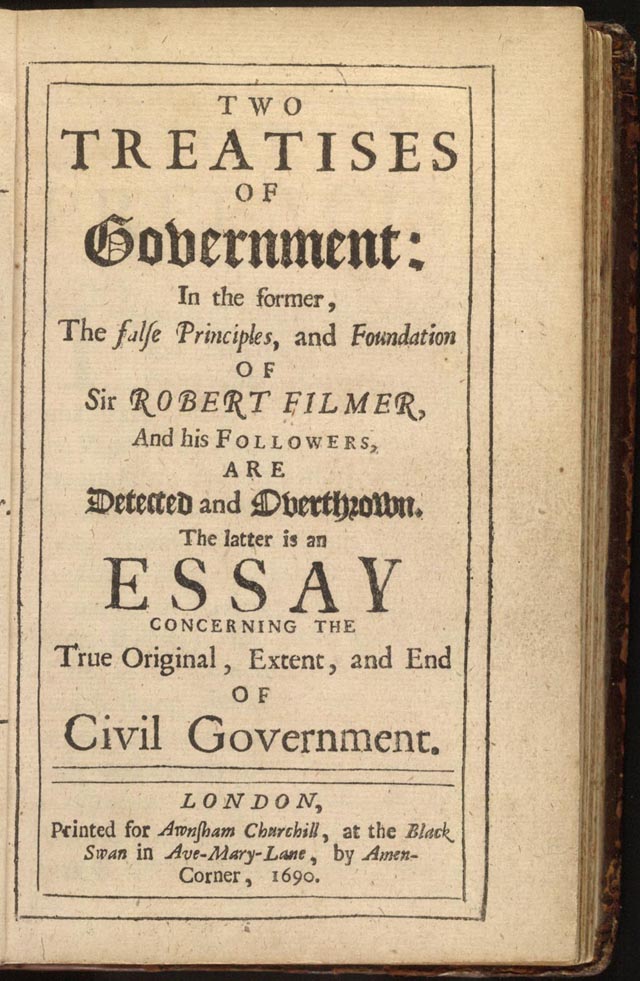 WorkModern European1689
Two Treatises of Government
Locke's theory of natural rights and government by consent.
Read the full pageTwo Treatises of Government (full title: Two Treatises of Government: In the Former, The False Principles, and Foundation of Sir Robert Filmer, and His Followers, Are Detected and Overthrown. The Latter Is an Essay Concerning The True Original, Extent, and End of Civil Government) is English philosopher John Locke's principal work of political philosophy. It was published anonymously in 1689, after the Glorious Revolution, but likely drafted 1680-81 during the Exclusion Crisis (1679–81). The First Treatise attacks patriarchalism in the form of sentence-by-sentence refutation of the late Robert Filmer's (c. 1588–1653) Patriarcha, which argues for a divinely ordained, hereditary, absolute monarchy, ideas which remained current with living defenders. The Second Treatise outlines Locke's ideas for a more civilized society based on natural rights and contract theory, with government requiring the consent of the governed, and, under limited circumstances, the right to overthrow the ruler. "There can be no doubt that the Second Treatise was, in its time and place, a revolutionary work." The book is a key foundational text in the theory of liberalism.
This publication contrasts with earlier political works by Locke himself. In Two Tracts on Government, written in 1660, Locke defends a conservative position; however, Locke never published this earlier work.
- 3
 WorkModern European1689
An Essay Concerning Human Understanding
Locke's empiricist account of the origin and limits of knowledge.
Read the full pageAn Essay Concerning Human Understanding is an essay by John Locke concerning the foundation of human knowledge and understanding. It first appeared in 1689 (although dated 1690) with the printed title An Essay Concerning Humane Understanding. He describes the mind at birth as a blank slate (tabula rasa, although he did not use those actual words) filled later through experience. The essay was one of the principal sources of empiricism in modern philosophy, and influenced many enlightenment philosophers, such as David Hume and George Berkeley.
Book I of the Essay is Locke's attempt to refute the rationalist notion of innate ideas. Book II sets out Locke's theory of ideas, including his distinction between passively acquired simple ideas—such as "red", "sweet", "round"—and actively built complex ideas, such as numbers, causes and effects, abstract ideas, ideas of substances, identity, and diversity. Locke also distinguishes between the truly existing primary qualities of bodies, like shape, motion and the arrangement of minute particles, and the secondary qualities that are "powers to produce various sensations in us" such as "red" and "sweet." These secondary qualities, Locke claims, are dependent on the primary qualities. He also offers a theory of personal identity, offering a largely psychological criterion. Book III is concerned with language, and Book IV with knowledge, including intuition, mathematics, moral philosophy, natural philosophy ("science"), faith, and opinion.
- 4
 WorkModern European1739
A Treatise of Human Nature
Hume's youthful masterpiece, which "fell dead-born from the press".
Read the full pageA Treatise of Human Nature: Being an Attempt to Introduce the Experimental Method of Reasoning into Moral Subjects (1739–40) is a book by Scottish philosopher David Hume, considered by many to be Hume's most important work and one of the most influential works in the history of philosophy. The book has appeared in many editions since the death of the author in 1776.
The Treatise is a classic statement of philosophical empiricism, scepticism, and naturalism. In the introduction Hume presents the idea of placing all science and philosophy on a novel foundation: namely, an empirical investigation into human nature. Impressed by Isaac Newton's achievements in the physical sciences, Hume sought to introduce the same experimental method of reasoning into the study of human psychology, with the aim of discovering the "extent and force of human understanding". Against the philosophical rationalists, Hume argues that the passions, rather than reason, cause human behaviour. He introduces the famous problem of induction, arguing that inductive reasoning and our beliefs regarding cause and effect cannot be justified by reason; instead, our faith in induction and causation is caused by mental habit and custom. Hume defends a sentimentalist account of morality, arguing that ethics is based on sentiment and the passions rather than reason, and famously declaring that "reason is, and ought only to be the slave of the passions." Hume also offers a sceptical theory of personal identity and a compatibilist account of free will.
- 5
 WorkModern European1748
An Enquiry Concerning Human Understanding
Hume's accessible restatement of his epistemology, including the problem of induction.
Read the full pageAn Enquiry Concerning Human Understanding is a book by the Scottish empiricist philosopher David Hume, published in English in 1748 under the title Philosophical Essays Concerning Human Understanding until a 1757 edition came up with the now-familiar name. It was a revision of an earlier effort, Hume's A Treatise of Human Nature, published anonymously in London in 1739–40. Hume was disappointed with the reception of the Treatise, which "fell dead-born from the press," as he put it, and so tried again to disseminate his more developed ideas to the public by writing a shorter and more polemical work.
The end product of his labours was the Enquiry. The Enquiry dispensed with much of the material from the Treatise, in favour of clarifying and emphasizing its most important aspects. For example, Hume's views on personal identity do not appear. However, more vital propositions, such as Hume's argument for the role of habit in a theory of knowledge, are retained.
- 6
 WorkModern European1759
Candide
Voltaire's satire of Leibnizian optimism: "the best of all possible worlds".
Read the full pageCandide, ou l'Optimisme ( kon-DEED or kahn-DEED, French: [kɑ̃did] ) is a French satire written by Voltaire, a philosopher of the Age of Enlightenment, first published in 1759. The novella has been widely translated, with English versions titled Candidus: or, All for the Best (1759); Candide: or, The Optimist (1762); and Candide: Optimism (1947). A young man, Candide, lives a sheltered life in an Edenic paradise, being indoctrinated with Leibnizian optimism by his mentor, Professor Pangloss. This lifestyle is abruptly ended, followed by Candide's slow and painful disillusionment as he witnesses and experiences great hardships in the world. Voltaire concludes Candide with, if not rejecting Leibnizian optimism outright, advocating a deeply practical precept, "we must cultivate our garden", in lieu of the Leibnizian mantra of Pangloss, "all is for the best" in the "best of all possible worlds".
Candide is characterized by its tone as well as its erratic, fantastical, and fast-moving plot. A picaresque novel with a story akin to a serious bildungsroman, it parodies many adventure and romance clichés, in a tone that is bitter and matter-of-fact. The events discussed are often based on historical happenings. As philosophers of Voltaire's day contended with the problem of evil, so does Candide, albeit more directly and humorously. Voltaire ridicules religion, theologians, governments, armies, philosophies, and philosophers. Through Candide, he assaults Leibniz and his optimism.
- Read the full page
The Social Contract, originally published as On the Social Contract; or, Principles of Political Right (French: Du contrat social; ou, Principes du droit politique), is a 1762 French-language book by the Genevan philosopher Jean-Jacques Rousseau. The book theorizes about how to establish legitimate authority in a political community, that is, one compatible with individual freedom, in the face of the problems of commercial society, which Rousseau had already identified in his Discourse on Inequality (1755).
The Social Contract helped inspire political reforms or revolutions in Europe, especially in France. The Social Contract argued against the idea that monarchs were divinely empowered to legislate. Rousseau asserts that only the general will of the people has the right to legislate, for only under the general will can the people be said to obey only themselves and hence be free. Although Rousseau's notion of the general will is subject to much interpretive controversy, it seems to involve a legislature consisting of all adult members of the political community who are restricted to legislating general laws for the common good.


