Great books: 19th century
- 1
 WorkModern European1781
Critique of Pure Reason
Kant's investigation of the limits of reason: how synthetic a priori knowledge is possible.
Read the full pageThe Critique of Pure Reason (German: Kritik der reinen Vernunft; 1781; second edition 1787) is a book by the German philosopher Immanuel Kant, in which he seeks to determine the limits and scope of metaphysics. Also referred to as Kant's "First Critique", it was followed by his Critique of Practical Reason (1788) and Critique of Judgment (1790). In the preface to the first edition, Kant explains that by a "critique of pure reason" he means a critique "of the faculty of reason in general, in respect of all knowledge after which it may strive independently of all experience" and that he aims to decide on "the possibility or impossibility of metaphysics".
Kant builds on the work of empiricist philosophers such as John Locke and David Hume, as well as rationalist philosophers such as René Descartes, Gottfried Wilhelm Leibniz and Christian Wolff. He expounds new ideas on the nature of space and time, and tries to provide solutions to Hume's skepticism about knowledge of the relation of cause and effect and Descartes's skepticism about knowledge of the external world. This is argued through the transcendental idealism of objects (as appearance) and their form of appearance. Kant regards the former "as mere representations and not as things in themselves", and the latter as "only sensible forms of our intuition, but not determinations given for themselves or conditions of objects as things in themselves". This grants the possibility of a priori knowledge, since objects as appearance "must conform to our cognition...which is to establish something about objects before they are given to us". Knowledge independent of experience Kant calls "a priori" knowledge, while knowledge obtained through experience is termed "a posteriori". According to Kant, a proposition is a priori if it is necessary and universal. A proposition is necessary if it is not false in any case and so cannot be rejected; rejection is contradiction. A proposition is universal if it is true in all cases, and so admits of no exceptions. Knowledge gained a posteriori through the senses, Kant argues, never imparts absolute necessity and universality, because we might encounter an exception.
- 2WorkModern European1785
Groundwork of the Metaphysics of Morals
Kant's short foundational work introducing the categorical imperative.
Read the full pageGroundwork of the Metaphysics of Morals (1785; German: Grundlegung zur Metaphysik der Sitten; also known as the Foundations of the Metaphysics of Morals, Grounding of the Metaphysics of Morals, and the Grounding for the Metaphysics of Morals) is the first of Immanuel Kant's mature works on moral philosophy and the first of his trilogy of major works on ethics alongside the Critique of Practical Reason and The Metaphysics of Morals. It remains one of the most influential in the field. Kant conceives his investigation as a work of foundational ethics—one that clears the ground for future research by explaining the core concepts and principles of moral theory, and showing that they are normative for rational agents.
Kant proposes to lay bare the fundamental principle of morality and show that it applies to us. Central to the work is the role of what Kant refers to as the categorical imperative, which states that one must act only according to maxims which one could will to become a universal law. Kant argues that the rightness of an action is determined by the principle that a person chooses to act upon. This stands in stark contrast to the moral sense theories and teleological moral theories that dominated moral philosophy at the time of Kant's career.
- 3
 WorkModern European1792
A Vindication of the Rights of Woman
Wollstonecraft's case for women's education and rational equality.
Read the full pageA Vindication of the Rights of Woman: with Strictures on Political and Moral Subjects is a 1792 essay by British philosopher and women's rights advocate Mary Wollstonecraft. It is considered a feminist or, more precisely, proto-feminist piece, and one of the pioneering works in the tradition now known as feminist philosophy.
In this essay, Wollstonecraft refutes those educational and political theorists of the eighteenth century who did not believe women should receive a full education. She argues that women ought to have an education commensurate with their position in society, claiming that women are essential to the nation because they educate its children and because they could be "companions" to their husbands, rather than mere wives. Instead of viewing women as ornaments to society or property to be traded in marriage, Wollstonecraft maintains that they are human beings deserving of the same fundamental rights as men. Wollstonecraft specifically calls for equality between the sexes in particular areas of life, especially moral responsibility and educational access. Uncertainty regarding whether she believed women should have full voting rights or other political rights make it difficult to classify Wollstonecraft definitively as a modern feminist; furthermore, the word feminist did not emerge until decades after her death.
- 4
 WorkModern European1807
Phenomenology of Spirit
Hegel's journey of consciousness to absolute knowing, including the master–slave dialectic.
Read the full pageThe Phenomenology of Spirit (German: Phänomenologie des Geistes) is an 1807 book by the German philosopher Georg Wilhelm Friedrich Hegel. It is Hegel's first major work and is considered one of the most important and difficult works of German idealism. The book describes a "biography of Spirit" in which consciousness develops from its most basic forms of sensory experience to the highest form of self-knowledge, which Hegel terms "absolute knowing". The book's central argument is that human beings achieve freedom through a process of retrospective self-understanding.
Originally intended as the introduction to Hegel's larger philosophical system, the Phenomenology grew into a substantial work in its own right. Its central purpose is to serve as a "ladder" that guides the reader from the standpoint of "natural consciousness" to the standpoint of philosophical science. In its extensive Preface, Hegel critiques prior philosophical methods—such as mathematical formalism and romantic intuitionism—arguing that truth is not a static proposition but a dynamic, self-developing whole. The book follows a dialectical method, tracing the journey of consciousness through a series of stages or "shapes of consciousness". Each stage is examined through a process of immanent critique, whereby consciousness discovers internal contradictions in its own view of the world, compelling it to move to a new, more sophisticated stage that attempts to resolve these contradictions. The narrative progresses through stages identified as Consciousness, Self-Consciousness, Reason, Spirit, Religion, and finally, Absolute Knowing.
- 5
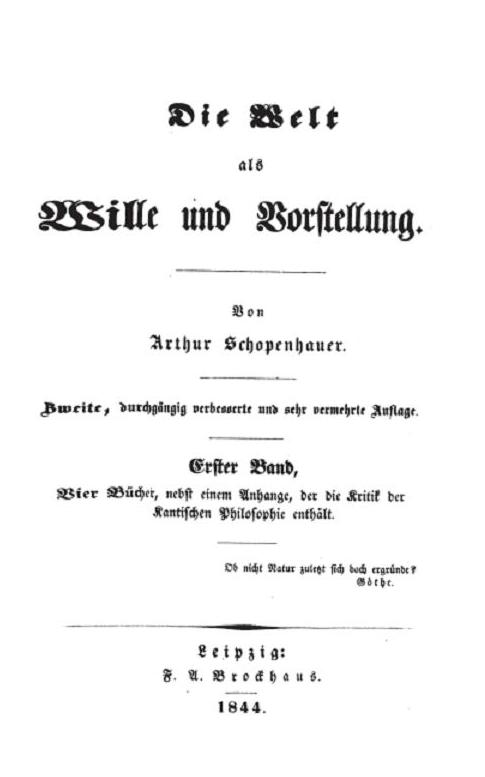 WorkModern European1818
The World as Will and Representation
Schopenhauer's pessimistic metaphysics of the Will.
Read the full pageThe World as Will and Representation (WWR; German: Die Welt als Wille und Vorstellung), sometimes translated as The World as Will and Idea, is the central work of the German philosopher Arthur Schopenhauer. The first edition was published in late 1818, with the date 1819 on the title page. A second, two-volume edition appeared in 1844: volume one was an edited version of the 1818 edition, while volume two consisted of commentary on the ideas expounded in volume one. A third expanded edition was published in 1859, the year before Schopenhauer's death. In 1948, an abridged version was edited by Thomas Mann.
In the summer of 1813, Schopenhauer submitted his doctoral dissertation—On the Fourfold Root of the Principle of Sufficient Reason—and was awarded a doctorate from the University of Jena. After spending the following winter in Weimar, he lived in Dresden and published his treatise On Vision and Colours in 1816. Schopenhauer spent the next several years working on his chief work, The World as Will and Representation. Schopenhauer asserted that the work is meant to convey a "single thought" from various perspectives. He develops his philosophy over four books covering epistemology, ontology, aesthetics, and ethics. Following these books is an appendix containing Schopenhauer's detailed Criticism of the Kantian Philosophy.
- Read the full page
Fear and Trembling (Danish: Frygt og Bæven) is a philosophical work by Søren Kierkegaard, published in 1843 under the pseudonym Johannes de silentio (Latin for John of the Silence). It is widely regarded as one of Kierkegaard's most influential texts and a foundational contribution to the philosophy of religion and existentialism.
The work is an extended meditation on Genesis 22, also known as the Binding of Isaac. Johannes de silentio examines the tension between ethical duty and faith through an analysis of Abraham's psychological state during his journey to Moriah. The text argues that it is impossible to understand Abraham's actions through the ethical framework of Hegel's philosophy. Rather, the actions can only be understood through a distinct category—faith.
- 7
 WorkModern European1848
The Communist Manifesto
"The history of all hitherto existing society is the history of class struggles."
Read the full pageThe Communist Manifesto, originally the Manifesto of the Communist Party, is a political pamphlet written by Karl Marx and Friedrich Engels. It was commissioned by the Communist League and published in London in 1848. The text represents the first and most systematic attempt by the two founders of scientific socialism to codify for wide consumption the historical materialist idea; namely, that "the history of all hitherto existing society is the history of class struggles", in which social classes are defined by the relationship of people to the means of production. Published amid the Revolutions of 1848 in Europe, the manifesto has become one of the world's most influential political documents. "A spectre is haunting Europe — the spectre of communism." and "Workers of the world, unite!" stand as two iconic lines that frame the text, marking its opening and its close, respectively, with the latter being reworked and popularized into a famous slogan of working-class solidarity.
In the Manifesto, Marx and Engels combine philosophical materialism with the Hegelian dialectical method in order to analyze the development of European society through its modes of production, including primitive communism, antiquity, feudalism, and capitalism, noting the emergence of a new, dominant class at each stage. The text outlines the relationship between the means of production, relations of production, forces of production, and mode of production, and posits that changes in society's economic "base" affect changes in its "superstructure". The authors assert that capitalism is marked by the exploitation of the proletariat (working class or wage labourers) by the ruling bourgeoisie, which is "constantly revolutionising the instruments [and] relations of production, and with them the whole relations of society". They argue that capital's need for a flexible labour force dissolves the old relations, and that its global expansion in search of new markets creates "a world after its own image".
- Read the full page
On Liberty is an essay written by the English philosophers Harriet Taylor Mill and John Stuart Mill and published in 1859 under the latter's name. It applied their ethical system of utilitarianism to society and state. The Mills suggested standards for the relationship between authority and liberty. They emphasized the importance of individuality, which they considered a prerequisite to the higher pleasures—the summum bonum of utilitarianism. Furthermore, the Mills asserted that democratic ideals may result in the tyranny of the majority. Among the standards proposed are the Mills' three basic liberties of individuals, their three legitimate objections to government intervention, and their two maxims regarding the relationship of the individual to society.
On Liberty was a greatly influential and well-received work. Some classical liberals and libertarians have criticized it for its apparent discontinuity with Utilitarianism, and vagueness in defining the arena within which individuals can contest government infringements on their personal freedom of action. The ideas presented in On Liberty have remained the basis of much political thought. It has remained in print since its initial publication.
- 9
 WorkModern European1861
Utilitarianism
Mill's defence of the greatest happiness principle with higher and lower pleasures.
Read the full pageUtilitarianism is a book written by English philosopher and economist John Stuart Mill, considered to be a classic exposition and defense of utilitarianism in ethics. It was originally published in 1861 as a series of three separate articles in Fraser's Magazine before it was collected and reprinted as a single work in 1863. The essay explains utilitarianism to its readers and addresses the numerous criticism against the theory during Mill's lifetime. It was heavily criticized upon publication; however, since then, Utilitarianism gained significant popularity and has been considered "the most influential philosophical articulation of a liberal humanistic morality that was produced in the nineteenth century."
Mill took many elements of his version of utilitarianism from Jeremy Bentham, the great nineteenth-century legal reformer and the propounder of utilitarianism, who along with William Paley were the two most influential English utilitarians prior to Mill. Like Bentham, Mill believed that happiness (or pleasure, which both Bentham and Mill equated with happiness) was the only thing humans do and should desire for its own sake. Since happiness is the only intrinsic good, and since more happiness is preferable to less, the goal of the ethical life is to maximize happiness. This is what Bentham and Mill call "the principle of utility" or "the greatest-happiness principle." Both Bentham and Mill thus endorse "classical" or "hedonistic" forms of utilitarianism.
- Read the full page
Capital: A Critique of Political Economy (German: Das Kapital. Kritik der politischen Ökonomie), also known as Das Kapital (German: [das kapiˈtaːl]), is a foundational text in Marxist theory by Karl Marx. His magnum opus, the work is a critical analysis of political economy, meant to reveal the economic patterns underpinning the capitalist mode of production. Capital is divided into three volumes, of which only the first was published during Marx's lifetime, in 1867; the others were completed from his manuscripts and published by his collaborator Friedrich Engels in 1885 and 1894.
The central argument of Capital is that the motivating force of capitalism is in the exploitation of labour, whose unpaid work is the ultimate source of surplus value and profit. Beginning with an analysis of the commodity, Marx argues that the capitalist mode of production is a historically specific system where social relations are mediated by commodity exchange. He posits a labour theory of value, contending that the economic value of a commodity is determined by the socially necessary labour time required for its production. Under this system, the worker's capacity to labour (their labour power) is sold as a commodity, but its use-value—the ability to create new value—is greater than its exchange-value (the wage), allowing the capitalist to extract surplus value. This process drives capital accumulation, which in turn fosters technological change, the creation of a reserve army of labour, and a long-term tendency of the rate of profit to fall, leading to economic crises and intensifying class conflict.


