Great books: medieval
- 1
 WorkMedieval Latin524
The Consolation of Philosophy
Lady Philosophy consoles the imprisoned Boethius on fortune, happiness and providence.
Read the full pageOn the Consolation of Philosophy (Latin: De consolatione philosophiae), often titled as The Consolation of Philosophy or simply the Consolation, is a philosophical work by the Roman philosopher and Christian theologian Boethius. Written in 523 while he was imprisoned and awaiting execution by the Ostrogothic King Theodoric, it is often described as the last great Western work of the Classical Period. Boethius's Consolation heavily influenced the philosophy of late antiquity, as well as Medieval and early Renaissance Christianity.
On the Consolation of Philosophy was written in AD 523 during a one-year imprisonment Boethius served while awaiting trial—and eventual execution—for the alleged crime of treason under the Ostrogothic King Theodoric the Great. Boethius was at the very heights of power in Rome, holding the prestigious office of magister officiorum, and was brought down by treachery. This experience inspired the text, which reflects on how evil can exist in a world governed by God (an example of theodicy), and how happiness is still attainable amidst fickle fortune, while also considering the nature of happiness and God. In 1891, the academic Hugh Fraser Stewart described the work as "by far the most interesting example of prison literature the world has ever seen."
- 2WorkIndianc. 720
Brahma Sūtra Bhāṣya
Śaṅkara's commentary on the Brahma Sūtras, the classic statement of Advaita.
Read the full pageThe Brahma Sūtras (Sanskrit: ब्रह्मसूत्राणि), also known as the Vedanta Sūtra (Sanskrit: वेदान्त सूत्र), or as Shariraka Sūtra, and Bhikshu-sūtra (latter two in monastic traditions), are a Sanskrit text which criticizes the metaphysical dualism of the influential Samkhya philosophy, and instead synthesizes and harmonizes divergent Upanishadic ideas and practices about the essence of existence, postulating Brahman as the only origin and essence of everything. The text is attributed to the sage Badarayana, who is also called Vyāsa (arranger), but is probably an accumulation of incremental additions and changes by various authors to an earlier work, completed in its surviving form in approximately 400–450 CE. The oldest version may have been composed between 500 BCE and 200 BCE, with 200 BCE being the most likely date.
The Brahma Sūtras consist of 555 aphoristic verses (sutras) in four chapters, dealing with attaining knowledge of Brahman. Rejecting the smriti as a base of knowledge, the text declares that the Vedic Upanishads are the only acceptable source of truth, presenting infallible revelations describing the same metaphysical reality, Brahman, which cannot be different for different people. The text attempts to synthesize and harmonize diverse and sometimes apparently conflicting vidyas ("knowledges") and upasanas (meditation, worship) concerning the essence of existence, stating that they are actually synonyms for Brahman. It does so from a bhedabheda perspective, arguing, as John Koller states: "that Brahman and Atman are, in some respects, different, but, at the deepest level, non-different (advaita), being identical."
- Read the full page
The Proslogion (Latin: Proslogium, lit. 'Discourse') is a prayer (or meditation) written by the medieval cleric Saint Anselm of Canterbury between 1077 and 1078. In each chapter, Anselm juxtaposes contrasting attributes of God to resolve apparent contradictions in Christian theology. This meditation is considered the first-known philosophical formulation that sets out an ontological argument for the existence of God.
The original title for this discourse was to be Faith Seeking Understanding.
- 4WorkIslamic1095
The Incoherence of the Philosophers
Al-Ghazālī's attack on twenty theses of the Aristotelian philosophers.
Read the full pageThe Incoherence of the Philosophers (Arabic: تهافت الفلاسفة, romanized: Tahāfut al-Falāsifa) is a landmark 11th-century work by the Muslim polymath al-Ghazali, a student of the Asharite school of Islamic theology, criticizing the Avicennian school of early Islamic philosophy. Muslim philosophers such as Ibn Sina (Avicenna) and al-Farabi (Alpharabius) are denounced in this book, as they follow Greek philosophy even when, in the author's perception, it contradicts Islam. The text was dramatically successful, and marked a milestone in the ascendance of the Asharite school within Islamic philosophy and theological discourse.
The book favors faith over philosophy in matters specifically concerning metaphysics or knowledge of the divine.
- Read the full page
The Incoherence of the Incoherence (Arabic: تهافت التهافت Tahāfut al-Tahāfut) by Andalusian Muslim polymath and philosopher Ibn Rushd (Arabic: ابن رشد, romanized: Ibn Rushd, 1126–1198) is an important Islamic philosophical treatise in which the author defends the use of Aristotelian philosophy within Islamic thought.
It was written in the style of a dialogue against al-Ghazali's claims in The Incoherence of the Philosophers (Tahāfut al-Falasifa), which criticized Neoplatonic thought.
- 6
 WorkJewish1190
The Guide for the Perplexed
Maimonides reconciles the Torah with Aristotelian philosophy.
Read the full pageThe Guide for the Perplexed (Judeo-Arabic: דלאלת אלחאירין, romanized: Dalālat al-ḥā'irīn; Arabic: دلالة الحائرين, romanized: Dalālat al-ḥā'irīn; Hebrew: מורה הנבוכים, romanized: Moreh HaNevukhim) is a 12th-century work of Jewish theology by Maimonides. It seeks to reconcile Aristotelianism with Rabbinical Jewish theology by finding rational explanations for many events in the text. It was written in Judeo-Arabic, a dialect of Classical Arabic using the Hebrew alphabet. It was sent originally, part after part, to his student, Rabbi Joseph ben Judah of Ceuta, the son of Rabbi Judah, and is the main source of Maimonides' philosophical views, as opposed to his opinions on Jewish law.
Since many of the philosophical concepts, such as his view of theodicy and the relationship between philosophy and religion, are relevant beyond Judaism, it has been the work most commonly associated with Maimonides in the non-Jewish world and it is known to have influenced several major non-Jewish philosophers. Following its publication, "almost every philosophic work for the remainder of the Middle Ages cited, commented on, or criticized Maimonides' views." Within Judaism, the Guide became widely popular, with many Jewish communities requesting copies of the manuscript, but also quite controversial, with some communities limiting its study or banning it altogether.
- 7
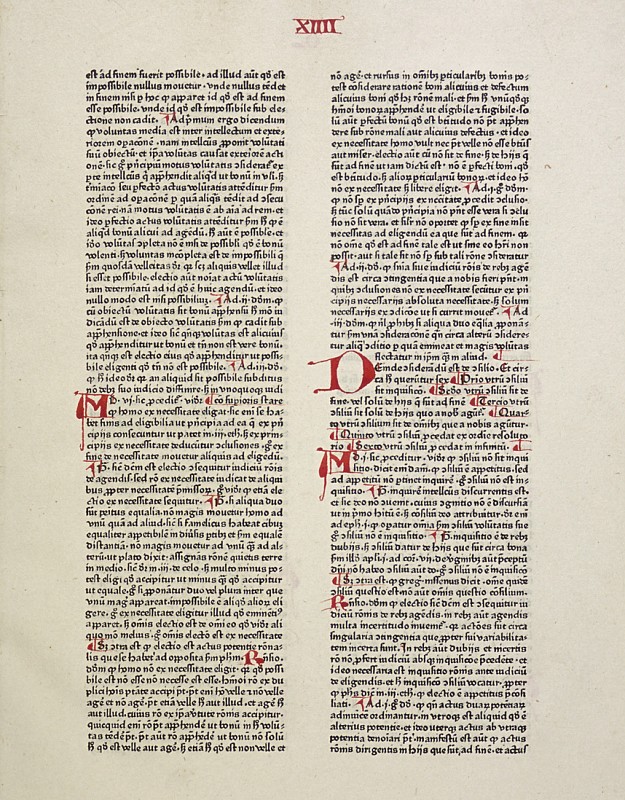 WorkMedieval Latin1265 – 1274
Summa Theologiae
Aquinas's unfinished masterpiece of systematic theology and philosophy, home of the Five Ways.
Read the full pageThe Summa Theologiae or Summa Theologica (transl. 'Summary of Theology'), often referred to simply as the Summa, is the best-known work of Thomas Aquinas (1225–1274), a scholastic theologian and Doctor of the Church. It is a compendium of all of the main theological teachings of the Catholic Church. Presenting the reasoning for almost all points of Christian theology in the West, topics of the Summa follow the following cycle: God; Creation, Man; Man's purpose; Christ; the Sacraments; and back to God.
Although unfinished, it is "one of the classics of the history of philosophy and one of the most influential works of Western literature". It remains Aquinas's "most perfect work, the fruit of his mature years, in which the thought of his whole life is condensed".
- Read the full page
The Masnavi is an extensive Persian masnavi (a poetic form) written by Rumi, and one of the most influential works in the history of Sufism. It is a series of six books of poetry that together amount to around 25,000 verses or 50,000 lines.
Sometimes described as being like a "Quran in Persian", some Muslims regard the Masnavi as one of the most important works of Islamic literature, falling behind only the Quran. It has been viewed by many commentators as the greatest mystical poem in world literature.
- 9
 WorkIslamic1377
Muqaddimah
Ibn Khaldūn's introduction to history: cycles of civilisation and social cohesion.
Read the full pageThe Muqaddimah (Arabic: مقدّمة meaning "the introduction" or "the prologomenon") is a 14th-century Arabic treatise on historiography, sociology, and the philosophy of history written by Ibn Khaldun. Some modern thinkers view it as the first work dealing with the social sciences of sociology, demography, and cultural history. The Muqaddimah also deals with Islamic theology, historiography, the philosophy of history, economics, political theory, and ecology.
Ibn Khaldun wrote the work in 1377 as the introduction and the first book of his planned work of world history, the Kitab al-ʿIbar ("Book of Lessons"; full title: Kitābu l-ʻibari wa Dīwāni l-Mubtada' wal-Ḥabar fī ayāmi l-ʻarab wal-ʿajam wal-barbar, waman ʻĀsarahum min Dhawī sh-Shalṭāni l-Akbār, i.e.: "Book of Lessons, Record of Beginnings and Events in the history of the Arabs and Foreigners and Berbers and their Powerful Contemporaries"), but already in his lifetime it became regarded as an independent work on its own.


