Great books: early 20th century
- 1
 WorkModern European1883
Thus Spoke Zarathustra
Nietzsche's philosophical novel of the Übermensch and eternal recurrence.
Read the full pageThus Spoke Zarathustra: A Book for All and None (German: Also sprach Zarathustra: Ein Buch für Alle und Keinen), also translated as Thus Spake Zarathustra, is a work of philosophical fiction written by German philosopher Friedrich Nietzsche and published in four volumes between 1883 and 1885. The protagonist is nominally the historical Zarathustra, more commonly called Zoroaster in the West.
Much of the book consists of discourses by Zarathustra on a wide variety of subjects, most of which end with the refrain "thus spoke Zarathustra." The character of Zarathustra first appeared in Nietzsche's earlier book The Gay Science (at §342, which closely resembles §1 of "Zarathustra's Prologue" in Thus Spoke Zarathustra).
- Read the full page
Beyond Good and Evil: Prelude to a Philosophy of the Future (German: Jenseits von Gut und Böse: Vorspiel einer Philosophie der Zukunft) is a book by philosopher Friedrich Nietzsche that covers ideas in his previous work Thus Spoke Zarathustra but with a more polemical approach. It was first published in 1886 under the publishing house C. G. Naumann of Leipzig at the author's own expense and first translated into English by Helen Zimmern, who was two years younger than Nietzsche and knew the author.
According to translator Walter Kaufman, the title refers to the need for moral philosophy to go beyond simplistic black and white moralizing, as contained in statements such as "X is good" or "X is evil". At the beginning of the book (§ 2), Nietzsche attacks the very idea of using strictly opposite terms such as "Good versus Evil".
- 3
 WorkModern European1887
On the Genealogy of Morality
Three essays on the origins of moral values: master and slave morality, guilt, ascetic ideals.
Read the full pageOn the Genealogy of Morality: A Polemic (German: Zur Genealogie der Moral: Eine Streitschrift; sometimes translated as On the Genealogy of Morals) is an 1887 book by the German philosopher Friedrich Nietzsche. It consists of a preface and three interrelated treatises ('Abhandlungen' in German) that expand and follow through on concepts that Nietzsche outlined in Beyond Good and Evil (1886). The three treatises trace episodes in the evolution of moral concepts confronting the "moral prejudices" of Christian morality.
Some Nietzschean scholars consider Genealogy to be a work of sustained brilliance and power as well as his masterpiece. Since its publication, it has influenced many authors and philosophers.
- 4
 WorkModern European1921
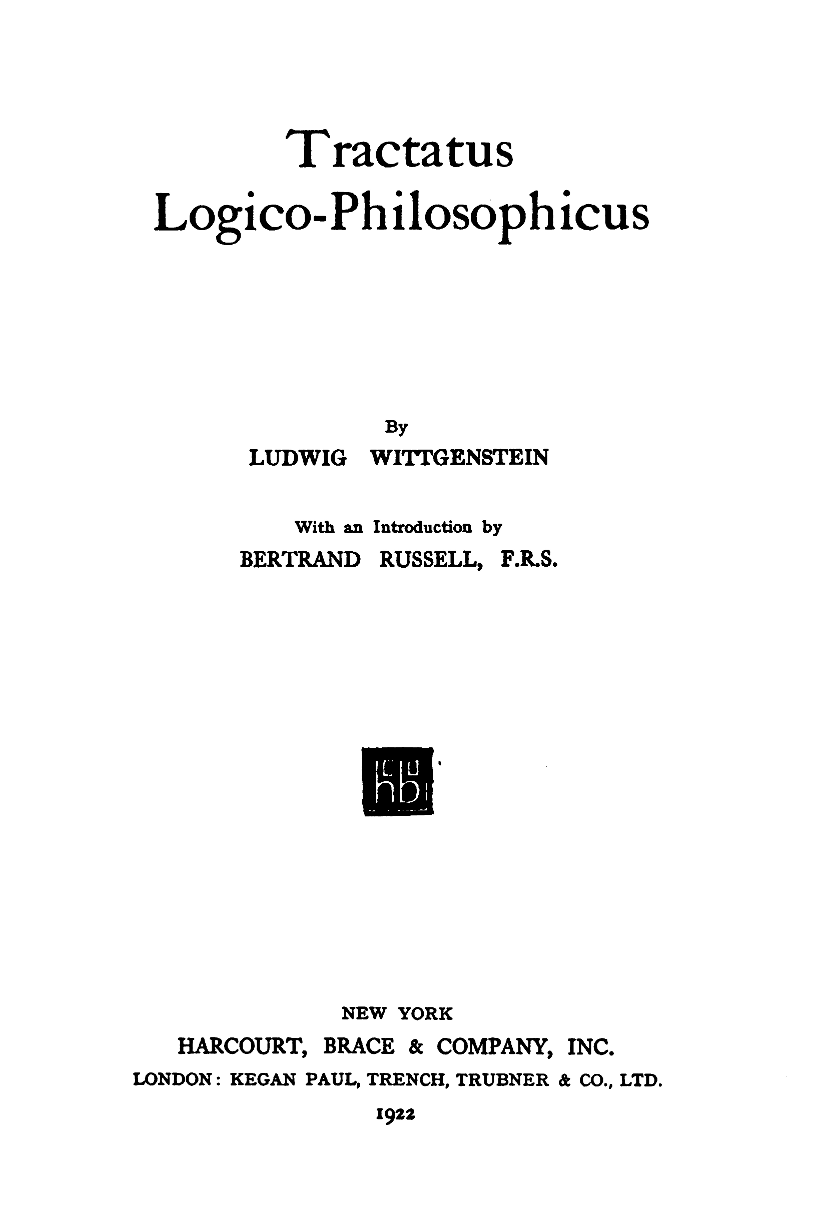
Tractatus Logico-Philosophicus
Wittgenstein's numbered propositions on language, logic and the world.
Read the full pageThe Tractatus Logico-Philosophicus (widely abbreviated and cited as TLP) is the only book-length philosophical work by the Austrian philosopher Ludwig Wittgenstein that was published during his lifetime. The project had a broad goal: to identify the relationship between language and reality, and to define the limits of science. Wittgenstein wrote the notes for the Tractatus while he was a soldier during World War I and completed it during a military leave in the summer of 1918. It was originally published in German in 1921 as Logisch-Philosophische Abhandlung (Logical-Philosophical Treatise). In 1922 it was published together with an English translation and a Latin title, which was suggested by G. E. Moore as homage to Baruch Spinoza's Tractatus Theologico-Politicus (1670).
The Tractatus is written in an austere and succinct literary style, containing almost no arguments as such, but consists of 525 declarative statements, which are hierarchically numbered.
- 5Read the full page
Ich und Du, usually translated as I and Thou, is a book by Martin Buber, published in 1923. It was first translated from German to English in 1937 by Ronald Gregor Smith, with a later translation by Walter Kaufmann being published in 1970. It is Buber's best-known work, setting forth his critique of modern objectification in relationships with others through the contrast between an "I-Thou" and an "I-It" understanding of the world.
Buber's main proposition is that we may address existence in two ways:
- 6
 WorkModern European1927
Being and Time
Heidegger's analysis of Dasein and the question of the meaning of Being.
Read the full pageBeing and Time (German: Sein und Zeit) is the 1927 magnum opus of German philosopher Martin Heidegger and a key document of existentialism. Being and Time had a notable impact on subsequent philosophy, literary theory and many other fields. Though controversial, its stature in intellectual history has been compared with works by Immanuel Kant and G. W. F. Hegel. The book attempts to revive ontology through an analysis of Dasein, or "being-in-the-world." It is also noted for an array of neologisms and complex language, as well as an extended treatment of "authenticity" as a means to grasp and confront the unique and finite possibilities of the individual.
Richard Wolin notes that the work "implicitly adopted the critique of mass society" epitomised earlier by Søren Kierkegaard and Friedrich Nietzsche. "Elitist complaints about the 'dictatorship of public opinion' were common currency to the German mandarins of the twenties," according to Jürgen Habermas (1989). Wolin writes that Being and Time is "suffused by a sensibility derived from secularized Protestantism" and its stress on original sin, and that the human condition is portrayed as "essentially a curse." Wolin cites the work's extended emphasis on "emotionally laden concepts" like guilt, conscience, angst and death.
- 7Read the full page
The Myth of Sisyphus is a 1942 philosophical work by Albert Camus. Influenced by philosophers such as Søren Kierkegaard, Arthur Schopenhauer, and Friedrich Nietzsche, Camus introduces his philosophy of the absurd. The absurd lies in the juxtaposition between the fundamental human need to attribute meaning to life and the "unreasonable silence" of the universe in response. Camus says that the realization of the absurd does not justify suicide, and instead requires "revolt". He then outlines several approaches to the absurd life. In the final chapter, Camus compares the absurdity of man's life with the situation of Sisyphus, a figure of Greek mythology who was condemned to repeat forever the same meaningless task of pushing a boulder up a mountain, only to see it roll down again just as it nears the top. The essay concludes, "The struggle itself towards the heights is enough to fill a man's heart. One must imagine Sisyphus happy."
The work can be seen in relation to other absurdist works by Camus: the novel The Stranger (1942), the plays The Misunderstanding (1942) and Caligula (1944), and especially the essay The Rebel (1951).
- 8WorkModern European1943
Being and Nothingness
Sartre's phenomenological ontology of freedom and bad faith.
Read the full pageBeing and Nothingness: An Essay on Phenomenological Ontology (French: L'Être et le néant : Essai d'ontologie phénoménologique), sometimes published with the subtitle A Phenomenological Essay on Ontology, is a 1943 book by the philosopher Jean-Paul Sartre. In the book, Sartre develops a philosophical account in support of his existentialism, dealing with topics such as consciousness, perception, social philosophy, self-deception, the existence of "nothingness", psychoanalysis, and the question of free will.
While a prisoner of war in 1940 and 1941, Sartre read Martin Heidegger's Being and Time (1927), which uses the method of Husserlian phenomenology as a lens for examining ontology. Sartre attributed the course of his own philosophical inquiries to his exposure to this work. Though influenced by Heidegger, Sartre was profoundly skeptical of any measure by which humanity could achieve a kind of personal state of fulfillment comparable to the hypothetical Heideggerian "re-encounter with Being". In Sartre's account, man is a creature haunted by a vision of "completion" (what Sartre calls the ens causa sui, meaning literally "a being that causes itself"), which many religions and philosophers identify as God. Born into the material reality of one's body, in a material universe, one finds oneself inserted into being. In accordance with Husserl's notion that consciousness can only exist as consciousness of something, Sartre develops the idea that there can be no form of self that is "hidden" inside consciousness. On these grounds, Sartre goes on to offer a philosophical critique of Sigmund Freud's theories, based on the claim that consciousness is essentially self-conscious.
