Medieval Latin thinkers: Alighieri to Palamas
- 1
 PhilosopherMedieval Latin1265 – 1321
Dante Alighieri
Dante Alighieri, widely known mononymously as Dante, was an Italian poet, writer, and philosopher. His Divine Comedy, originally called Comedìa (modern Italian: Commedia) and later christened Divina by Giovanni Boccaccio, is widely considered one of the most important poems of the Middle Ages and the greatest literary
Read the full pageDante Alighieri (Italian: [ˈdante aliˈɡjɛːri]; most likely baptized Durante di Alighiero degli Alighieri; c. May 1265 – September 14, 1321), widely known mononymously as Dante, was an Italian poet, writer, and philosopher. His Divine Comedy, originally called Comedìa (modern Italian: Commedia) and later christened Divina by Giovanni Boccaccio, is widely considered one of the most important poems of the Middle Ages and the greatest literary work in the Italian language.
At a time when Latin was still the dominant language for scholarly and literary writing—and when many Italian poets drew inspiration from French or Provençal traditions—Dante broke with both by writing in the vernacular, specifically his native Tuscan dialect. His De vulgari eloquentia (On Eloquence in the Vernacular) was one of the first scholarly defenses of the vernacular as well as a watershed study of the troubadour tradition and its craft of rhyme. His use of the Florentine dialect for works such as The New Life (1295) and Divine Comedy helped establish the modern-day standardized Italian language. His work set a precedent that important Italian writers such as Petrarch and Boccaccio would later follow.
- 2PhilosopherMedieval Latin1270 – 1347
Abner of Burgos
Abner of Burgos was a Jewish philosopher, a convert to Christianity, and a polemical writer against his former religion. Known after his conversion as Alfonso of Valladolid or "Master Alfonso."
Read the full pageAbner of Burgos (c. 1270 – c. 1347, or a little later) was a Jewish philosopher, a convert to Christianity, and a polemical writer against his former religion. Known after his conversion as Alfonso of Valladolid or "Master Alfonso."
As a student he acquired a certain mastery in Biblical and Talmudical studies, to which he added an intimate acquaintance with Peripatetic philosophy and astrology. What we know of his biography comes primarily from his own comments in his Moreh Zedek/Mostrador de justicia. According to that work, he stated that his religious doubts arose in 1295 when he treated a number of Jews for distress following their involvement in the failed messianic movement in Avila. As Abner tells it, he "had a dream" in which a similar experience of crosses mysteriously appearing on his garments drove him to question his ancestral faith.
- 3
 PhilosopherMedieval Latin1275 – 1344
Walter Burley
Walter Burley was an English scholastic philosopher and logician with at least 50 works attributed to him. He studied under Thomas Wilton and received his Master of Arts degree in 1301, and was a fellow of Merton College, Oxford until about 1310.
Read the full pageWalter Burley (or Burleigh; c. 1275 – 1344/45) was an English scholastic philosopher and logician with at least 50 works attributed to him. He studied under Thomas Wilton and received his Master of Arts degree in 1301, and was a fellow of Merton College, Oxford until about 1310. He then spent sixteen years in Paris, becoming a fellow of the Sorbonne by 1324, before spending 17 years as a clerical courtier in England and Avignon. Burley disagreed with William of Ockham on a number of points concerning logic and natural philosophy. He was known as the Doctor Planus et Perspicuus.
Burley was born in 1274 or 1275, possibly in Burley-in-Wharfedale, Yorkshire, or in Burley near Leeds. Little is known of his early life. He was made rector of Welbury in Yorkshire in 1309, probably through the influence of Sir John de Lisle, a friend of William Greenfield. As throughout his career, he did not act as rector, employing a substitute and using the income from the living to finance his study in Paris, where he completed his lectures on Peter Lombard's Sentences, and probably encountered the work of his contemporary William of Ockham. Burley's commentary on the Sentences has not survived.
- 4
 PhilosopherMedieval Latin1280 – 1342
Benedict XII
Pope Benedict XII, born Jacques Fournier, was a cardinal and inquisitor, and later, head of the Catholic Church from 30 December 1334 to his death, in April 1342. He was the third Avignon pope and reformed monastic orders and opposed nepotism.
Read the full pagePope Benedict XII (Latin: Benedictus XII, Italian: Benedetto XII, French: Benoît XII; 1285 – 25 April 1342), born Jacques Fournier, was a cardinal and inquisitor, and later, head of the Catholic Church from 30 December 1334 to his death, in April 1342. He was the third Avignon pope and reformed monastic orders and opposed nepotism. Unable to remove his capital to Rome or Bologna, Benedict started the great palace at Avignon. He settled the beatific vision controversy of Pope John XXII with the bull Benedictus Deus, which stated that souls may attain the "fullness of the beatific vision" before the Last Judgment. Despite many diplomatic attempts with Emperor Louis IV to resolve their differences, Benedict failed to bring the Holy Roman Empire back under papal dominance. He died 25 April 1342 and was buried in Avignon.
Jacques Fournier was born in Saverdun in the County of Foix around 1285. He joined the Cistercian Order and studied at the Collège des Bernardins at the University of Paris. In 1311 he was made Abbot of Fontfroide Abbey and quickly became known for his intelligence and organisational ability.
- 5
 PhilosopherMedieval Latin1280 – 1322
Petrus Aureolus
Petrus Aureoli, often anglicized Peter Auriol, was a scholastic philosopher and theologian.
Read the full pagePetrus Aureoli (c. 1280 – 10 January 1322), often anglicized Peter Auriol, was a scholastic philosopher and theologian.
Little of his life before 1312 is known. After this time, he taught at the Franciscan convent in Bologna, then at the convent in Toulouse, around 1314. He went to Paris in 1316 in order to qualify for his doctorate, where he read the Sentences. In 1318 he was appointed master of theology at the University of Paris. In 1321, he was appointed by his mentor, Pope John XXII, to the position of Archbishop of Aix-en-Provence, but died not long after in 1322.
- 6PhilosopherMedieval Latin1285 – 1343
Walter Chatton
Walter Chatton was an English Scholastic theologian and philosopher who regularly sparred philosophically with William of Ockham, who is well known for Occam's razor. Chatton proposed an "anti-razor".
Read the full pageWalter Chatton (c. 1290–1343) was an English Scholastic theologian and philosopher who regularly sparred philosophically with William of Ockham, who is well known for Occam's razor.
Chatton proposed an "anti-razor". From his Lectura I d. 3, q. 1, a. 1:
- 7PhilosopherMedieval Latin1290 – 1349
Robert Holkot
Robert Holcot, OP was an English Dominican scholastic philosopher, theologian and influential Biblical scholar.
Read the full pageRobert Holcot, OP (c. 1290 – 1349) was an English Dominican scholastic philosopher, theologian and influential Biblical scholar.
He was born in Holcot, Northamptonshire. A follower of William of Ockham, he was nicknamed the Doctor firmus et indefatigabilis, the "strong and tireless doctor." He made important contributions to semantics, the debate over God’s knowledge of future contingent events; discussions of predestination, grace and merit; and philosophical theology more generally.
- 8PhilosopherMedieval Latin1290 – 1344
Francis of Marchia
Francis of Marchia was an Italian Franciscan theologian and philosopher. He was an ally of William of Ockham and Michael of Cesena, and opponent of Pope John XXII, in the struggles of the Franciscan Spirituals, leading to his expulsion from the order in 1329.
Read the full pageFrancis of Marchia (c. 1290 - after 1344) was an Italian Franciscan theologian and philosopher. He was an ally of William of Ockham and Michael of Cesena, and opponent of Pope John XXII, in the struggles of the Franciscan Spirituals, leading to his expulsion from the order in 1329. He was commenting on the Sentences of Peter Lombard around 1320, but no longer closely bound to Lombard; for example he incidentally theorises on projectile motion, views now thought to be taken from Richard Rufus of Cornwall. He was nicknamed Doctor succinctus ('the concise teacher').
After his initial education Francis of Marchia became an instructor at various places to include a studia. His most famous teachings were his commentaries on the Sentences at the University of Paris. It is likely that Marchia's lectures were transcribed by his students, which he edited resulting in several versions of his commentary in manuscript form. Before leaving for Avignon around 1324 to teach at a Franciscan convent, Marchia composed several scholarly commentaries, including two on Aristotle's Metaphysics and one on Physics. The Quodlibet was written afterwards, between 1324 and 1328. Marchia supported the Franciscan Minister General, Michael of Cesena, and renounced Pope John XXII's concept of poverty in 1328. Following the renunciation he fled with Michael and William of Ockham to Munich. The Improbatio, a rebuttal to the Pope's Papal bull titled Quia vir reprobus, was written during this time, as well as the Allegationes Religiosorum Vivorum, co-authored by Marchia and Ockham and assembled by Michael. In 1343 Marchia repented and died shortly after.
- 9
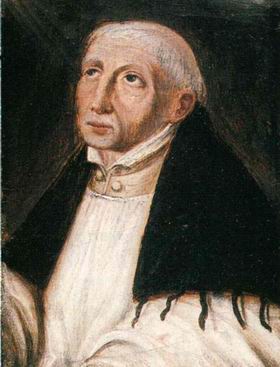 PhilosopherMedieval Latin1293 – 1381
John of Ruysbroeck
John of Ruusbroec or Jan van Ruusbroec, sometimes modernized Ruysbroeck, was an Augustinian canon and one of the most important of the medieval mystics of the Low Countries. Some of his main literary works include The Kingdom of the Divine Lovers, The Twelve Beguines, The Spiritual Espousals, A Mirror of Eternal Blesse
Read the full pageJohn of Ruusbroec or Jan van Ruusbroec, sometimes modernized Ruysbroeck, was an Augustinian canon and one of the most important of the medieval mystics of the Low Countries. Some of his main literary works include The Kingdom of the Divine Lovers, The Twelve Beguines, The Spiritual Espousals, A Mirror of Eternal Blessedness, The Little Book of Enlightenment, and The Sparkling Stone. Some of his letters also survive, as well as several short sayings (recorded by some of his disciples, such as Jan van Leeuwen). He wrote in the Middle Dutch vernacular, the language of the common people of the Low Countries, rather than in Latin, the language of the Catholic Church liturgy and official texts, in order to reach a wider audience.
John had a devout mother, who brought him up in the Catholic Church; nothing is known about his father. John's surname, Van Ruusbroec, is not a surname in the modern sense but a toponymic that refers to his native hamlet - modern-day Ruisbroek near Brussels.
- 10
 PhilosopherMedieval Latin1295 – 1366
Henry Suso
Henry Suso, OP was a German Dominican friar and the most popular vernacular writer of the fourteenth century (when considering the number of surviving manuscripts). An important author in both Latin and Middle High German, he is also notable for defending Meister Eckhart's legacy after Eckhart was posthumously condemne
Read the full pageHenry Suso, OP (also called Amandus, a name adopted in his writings, and Heinrich Seuse or Heinrich von Berg in German; 21 March 1295 – 25 January 1366) was a German Dominican friar and the most popular vernacular writer of the fourteenth century (when considering the number of surviving manuscripts). An important author in both Latin and Middle High German, he is also notable for defending Meister Eckhart's legacy after Eckhart was posthumously condemned for heresy in 1329. He died in Ulm on 25 January 1366, and was beatified by the Catholic Church in 1831.
Suso was born Heinrich von Berg, a member of the ruling family of Berg. He was born in either the free imperial city of Überlingen on Lake Constance or nearby Constance, on 21 March 1295 (or perhaps on that date up to 1297–99). Later, out of humility and devotion to his mother, he took her family name, which was Sus (or Süs, meaning "sweet"). At 13 years of age he was admitted to the novitiate of the Dominican Order at their priory in Constance. After completing that year of probation, he advanced to do his preparatory, philosophical, and theological studies there.
- 11PhilosopherMedieval Latin1295 – 1360
Richard FitzRalph
Richard FitzRalph was a scholastic philosopher, theologian, and Norman Irish Archbishop of Armagh during the 14th century. His thought exerted a significant influence on John Wycliffe's.
Read the full pageRichard FitzRalph (also Fitz Ralph; c. 1300 – 16 December 1360) was a scholastic philosopher, theologian, and Norman Irish Archbishop of Armagh during the 14th century. His thought exerted a significant influence on John Wycliffe's.
FitzRalph was born into a well-off burgess family of Anglo-Norman/Hiberno-Norman descent in Dundalk, Ireland. He is noted as an ex-fellow and teacher of Balliol College, at the University of Oxford in 1325 (which is the earliest known record of him). By 1331, he was a Regent master in Theology, and soon after was made Vice-Chancellor of the university; this was an almost unparalleled achievement for someone still in his early thirties, let alone an Irishman (although John Prince, in his "Worthies of Devon" makes the case for him being a Devonian and member of the Shillingford family.
- 12
 PhilosopherMedieval Latin1296 – 1359
Gregory Palamas
Gregory Palamas was a Byzantine Greek theologian and Eastern Orthodox cleric of the late Byzantine period. A monk of Mount Athos (modern Greece) and later archbishop of Thessalonica, he is famous for his defense of hesychast spirituality, the uncreated character of the light of the Transfiguration, and the distinction
Read the full pageGregory Palamas was a Byzantine Greek theologian and Eastern Orthodox cleric of the late Byzantine period. A monk of Mount Athos (modern Greece) and later archbishop of Thessalonica, he is famous for his defense of hesychast spirituality, the uncreated character of the light of the Transfiguration, and the distinction between God's essence and energies (i.e., the divine will, divine grace, etc.). His teaching unfolded over the course of three major controversies, (1) with the Italo-Greek Barlaam between 1336 and 1341, (2) with the monk Gregory Akindynos between 1341 and 1347, and (3) with the philosopher Gregoras, from 1348 to 1355. His theological contributions are sometimes referred to as Palamism, and his followers as Palamites.
Gregory has been venerated as a saint in the Eastern Orthodox Church since 1368. Within the Post Vatican II Catholic Church, he has also been called a saint; Pope John Paul II repeatedly called Gregory a great theological writer. Since 1971, the Melkite Greek Catholic Church has venerated Gregory as a saint. Some of his writings are collected in the Philokalia, and since the Ottoman period, the second Sunday of Great Lent is dedicated to the memory of Gregory Palamas in most branches of the Eastern Orthodoxy, while in some Eastern Catholic Churches, the issue is disputed.