Indian thinkers, early 20th century: Yogi to Jaimini
- 1
 PhilosopherIndian1917 – 2008
Maharishi Mahesh Yogi
Maharishi Mahesh Yogi was the creator of Transcendental Meditation (TM) and leader of the worldwide organization that has been characterized in multiple ways, including as a new religious movement and as non-religious. He became known as Maharishi (meaning "great seer") and Yogi as an adult.
Read the full pageMaharishi Mahesh Yogi (born Mahesh Prasad Varma, 12 January 1911? – 5 February 2008) was the creator of Transcendental Meditation (TM) and leader of the worldwide organization that has been characterized in multiple ways, including as a new religious movement and as non-religious. He became known as Maharishi (meaning "great seer") and Yogi as an adult.
After earning a degree in physics at Allahabad University in 1942, Maharishi Mahesh Yogi became an assistant and disciple of Swami Brahmananda Saraswati (also known as Guru Dev), the Shankaracharya (spiritual leader) of the Jyotir Math in the Indian Himalayas. The Maharishi credits Brahmananda Saraswati with inspiring his teachings. In 1955, the Maharishi began to introduce his Transcendental Deep Meditation (later renamed Transcendental Meditation) to India and the world. His first global tour began in 1958. His devotees referred to him as His Holiness, and because he laughed frequently in early TV interviews, he was sometimes referred to as the "giggling guru."
- 2
 PhilosopherIndian1918 – 2014
B. K. S. Iyengar
Bellur Krishnamachar Sundararaja Iyengar was an Indian teacher of yoga and author. He is the founder of the style of yoga as exercise called "Iyengar Yoga", and was considered one of the foremost yoga gurus in the world.
- ◆Iyengar Yoga
Read the full pageBellur Krishnamachar Sundararaja Iyengar (14 December 1918 – 20 August 2014) was an Indian teacher of yoga and author. He is the founder of the style of yoga as exercise called "Iyengar Yoga", and was considered one of the foremost yoga gurus in the world. He was the author of many books on yoga practice and philosophy including Light on Yoga, Light on Pranayama, Light on the Yoga Sutras of Patanjali, and Light on Life. Iyengar was one of the earliest students of Tirumalai Krishnamacharya, who is often called "the father of modern yoga". He has been credited with popularizing yoga, first in India and then around the world.
The Indian government awarded Iyengar the Padma Shri in 1991, the Padma Bhushan in 2002, and the Padma Vibhushan in 2014. In 2004, Iyengar was named one of the 100 most influential people in the world by Time magazine.
- 3
 PhilosopherIndian1918 – 2010
Raimon Panikkar
Raimon Panikkar Alemany, also known as Raimundo Panikkar and Raymond Panikkar, was a Spanish Catholic priest and a proponent of interfaith dialogue. As a scholar, he specialized in comparative religion.
Read the full pageRaimon Panikkar Alemany, also known as Raimundo Panikkar and Raymond Panikkar (November 2, 1918 – August 26, 2010), was a Spanish Catholic priest and a proponent of interfaith dialogue. As a scholar, he specialized in comparative religion.
Raimon Panikkar was born to a Spanish Catholic mother and a Malayali Hindu Indian father in Barcelona. His mother was well-educated and from the Catalan bourgeoisie. His father, Ramunni Panikkar, belonged to a Nair family from Malabar, South India. Panikkar's father was a freedom fighter during British colonial rule in India, who later escaped from Britain and married into a Catalan family. Panikkar's father studied in England and was the representative of a German chemical company in Barcelona.
- 4
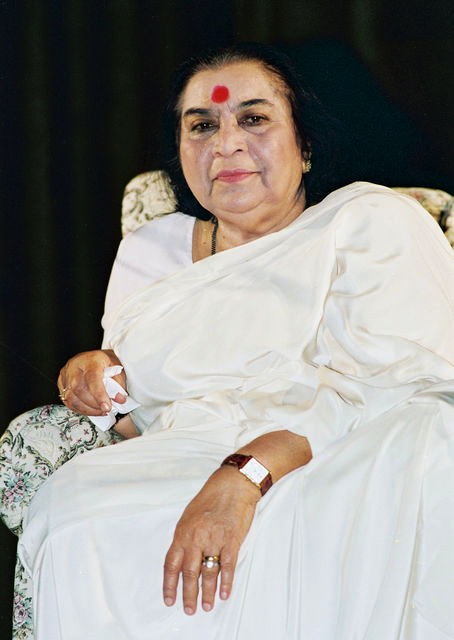 PhilosopherIndian1923 – 2011
Nirmala Srivastava
Nirmala Srivastava, also known as Shri Mataji Nirmala Devi, was the founder and guru of Sahaja Yoga, a new religious movement. She claimed to have been born fully realised and spent her life working for peace by developing and promoting a simple technique through which people can achieve their self-realization.
- ◆Sahaja Yoga
Read the full pageNirmala Srivastava (née Nirmala Salve; 21 March 1923 – 23 February 2011), also known as Shri Mataji Nirmala Devi, was the founder and guru of Sahaja Yoga, a new religious movement. She claimed to have been born fully realised and spent her life working for peace by developing and promoting a simple technique through which people can achieve their self-realization.
Born in Chhindwara, Madhya Pradesh, India to a Hindu father and a Christian mother, Prasad and Cornelia Salve, her parents named her Nirmala, which means "immaculate". She said that she was born self-realised. Her father, a scholar of fourteen languages, translated the Quran into Marathi, and her mother was the first woman in India to receive an honours degree in mathematics. Shri Mataji descended from the royal Shalivahana/Satavahana dynasty. The former union minister N. K. P. Salve was her brother and the lawyer Harish Salve is her nephew. The Salve surname is one of several in the Satavahana Maratha clan.
- 5PhilosopherIndian1925 – 1996
Swami Rama
Swami Rama was an Indian yoga guru. He moved to the US in 1969, initially teaching yoga at the YMCA, and founding the Himalayan Institute of Yoga Science and Philosophy in Illinois in 1971; its headquarters moved to its current location in Honesdale, Pennsylvania in 1977.
Read the full pageSwami Rama (Svāmī Rāma; 1925 – 13 November 1996) was an Indian yoga guru. He moved to the US in 1969, initially teaching yoga at the YMCA, and founding the Himalayan Institute of Yoga Science and Philosophy in Illinois in 1971; its headquarters moved to its current location in Honesdale, Pennsylvania in 1977. He became famous for his ability to control his body in yoga nidra, writing many books including the autobiographical Living with Himalayan Masters. From the 1970s onwards, there were persistent allegations of sexual abuse of his followers; in 1997 a woman won a lawsuit against him for multiple sexual assaults.
Swami Rama was born Brij Kiśore Dhasmana or Brij Kiśore Kumar, to a northern Indian Brahmin family in the village of Toli in the Garhwal Himalayas. He claimed that he was raised somewhere in the monasteries and holy caves of the Himalayas by his personal guru or master Sri Madhavananda Bharati. He further claimed to have gained degree-level qualifications from an Indian school of homeopathic medicine, the University of Hamburg, Utrecht University, and finally the University of Oxford. However, in 1987 two of his closest followers left his Himalayan Institute when they learnt that part of his official biography had been "fabricated"; further, Vanessa Webber of the Cult Awareness Network has stated that his academic background could not be verified.
- 6
 PhilosopherIndian1931 – 1990
Osho
Provocative Indian mystic and speaker who blended Zen, Tantra, Sufism and Western psychology into a philosophy of meditation, celebration and radical freedom.
- ◆Meditation as the art of witnessing
- ◆Zorba the Buddha — uniting worldly joy and spiritual depth
- ◆Dynamic meditation
- ◆Against organised religion and dogma
- ◆Love and freedom over morality
Read the full pageChandra Mohan Jain — later Acharya Rajneesh, Bhagwan Shree Rajneesh and finally Osho — was a philosophy lecturer from Jabalpur who became one of the most widely read and most controversial spiritual teachers of the 20th century. His thousands of recorded discourses on the Buddha, Laozi, Zhuangzi, Kabir, Jesus, the Upaniṣads, Heraclitus and Nietzsche were transcribed into more than 600 books.
His central teaching is meditation understood as witnessing: watching thoughts, feelings and bodily sensations without identifying with them. Because modern people are too restless to sit silently, he devised "active" methods such as Dynamic Meditation, in which catharsis precedes stillness. His ideal was "Zorba the Buddha" — a person who fully enjoys the senses and the world like Kazantzakis's Zorba, yet has the inner silence of the Buddha.
- 7
 PhilosopherIndian1931 – 2007
Chinmoy Kumar Ghose
Chinmoy Kumar Ghose, better known as Sri Chinmoy, was an Indian spiritual leader who taught meditation in the United States after moving to New York City in 1964. Chinmoy established his first meditation center in Queens, New York, and eventually had seven thousand students in 60 countries.
Read the full pageChinmoy Kumar Ghose (27 August 1931 – 11 October 2007), better known as Sri Chinmoy, was an Indian spiritual leader who taught meditation in the United States after moving to New York City in 1964. Chinmoy established his first meditation center in Queens, New York, and eventually had seven thousand students in 60 countries. He was an author, artist, poet, and musician; he also held public events such as concerts and meditations on the theme of inner peace. Chinmoy advocated a spiritual path to God through prayer and meditation. He advocated athleticism including distance running, swimming, and weightlifting. He organized marathons and other races, and was an active runner and, following a knee injury, weightlifter. Some ex-members have accused Chinmoy of running a cult.
Chinmoy was the youngest of seven children, born in Shakpura, Boalkhali Upazila, in the Chittagong District of East Bengal, British India (now in Bangladesh). He lost his father to illness in 1943, and his mother a few months later. Chinmoy began his practice of meditation at the age of 11. In 1944, the 12-year-old Chinmoy joined his brothers and sisters at the Sri Aurobindo Ashram in Pondicherry, where his elder brothers Hriday and Chitta had already established a presence. It was Chitta that gave Chinmoy his name which means "full of divine consciousness".
- 8
 PhilosopherIndianborn 1933
Amartya Sen
Amartya Kumar Sen is an Indian economist and philosopher. Sen has taught and worked in England and the United States since 1972.
- ◆Capability approach
- ◆human development theory
- ◆famine
Read the full pageAmartya Kumar Sen (Bengali: [ˈɔmortːo ˈʃen]; born 3 November 1933) is an Indian economist and philosopher. Sen has taught and worked in England and the United States since 1972. In 1998, he received the Nobel Prize in Economic Sciences for his contributions to welfare economics. He has also made major contributions to social choice theory, economic and social justice, economic theories of famines, decision theory, development economics, public health, and the measures of well-being of countries.
Sen is currently the Thomas W. Lamont University Professor, and professor of economics and philosophy, at Harvard University. He previously served as master of Trinity College at the University of Cambridge. In 1999, he received India's highest civilian honour, Bharat Ratna, for his contribution to welfare economics. The German Publishers and Booksellers Association awarded him the 2020 Peace Prize of the German Book Trade for his pioneering scholarship addressing issues of global justice and combating social inequality in education and healthcare.
- 9
 PhilosopherIndiand. 1918
Sai Baba of Shirdi
Sai Baba of Shirdi, also known as Shirdi Sai Baba, was an Indian spiritual master considered to be a saint, and revered by both Hindu and Muslim devotees during and after his lifetime. According to accounts from his life, Sai Baba preached the importance of "realisation of the self" and criticised "love towards perisha
Read the full pageSai Baba of Shirdi (c. 1838–15 October 1918), also known as Shirdi Sai Baba, was an Indian spiritual master considered to be a saint, and revered by both Hindu and Muslim devotees during and after his lifetime.
According to accounts from his life, Sai Baba preached the importance of "realisation of the self" and criticised "love towards perishable things". His teachings concentrated on a moral code of love, forgiveness, helping others, charity, contentment, inner peace, and devotion to God and Guru.
- 10
 PhilosopherIndian
Brihaspati
Brihaspati (Sanskrit: बृहस्पति, IAST: Bṛhaspati) is a Hindu god. In the ancient Vedic scriptures, Brihaspati is associated with fire, and the word also refers to a god who counsels the devas and devis (gods and goddesses).
Read the full pageBrihaspati (Sanskrit: बृहस्पति, IAST: Bṛhaspati) is a Hindu god. In the ancient Vedic scriptures, Brihaspati is associated with fire, and the word also refers to a god who counsels the devas and devis (gods and goddesses). In some later texts, the word refers to the largest planet of the Solar System, Jupiter, and the deity is associated with the planet as a Navagraha.
Brihaspati appears in the Rigveda (pre-1000 BCE), such as in the dedications to him in the hymn 50 of Book 4; he is described as a sage born from the first great light, the one who drove away darkness, is bright and pure, and carries a special bow whose string is Rta or "cosmic order" (basis of dharma). His knowledge and character is revered, and he is considered Guru (teacher) by all the Devas. In the Vedic literature and other ancient texts, sage Brihaspati is also called by other names such as Bramanaspati, Purohita, Angirasa (son of Angiras) and Vyasa; he is sometimes identified with god Agni (fire). His wife is Tara (or goddess who personifies the stars in the sky).
- 11PhilosopherIndian
Jaimini
Jaimini was an ancient Indian scholar who founded the Mīmāṃsā school of Hindu philosophy. He is the son of Parāśara and is considered to be a disciple of sage Vyasa.
Read the full pageJaimini was an ancient Indian scholar who founded the Mīmāṃsā school of Hindu philosophy. He is the son of Parāśara and is considered to be a disciple of sage Vyasa. Traditionally attributed to be the author of the Mimamsa Sutras and the Jaimini Sutras, he is estimated to have lived around 4th to 2nd century BCE. His school is considered non-theistic, but emphasizes ritual parts of the Vedas as essential to dharma. Jaimini is known for his studies of the older Vedic rituals.
Jaimini's guru was Badarayana, who founded the Vedanta school of Hindu philosophy. He is also credited with authoring the Brahma Sutras. Both Badarayana and Jaimini quoted each other as they analyzed each other's theories. Badarayana emphasises knowledge, while Jaimini emphasises rituals. They sometimes agree with each other, sometimes disagree, and often present antithesis to each other.