Indian thinkers, early 20th century: Khan to Saraswati
- 1
 PhilosopherIndian1882 – 1927
Inayat Khan
Inayat Khan Rehmat Khan, was an Indian professor of musicology, singer, exponent of the sarasvati vina, poet, philosopher, writer, and pioneer of the transmission of Sufism to the West. At the urging of his students, and on the basis of his ancestral Sufi tradition and four-fold training and authorisation at the hands
Read the full pageInayat Khan Rehmat Khan (Urdu: عنایت خان رحمت خان; 5 July 1882 – 5 February 1927), was an Indian professor of musicology, singer, exponent of the sarasvati vina, poet, philosopher, writer, and pioneer of the transmission of Sufism to the West. At the urging of his students, and on the basis of his ancestral Sufi tradition and four-fold training and authorisation at the hands of Sayyid Abu Hashim Madani (d. 1907) of Hyderabad, he established an order of Sufism (The Sufi Order) in London in 1914. By the time of his death in 1927, centers had been established throughout Europe and North America, and multiple volumes of his teachings had been published.
Inayat Khan was born in Baroda to a noble Mughal family. His paternal ancestors, comprising yüzkhans (Central Asian lords) and bakshys (shamans), were Turkmen from the Chagatai Khanate who settled in Sialkot, Punjab during the reign of Timur. Inayat Khan's maternal grandfather, Sangit Ratna Maulabakhsh Sholay Khan, was a Hindustani classical musician and educator known as "the Beethoven of India". His maternal grandmother, Qasim Bibi, was from the royal house of Tipu Sultan of Mysore.
- 2
 PhilosopherIndian1887 – 1963
Sivananda Saraswati
Swami Sivananda Saraswati, also called Swami Sivananda, was a yoga guru, a Hindu spiritual teacher, and a proponent of Vedanta. Sivananda was born in Pattamadai, in the Tirunelveli district of modern Tamil Nadu, and was named Kuppuswami.
Read the full pageSwami Sivananda Saraswati (IAST: Svāmī Śivānanda Sarasvatī; 8 September 1887 – 14 July 1963), also called Swami Sivananda, was a yoga guru, a Hindu spiritual teacher, and a proponent of Vedanta. Sivananda was born in Pattamadai, in the Tirunelveli district of modern Tamil Nadu, and was named Kuppuswami. He studied medicine and served in British Malaya as a physician for several years before taking up monasticism.
He was the founder of the Divine Life Society (DLS) in 1936, Yoga-Vedanta Forest Academy (1948), and the author of over 200 books on yoga, Vedanta, and a variety of subjects. He established Sivananda Ashram, the headquarters of the DLS, on the bank of the Ganges at Muni Ki Reti, 3 kilometres (1.9 miles) from Rishikesh, and lived most of his life there.
- 3
 PhilosopherIndian1888 – 1975
Sarvepalli Radhakrishnan
Sarvepalli Radhakrishnan was an Indian academic, philosopher and statesman who served as the Vice President of India from 1952 to 1962 and President of India from 1962 to 1967. He was the ambassador of India to the Soviet Union from 1949 to 1952.
Read the full pageSarvepalli Radhakrishnan (Telugu: [sɐɾʋeːpɐlːi ɾaːd̪ʰaːkɾuʂɳɐn] ; 5 September 1888 – 17 April 1975) was an Indian academic, philosopher and statesman who served as the Vice President of India from 1952 to 1962 and President of India from 1962 to 1967. He was the ambassador of India to the Soviet Union from 1949 to 1952. He was also the vice-chancellor of Banaras Hindu University from 1939 to 1948 and the vice-chancellor of Andhra University from 1931 to 1936. Radhakrishnan is considered one of the most influential and distinguished 20th century scholars of comparative religion and philosophy, he held the King George V Chair of Mental and Moral Science at the University of Calcutta from 1921 to 1932 and Spalding Chair of Eastern Religion and Ethics at University of Oxford from 1936 to 1952.
Radhakrishnan's philosophy was grounded in Advaita Vedanta, reinterpreting this tradition for a contemporary understanding. He defended Hinduism against what he called "uninformed Western criticism", contributing to the formation of contemporary Hindu identity. He has been influential in shaping the understanding of Hinduism, in both India and the west, and earned a reputation as a bridge-builder between India and the West.
- 4PhilosopherIndian1888 – 1989
Tirumalai Krishnamacharya
Tirumalai Krishnamacharya was an Indian yoga teacher, ayurvedic healer and scholar. He is seen as one of the most important gurus of modern yoga, and is often called "Father of Modern Yoga" for his wide influence on the development of postural yoga.
- ◆"Father of modern yoga"
Read the full pageTirumalai Krishnamacharya (18 November 1888 – 28 February 1989) was an Indian yoga teacher, ayurvedic healer and scholar. He is seen as one of the most important gurus of modern yoga, and is often called "Father of Modern Yoga" for his wide influence on the development of postural yoga. Like earlier pioneers influenced by physical culture such as Yogendra and Kuvalayananda, he contributed to the revival of hatha yoga.
Krishnamacharya held degrees in all the six Vedic darśanas, or Indian philosophies. While under the patronage of the King of Mysore, Krishna Raja Wadiyar IV, Krishnamacharya traveled around India giving lectures and demonstrations to promote yoga, including such feats as apparently stopping his heartbeat. He is widely considered as the architect of vinyāsa, in the sense of combining breathing with movement; the style of yoga he created has come to be called Viniyoga or Vinyasa Krama Yoga. Underlying all of Krishnamacharya's teachings was the principle "Teach what is appropriate for an individual." While he is revered in other parts of the world as a yogi, in India Krishnamacharya is mainly known as a healer who drew from both ayurvedic and yogic traditions to restore health and well-being to those he treated. He wrote four books on yoga—Yoga Makaranda (1934), Yogaasanagalu (c. 1941), Yoga Rahasya, and Yogavalli (Chapter 1 – 1988)—as well as several essays and poetic compositions.
- 5
 PhilosopherIndian1891 – 1956
B. R. Ambedkar
Architect of India's constitution and philosopher of social democracy who reinterpreted Buddhism against caste.
Read the full pageBhimrao Ramji Ambedkar (14 April 1891 – 6 December 1956) was an Indian jurist, economist, social reformer and politician who chaired the committee that drafted the Constitution of India based on the debates of the Constituent Assembly of India and the first draft of Sir Benegal Narsing Rau. Ambedkar served as Law and Justice minister in the first cabinet of Jawaharlal Nehru. He later renounced Hinduism and converted to Buddhism, inspiring the Dalit Buddhist movement.
After graduating from Elphinstone College, University of Bombay, Ambedkar studied economics at Columbia University and the London School of Economics, receiving doctorates in 1927 and 1923, respectively, and was among a handful of Indian students to have done so at either institution in the 1920s. During his time at Columbia University, Ambedkar came under the influence of John Dewey and his philosophy of pragmatism. He also trained in the law at Gray's Inn, London. In his early career, he was an economist, professor, and lawyer. His later life was marked by his political activities; he became involved in campaigning and negotiations for partition, publishing journals, advocating political rights and social freedom for Dalits, and contributing to the establishment of the state of India. In 1956, he converted to Buddhism, initiating mass conversions of Dalits. He was also appointed to work with the Simon Commission.
- 6
 PhilosopherIndian1893 – 1952
Paramahansa Yogananda
Paramahansa Yogananda was an American Hindu monk, yogi, and guru who founded the Self-Realization Fellowship (SRF)/Yogoda Satsanga Society of India (YSS), a religious meditation and Kriya Yoga organization, to disseminate his teachings. A chief disciple of the yoga guru Swami Sri Yukteswar Giri, he was sent by his line
Read the full pageParamahansa Yogananda (; born Mukunda Lal Ghosh; January 5, 1893 – March 7, 1952) was an American Hindu monk, yogi, and guru who founded the Self-Realization Fellowship (SRF)/Yogoda Satsanga Society of India (YSS), a religious meditation and Kriya Yoga organization, to disseminate his teachings. A chief disciple of the yoga guru Swami Sri Yukteswar Giri, he was sent by his lineage to spread yogic teachings to the West. He immigrated to the US at the age of 27, intending to demonstrate a unity between Eastern and Western religions and advocate for a balance between Western material growth and Indian spirituality. His longstanding influence on the American yoga movement, and especially the yoga culture of Los Angeles, led yoga experts to consider him the "Father of Yoga in the West". He lived his final 32 years in the US.
Yogananda was among the first Indian religious teachers to settle in the US, and the first prominent Indian to be hosted in the White House (by President Calvin Coolidge in 1927); his early acclaim led to him being dubbed "the 20th century's first superstar guru" by the Los Angeles Times. Arriving in Boston in 1920, he embarked on a successful transcontinental speaking tour before settling in Los Angeles in 1925. Over the next two and a half decades, he established a monastic order, trained disciples, conducted teaching tours, acquired properties for his organization in California, and initiated thousands into Kriya Yoga. By 1952, SRF had over 100 centers in both India and the United States. As of 2012, they had groups in nearly every major American city. His "plain living and high thinking" principles attracted people from all backgrounds among his followers.
- 7
 PhilosopherIndian1895 – 1986
Jiddu Krishnamurti
Jiddu Krishnamurti was an Indian spiritual figure, speaker, and writer. Adopted by members of the Theosophical Society as a child, Krishnamurti was raised to fill the mantle of the prophesied World Teacher, a role tasked with aiding humankind's spiritual evolution.
Read the full pageJiddu Krishnamurti was an Indian spiritual figure, speaker, and writer. Adopted by members of the Theosophical Society as a child, Krishnamurti was raised to fill the mantle of the prophesied World Teacher, a role tasked with aiding humankind's spiritual evolution. In 1922, he began to suffer from painful, seizure-like mystical episodes that would produce a lasting change in his perception of reality. In 1929, he broke from the Theosophy movement and disbanded the Order of the Star in the East, a related organization which had been formed around him. He spent the rest of his life speaking to groups and individuals around the world, hoping to contribute a radical transformation of mankind.
Krishnamurti asserted that "truth is a pathless land" and advised against following any doctrine, discipline, teacher, guru, or authority, including himself. Nonetheless, during his life he tried to share his insights in "the teachings", urging for a state without conceptual deliberations and thought. In Krishnamurti's perception, such a righteousness was only possible through the practice of passive or choiceless awareness, which he called the essence of "true meditation" in contrast to contrived techniques. He gained a wider recognition in the 1950s, after Aldous Huxley had introduced him to his mainstream publisher and the publication of The First and Last Freedom (1954). Many of his talks and writings have been published since, among them Commentaries on Living (1956–60) and Krishnamurti's Notebook (written 1961-62).
- 8PhilosopherIndian1895 – 1986
Jiddu Krishnamurti
Rejected the role of world teacher prepared for him and spent sixty years urging people to free themselves from all authority, including his own.
- ◆Truth is a pathless land
- ◆Choiceless awareness
- ◆The observer is the observed
- ◆Freedom from the known
Read the full pageJiddu Krishnamurti was an Indian spiritual figure, speaker, and writer. Adopted by members of the Theosophical Society as a child, Krishnamurti was raised to fill the mantle of the prophesied World Teacher, a role tasked with aiding humankind's spiritual evolution. In 1922, he began to suffer from painful, seizure-like mystical episodes that would produce a lasting change in his perception of reality. In 1929, he broke from the Theosophy movement and disbanded the Order of the Star in the East, a related organization which had been formed around him. He spent the rest of his life speaking to groups and individuals around the world, hoping to contribute a radical transformation of mankind.
Krishnamurti asserted that "truth is a pathless land" and advised against following any doctrine, discipline, teacher, guru, or authority, including himself. Nonetheless, during his life he tried to share his insights in "the teachings", urging for a state without conceptual deliberations and thought. In Krishnamurti's perception, such a righteousness was only possible through the practice of passive or choiceless awareness, which he called the essence of "true meditation" in contrast to contrived techniques. He gained a wider recognition in the 1950s, after Aldous Huxley had introduced him to his mainstream publisher and the publication of The First and Last Freedom (1954). Many of his talks and writings have been published since, among them Commentaries on Living (1956–60) and Krishnamurti's Notebook (written 1961-62).
- 9
 PhilosopherIndian1896 – 1977
A. C. Bhaktivedanta Swami Prabhupada
Abhay Charanaravinda Bhaktivedanta Swami Prabhupada was an Indian spiritual, philosophical, and religious teacher who spread the Hare Krishna mantra and the teachings of "Krishna consciousness" to the world. Born as Abhay Charan De and later legally named Abhay Charanaravinda Bhaktivedanta Swami, he is often referred t
- ◆the Hare Krishna movement
Read the full pageAbhay Charanaravinda Bhaktivedanta Swami Prabhupada (1 September 1896 – 14 November 1977) was an Indian spiritual, philosophical, and religious teacher who spread the Hare Krishna mantra and the teachings of "Krishna consciousness" to the world. Born as Abhay Charan De and later legally named Abhay Charanaravinda Bhaktivedanta Swami, he is often referred to as "Bhaktivedanta Swami", "Srila Prabhupada", or simply "Prabhupada".
To carry out an order received in his youth from his spiritual teacher to spread "Krishna consciousness" in English, he journeyed from Kolkata to New York City in 1965 at the age of 69, on a cargo ship with little more than a few trunks of books. He knew no one in America, but he chanted Hare Krishna in a park in New York City, gave classes, and in 1966, with the help of some early students, established the International Society for Krishna Consciousness (ISKCON), which now has centers around the world.
- 10
 PhilosopherIndian1896 – 1982
Anandamayi Ma
Anandamayi Ma was an Indian saint, teacher, and mystic. She was revered as an incarnation of Hindu goddess Durga.
Read the full pageAnandamayi Ma (born Nirmala Sundari; 30 April 1896 – 27 August 1982) was an Indian saint, teacher, and mystic. She was revered as an incarnation of Hindu goddess Durga.
She was described by Sivananda Saraswati (of the Divine Life Society) as "la fleur la plus parfaite que le sol de l'Inde ait produite" [the most perfect flower the Indian soil has produced]. Her life was suffused in Bhakti Yoga and she was considered an epitome of "divine grace" that inspired the societal cultural milieu to lead the path of service, love and constant remembrance of the divine. Her followers experienced her spiritual attributes including precognition, faith healing and miracles. Paramahansa Yogananda translates the Sanskrit epithet Anandamayi as "Joy-permeated" in English. This name was given to her by her devotees in the 1920s to describe her perpetual state of divine joy.
- 11
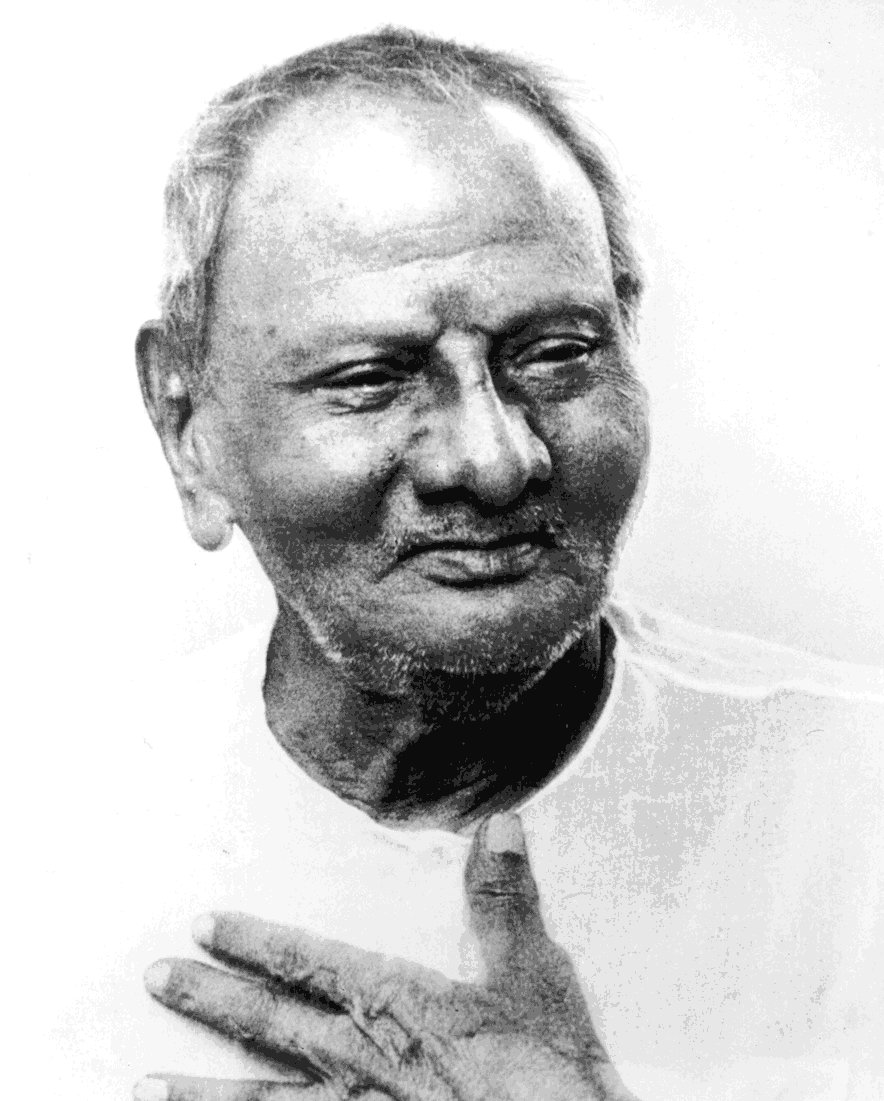 PhilosopherIndian1897 – 1981
Nisargadatta Maharaj
Nisargadatta Maharaj (pronounced [nisəɾgəd̪ɑːt̪t̪ə məɦaːɾaːd͡ʒ]; was an Indian guru of nonduality, belonging to the Inchagiri Sampradaya, a lineage of teachers from the Navnath Sampradaya. The publication in 1973 of I Am That, an English translation of his talks in Marathi by Maurice Frydman, brought him worldwide reco
Read the full pageNisargadatta Maharaj (pronounced [nisəɾgəd̪ɑːt̪t̪ə məɦaːɾaːd͡ʒ] ; (born Maruti Shivrampant Kambli; 17 April 1897 – 8 September 1981) was an Indian guru of nonduality, belonging to the Inchagiri Sampradaya, a lineage of teachers from the Navnath Sampradaya.
The publication in 1973 of I Am That, an English translation of his talks in Marathi by Maurice Frydman, brought him worldwide recognition and followers, especially from North America and Europe.
- 12
 PhilosopherIndian1916 – 1993
Chinmayananda Saraswati
Swami Chinmayananda Saraswati (IAST: Svāmī Cinmayānanda Sarasvatī), also known as Pujya Gurudev Swami Chinmayananda Saraswati, was a Hindu spiritual leader and teacher. In 1953, he founded Chinmaya Mission, a worldwide nonprofit organisation, in order to spread the knowledge of Advaita Vedanta as well as the Bhagavad G
Read the full pageSwami Chinmayananda Saraswati (IAST: Svāmī Cinmayānanda Sarasvatī), also known as Pujya Gurudev Swami Chinmayananda Saraswati (born Balakrishna Menon; 8 May 1916 – 3 August 1993), was a Hindu spiritual leader and teacher. In 1953, he founded Chinmaya Mission, a worldwide nonprofit organisation, in order to spread the knowledge of Advaita Vedanta as well as the Bhagavad Gita, the Upanishads, and other ancient Hindu scriptures. Through the Mission, Swami Chinmayananda spearheaded a global Hindu spiritual and cultural renaissance that popularised these spiritual texts and values to English speaking audiences across India and globally.
Swami Chinmayananda was originally a journalist and participated in the Indian independence movement. Under the tutelage of Swami Sivananda and later Tapovan Maharaj, he began studying Vedanta and took the vow of sannyasa. He gave his first jñāna yajña, or lecture series about Hindu spirituality, in 1951, starting the work of the Mission. Today, Chinmaya Mission encompasses more than 300 centres in India and internationally and conducts educational, spiritual, and charitable activities.