Greek & Roman thinkers, ancient: Euhemerus to Menedemus
- 1PhilosopherGreek & Roman400 – 300 BCE
Euhemerus
Euhemerus was a Greek mythographer at the court of Cassander, the king of Macedon. Euhemerus's birthplace is disputed, with Messina in Sicily as the most probable location, while others suggest Chios or Tegea.
Read the full pageEuhemerus (; also spelled Euemeros or Evemerus; Ancient Greek: Εὐήμερος, romanized: Euhēmeros, lit. 'happy' or 'prosperous'; late fourth century BC) was a Greek mythographer at the court of Cassander, the king of Macedon. Euhemerus's birthplace is disputed, with Messina in Sicily as the most probable location, while others suggest Chios or Tegea.
The philosophy attributed to and named for Euhemerus, euhemerism, holds that many mythological tales can be attributed to historical persons and events, the accounts of which have become altered and exaggerated over time.
- 2PhilosopherGreek & Roman400 – 300 BCE
Hegesias of Cyrene
Hegesias of Cyrene was a Cyrenaic philosopher. He argued that eudaimonia (happiness) is impossible to achieve, and that the goal of life should be the avoidance of pain and sorrow.
Read the full pageHegesias (Ancient Greek: Ἡγησίας; fl. 290 BC) of Cyrene was a Cyrenaic philosopher. He argued that eudaimonia (happiness) is impossible to achieve, and that the goal of life should be the avoidance of pain and sorrow. Conventional values such as wealth, poverty, freedom, and slavery are all indifferent and produce no more pleasure than pain. Cicero claims that Hegesias wrote a book called ἀποκαρτερῶν (Death by Starvation), which persuaded so many people that death is more desirable than life that Hegesias was banned from teaching in Alexandria. It has been thought by some that Hegesias was influenced by Buddhist teachings.
Diogenes Laërtius describes Hegesias as the pupil of Paraebates, who was a pupil of Epitimides, who was a pupil of Antipater of Cyrene, who was a pupil of Aristippus (c. 435 – c. 360 BC). He was the fellow-student of Anniceris, but he differed from Anniceris by presenting the system which Anniceris softened and improved in its most nihilistic form.
- 3
 PhilosopherGreek & Roman400 – 340 BCE
Arete of Cyrene
Arete of Cyrene was a Cyrenaic philosopher who lived in Cyrene, Libya. She was the daughter of Aristippus of Cyrene.
Read the full pageArete of Cyrene (; Ancient Greek: Ἀρήτη; fl. 4th century BC) was a Cyrenaic philosopher who lived in Cyrene, Libya. She was the daughter of Aristippus of Cyrene.
Arete learned philosophy from her father, Aristippus, who had himself learned philosophy from Socrates. Arete, in turn, taught philosophy to her son – Aristippus the Younger – who was nicknamed "Mother-taught" (Greek: μητροδίδακτος).
- 4PhilosopherGreek & Roman400 – 300 BCE
Diodorus Cronus
Diodorus Cronus was an Ancient Greek philosopher and dialectician connected to the Megarian school. He was most notable for logic innovations, including his master argument formulated in response to Aristotle's discussion of future contingents.
Read the full pageDiodorus Cronus (; Greek: Διόδωρος Κρόνος; died c. 284 BC) was an Ancient Greek philosopher and dialectician connected to the Megarian school. He was most notable for logic innovations, including his master argument formulated in response to Aristotle's discussion of future contingents.
Diodorus was the son of Ameinias of Iasus in Caria. He lived in the court of Alexandria in the reign of Ptolemy I Soter, who is said to have given him the surname of Cronus ("old fogey") on account of his inability to solve at once some dialectic problem proposed by Stilpo, when the two philosophers were dining with the king. Diodorus is said to have taken that disgrace so much to heart that after his return from the meal, and writing a treatise on the problem, he died in despair. However, according to Strabo, Diodorus himself adopted the surname of Cronus from his teacher, Apollonius Cronus. Diodorus is thought to have died around 284 BC; his date of birth is unknown. It was once thought that he was old enough to have influenced Aristotle (384–322 BC), but there is no strong evidence for this.
- 5
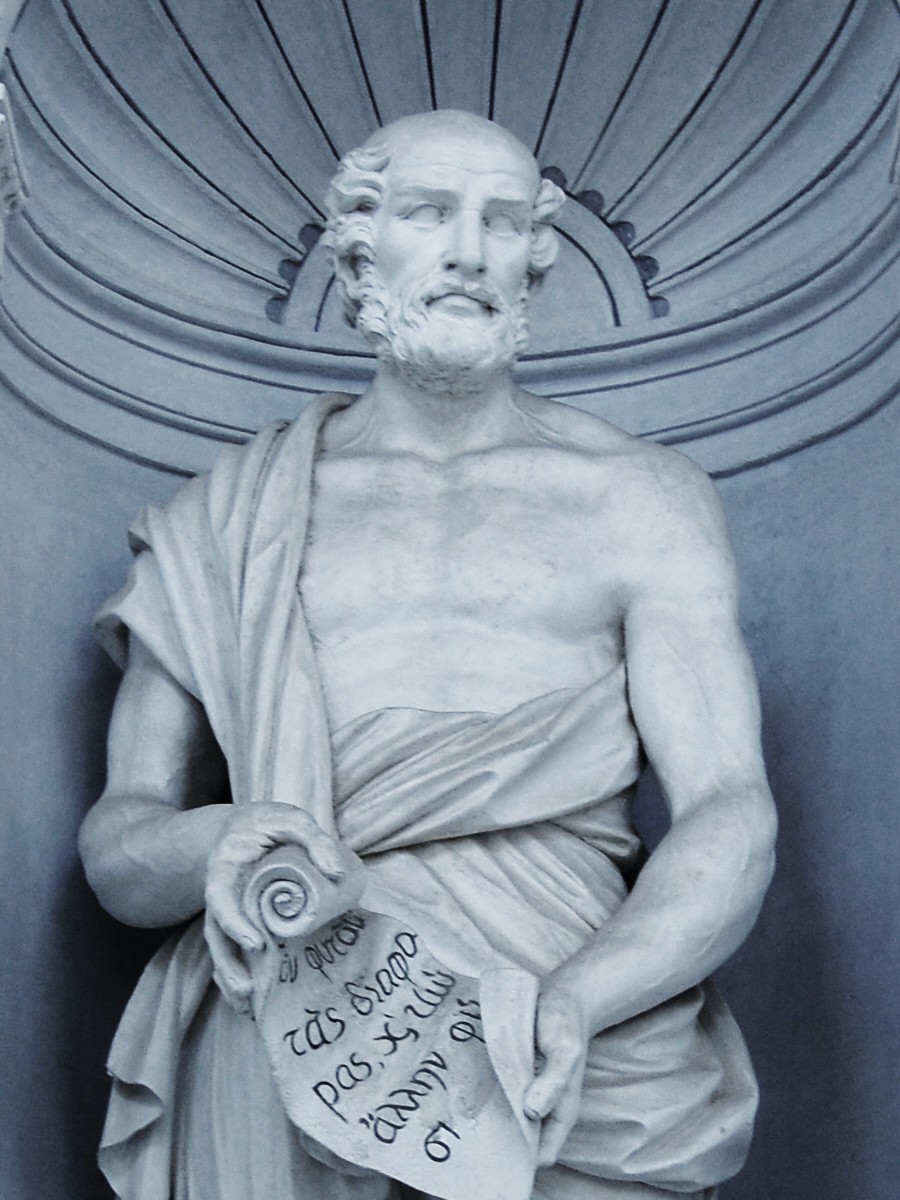 PhilosopherGreek & Roman371 – 287 BCE
Theophrastus
Theophrastus was an ancient Greek philosopher and naturalist. A native of Eresos in Lesbos, he was Aristotle's close colleague and successor as head of the Lyceum, the Peripatetic school of philosophy in Athens.
- ◆Prosleptic
- ◆hypothetical syllogism
- ◆Encyclopædia Britannica Online
- ◆Modus ponens
- ◆modus tollens
- ◆Stanford Encyclopedia of Philosophy
Read the full pageTheophrastus (; Ancient Greek: Θεόφραστος, romanized: Theophrastos, lit. 'godly phrased'; c. 371 – c. 287 BC) was an ancient Greek philosopher and naturalist. A native of Eresos in Lesbos, he was Aristotle's close colleague and successor as head of the Lyceum, the Peripatetic school of philosophy in Athens. Theophrastus wrote numerous treatises across all areas of philosophy, working to support, improve, expand, and develop the Aristotelian system. He made significant contributions to various fields, including ethics, metaphysics, botany, and natural history. Often considered the "father of botany" for his groundbreaking works "Enquiry into Plants" (Ancient Greek: Περὶ φυτῶν ἱστορία, romanized: Peri phytōn historia) and "On the Causes of Plants", (Ancient Greek: Περὶ αἰτιῶν φυτικῶν, romanized: Peri aitiōn phytikōn), Theophrastus established the foundations of botanical science. His given name was Tyrtamos (Ancient Greek: Τύρταμος); the nickname Theophrastus ("divine speaker") was reputedly given to him by Aristotle in recognition of his eloquent style.
He came to Athens at a young age and initially studied in Plato's school. After Plato's death, he attached himself to Aristotle who took to Theophrastus in his writings. When Aristotle fled Athens, Theophrastus took over as head of the Lyceum. Theophrastus presided over the Peripatetic school for thirty-six years, during which time the school flourished greatly. He is often considered the father of botany for his works on plants. After his death, the Athenians honoured him with a public funeral. His successor as head of the school was Strato of Lampsacus.
- 6
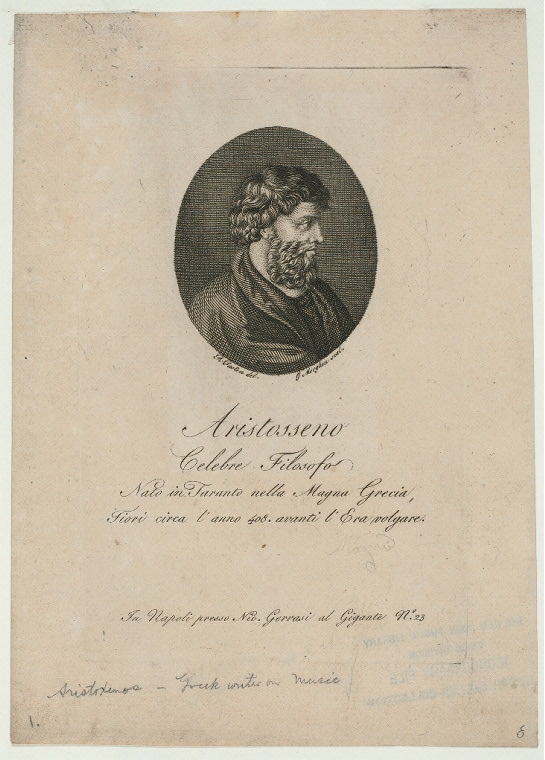 PhilosopherGreek & Roman360 – 300 BCE
Aristoxenus
Aristoxenus of Tarentum was a Greek Peripatetic philosopher, and a pupil of Aristotle. Most of his writings, which dealt with philosophy, ethics and music, have been lost, but one musical treatise, Elements of Harmony (Greek: Greek: Ἁρμονικὰ στοιχεῖα; Latin: Elementa harmonica), survives incomplete, as well as some fra
Read the full pageAristoxenus of Tarentum (Greek: Ἀριστόξενος ὁ Ταραντῖνος; born c. 375, fl. 335 BC) was a Greek Peripatetic philosopher, and a pupil of Aristotle. Most of his writings, which dealt with philosophy, ethics and music, have been lost, but one musical treatise, Elements of Harmony (Greek: Greek: Ἁρμονικὰ στοιχεῖα; Latin: Elementa harmonica), survives incomplete, as well as some fragments concerning rhythm and meter. The Elements is the chief source of our knowledge of ancient Greek music.
Aristoxenus was born at Tarentum (in modern-day Apulia, southern Italy) in Magna Graecia, and was the son of a learned musician named Spintharus (otherwise Mnesias). He learned music from his father, and having then been instructed by Lamprus of Erythrae and Xenophilus the Pythagorean, he finally became a pupil of Aristotle, whom he appears to have rivaled in the variety of his studies.
- 7
 PhilosopherGreek & Roman359 – 279 BCE
Stilpo
Stilpo or Stilpon, in Latin sources also Stilbo or Stilbon, was a Greek philosopher of the Megarian school. He was a contemporary of Theophrastus, Diodorus Cronus, and Crates of Thebes.
- ◆universal
Read the full pageStilpo or Stilpon (Ancient Greek: Στίλπων, Stílpōn; c. 360 – c. 280 BC), in Latin sources also Stilbo or Stilbon, was a Greek philosopher of the Megarian school. He was a contemporary of Theophrastus, Diodorus Cronus, and Crates of Thebes. None of his writings survive, but he is described in the writings of others as being interested in logic and dialectic, and he argued that the universal is fundamentally separated from the individual and concrete. His ethical teachings approached that of the Cynics and Stoics. His most important followers were Pyrrho, the founder of Pyrrhonism, and Zeno of Citium, the founder of Stoicism.
He was a native of Megara. He probably lived after the time of Euclid of Megara, which makes it unlikely that he was a pupil of Euclid, as stated by some; and others state that he was the pupil of Thrasymachus of Corinth, or of Pasicles, the brother of Crates of Thebes. According to one account, he engaged in dialectic encounters with Diodorus Cronus at the court of Ptolemy Soter; according to another, he did not comply with the invitation of the king, to go to Alexandria. We are further told that Demetrius, the son of Antigonus, honoured him no less, spared his house at the capture of Megara, and offered him indemnity for the injury which it had received, which, however, Stilpo declined. Uniting elevated sentiment with gentleness and patience, he, as Plutarch says, was an ornament to his country and friends, and had his acquaintance sought by kings. His original propensity to wine and voluptuousness he is said to have entirely overcome; in inventive power and dialectic art to have surpassed his contemporaries, and to have inspired almost all Greece with a devotion to Megarian philosophy. A number of distinguished men too are named, whom he is said to have drawn away from Theophrastus, Aristotle of Cyrene, and others, and attached to himself; among others Crates the Cynic, and Zeno, the founder of the Stoic school. Among his followers were Menedemus and Asclepiades, the leaders of the Eretrian school of philosophy. One of his pupils, Nicarete, was also said to have been his mistress. Stilpo was praised for his political wisdom, his simple, straightforward disposition, and the equanimity with which he tolerated his rebellious daughter. Cicero relates that Stilpo's friends had described him as "vehemently addicted to wine and women", but that his philosophy eliminated his inclinations.
- 8
 PhilosopherGreek & Roman350 – 283 BCE
Demetrius of Phalerum
Demetrius of Phalerum was an Athenian orator originally from Phalerum, an ancient port of Athens. A student of Theophrastus, and perhaps of Aristotle, he was one of the first members of the Peripatetic school of philosophy.
Read the full pageDemetrius of Phalerum (also Demetrius of Phaleron or Demetrius Phalereus; Ancient Greek: Δημήτριος ὁ Φαληρεύς; c. 350 – c. 280 BC) was an Athenian orator originally from Phalerum, an ancient port of Athens. A student of Theophrastus, and perhaps of Aristotle, he was one of the first members of the Peripatetic school of philosophy. Demetrius had been a distinguished statesman who was appointed by Cassander, the King of Macedon, to govern Athens, where Demetrius ruled as sole ruler for ten years. During this time, he introduced important reforms of the legal system, while also maintaining pro-Cassander oligarchic rule.
Demetrius was exiled by his enemies in 307 BC. He first went to Thebes, and then, after 297 BC, went to the court of Alexandria. He wrote extensively on the subjects of history, rhetoric, and literary criticism. He is not to be confused with his grandson, also called Demetrius of Phaleron, who probably served as regent of Athens between 262 and 255, on behalf of the Macedonian King Antigonos Gonatas.
- 9
 PhilosopherGreek & Roman350 – 290 BCE
Eudemus of Rhodes
Eudemus of Rhodes was an ancient Greek philosopher, considered the first historian of science. He was one of Aristotle's most important pupils, editing his teacher's work and making it more easily accessible.
Read the full pageEudemus of Rhodes (Ancient Greek: Εὔδημος; flourished before 300 BC) was an ancient Greek philosopher, considered the first historian of science. He was one of Aristotle's most important pupils, editing his teacher's work and making it more easily accessible. Eudemus' nephew, Pasicles, was also credited with editing Aristotle's works.
Eudemus was born on the isle of Rhodes, but spent a large part of his life in Athens, where he studied philosophy at Aristotle's Peripatetic School. Eudemus's collaboration with Aristotle was long-lasting and close, and he was generally considered to be one of Aristotle's most brilliant pupils: he and Theophrastus of Lesbos were regularly called not Aristotle's "disciples", but his "companions" (ἑταῖροι).
- 10
 PhilosopherGreek & Roman350 – 290 BCE
Dicaearchus
Dicaearchus of Messana, also written Dikaiarchos (), was a Greek philosopher, geographer and author. Dicaearchus was a student of Aristotle in the Lyceum.
Read the full pageDicaearchus of Messana (; Ancient Greek: Δικαίαρχος Dikaiarkhos; c. 370/350 – c. post 323 BC), also written Dikaiarchos (), was a Greek philosopher, geographer and author. Dicaearchus was a student of Aristotle in the Lyceum. Very little of his work remains extant. He wrote on geography and the history of Greece, of which his most important work was his Life of Greece. Although modern scholars often consider him a pioneer in the field of cartography, this is based on a misinterpretation of a reference in Cicero to Dicaearchus's tabulae, which does not refer to any maps made by Dicaearchus but is a pun on account books and refers to Dicaearchus's Descent into the Sanctuary of Trophonius. He also wrote books on ancient Greek poets, philosophy and politics.
He was the son of one Pheidias, and born at Messana in Sicily, Magna Graecia, though he passed part of his life in Greece, and especially in Athens and the Peloponnesus. He also travelled to make his measurements of mountains. He was a disciple of Aristotle and a friend of Aristoxenus (a letter written to him is attested in Cicero). Eighteenth- and early nineteenth-century scholarship often considered him a friend of Theophrastus as well, but this is based on the reference to a man named Theophrastus in the spurious Description of Greece, which is transmitted under Dicaearchus's name but actually consists of excerpts from a geographic poem written by Dionysius, son of Calliphon, and from a prose periegesis of Greece, written by Heraclides Criticus. It is uncertain when Dicaearchus died. The only certain terminus post quem is the death of Alexander the Great (323 BC). According to Pliny, Dicaearchus measured mountains "with the support of the kings" (cura regum). Most scholars identify these kings as Cassander and Ptolemy I Soter. If this identification is correct, this would put Dicaearchus's activity between 306 and 287 BC. However, the kings might also refer to Philip III Arrhidaeus and Alexander IV, who were the nominatim kings after the death of Alexander the Great. If that identification is correct, this moves his activity to 323–317 BC.
- 11PhilosopherGreek & Roman340 – 250 BCE
Theodoros the Atheist
Theodorus the Atheist, of Cyrene, was a Greek philosopher of the Cyrenaic school. He lived in both Greece and Alexandria, before ending his days in his native city of Cyrene.
Read the full pageTheodorus the Atheist (Ancient Greek: Θεόδωρος ὁ ἄθεος, romanized: Theódōros ho átheos; c. 340 – c. 250 BCE), of Cyrene, was a Greek philosopher of the Cyrenaic school. He lived in both Greece and Alexandria, before ending his days in his native city of Cyrene. As a Cyrenaic philosopher, he taught that the goal of life was to obtain joy and avoid grief, and that the former resulted from knowledge, and the latter from ignorance. However, his principal claim to fame was his alleged atheism. He was usually designated by ancient writers ho atheos (ὁ ἄθεος), "the atheist".
Theodorus was a disciple of Aristippus the Younger, grandson of the elder and more famous Aristippus. He heard the lectures of a number of philosophers beside Aristippus; such as Anniceris, and Dionysius the dialectician, Zeno of Citium, and Pyrrho.
- 12PhilosopherGreek & Roman340 – 265 BCE
Menedemus
Menedemus of Eretria was a Greek philosopher and founder of the Eretrian school. He learned philosophy first in Athens, and then, with his friend Asclepiades, he subsequently studied under Stilpo and Phaedo of Elis.
Read the full pageMenedemus of Eretria was a Greek philosopher and founder of the Eretrian school. He learned philosophy first in Athens, and then, with his friend Asclepiades, he subsequently studied under Stilpo and Phaedo of Elis. Nothing survives of his philosophical views apart from a few scattered remarks recorded by later writers.
Menedemus was born at Eretria. He was a member of the noble Theopropidai family, which held significant religious authority but had become impoverished by Menedemus's time. Like his father, Cleisthenes, he worked as a builder and tent maker.