Greek & Roman thinkers, ancient: Chios to Elis
- 1PhilosopherGreek & Roman490 – 422 BCE
Ion of Chios
Ion of Chios was a Greek writer, dramatist, lyric poet and philosopher. He was a contemporary of Aeschylus, Euripides and Sophocles.
Read the full pageIon of Chios (; Ancient Greek: Ἴων ὁ Χῖος; c. 490/480 – c. 420 BC) was a Greek writer, dramatist, lyric poet and philosopher. He was a contemporary of Aeschylus, Euripides and Sophocles. Of his many plays and poems only a few titles and fragments have survived. He also wrote some prose works, including a Pythagorean text, the Triagmos, of which a few fragments survive.
He was the son of Orthomenes, and was surnamed the son of Xuthus: probably a nickname alluding to Xuthus, the father of the mythical Ion. When very young he went to Athens, where he enjoyed the society of Cimon, of whom he left laudatory notices in some of his works which are quoted by Plutarch. Plutarch informs us that Ion severely criticised Pericles, who is said to have been his rival in love. Ion was familiarly acquainted with Aeschylus, if we may believe an anecdote related by Plutarch, but he did not come forward as a tragedian till after Aeschylus' death. We also learn from Ion himself that he met Sophocles in Chios, when the latter was commander of the expedition against Samos, 440 BC.
- 2
 PhilosopherGreek & Roman470 – 399 BCE
Socrates
The Athenian who wrote nothing yet changed philosophy forever by questioning everyone about how to live — and died for it.
- ◆The unexamined life is not worth living
- ◆Socratic method: question, define, refute
- ◆Virtue is knowledge; no one does wrong willingly
- ◆Wisdom begins in knowing that you do not know
Read the full pageSocrates was a stonemason's son who spent his life in the marketplace of Athens asking people questions. What is courage? What is justice? What is piety? Those who thought they knew — generals, politicians, poets — found under his cross-examination (elenchus) that their definitions collapsed into contradiction.
He claimed no wisdom of his own except awareness of his ignorance. When the Delphic oracle declared no one wiser than Socrates, he concluded it meant that he alone knew he knew nothing. His real subject was the care of the soul: how to live a good life. He held that virtue is a kind of knowledge, so that no one does wrong knowingly, and that it is worse to do injustice than to suffer it.
- 3PhilosopherGreek & Roman460 – 500 BCE
Diogenes of Apollonia
Diogenes of Apollonia was a pre-Socratic Greek philosopher, and was a native of the Milesian colony Apollonia in Thrace. He lived for some time in Athens.
- ◆arche
Read the full pageDiogenes of Apollonia ( dy-OJ-in-eez; Ancient Greek: Διογένης ὁ Ἀπολλωνιάτης, romanized: Diogénēs ho Apollōniátēs; fl. 5th century BC) was a pre-Socratic Greek philosopher, and was a native of the Milesian colony Apollonia in Thrace. He lived for some time in Athens. He believed air to be the one source of all being from which all other substances were derived, and, as a primal force, to be both divine and intelligent. He also wrote a description of the organization of blood vessels in the human body. His ideas were parodied by the dramatist Aristophanes, and may have influenced the Orphic philosophical commentary preserved in the Derveni papyrus. His philosophical work has not survived in a complete form, and his doctrines are known chiefly from lengthy quotations of his work by Simplicius, as well as a few summaries in the works of Aristotle, Theophrastus, and Aetius.
Diogenes was a native of the Milesian colony Apollonia Pontica in Thrace, present-day Sozopol on the Black Sea. His father's name was Apollothemis. Nothing is known of the events in his life, except that he lived for some time in Athens. Diogenes Laërtius states that his unpopularity, or "intense jealousy", put his life in danger in Athens, but there may be confusion with Anaxagoras who is mentioned in the same passage. Like all the physiologoi (natural philosophers), he wrote in the Ionic dialect.
- 4PhilosopherGreek & Roman459 – 399 BCE
Thrasymachus
Thrasymachus was a sophist of ancient Greece best known as a character in Plato's Republic.
Read the full pageThrasymachus (; Ancient Greek: Θρασύμαχος Thrasýmachos; c. 459 – c. 400 BC) was a sophist of ancient Greece best known as a character in Plato's Republic.
Thrasymachus was a citizen of Chalcedon, on the Bosphorus. His career appears to have been spent as a sophist at Athens, although the exact nature of his work and thought is unclear. He is credited with an increase in the rhythmic character of Greek oratory, especially the use of the paeonic rhythm in prose, and a greater appeal to the emotions through gesture.
- 5
 PhilosopherGreek & Roman450 – 300 BCE
Diotima of Mantinea
Diotima of Mantinea (; Greek: Διοτίμα; Latin: Diotīma) is the name or pseudonym of an ancient Greek character in Plato's dialogue Symposium, possibly an actual historical figure, indicated as having lived circa 440 B.C. Her ideas and doctrine of Eros as reported by the character of Socrates in the dialogue are the orig
- ◆Platonic love
Read the full pageDiotima of Mantinea (; Greek: Διοτίμα; Latin: Diotīma) is the name or pseudonym of an ancient Greek character in Plato's dialogue Symposium, possibly an actual historical figure, indicated as having lived circa 440 B.C. Her ideas and doctrine of Eros as reported by the character of Socrates in the dialogue are the origin of the concept today known as love.
In Plato's Symposium the members of a party discuss the meaning of love. Socrates says that in his youth he was taught "the philosophy of love" by Diotima, a prophetess who successfully postponed the Plague of Athens. In an account that Socrates recounts at the symposium, Diotima says that Socrates has confused the idea of love with the idea of the beloved. Love, she says, is neither fully beautiful nor good, as the earlier speakers in the dialogue had argued. Diotima gives Socrates a genealogy of Love (Eros), stating that he is the son of "resource (poros) and poverty (penia)". In her view, love drives the individual to seek beauty, first earthly beauty, or beautiful bodies. Then as a lover grows in wisdom, the beauty that is sought is spiritual, or beautiful souls. For Diotima, the most correct use of love of other human beings is to direct one's mind to love of wisdom, or philosophy.
- 6PhilosopherGreek & Roman450 – 350 BCE
Alcidamas
Alcidamas (Ancient Greek: Ἀλκιδάμας), of Elaea, in Aeolis, was a Greek sophist and rhetorician, who flourished in the 4th century BC.
Read the full pageAlcidamas (Ancient Greek: Ἀλκιδάμας), of Elaea, in Aeolis, was a Greek sophist and rhetorician, who flourished in the 4th century BC.
He was the pupil and successor of Gorgias and taught at Athens at the same time as Isocrates, to whom he was a rival and opponent. We possess two declamations under his name: On Sophists (Περὶ Σοφιστῶν), directed against Isocrates and setting forth the superiority of extempore over written speeches (a more recently discovered fragment of another speech against Isocrates is probably of later date); Odysseus (perhaps spurious) in which Odysseus accuses Palamedes of treachery during the siege of Troy.
- 7
 PhilosopherGreek & Roman450 – 450 BCE
Diagoras of Melos
Diagoras of Melos (Greek: Διαγόρας ὁ Μήλιος) or Diagoras "the Atheist" was a Greek poet and sophist of the 5th century BC. Throughout antiquity, he was regarded as an atheist, but very little is known for certain about what he actually believed.
Read the full pageDiagoras of Melos (Greek: Διαγόρας ὁ Μήλιος) or Diagoras "the Atheist" was a Greek poet and sophist of the 5th century BC. Throughout antiquity, he was regarded as an atheist, but very little is known for certain about what he actually believed. Anecdotes about his life indicate that he spoke out against ancient Greek religion. He allegedly chopped up a wooden statue of Heracles and used it to boil his turnips and revealed the secrets of the Eleusinian Mysteries. The Athenians accused him of asebeia (impiety) and banished him from their city. He died in Corinth.
Diagoras was the son of Telecleides or Teleclytus, and was born in the island of Melos, one of the Cyclades. According to the Suda, he was a disciple of Democritus after Democritus had paid 10,000 drachmas to free Diagoras from captivity following the cruel subjugation of Melos (416 BC); however no early sources mention an association with Democritus. The Suda also states that in his youth Diagoras had acquired some reputation as a lyric poet, and this is probably the cause of his being mentioned with the lyric poets Simonides, Pindar, and Bacchylides. Among his encomia is mentioned in particular a eulogy on Arianthes of Argos, who is otherwise unknown, another on Nicodorus, a statesman of Mantineia, and a third upon the Mantineians. Nicodorus was celebrated as a statesman and lawgiver in his native place; Aelian informs us that Diagoras was the lover of Nicodorus, and assisted Nicodorus in his legislation. The constitution of Mantineia was later praised by Aristotle and Polybius as a rare example of democratic moderation and equilibrium.
- 8
 PhilosopherGreek & Roman436 – 365 BCE
Euclid of Megara
Euclid of Megara was a Greek Socratic philosopher who founded the Megarian school of philosophy. He was a pupil of Socrates in the late 5th century BC, and was present at his death.
- ◆Eristic
Read the full pageEuclid of Megara (; Ancient Greek: Εὐκλείδης Eucleides; c. 435 – c. 365 BC) was a Greek Socratic philosopher who founded the Megarian school of philosophy. He was a pupil of Socrates in the late 5th century BC, and was present at his death. He held the supreme good to be one, eternal and unchangeable, and denied the existence of anything contrary to the good. Editors and translators in the Middle Ages often confused him with Euclid of Alexandria when discussing the latter's Elements.
Euclid was born in Megara. In Athens he became a follower of Socrates: so eager was he to listen to the teaching and discourse of Socrates that when, for a time, Athens had a ban on any citizen of Megara entering the city, Euclid would sneak into Athens after nightfall disguised as a woman, to hear him speak. He is represented in the preface of Plato's Theaetetus as being responsible for writing down the conversation between Socrates and the young Theaetetus many years earlier. Socrates is also supposed to have reproved Euclid for his fondness for eristic disputes. He was present at Socrates's death (399 BCE), after which Euclid returned to Megara, where he offered refuge to Plato and other frightened pupils of Socrates.
- 9
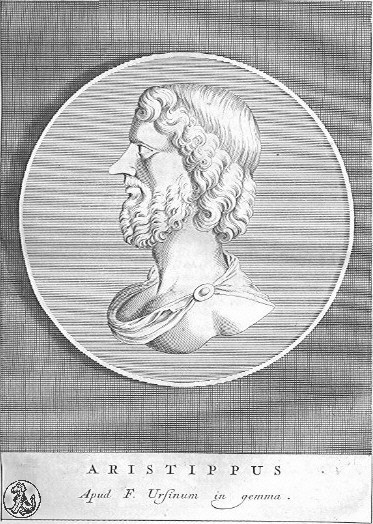 PhilosopherGreek & Roman434 – 355 BCE
Aristippus
Aristippus of Cyrene was a hedonistic Greek philosopher and the founder of the Cyrenaic school of philosophy. He was a pupil of Socrates, but adopted a different philosophical outlook, teaching that the goal of life was to seek pleasure by adapting circumstances to oneself and by maintaining proper control over both ad
- ◆Hedonism
Read the full pageAristippus of Cyrene (; Ancient Greek: Ἀρίστιππος ὁ Κυρηναῖος; c. 435 – c. 356 BCE) was a hedonistic Greek philosopher and the founder of the Cyrenaic school of philosophy. He was a pupil of Socrates, but adopted a different philosophical outlook, teaching that the goal of life was to seek pleasure by adapting circumstances to oneself and by maintaining proper control over both adversity and prosperity. His view that pleasure is the only good came to be called ethical hedonism. Due to the ideological and philosophical differences between Socrates and himself, Aristippus faced backlash from Socrates and many of his fellow pupils. With respect to his hedonistic beliefs, Aristippus's most famous phrase was, "I possess, I am not possessed." Despite having two sons, Aristippus identified his daughter Arete as the "intellectual heiress" of his work, resulting in the systematization of his work and the Cyrenaic school of philosophy, by Arete, and her son Aristippus the Younger, Aristippus's grandson, during the later years of his life and after his death.
There are indications that Aristippus was conflated with his grandson, Aristippus the Younger.
- 10
 PhilosopherGreek & Roman430 – 354 BCE
Xenophon
Xenophon of Athens was a Greek military leader, philosopher, economist, and historian. At the age of 30, he was elected as one of the leaders of the retreating Greek mercenaries, the Ten Thousand, who had been part of Cyrus the Younger's attempt to seize control of the Achaemenid Empire.
Read the full pageXenophon of Athens (; Ancient Greek: Ξενοφῶν; c. 430 – 355/354 BC) was a Greek military leader, philosopher, economist, and historian. At the age of 30, he was elected as one of the leaders of the retreating Greek mercenaries, the Ten Thousand, who had been part of Cyrus the Younger's attempt to seize control of the Achaemenid Empire. As the military historian Theodore Ayrault Dodge wrote, "the centuries since have devised nothing to surpass the genius of this warrior".
For at least two millennia, it has been debated whether Xenophon was first and foremost a general, historian, or philosopher. For the majority of time in the past two millennia, Xenophon was recognised as a philosopher. Quintilian in The Orator's Education discusses the most prominent historians, orators and philosophers as examples of eloquence and recognises Xenophon's historical work, but ultimately places Xenophon next to Plato as a philosopher. Today, Xenophon is recognised as one of the greatest writers of antiquity. Xenophon's works span multiple genres and are written in plain Attic Greek, which is why they have often been used in translation exercises for contemporary students of the Ancient Greek language. In the Lives and Opinions of Eminent Philosophers, Diogenes Laërtius observed that Xenophon was known as the "Attic Muse" because of the sweetness of his diction.
- 11PhilosopherGreek & Roman430 – 360 BCE
Aeschines of Sphettus
Aeschines of Sphettus or Aeschines Socraticus (Ancient Greek: Αἰσχίνης Σωκρατικός), son of Lysanias, of the deme Sphettus of Athens, was a philosopher who in his youth was a follower of Socrates. Historians call him Aeschines Socraticus—"the Socratic Aeschines"—to distinguish him from the more historically influential
Read the full pageAeschines of Sphettus (Ancient Greek: Αἰσχίνης Σφήττιος, c. 425 BC – c. 350 BC) or Aeschines Socraticus (Ancient Greek: Αἰσχίνης Σωκρατικός), son of Lysanias, of the deme Sphettus of Athens, was a philosopher who in his youth was a follower of Socrates. Historians call him Aeschines Socraticus—"the Socratic Aeschines"—to distinguish him from the more historically influential Athenian orator also named Aeschines. His name is sometimes but now rarely written as Aischines or Æschines.
According to Plato, Aeschines of Sphettus was present at the trial and execution of Socrates. We know that after Socrates' death, Aeschines went on to write philosophical dialogues, just as Plato did, in which Socrates was main speaker. Though Aeschines' dialogues have survived only as fragments and quotations by later writers, he was renowned in antiquity for his accurate portrayal of Socratic conversations. According to John Burnet, Aeschines' style of presenting Socratic dialogue was closer to Plato's than Xenophon's. (Some modern scholars believe that Xenophon's writings are inspired almost entirely by Plato's and/or by the influence of other Socratics such as Antisthenes and Hermogenes. On the other hand, there is no good reason to think that Aeschines' writings were not based almost entirely on his own personal recollections of Socrates.)
- 12PhilosopherGreek & Roman401 – 400 BCE
Phaedo of Elis
Phaedo of Elis (; also, Phaedon; Ancient Greek: Φαίδων ὁ Ἠλεῖος, gen.: Φαίδωνος; fl. 4th century BC was a Greek philosopher. A native of Elis, he was captured in war as a boy and sold into slavery.
Read the full pagePhaedo of Elis (; also, Phaedon; Ancient Greek: Φαίδων ὁ Ἠλεῖος, gen.: Φαίδωνος; fl. 4th century BC was a Greek philosopher. A native of Elis, he was captured in war as a boy and sold into slavery. He subsequently came into contact with Socrates at Athens, who warmly received him and had him freed. He was present at the death of Socrates, and Plato named one of his dialogues Phaedo.
He returned to Elis, and founded the Elean School of philosophy. Almost nothing is known of his doctrines, but his school survived him and was subsequently transferred to Eretria by his pupil Menedemus, where it became the Eretrian school.