Greek & Roman thinkers, ancient: Lampsacus to Chrysostom
- 1
 PhilosopherGreek & Roman335 – 269 BCE
Strato of Lampsacus
Strato of Lampsacus was a Peripatetic philosopher, and the third director (scholarch) of the Lyceum after the death of Theophrastus. He devoted himself especially to the study of natural science, and increased the naturalistic elements in Aristotle's thought to such an extent, that he denied the need for an active god
Read the full pageStrato of Lampsacus (; Ancient Greek: Στράτων ὁ Λαμψακηνός, romanized: Strátōn ho Lampsakēnós, c. 335 – c. 269 BCE) was a Peripatetic philosopher, and the third director (scholarch) of the Lyceum after the death of Theophrastus. He devoted himself especially to the study of natural science, and increased the naturalistic elements in Aristotle's thought to such an extent, that he denied the need for an active god to construct the universe, preferring to place the government of the universe in the unconscious force of nature alone.
Strato, son of Arcesilaus or Arcesius, was born in Lampsacus between 340 and 330 BCE. He might have known Epicurus during his period of teaching in Lampsacus between 310 and 306 BCE. He attended Aristotle's school in Athens, after which he went to Egypt as tutor to Ptolemy II, where he also taught Aristarchus of Samos. He returned to Athens after the death of Theophrastus (c. 287 BCE), succeeding him as head of the Lyceum. He died sometime between 270 and 268 BCE.
- 2
 PhilosopherGreek & Roman320 – 230 BCE
Timon of Phlius
Timon of Phlius was an Ancient Greek philosopher from the Hellenistic period, who was the student of Pyrrho. Unlike Pyrrho, who wrote nothing, Timon wrote satirical philosophical poetry called Silloi (Σίλλοι) as well as a number of prose writings.
Read the full pageTimon of Phlius (; Ancient Greek: Τίμων ὁ Φλιάσιος, romanized: Tímōn ho Phliásios, gen. Τίμωνος, Tímōnos; c. 320 BC – c. 235 BC) was an Ancient Greek philosopher from the Hellenistic period, who was the student of Pyrrho. Unlike Pyrrho, who wrote nothing, Timon wrote satirical philosophical poetry called Silloi (Σίλλοι) as well as a number of prose writings. These have been lost, but the fragments quoted in later authors allow a rough outline of his philosophy to be reconstructed.
The primary source for Timon's biography is the account in Diogenes Laërtius, which claims to be taken from earlier authors such as Apollonides of Nicaea, Antigonus of Carystus, and Sotion, whose works have now been lost. According to Diogenes, Timon was born in Phlius, and was at first a dancer in the theatre, but he abandoned this profession for the study of philosophy, and, having moved to Megara, he spent some time with Stilpo, returned home to marry, and then moved to Elis with his wife, and heard Pyrrho, whose tenets he adopted. Driven again from Elis by straitened circumstances, he spent some time on the Hellespont and the Propontis, and taught at Chalcedon as a sophist with such success that he made a fortune. He then moved to Athens, where he lived until his death, with the exception of a short residence at Thebes. According to Diogenes he knew the kings Antigonus and Ptolemy II Philadelphus. The Suda also claims he was linked to several literary figures such as: Alexander Aetolus and Homerus, whom he is said to have assisted in the composition of their tragedies; and Aratus, whom he is said to have taught. He died at an age of almost ninety.
- 3
 PhilosopherGreek & Roman116 – 27 BCE
Marcus Terentius Varro
Marcus Terentius Varro was a Roman polymath and a prolific author. He is regarded as ancient Rome's greatest scholar, and was described by Petrarch as "the third great light of Rome" (after Virgil and Cicero).
Read the full pageMarcus Terentius Varro (116–27 BC) was a Roman polymath and a prolific author. He is regarded as ancient Rome's greatest scholar, and was described by Petrarch as "the third great light of Rome" (after Virgil and Cicero). He is sometimes called Varro Reatinus ("Varro of Rieti") to distinguish him from his younger contemporary Varro Atacinus ("Varro of Atax").
Varro was born in or near Reate (modern Rieti in Lazio) into a family thought to be of equestrian rank. He always remained close to his roots in the area, owning a large farm in the Reatine plain (reported as near Lago di Ripasottile,) until his old age. He supported Pompey, reaching the office of praetor, after having served as tribune of the people, quaestor and curule aedile. It is probable that Varro was discontented with the course on which Pompey entered when the First Triumvirate formed c. 60 BC, and he may thus have lost his chance of rising to the consulship. He actually ridiculed the coalition in a work entitled the Three-Headed Monster (Τρικάρανος in the Greek of Appian, The Civil Wars, II.ii.9). He was one of the commission of twenty that carried out the great agrarian scheme of Caesar for the resettlement of Capua and Campania (59 BC).
- 4
 PhilosopherGreek & Roman106 – 43 BCE
Cicero
Roman statesman who brought Greek philosophy into Latin and shaped natural-law thinking.
- ◆Exceptio probat regulam in casibus non exceptis
- ◆Humanitas
- ◆Inter arma enim silent leges
- ◆Non nobis solum
- ◆O tempora, o mores!
- ◆Salus populi suprema lex esto
Read the full pageMarcus Tullius Cicero ( SISS-ər-oh, Classical Latin: [ˈmaːrkʊs ˈtʊlli.ʊs ˈkɪkɛroː]; 3 January 106 BC – 7 December 43 BC) was a Roman statesman, lawyer, scholar, philosopher, orator, and writer who tried to uphold optimate principles during the political crises of the Roman Republic that led to the establishment of the Roman Empire. The extensive writings of Cicero include treatises on rhetoric, philosophy, and politics. He is considered one of Rome's greatest orators and prose stylists and the innovator of what became known as "Ciceronian rhetoric". Cicero was educated in Rome and in Greece. He came from a wealthy municipal (municipium) family of the Roman equestrian order, and served as consul in 63 BC.
Cicero greatly influenced both ancient and modern reception of the Latin language. A substantial percentage of his work has survived, and he was admired by ancient and modern authors alike. He adapted the arguments of the chief schools of Hellenistic philosophy in Latin and coined a large portion of Latin philosophical vocabulary via lexical innovation (e.g. neologisms such as evidentia, generator, humanitas, infinitio, qualitas, and quantitas), almost 150 of which were the result of translating Greek philosophical terms.
- 5PhilosopherGreek & Roman100 – 60 BCE
Andronicus of Rhodes
Andronikos of Rhodes was a Greek philosopher from Rhodes who was also the scholarch (head) of the Peripatetic school. He is most famous for publishing a new edition of the works of Aristotle that forms the basis of the texts that survive today.
Read the full pageAndronikos of Rhodes (Ancient Greek: Ἀνδρόνικος ὁ Ῥόδιος, romanized: Andrónikos ho Rhódios; Latin: Andronicus Rhodius; fl. c. 60 BC) was a Greek philosopher from Rhodes who was also the scholarch (head) of the Peripatetic school. He is most famous for publishing a new edition of the works of Aristotle that forms the basis of the texts that survive today.
Little is known about Andronicus' life. He is reported to have been the eleventh scholarch of the Peripatetic school. He taught in Rome, about 58 BC, and was the teacher of Boethus of Sidon, with whom Strabo studied.
- 6PhilosopherGreek & Roman98 – 45 BCE
Nigidius Figulus
Publius Nigidius Figulus was a scholar of the Late Roman Republic and one of the praetors for 58 BC. He was a friend of Cicero, to whom he gave his support at the time of the Catilinarian conspiracy.
Read the full pagePublius Nigidius Figulus (c. 98 – 45 BC) was a scholar of the Late Roman Republic and one of the praetors for 58 BC. He was a friend of Cicero, to whom he gave his support at the time of the Catilinarian conspiracy. Nigidius sided with the Optimates in the civil war between Julius Caesar and Pompeius Magnus.
Among his contemporaries, Nigidius's reputation for learning was second only to that of Varro. Even in his own time, his works were regarded as often abstruse, perhaps because of their esoteric Pythagoreanism, into which Nigidius incorporated Stoic elements. Jerome called him Pythagoricus et magus, a "Pythagorean and mage," and in the medieval and Renaissance tradition he is portrayed as a magician, diviner, or occultist. His vast works survive only in fragments preserved by other authors.
- 7
 PhilosopherGreek & Roman64 BCE – 23 CE
Strabo
Strabo was a Greek geographer who was born in Asia Minor. He is best known for his work Geographica, which presented a descriptive history of people and places from different regions of the world known during his lifetime.
Read the full pageStrabo ( STRAY-bo; Greek: Στράβων, romanized: Strábōn; c. 64-63 BC – 24 AD) was a Greek geographer who was born in Asia Minor. He is best known for his work Geographica, which presented a descriptive history of people and places from different regions of the world known during his lifetime. Additionally, Strabo authored historical works, but only fragments and quotations of these survive in the writings of other authors.
Strabo was born to an affluent family from Amaseia in Pontus in around 64 BC. His family had been involved in politics since at least the reign of Mithridates V. Strabo was related to Dorylaeus on his mother's side. Several other family members, including his paternal grandfather, had served Mithridates VI during the Mithridatic Wars. As the war drew to a close, Strabo's grandfather had turned several Pontic fortresses over to the Romans. Strabo wrote that "great promises were made in exchange for these services", and, as Persian culture endured in Amaseia even after Mithridates and Tigranes were defeated, scholars have speculated about how the family's support for Rome might have affected their position in the local community and whether they might have been granted Roman citizenship as a reward.
- 8
 PhilosopherGreek & Roman5 – 66
Paul the Apostle
Paul, commonly known as Paul the Apostle or Saint Paul, was a Christian apostle who spread the teachings of Jesus in the first century AD. For his contributions to the New Testament, he is generally regarded as one of the most important figures of the Apostolic Age, and he also founded several Christian communities in
Read the full pagePaul (born Saul of Tarsus; c. 5 – c. 64/65 AD), commonly known as Paul the Apostle or Saint Paul, was a Christian apostle who spread the teachings of Jesus in the first century AD. For his contributions to the New Testament, he is generally regarded as one of the most important figures of the Apostolic Age, and he also founded several Christian communities in Asia Minor and Europe from the mid-40s to the mid-50s AD.
The main sources of information on Paul's life and works are Paul's letters and the Acts of the Apostles in the New Testament. Approximately half of their contents document his travels, preaching, and miracles. While he was not one of the Twelve Apostles and did not know Jesus during his lifetime, but claims to have met him post-resurrection, Paul was a contemporary of Jesus and personally knew eyewitnesses of Jesus such as his closest disciples (Peter and John) and brother James since the mid 30s AD, within a few years of the crucifixion (c. 30–33 AD). He had knowledge of the life of Jesus and his teachings. Paul argued over issues such as the circumcision of gentiles, while his exalted Christology was taken for granted and widely accepted in the early church. According to Acts, Paul was a Pharisee and participated in the persecution of early disciples of Jesus before his conversion. On his way to arrest Christians in Damascus, Paul saw a bright light, heard Christ speak, was blinded, and later healed by Ananias. After these events, Paul was baptized, beginning immediately to proclaim that Jesus of Nazareth was the Jewish messiah and the Son of God. He made three missionary journeys to spread the Christian message to non-Jewish communities.
- 9
 PhilosopherGreek & Roman15 – 100
Apollonius of Tyana
Apollonius of Tyana was a Greek philosopher and religious leader from the town of Tyana, Cappadocia in Roman Anatolia, who spent his life travelling and teaching in the Middle East, North Africa and India. He is a central figure in Neopythagoreanism and was one of the most famous "miracle workers" of his day.
- ◆Divination
- ◆miracle-work
Read the full pageApollonius of Tyana (Ancient Greek: Ἀπολλώνιος ὁ Τυανεύς; c. AD 15 – c. 100) was a Greek philosopher and religious leader from the town of Tyana, Cappadocia in Roman Anatolia, who spent his life travelling and teaching in the Middle East, North Africa and India. He is a central figure in Neopythagoreanism and was one of the most famous "miracle workers" of his day.
His exceptional personality and his mystical way of life, which was regarded as exemplary, impressed his contemporaries and had a lasting cultural influence. Numerous legends surrounding him and accounts of his life are contained in the extensive Life of Apollonius. Many of the ancient legends of Apollonius consist of numerous reports about miracles that he was said to have performed as a wandering sage with his lifelong companion Damis.
- 10
 PhilosopherGreek & Roman35 – 108
Ignatius of Antioch
Ignatius of Antioch, also known as Ignatius Theophorus (Ἰγνάτιος ὁ Θεοφόρος, Ignátios ho Theophóros, 'the God-bearing'), was an early Christian writer and the Patriarch of Antioch. While en route to Rome, where he was to be killed, Ignatius wrote a series of letters.
Read the full pageIgnatius of Antioch (; Ancient Greek: Ἰγνάτιος Ἀντιοχείας, romanized: Ignátios Antiokheías; died c. 108), also known as Ignatius Theophorus (Ἰγνάτιος ὁ Θεοφόρος, Ignátios ho Theophóros, 'the God-bearing'), was an early Christian writer and the Patriarch of Antioch. While en route to Rome, where he was to be killed, Ignatius wrote a series of letters. This correspondence forms a central part of a later collection of works by the Apostolic Fathers. He is considered one of the three most important of these, together with Clement of Rome and Polycarp. Although the authenticity of his letters has been questioned, they continue to serve as an example of early Christian theology, and address important topics including ecclesiology, the sacraments, and the role of bishops.
Nothing is known of Ignatius' life apart from the words of his letters and later traditions. It is said Ignatius converted to Christianity at a young age. Tradition identifies him and his friend Polycarp as disciples of John the Apostle. Later, Ignatius was chosen to serve as Bishop of Antioch; the fourth-century Church historian Eusebius writes that Ignatius succeeded Evodius. Theodoret of Cyrrhus claimed that St. Peter himself left directions that Ignatius be appointed to this episcopal see. Ignatius was called Theophorus (God Bearer). A tradition exists that he was one of the children whom Jesus Christ took in his arms and blessed.
- 11
 PhilosopherGreek & Roman40 – 120
Plutarch
Plutarch was a Greek and later Roman Middle Platonist philosopher, historian, biographer, essayist, and priest at the Temple of Apollo in Delphi. He is known primarily for his Parallel Lives, a series of biographies of illustrious Greeks and Romans, and Moralia, a collection of essays and speeches.
Read the full pagePlutarch (; Ancient Greek: Πλούταρχος, Ploútarchos, Koine Greek: [ˈplúːtarkʰos]; before AD 50 – after 120) was a Greek and later Roman Middle Platonist philosopher, historian, biographer, essayist, and priest at the Temple of Apollo in Delphi. He is known primarily for his Parallel Lives, a series of biographies of illustrious Greeks and Romans, and Moralia, a collection of essays and speeches. Upon becoming a Roman citizen, he was possibly named Lucius Mestrius Plutarchus (Λούκιος Μέστριος Πλούταρχος).
Plutarch was born to a prominent family in the small town of Chaeronea, about thirty kilometres (19 mi) east of Delphi, in the Greek region of Boeotia. His family was long established in the town; his father was named Autobulus and his grandfather was named Lamprias. His brothers, Timon and Lamprias, are frequently mentioned in his essays and dialogues, which speak of Timon in particular in the most affectionate terms.
- 12
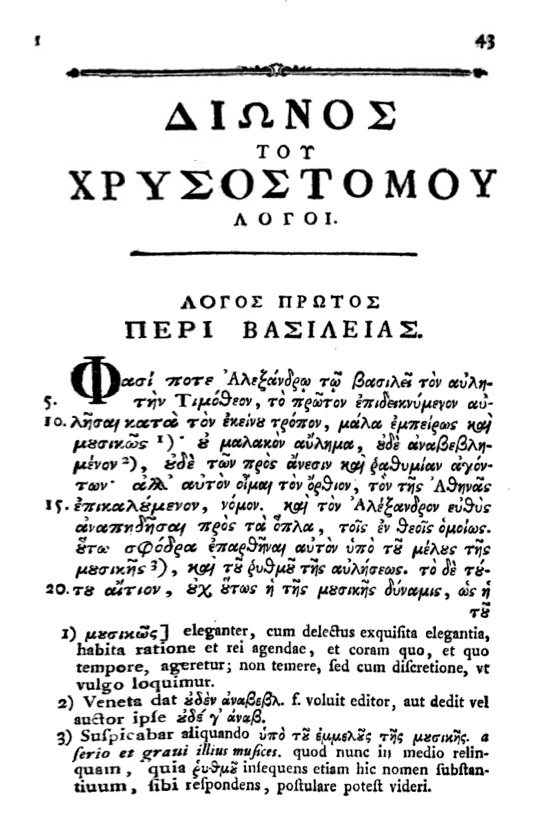 PhilosopherGreek & Roman40 – 120
Dio Chrysostom
Dio Chrysostom (; Ancient Greek: Δίων Χρυσόστομος Dion Chrysostomos), Dio of Prusa or Cocceianus Dio, was a Greek orator, writer, philosopher and historian of the Roman Empire in the 1st century AD. Eighty of his Discourses (or Orations; Λόγοι) are extant, as well as a few letters, a mock essay Encomium on Hair, and a
Read the full pageDio Chrysostom (; Ancient Greek: Δίων Χρυσόστομος Dion Chrysostomos), Dio of Prusa or Cocceianus Dio (c. 40 – c. 115 AD), was a Greek orator, writer, philosopher and historian of the Roman Empire in the 1st century AD. Eighty of his Discourses (or Orations; Λόγοι) are extant, as well as a few letters, a mock essay Encomium on Hair, and a few other fragments. His sobriquet Chrysostom comes from the Greek chrysostomos, which literally means "golden-mouthed".
He was born at Prusa (now Bursa), in the Roman province of Bithynia (now part of northwestern Turkey). His father, Pasicrates, seems to have bestowed great care on his son Dio's education. At first he lived in Prusa, where he held important offices, composed speeches and other rhetorical and sophistical essays, and studied philosophy. The Stoic and Platonist philosophies, however, appear to have had the greatest charms for him, particularly the stoicism of Musonius Rufus.