Greek & Roman thinkers, ancient: Anacharsis to Antiphon
- 1
 PhilosopherGreek & Roman700 – 600 BCE
Anacharsis
Anacharsis (; Ancient Greek: Ἀνάχαρσις, romanized: Anákharsis) was a Scythian prince and philosopher of uncertain historicity who lived in the 6th century BC.
Read the full pageAnacharsis (; Ancient Greek: Ἀνάχαρσις, romanized: Anákharsis) was a Scythian prince and philosopher of uncertain historicity who lived in the 6th century BC.
Anacharsis was the brother of the Scythian king Saulius, and both of them were the sons of the previous Scythian king, Gnurus.
- 2
 PhilosopherGreek & Roman700 – 600 BCE
Epimenides of Crete
Epimenides of Crete (; Ancient Greek: Ἐπιμενίδης) was a semi-mythical 7th- or 6th-century BC Greek seer and philosopher-poet, from Knossos or Phaistos.
Read the full pageEpimenides of Crete (; Ancient Greek: Ἐπιμενίδης) was a semi-mythical 7th- or 6th-century BC Greek seer and philosopher-poet, from Knossos or Phaistos.
While tending his father's sheep, Epimenides is said to have fallen asleep for fifty-seven years in a Cretan cave sacred to Zeus, after which he reportedly awoke with the gift of prophecy (Diogenes Laërtius i. 109–115). Diogenes Laërtius relates that when a pestilence raged in Athens, the Pythonic oracle told the Athenians to bring Epimenides from Crete to give advice. When he came, he set sheep on Mars Hill and where they lay down had altars erected "to the suitable god", explaining the existence of these anonymous altars. One of these was apparently mentioned by Saint Paul in his speech on that hill (Acts 17). Plutarch writes that Epimenides purified Athens after the pollution brought by the Alcmeonidae, and that the seer's expertise in sacrifices and reform of funeral practices were of great help to Solon in his reform of the Athenian state. The only reward he would accept was a branch of the sacred olive, and a promise of perpetual friendship between Athens and Knossos (Plutarch, Life of Solon, 12; Aristotle, Ath. Pol. 1).
- 3
 PhilosopherGreek & Roman650 – 570 BCE
Pittacus of Mytilene
Pittacus of Mytilene was a military general and one of the Seven Sages of Greece.
Read the full pagePittacus of Mytilene (; Ancient Greek: Πιττακός; c. 650 – c. 570 BC) was a military general and one of the Seven Sages of Greece.
Pittacus was a native of Mytilene and son of Hyrradius. He became a Mytilenaean general who, with his army, was victorious in the battle against the Athenians and their commander Phrynon. In consequence of this victory, the Mytilenaeans held Pittacus in the greatest honour and presented the supreme power into his hands. After ten years of reign, he resigned his position and the city and constitution were brought into good order.
- 4
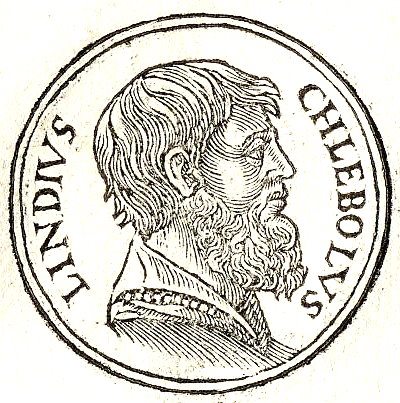 PhilosopherGreek & Roman630 – 560 BCE
Cleobulus of Lindos
Cleobulus was a Greek poet and a native of Lindos. He is one of the Seven Sages of Greece.
Read the full pageCleobulus (; Greek: Κλεόβουλος ὁ Λίνδιος, Kleoboulos ho Lindios; fl. 6th century BC) was a Greek poet and a native of Lindos. He is one of the Seven Sages of Greece.
Cleobulus was the son of Evagoras and a citizen of Lindus in Rhodes. Clement of Alexandria called Cleobulus king of the Lindians, and Plutarch spoke of him as the tyrant. The letter quoted by Diogenes Laërtius, in which Cleobulus invites Solon to Lindus as a democratic place of refuge from the tyrant Peisistratus in Athens, is undoubtedly a later forgery. Cleobulus is also said to have studied philosophy in Egypt. He had a daughter, Cleobulina, who found fame as a poet, composing riddles in hexameter verse. Cleobulus is said to have lived to the age of seventy, and to have been greatly distinguished for strength and beauty of person.
- 5
 PhilosopherGreek & Roman600 – 520 BCE
Chilon of Sparta
Chilon of Sparta was a Spartan politician credited with the militarization of Spartan society, and one of the Seven Sages of Greece.
Read the full pageChilon of Sparta (Ancient Greek: Χείλων; fl. 6th century BC) was a Spartan politician credited with the militarization of Spartan society, and one of the Seven Sages of Greece.
Chilon was the son of Damagetus, and lived towards the beginning of the 6th century BC. Herodotus speaks of him as contemporary with Hippocrates, the father of Peisistratus. Diogenes Laërtius states that he was an old man in the 52nd Olympiad (572 BC), and that he was elected an ephor (overseer) in Sparta in the 56th Olympiad (556/5 BC). Alcidamas states that he was a member of the Spartan assembly. Diogenes Laërtius even goes so far as to claim that Chilon was also the first person who introduced the custom of joining the ephors to the kings as their counselors.
- 6PhilosopherGreek & Roman580 – 499 BCE
Pherecydes of Syros
Pherecydes of Syros was an Ancient Greek mythographer and proto-philosopher from the island of Syros. Little is known about his life and death.
- ◆Metempsychosis
- ◆Time
- ◆Demiurge
Read the full pagePherecydes of Syros (; Ancient Greek: Φερεκύδης ὁ Σύριος; fl. 6th century BCE) was an Ancient Greek mythographer and proto-philosopher from the island of Syros. Little is known about his life and death. Some ancient testimonies counted Pherecydes among the Seven Sages of Greece, although he is generally believed to have lived in the generation after them. Others claim he may have been a teacher of Pythagoras, a student of Pittacus, or a well-traveled autodidact who had studied secret Phoenician books.
Pherecydes wrote a book on cosmogony, known as the "Pentemychos" or "Heptamychos". He was considered the first writer to communicate philosophical ideas in prose as opposed to verse. However, other than a few short fragments preserved in quotations from other ancient philosophers and a long fragment discovered on an Egyptian papyrus, his work is lost. However, it survived into the Hellenistic period and a significant amount of its content can be conjectured indirectly through ancient testimonies. His cosmogony was derived from three divine principles: Zas (Life), Cthonie (Earth), and Chronos (Time). In the narrative, Chronos creates the Classical elements and other gods in cavities within the earth. Later, Zas defeats the dragon Ophion in a battle for supremacy and throws him in Oceanus. Zas marries Chthoniê, who then becomes the recognizable Earth (Gê) with forests and mountains. Chronos retires from the world as creator, and Zas succeeds him as ruler and assigns all beings their place.
- 7PhilosopherGreek & Roman524 – 435 BCE
Epicharmus of Kos
Epicharmus of Cos (variantly Epicharmus of Kos, Epicharmus Comicus or Epicharmus Comicus Syracusanus; Ancient Greek: Ἐπίχαρμος ὁ Κῷος), thought to have lived between c. 550 and c. 460 BC, was a Greek dramatist and philosopher who is often credited with being one of the first comedic writers, having originated the Doric
Read the full pageEpicharmus of Cos (variantly Epicharmus of Kos, Epicharmus Comicus or Epicharmus Comicus Syracusanus; Ancient Greek: Ἐπίχαρμος ὁ Κῷος), thought to have lived between c. 550 and c. 460 BC, was a Greek dramatist and philosopher who is often credited with being one of the first comedic writers, having originated the Doric or Sicilian comedic form.
Most of the information about Epicharmus comes from the writings of Athenaeus, Suda and Diogenes Laërtius, although fragments and comments come up in a host of other ancient authors as well. The standard edition of his fragments was made by Kaibel (1890) to which there has been various additions and emendments. There have also been some papyrus finds of longer sections of text, but these are often so full of holes that it is difficult to make sense of them. Plato mentions Epicharmus in his dialogue Gorgias and in Theaetetus. In the latter, Socrates refers to Epicharmus as "the prince of Comedy", Homer as "the prince of Tragedy", and both as "great masters of either kind of poetry". Aristotle (Poetics 5.1449b5) writes that he and Phormis invented comic plots (μῦθοι, muthoi).
- 8PhilosopherGreek & Roman500 BCE
Cratylus
Cratylus ( KRAT-il-əs; Ancient Greek: Κρατύλος, Kratylos) was an ancient Athenian philosopher from the mid-late 5th century BC, known mostly through his portrayal in Plato's dialogue Cratylus. He was a radical proponent of Heraclitean philosophy and influenced the young Plato.
Read the full pageCratylus ( KRAT-il-əs; Ancient Greek: Κρατύλος, Kratylos) was an ancient Athenian philosopher from the mid-late 5th century BC, known mostly through his portrayal in Plato's dialogue Cratylus. He was a radical proponent of Heraclitean philosophy and influenced the young Plato.
Little is known of Cratylus beyond his status as a disciple of Heraclitus of Ephesus, Asia Minor. Modern biographers have not reached consensus on his approximate date of birth, arguing alternately for an age comparable either to Plato or Socrates. Cratylus is mentioned in Aristotle's Metaphysics in a passage that seemingly implies he was an established and active philosopher in Athens during the mid-late 5th century, and that Plato was briefly interested in his teachings prior to aligning with Socrates.
- 9PhilosopherGreek & Roman500 – 500 BCE
Timaeus of Locri
Timaeus of Locri (pronunciation in modern English; Ancient Greek: Τίμαιος ὁ Λοκρός, romanized: Tímaios ho Lokrós; Latin: Timaeus Locrus) is a character in two of Plato's dialogues, Timaeus and Critias. In both, he appears as a philosopher of the Pythagorean school.
Read the full pageTimaeus of Locri (pronunciation in modern English ; Ancient Greek: Τίμαιος ὁ Λοκρός, romanized: Tímaios ho Lokrós; Latin: Timaeus Locrus) is a character in two of Plato's dialogues, Timaeus and Critias. In both, he appears as a philosopher of the Pythagorean school. If there ever existed a historical Timaeus of Locri, he would have lived in the fifth century BC, but his historicity is dubious since he only appears as a literary figure in Plato's works; all other ancient sources are either based on Plato or are fictional accounts.
In Plato's works, Timaeus appears as a wealthy aristocrat from the Greek colony of Lokroi Epizephyrioi (present-day Locri in Calabria) in Magna Graecia, who had served in high offices in his native town before coming to Athens, where the dialogue of Timaeus is set. Plato does not explicitly label Timaeus a Pythagorean, but leaves enough hints for the reader to infer this. He appears competent in all areas of ancient philosophy, especially natural philosophy and astronomy.
- 10
 PhilosopherGreek & Roman500 BCE
Archelaus
Archelaus was a Greek philosopher, a pupil of Anaxagoras, and may have been a teacher of Socrates. He asserted that the principle of motion was the separation of hot from cold, from which he endeavoured to explain the formation of the Earth and the creation of animals and humans.
Read the full pageArchelaus (; Greek: Ἀρχέλαος; fl. 5th century BC) was a Greek philosopher, a pupil of Anaxagoras, and may have been a teacher of Socrates. He asserted that the principle of motion was the separation of hot from cold, from which he endeavoured to explain the formation of the Earth and the creation of animals and humans.
Archelaus was a philosopher of the Ionian School, called Physicus from having been the first to teach natural philosophy at Athens. This statement of Diogenes Laërtius, is contradicted by Clement of Alexandria, but the two may be reconciled by supposing that Archelaus was the first Athenian who did so. According to Simplicius, who probably got his information from Theophrastus, Archelaus was a native of Athens, even though Diogenes Laërtius says it is unclear if he was born in Athens or Miletus. He was the son of Apollodorus, or as some say, of Mydon, Midon, or Myson; was a pupil of Anaxagoras; and is said to have taught at Lampsacus before he established himself at Athens. He is commonly reported to have taught Socrates and Euripides. If he was the instructor of Socrates, he is never mentioned by Xenophon, Plato, or Aristotle, and this story may have been an attempt to connect Socrates with the Ionian School. However, Diogenes Laërtius does report, on the authority of Ion of Chios, a contemporary of Socrates, that Socrates went with Archelaus on a trip to Samos. Also, some scholars have seen in Socrates' "autobiographical" sketch in Plato's Phaedo a reference to Archelaus' theory about the generation and nourishment of the first animals. The tradition which connects Archelaus with Euripides may have arisen from a confusion with Euripides' patron, Archelaus I, king of Macedonia.
- 11
 PhilosopherGreek & Roman500 – 400 BCE
Eubulides
Eubulides of Miletus was a philosopher of the Megarian school who is famous for his paradoxes.
- ◆Liar paradox
- ◆Sorites paradox
Read the full pageEubulides (Greek: Εὐβουλίδης; fl. 4th century BCE) of Miletus was a philosopher of the Megarian school who is famous for his paradoxes.
According to Diogenes Laërtius, Eubulides was a pupil of Euclid of Megara, the founder of the Megarian school. He was a contemporary of Aristotle, against whom he wrote with great bitterness. He taught logic to Demosthenes, and he is also said to have taught Apollonius Cronus, the teacher of Diodorus Cronus, and the historian Euphantus.
- 12PhilosopherGreek & Roman500 – 500 BCE
Antiphon
The name Antiphon the Sophist (; Ancient Greek: Ἀντιφῶν) is used to refer to the writer of several Sophistic treatises. He probably lived in Athens in the last two decades of the 5th century BC, but almost nothing is known of his life.
Read the full pageThe name Antiphon the Sophist (; Ancient Greek: Ἀντιφῶν) is used to refer to the writer of several Sophistic treatises. He probably lived in Athens in the last two decades of the 5th century BC, but almost nothing is known of his life.
It has been debated since antiquity whether the writer of these Sophistic treatises was in fact none other than Antiphon the Orator, or whether Antiphon the Sophist was indeed a separate person. This remains an active scholarly controversy; of recent editors, Gagarin, and Laks and Most, believe there to be only one Antiphon, whereas G. J. Pendrick argues for the existence of two separate individuals.