Modern European thinkers, renaissance & early modern: Reid to Ferguson
- 1
 PhilosopherModern European1710 – 1796
Thomas Reid
Thomas Reid was a Scottish philosopher best known for his philosophical method, his theory of perception, and its wide implications on epistemology, and as the developer and defender of an agent-causal theory of free will. He also focused extensively on ethics, theory of action, language and philosophy of mind.
- ◆Direct realism
- ◆Epistemological externalism
- ◆Sensation
- ◆perception
- ◆Agent causality
Read the full pageThomas Reid (; 7 May (O.S. 26 April) 1710 – 7 October 1796) was a Scottish philosopher best known for his philosophical method, his theory of perception, and its wide implications on epistemology, and as the developer and defender of an agent-causal theory of free will. He also focused extensively on ethics, theory of action, language and philosophy of mind.
He was the founder of the Scottish School of Common Sense and played an integral role in the Scottish Enlightenment. In 1783 he was a joint founder of the Royal Society of Edinburgh. A contemporary of David Hume, Reid was also "Hume's earliest and fiercest critic".
- 2
 PhilosopherModern European1711 – 1765
Mikhail Lomonosov
Mikhail Vasilyevich Lomonosov was a Russian polymath, scientist and writer, who made important contributions to literature, education, and science. Among his discoveries were the atmosphere of Venus, the law of conservation of mass in chemical reactions, the theoretical prediction of Antarctica, and the idea of coaxial
Read the full pageMikhail Vasilyevich Lomonosov (; 19 November [O.S. 8 November] 1711 – 15 April [O.S. 4 April] 1765) was a Russian polymath, scientist and writer, who made important contributions to literature, education, and science. Among his discoveries were the atmosphere of Venus, the law of conservation of mass in chemical reactions, the theoretical prediction of Antarctica, and the idea of coaxial rotors. His spheres of science were natural science, chemistry, physics, mineralogy, history, art, philology, optical devices and others. One of the founders of modern geology, Lomonosov was also a poet and influenced the formation of the modern Russian literary language.
Lomonosov was born in the village of Mishaninskaya, later renamed Lomonosovo in his honor, in Archangelgorod Governorate, on an island in Northern Dvina not far from Kholmogory, in the far north of Russia. His father, Vasily Dorofeyevich Lomonosov, was a prosperous peasant fisherman turned ship owner, who amassed a small fortune transporting goods from Arkhangelsk to Pustozyorsk, Solovki, Kola, and Lapland. Lomonosov's mother was Vasily's first wife, a deacon's daughter, Elena Ivanovna Sivkova.
- 3
 PhilosopherModern European1712 – 1764
Francesco Algarotti
Count Francesco Algarotti was an Italian polymath, active as a philosopher, writer, anglophile, art critic and art collector. He was a man of broad knowledge, an expert in Newtonianism, architecture and opera.
Read the full pageCount Francesco Algarotti (11 December 1712 – 3 May 1764) was an Italian polymath, active as a philosopher, writer, anglophile, art critic and art collector. He was a man of broad knowledge, an expert in Newtonianism, architecture and opera. He was a friend of Frederick the Great and leading authors of his times: Voltaire, Jean-Baptiste de Boyer, Marquis d'Argens, Pierre-Louis de Maupertuis and the atheist Julien Offray de La Mettrie. Lord Chesterfield, Thomas Gray, George Lyttelton, Thomas Hollis, Metastasio, Benedict XIV and Heinrich von Brühl were among his correspondents.
Algarotti was born in Venice as the son of a rich merchant. His father and uncle were art collectors. Unlike his older brother, Bonomo he did not step into the company, but decided to become an author. Francesco obtained a classical education. He also studied natural sciences and mathematics at the Rome and experimental physics and medicine at the University of Bologna under Francesco Maria Zanotti who became a lifelong friend. In 1728, he conducted experiments regarding optics. He was educated in his native Venice and in Rome and Bologna.
- 4
 PhilosopherModern European1713 – 1784
Denis Diderot
Denis Diderot was a French philosopher, art critic, and writer, best known for serving as co-founder, chief editor, and contributor to the Encyclopédie along with Jean le Rond d'Alembert. He was a prominent figure during the Age of Enlightenment.
Read the full pageDenis Diderot (; French: [dəni did(ə)ʁo]; 5 October 1713 – 31 July 1784) was a French philosopher, art critic, and writer, best known for serving as co-founder, chief editor, and contributor to the Encyclopédie along with Jean le Rond d'Alembert. He was a prominent figure during the Age of Enlightenment.
Diderot studied philosophy at a Jesuit college, then considered working in the church clergy before briefly studying law. When he decided to become a writer in 1734, his father disowned him. He lived a bohemian existence for the next decade. In the 1740s he wrote many of his best-known works in fiction and non-fiction, including the 1748 novel Les Bijoux indiscrets (The Indiscreet Jewels).
- 5
 PhilosopherModern European1715 – 1771
Claude Adrien Helvétius
Claude Adrien Helvétius was a French philosopher, Freemason, and littérateur.
Read the full pageClaude Adrien Helvétius (; French: [klod adʁijɛ̃ ɛlvesjys]; 26 January 1715 – 26 December 1771) was a French philosopher, Freemason, and littérateur.
Claude Adrien Helvétius was born in Paris, France, and was descended from a family of physicians, originally surnamed Schweitzer (meaning "Swiss" in German; Latinized as Helvétius). His great-grandfather Johann Friedrich Schweitzer known as "Helvetius", was a Dutch physician and alchemist, of German extraction. His grandfather Adriaan Helvetius introduced the use of ipecacuanha; his father Jean Claude Adrien Helvétius was first physician to Marie Leszczyńska, queen of France. Claude Adrien was trained for a financial career, apprenticed to his maternal uncle in Caen, but he occupied his spare time with poetry. Aged twenty-three, at the queen's request, he was appointed as a farmer-general, a tax-collecting post worth 100,000 crowns a year. Thus provided for, he proceeded to enjoy life to the utmost, with the help of his wealth and liberality, his literary and artistic tastes – he attended, for example, the progressive Club de l'Entresol. As he grew older, he began to seek more lasting distinctions, stimulated by the success of Pierre Louis Maupertuis as a mathematician, of Voltaire as a poet, and of Montesquieu as a philosopher. His wife, Anne-Catherine de Ligniville, Madame Helvétius, maintained a salon attended by the leading figures of the Enlightenment for over five decades.
- 6
 PhilosopherModern European1717 – 1783
Jean Le Rond d'Alembert
Jean Le Rond d'Alembert was a French mathematician, physicist, philosopher, and music theorist. Until 1759 he was, together with Denis Diderot, a co-editor of the Encyclopédie.
- ◆Ratio test
- ◆D'Alembert force
- ◆D'Alembert reduction
- ◆D'Alembert system
- ◆Wave equation
- ◆D'Alembert's formula
Read the full pageJean Le Rond d'Alembert ( DAL-əm-BAIR; French: [ʒɑ̃ lə ʁɔ̃ dalɑ̃bɛʁ]; 16 November 1717 – 29 October 1783) was a French mathematician, physicist, philosopher, and music theorist. Until 1759 he was, together with Denis Diderot, a co-editor of the Encyclopédie.
His most famous achievements include the wave equation, also known as d'Alembert's equation, and D'Alembert's formula for solving said equation. In French, the fundamental theorem of algebra is named in his honour.
- 7
 PhilosopherModern European1717 – 1778
Étienne-Gabriel Morelly
Étienne-Gabriel Morelly was a French utopian thinker, philosopher and novelist. An otherwise "obscure tax official", and teacher, Morelly wrote two books on education, a critique of Montesquieu and The Code of Nature, which was published anonymously in France in 1755.
Read the full pageÉtienne-Gabriel Morelly (French: [etjɛn gabʁjɛl mɔʁɛli]; 1717–1778) was a French utopian thinker, philosopher and novelist. An otherwise "obscure tax official", and teacher, Morelly wrote two books on education, a critique of Montesquieu and The Code of Nature, which was published anonymously in France in 1755. This book, initially attributed to philosophes including Rousseau and Diderot, criticised contemporary society, postulated a social order without avarice, and proposed a constitution intended to lead to an egalitarian society without property, marriage, church or police.
According to The Code of Nature, "...where no property exists, none of its pernicious consequences could exist...." As Morelly believed that almost all social and moral ills were a consequence of private property, his proposed constitution eliminates most private property. As a result of this latter characteristic of his utopia, Morelly is often seen as a significant forerunner of later socialist and communist thinkers. François-Noël Babeuf, Charles Fourier, Pierre-Joseph Proudhon, Louis Blanc, Friedrich Engels, and Karl Marx all discussed Morelly's ideas in their own writing.
- 8
 PhilosopherModern European1720 – 1793
Charles Bonnet
Charles Bonnet was a Genevan naturalist and philosophical writer. He is responsible for coining the term phyllotaxis to describe the arrangement of leaves on a plant.
- ◆Phyllotaxis
Read the full pageCharles Bonnet (French: [ʃaʁl bɔnɛ]; 13 March 1720 – 20 May 1793) was a Genevan naturalist and philosophical writer. He is responsible for coining the term phyllotaxis to describe the arrangement of leaves on a plant. He was among the first to notice parthenogenetic reproduction in aphids and established that insects respired through their spiracles. He was among the first to use the term "evolution" in a biological context. Deaf from an early age, he also suffered from failing eyesight and had to make use of assistants in later life to help in his research.
Bonnet was born in Geneva, the son of Pierre Bonnet and Anne-Marie Lullin de Châteauvieux. Although originally from France, the family had been driven into Geneva by religious persecution of Protestants in the 16th century. At age seven he lost his hearing, which pushed him into an interest in the natural world. His schoolmates troubled him due to the hearing handicap and the parents took him out and had a private tutor. Bonnet seems never to have left the Geneva region, and does not appear to have taken any part in public affairs except for the period between 1752 and 1768, during which he was a member of the republic's Council of Two Hundred. The last twenty five years of his life he spent quietly in the country, at Genthod, near Geneva, where he died after a long and painful illness on 20 May 1793. His wife was a lady of the family of De la Rive. They had no children, but Madame Bonnet's nephew, the celebrated Horace-Bénédict de Saussure, was brought up as their son.
- 9
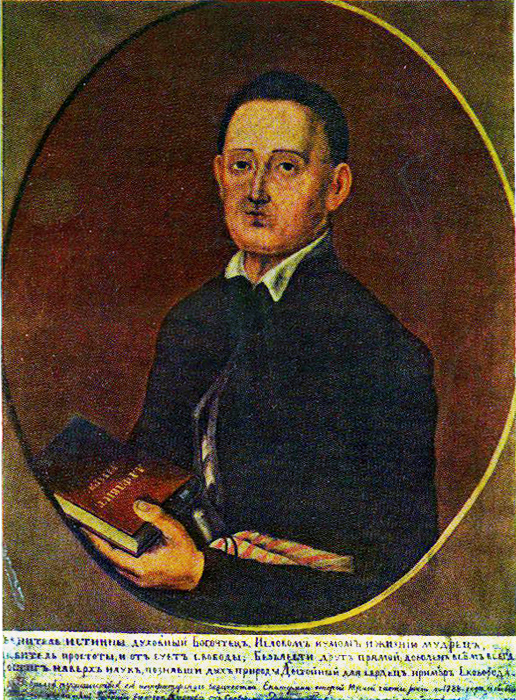 PhilosopherModern European1722 – 1794
Hryhorii Skovoroda
Hryhorii Skovoroda, also Gregory Skovoroda or Grigory Skovoroda, was a philosopher of Ukrainian Cossack origin who lived and worked in the Russian Empire. He was a poet, a teacher and a composer of liturgical music.
Read the full pageHryhorii Skovoroda, also Gregory Skovoroda or Grigory Skovoroda (Latin: Gregorius Scovoroda; Ukrainian: Григорій Савич Сковорода, Hryhorii Savych Skovoroda; Russian: Григорий Саввич Сковорода, Grigory Savvich Skovoroda; 3 December 1722 – 9 November 1794), was a philosopher of Ukrainian Cossack origin who lived and worked in the Russian Empire. He was a poet, a teacher and a composer of liturgical music. His significant influence on his contemporaries and succeeding generations and his way of life were universally regarded as Socratic, and he was often called a "Socrates".
Skovoroda, whose native tongue was vernacular Ukrainian, wrote his texts in a mixture of three languages: Church Slavonic, Ukrainian, and Russian, with some elements from Latin and Greek and a large number of Western-Europeanisms. Different views exist about how to characterize the base language upon which he developed his highly individual idiom. One scholar has identified this base language as the variety of Russian spoken by the upper classes in Kharkiv and the surrounding Sloboda Ukraine region; this version of Russian contained many Ukrainianisms. According to another view, he wrote some of his works in the Ukrainian variety of Church Slavonic and others in the old Ukrainian literary language. The majority of his surviving letters are written in Latin and Greek.
- 10
 PhilosopherModern European1723 – 1790
Adam Smith
Moral philosopher of sympathy and the impartial spectator, and father of economics.
- ◆Classical economics
- ◆Free market
- ◆Division of labour
- ◆Absolute advantage
- ◆Invisible hand
Read the full pageAdam Smith (baptised 16 June [O.S. 5 June] 1723 – 17 July 1790) was a Scottish economist and philosopher who was a pioneer in the field of political economy and key figure during the Scottish Enlightenment. Seen by many as the "father of economics", or the "father of capitalism", he is primarily known for two classic works: The Theory of Moral Sentiments (1759) and An Inquiry into the Nature and Causes of the Wealth of Nations (1776). The latter, often abbreviated as The Wealth of Nations, is regarded as his magnum opus, marking the inception of modern economic scholarship as a comprehensive system and an academic discipline. Smith refuses to explain the distribution of wealth and power in terms of divine will and instead appeals to natural, political, social, economic, legal, environmental and technological factors, as well as the interactions among them. The work is notable for its contribution to economic theory, particularly in its exposition of the concept of absolute advantage.
Born in Kirkcaldy, Fife, he studied social philosophy at the University of Glasgow and at the University of Oxford, where he was one of the only students to benefit from scholarships set up by John Snell. Following his graduation, he delivered a successful series of public lectures at the University of Edinburgh, that met with acclaim. This led to a collaboration with David Hume during the Scottish Enlightenment. Smith obtained a professorship at Glasgow, where he taught moral philosophy. During this period, he wrote and published The Theory of Moral Sentiments. Subsequently, he assumed a tutoring position that facilitated travel throughout Europe, where he encountered intellectual figures of his era.
- 11
 PhilosopherModern European1723 – 1789
Baron d'Holbach
Paul Thiry, Baron d'Holbach, known as d'Holbach, was a Franco-German philosopher, encyclopedist and writer, who was a prominent figure in the French Enlightenment. He was born in Edesheim, near Landau in the Rhenish Palatinate, but lived and worked mainly in Paris, where he kept a salon.
Read the full pagePaul Thiry, Baron d'Holbach (; French: [dɔlbak]; 8 December 1723 – 21 January 1789), known as d'Holbach, was a Franco-German philosopher, encyclopedist and writer, who was a prominent figure in the French Enlightenment. He was born in Edesheim, near Landau in the Rhenish Palatinate, but lived and worked mainly in Paris, where he kept a salon. He helped in the dissemination of "Protestant and especially German thought", particularly in the field of the sciences, but was known more for his atheism and voluminous writings against religion, famously including The System of Nature (1770) and The Universal Morality (1776).
Sources differ regarding d'Holbach's dates of birth and death. His exact birthday is unknown, although records show that he was baptised on 8 December 1723. Some authorities incorrectly give June 1789 as the month of his death. D'Holbach's mother, Catherine Jacobina (née Holbach; 1684–1743), was the daughter of Johannes Jacobus Holbach (died 1723). His father, Johann Jakob Dietrich (with other notations: ger.: Johann Jakob Dirre; fr.: Jean-Jacques Thiry; 1672–1756), was a wine-grower.
- 12
 PhilosopherModern European1723 – 1816
Adam Ferguson
Adam Ferguson (Scottish Gaelic: Adhamh MacFhearghais), also known as Ferguson of Raith, was a Scottish philosopher and historian of the Scottish Enlightenment. Ferguson was sympathetic to traditional societies, such as the Highlands, for producing courage and loyalty.
- ◆The principle of moral approbation
Read the full pageAdam Ferguson (Scottish Gaelic: Adhamh MacFhearghais), also known as Ferguson of Raith (1 July N.S. / 20 June O.S. 1723 – 22 February 1816), was a Scottish philosopher and historian of the Scottish Enlightenment.
Ferguson was sympathetic to traditional societies, such as the Highlands, for producing courage and loyalty. He criticized commercial society as making men weak, dishonourable, and unconcerned for their community.