Modern European thinkers, renaissance & early modern: Prokopovich to Mably
- 1
 PhilosopherModern European1681 – 1736
Feofan Prokopovich
Theophan or Feofan Prokopovich was a Russian Orthodox bishop, theologian, pietist, writer, poet, mathematician, astronomer, pedagogue and philosopher of Ukrainian origin. He was the rector of the Academia Mohileana in Kiev, the bishop of Pskov, and the archbishop of Novgorod.
Read the full pageTheophan or Feofan Prokopovich (Russian: Феофан Прокопович; Ukrainian: Феофан Прокопович, romanized: Feofan Prokopovych; 18 June [O.S. 8 June] 1681 – 19 September [O.S. 8 September] 1736) was a Russian Orthodox bishop, theologian, pietist, writer, poet, mathematician, astronomer, pedagogue and philosopher of Ukrainian origin. He was the rector of the Academia Mohileana in Kiev (1711–1716), the bishop of Pskov (1718–1725), and the archbishop of Novgorod (1725–1736).
Prokopovich elaborated upon and implemented Peter the Great's reform of the Russian Orthodox Church; he served as the first vice-president of the Most Holy Synod from 1721, which replaced the office of the patriarch. He was the de facto leader of the synod (and the Russian Orthodox Church) following the death of Stefan Yavorsky in 1722. Prokopovich also wrote many religious verses and some of the most enduring sermons in the Russian language.
- 2
 PhilosopherModern European1683 – 1744
John Theophilus Desaguliers
John Theophilus Desaguliers was a French-born British natural philosopher, clergyman, engineer and freemason who was elected to the Royal Society in 1714 as experimental assistant to Isaac Newton. He had studied at Oxford and later popularized Newtonian theories and their practical applications in public lectures.
- ◆planetarium
- ◆hydraulics
- ◆steam engine
Read the full pageJohn Theophilus Desaguliers (12 March 1683 – 29 February 1744) was a French-born British natural philosopher, clergyman, engineer and freemason who was elected to the Royal Society in 1714 as experimental assistant to Isaac Newton. He had studied at Oxford and later popularized Newtonian theories and their practical applications in public lectures. Desaguliers's most important patron was James Brydges, 1st Duke of Chandos. As a Freemason, Desaguliers was instrumental in the success of the first Grand Lodge in London in the early 1720s and served as its third Grand Master.
Desaguliers was born in La Rochelle, several months after his father Jean Desaguliers, a Protestant minister, had been exiled as a Huguenot by the French government. Jean Desaguliers was ordained as an Anglican by Bishop Henry Compton of London, and sent to Guernsey. Meanwhile, the baby was baptised Jean Théophile Desaguliers in the Protestant Temple in La Rochelle, and he and his mother then escaped to join Jean in Guernsey.
- 3
 PhilosopherModern European1684 – 1754
Ludvig Holberg
Ludvig Holberg, Baron of Holberg was a writer, essayist, philosopher, historian and playwright born in Bergen, Norway, during the time of the Dano–Norwegian dual monarchy. He was influenced by Humanism, the Enlightenment and the Baroque.
Read the full pageLudvig Holberg, Baron of Holberg (3 December 1684 – 28 January 1754) was a writer, essayist, philosopher, historian and playwright born in Bergen, Norway, during the time of the Dano–Norwegian dual monarchy. He was influenced by Humanism, the Enlightenment and the Baroque. Holberg is considered the founder of modern Danish and Norwegian literature. He was also a prominent Neo-Latin author, known across Europe for his writing. He is best known for the comedies he wrote in 1722–1723 for the Lille Grønnegade Theatre in Copenhagen. Holberg's works about natural and common law were widely read by many Danish law students over two hundred years, from 1736 to 1936.
Holberg was the youngest of six brothers. His father, Christian Nielsen Holberg, died before Ludvig was one year old. He was educated in Copenhagen, and was a teacher at the University of Copenhagen for many years. At the same time, he started his successful career as an author, writing the first of a series of comedies.
- 4
 PhilosopherModern European1688 – 1772
Emmanuel Swedenborg
Emanuel Swedenborg was a Swedish polymath; a scientist, engineer, astronomer, anatomist, Christian theologian, philosopher, and mystic. He became best known for his book on the afterlife, Heaven and Hell.
- ◆Trinity
- ◆Correspondence
- ◆Last Judgment
- ◆Second Coming
Read the full pageEmanuel Swedenborg (; Swedish: [ɛˈmɑ̂ːnʉɛl ˈsvêːdɛnˌbɔrj] ; born Emanuel Swedberg; 29 January 1688 – 29 March 1772) was a Swedish polymath; a scientist, engineer, astronomer, anatomist, Christian theologian, philosopher, and mystic. He became best known for his book on the afterlife, Heaven and Hell (1758).
Swedenborg had a prolific career as an inventor and scientist. In 1741, at 53, he entered into a spiritual phase in which he began to experience dreams and visions, notably on Easter Weekend, on 6 April
- 5
 PhilosopherModern European1692 – 1752
Joseph Butler
Joseph Butler was an English Anglican bishop, theologian, apologist, and philosopher, born in Wantage in the English county of Berkshire (now in Oxfordshire). His principal works are the Fifteen Sermons Preached at the Rolls Chapel and The Analogy of Religion.
Read the full pageJoseph Butler (18 May 1692 O.S. – 16 June 1752 O.S.) was an English Anglican bishop, theologian, apologist, and philosopher, born in Wantage in the English county of Berkshire (now in Oxfordshire). His principal works are the Fifteen Sermons Preached at the Rolls Chapel (1726) and The Analogy of Religion (1736).
He is known for critiques of deism, Thomas Hobbes's egoism, and John Locke's theory of personal identity. The many philosophers and religious thinkers Butler influenced included David Hume, Thomas Reid, Adam Smith, Henry Sidgwick, John Henry Newman, and C. D. Broad, and is widely seen as "one of the pre-eminent English moralists." He played a major, if underestimated role in developing 18th-century economic discourse, influencing political economist Josiah Tucker.
- 6
 PhilosopherModern European1694 – 1778
Voltaire
Satirist of the Enlightenment, champion of tolerance and scourge of the Church; author of Candide.
Read the full pageFrançois-Marie Arouet (French: [fʁɑ̃swa maʁi aʁwɛ]; 21 November 1694 – 30 May 1778), known by his pen name Voltaire (, US also ; French: [vɔltɛːʁ]), was a French Enlightenment writer, philosopher (philosophe), satirist, and historian. Famous for his wit and his criticisms of the Catholic Church and slavery, Voltaire was an advocate of freedom of speech, freedom of religion, and separation of church and state.
Voltaire produced works in almost every literary form, including plays, poems, novels, essays, histories, and scientific expositions. He wrote more than 20,000 letters and 2,000 books and pamphlets. Voltaire was one of the first authors to become renowned and commercially successful internationally. He was an outspoken advocate of civil liberties and was at constant risk from the strict censorship laws of the Catholic French monarchy. His polemics satirized intolerance and religious dogma, as well as the French institutions of his day. His best-known work and magnum opus, Candide, is a novella that comments on, criticizes, and ridicules many events, thinkers and philosophies of his time, most notably Gottfried Leibniz and his belief that our world is of necessity the "best of all possible worlds".
- 7
 PhilosopherModern European1694 – 1768
Hermann Samuel Reimarus
Hermann Samuel Reimarus, was a German philosopher and writer of the Enlightenment who is remembered for his Deism, the doctrine that human reason can arrive at a knowledge of God and ethics from a study of nature and our own internal reality, thus eliminating the need for religions based on revelation. He denied the su
Read the full pageHermann Samuel Reimarus (22 December 1694, Hamburg – 1 March 1768, Hamburg), was a German philosopher and writer of the Enlightenment who is remembered for his Deism, the doctrine that human reason can arrive at a knowledge of God and ethics from a study of nature and our own internal reality, thus eliminating the need for religions based on revelation. He denied the supernatural origin of Christianity, and was the first influential critic to investigate the historical Jesus. According to Reimarus, Jesus was a mortal Jewish prophet, and the apostles founded Christianity as a religion separate from Jesus’ own ministry.
Reimarus was educated by his father and by the scholar J. A. Fabricius, whose son-in-law he subsequently became. He attended school at the Gelehrtenschule des Johanneums. He studied theology, ancient languages, and philosophy at the University of Jena, became Privatdozent at the University of Wittenberg in 1716, and in 1720–21 visited the Netherlands and England. In 1723 he became rector of the high school at Wismar, and in 1727 professor of Hebrew and Oriental languages at his native city's high school. Although he was offered more lucrative positions by other schools, he held this post until his death.
- 8
 PhilosopherModern European1698 – 1759
Pierre-Louis Moreau de Maupertuis
Pierre Louis Moreau de Maupertuis was a French mathematician, philosopher and man of letters. He became the director of the Académie des Sciences and the first president of the Prussian Academy of Science, at the invitation of Frederick the Great.
- ◆Maupertuis's principle
- ◆Principle of least action
- ◆Precursor of transmutation
Read the full pagePierre Louis Moreau de Maupertuis (; French: [mopɛʁtɥi]; 1698 – 27 July 1759) was a French mathematician, philosopher and man of letters. He became the director of the Académie des Sciences and the first president of the Prussian Academy of Science, at the invitation of Frederick the Great.
Maupertuis made an expedition to Lapland to determine the shape of the Earth. He is often credited with having discovered the principle of least action – a version of which is known as Maupertuis's principle – which he expressed as an integral equation that describes the path followed by a physical system. His work in natural history is interesting in relation to modern science since he touched on aspects of heredity and the struggle for life.
- 9
 PhilosopherModern European1703 – 1758
Jonathan Edwards
Jonathan Edwards was an American revivalist preacher, philosopher, and Congregationalist theologian. Edwards is widely regarded as one of America's most important and original philosophical theologians.
Read the full pageJonathan Edwards (October 5, 1703 – March 22, 1758) was an American revivalist preacher, philosopher, and Congregationalist theologian. Edwards is widely regarded as one of America's most important and original philosophical theologians.
Edwards's theological work is broad in scope but rooted in the Puritan heritage as exemplified in the Westminster and Savoy Confessions of Faith. Recent studies have emphasized how thoroughly Edwards grounded his life's work on conceptions of beauty, harmony, and ethical aptness, and how central the Age of Enlightenment was to his mindset. Edwards played a critical role in shaping the First Great Awakening and oversaw some of the first revivals in 1733–35 at his church in Northampton, Massachusetts. His work gave rise to a doctrine known as New England theology.
- 10
 PhilosopherModern European1704 – 1779
Louis de Jaucourt
Chevalier Louis de Jaucourt was a French scholar and the most prolific contributor to the Encyclopédie. Writing some 17,000 articles pro bono, his contributions amounted to around 25% of the entire work.
- ◆Encyclopédie
Read the full pageChevalier Louis de Jaucourt (French: [də ʒokuʁ]; 16 September 1704 – 3 February 1779) was a French scholar and the most prolific contributor to the Encyclopédie. Writing some 17,000 articles pro bono, his contributions amounted to around 25% of the entire work. His subjects included physiology, chemistry, botany, pathology, and political history.
Following the French Revolution, Jaucourt's legacy was largely overshadowed by those of Denis Diderot, Jean-Jacques Rousseau and others. This was mainly because of his aristocratic background. By the mid-20th century, however, his work was receiving more scholarly attention.
- 11
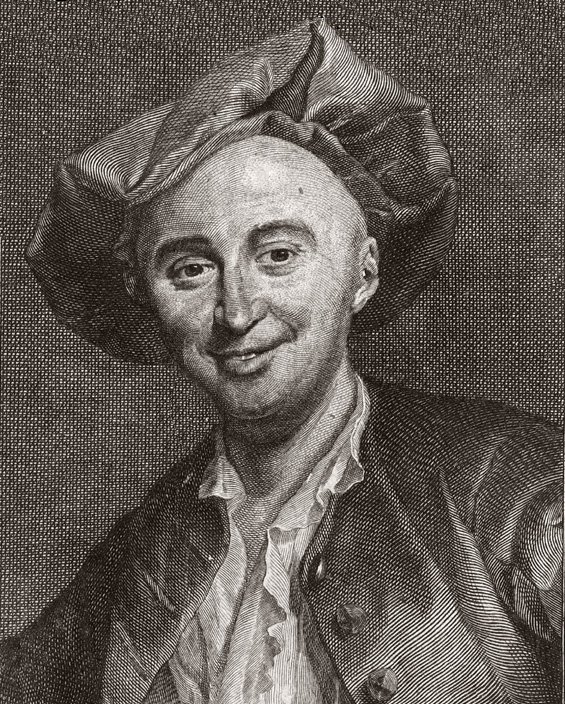 PhilosopherModern European1709 – 1751
Julien Offray de La Mettrie
Julien Offray de La Mettrie was a French physician and philosopher, and one of the earliest of the French materialists of the Enlightenment. He is best known for his 1747 work L'homme machine (Man a Machine).
- ◆Mechanistic
- ◆materialism
Read the full pageJulien Offray de La Mettrie (French: [ɔfʁɛ də la metʁi]; 23 November 1709 – 11 November 1751) was a French physician and philosopher, and one of the earliest of the French materialists of the Enlightenment. He is best known for his 1747 work L'homme machine (Man a Machine).
La Mettrie is most remembered for taking the position that humans are complex animals and no more have souls than other animals do. He considered that the mind is part of the body and that life should be lived so as to produce pleasure (hedonism). His views were so controversial that he had to flee France and settle in Berlin.
- 12
 PhilosopherModern European1709 – 1785
Gabriel Bonnot de Mably
Gabriel Bonnot de Mably, sometimes known as Abbé de Mably, was a French philosopher, historian, and writer, who for a short time served in the diplomatic corps. He was a popular 18th-century writer.
Read the full pageGabriel Bonnot de Mably (French: [ɡabʁijɛl bɔno də mabli]; 14 March 1709 in Grenoble – 2 April 1785 in Paris), sometimes known as Abbé de Mably, was a French philosopher, historian, and writer, who for a short time served in the diplomatic corps. He was a popular 18th-century writer.
Gabriel Bonnot was born at Mably, Loire into a family that belonged to the Noblesse de robe or Nobles of the Robe. This class formed the Second Estate whose rank derived from holding judicial or administrative posts and were often hard-working professionals, unlike the aristocratic Noblesse d'épée or Nobles of the Sword. He and his older brother Jean added "de Mably" to their names; his younger brother Étienne used another family property, at Condillac, Drôme. As 'Condillac', he also became a noted writer and philosopher.